The 2020 General Election Will Be The Royal Rumble of New Zealand Elections

Next year’s General Election is going to be the Royal Rumble of New Zealand elections. Everyone wants to play a part in it, but only one can win. It seems that every fortnight a new party casts its hat into the ring. Numbers man Dan McGlashan, author of Understanding New Zealand, explains the electoral ramifications of this large field.

We already know that all of the parties with a finger on the brass ring will try to keep it there or to strengthen their grip. Labour, National, the Greens, New Zealand First and ACT will all get a fat chunk of electoral funding pre-election and mainstream media publicity leading up to it, on account of their current Parliamentary presence. These parties, however, will have to contend with an usually wide field of challengers.

Not only are all the usual challengers present, but so are a range of newcomers.

The Aotearoa Legalise Cannabis Party will run again, potentially taking a seat’s worth of votes from other parties. Despite heavy pressure from the Greens to shut down their operations, the ALCP looks likely to not only run again but to do better than usual. Many people who habitually don’t vote on account of having no confidence in politicians will turn out to vote in the cannabis referendum, and they will be heavily tempted to throw a vote the ALCP’s way.

Green supporters tend to make the lazy assumption that, because the Greens champion cannabis law reform, ALCP voters must naturally have strong sympathies for them. In reality, the bulk of ALCP voters are Maoris and New Zealand-born white people, both of who are highly suspicious of the globalism of the Greens. ALCP voters are also much more rural than the urbanite Greens.

The Maori and Mana parties will be back, as the supporters of both parties have previously experienced the Parliamentary trough and want to be return there. Both of these parties appeal to a slightly wealthier constituency than the Maoris and Pacific Islanders who vote for Labour, which means that the presence of those parties threatens to skim those voters off the current Labour support.

This week brought news that Brian Tamaki of the Destiny Church is having another crack at Parliament. Tamaki already ran in 2005 with the Destiny New Zealand movement, winning 14,210 votes. Although this was less than 1% of the total vote, he seems to have been encouraged enough by the experience, and has entered his Coalition New Zealand Party into the 2020 race.

Tamaki’s voters will no doubt reflect the demographics of his church, which are being pulled apart by the two opposing poles. On the one hand, his constituents are poor, which inclines them to vote Labour, but on the other hand, they are horrified by Labour’s passionate support for the most degenerate aspects of the Globohomo Gayplex. His voters will be those who feel caught in the middle, as they will be most easily persuaded to vote for someone else.

Also running for the first time is the Sustainable New Zealand Party, led by Vernon Tava. This putative blue-green movement seeks to strike a balance between entrepreneurialism and ecomanagement. They are aiming at the centre of the political spectrum on account of their belief that the Greens cannot effectively negotiate from the left of Labour.

As I have written previously, Tava’s movement will compete directly with The Opportunities Party, who aren’t lying down. Although TOP have been beset by internal squabbling, they still have the cash, the profile and the will to mount another campaign. They came about halfway to getting over the 5% threshold last time, and this will enthuse them to try again.

The combined effect of all of these parties will probably be to draw votes away from the Labour Party (in the case of the Coalition New Zealand, Mana, Maori and ALCP parties), from the Green Party (in the case of Sustainable New Zealand and TOP) and from New Zealand First (in the case of the same parties as Labour). None are likely to win representation.

This doesn’t mean that the situation favours National. Not only can they expect to lose some votes to Sustainable New Zealand and perhaps even to Coalition New Zealand, but they have their own new challengers on the right to worry about.

The hard conservative vote will be stretched by the New Conservatives, led by Leighton Baker and Elliot Ikilei. They appear to appeal to the remnants of Colin Crag’s Conservative Party – conservatives who are disaffected by the current direction of things, i.e. reactionaries. They already have a devoted social media following, and they aren’t the only ones contesting the right-wing protest vote.

Alfred Ngaro looks set to run some kind of Christian Zionist party aimed at a demographic that is similar to Tamaki’s, only wealthier. This party will also fight for the votes of those who oppose reform on issues such as abortion and euthanasia. This will mean that the Christian centrist voters will be split over at least three new parties.

If all of this sounds to you like these new parties have very little chance of achieving anything, you’d be correct.

The bizarre irony of our political system is that there is almost no point to setting up on either wing, because the most you can hope for is to win 5% off the largest party on that wing, and what you will realistically achieve is to suck a few percent away and to cause that wing to get less representation in Parliament. Setting up on the left tends to favour the right, and vice versa.

Thus, the net result of all these parties running – and all but certainly not winning any representation – is, ironically, to disenfranchise their own voters, who might have otherwise supported a similar party that did win seats.

In any case, much like the actual Royal Rumbles, New Zealand elections are rigged. Labour and National have set up a system where challenging them is almost impossible. Not only do challengers get a fraction of the electoral broadcast funding that the Establishment parties get, but they also have to overcome a MMP threshold designed to deny momentum to any new movement.

It’s as if Andre the Giant and the Undertaker got together with Vince McMahon and arranged to have them enter the Royal Rumble last and second-to-last, and with a five-minute gap between their entry and the third-to-last competitor.

The realistic mostly likely outcome of having a large number of small parties competing is the complete fracture of the territory they are contesting, i.e. the centre and the far wings. This will mean that the winner of the 2020 Election will be the largest of the remainder of Labour or National. They will win not because of superior policy or popular support, but from having the fewest competitors for their voters.

Most alarmingly, whoever wins might well win an absolute majority, on account of that the centre will be shattered. This will lead to an absence of any moderating force that can act to restrain the majority winner, as New Zealand First did after the 2017 General Election. The possibility of an absolute Labour or National majority in 18 months’ time is very real.

*

Understanding New Zealand, by Dan McGlashan and published by VJM Publishing, is the comprehensive guide to the demographics and voting patterns of the New Zealand people. It is available on TradeMe (for Kiwis) and on Amazon (for international readers).

It’s Okay To Be Whatever You Naturally Are

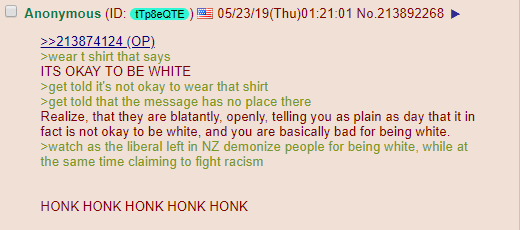
Some controversy has been generated this week from the fact that VJM Publishing sells ‘It’s Okay To Be White’ t-shirts on TradeMe (edit: or did, looks like the listing has now been taken down). Our doing so angered the Human Rights Commission, who argued that it spreads “a message of intolerance, racism and division”. This response argues that, not only are our actions the opposite of intolerance, hatred and division, but it is the Human Rights Commission itself that is guilty of this.

There’s a lot of discussion about what’s okay and what isn’t okay. This is the school of philosophy known as ethics, and it has been around for many thousands of years.

This is VJM Publishing’s take on it.

It’s okay to be white, brown, black, yellow or even red or purple. It’s okay to be tall or short, blue-eyed or brown, slim or solid, because these things are all natural and you can’t help them. It’s even okay to be ugly or dumb because, again, these things are natural and you can’t help them.

It’s okay to be an outgoing, choleric, even aggressive person, but it’s not okay to cause suffering to other sentient beings. Causing suffering is bad.

It’s also not okay to be is a member of an ideology that promotes hatred and division, because this leads directly to the suffering of sentient beings. The foremost way to promote hatred and division is to say that it’s not okay to be something that you naturally are. Such as your ethnicity.

This is the reason for the comment that these shirts are the opposite of racism. They literally are. Racism is to say that there’s something inherently wrong with being white, as if a person being born white is to be born carrying some debts that their ancestors racked up.

The racists in this situation are the Europhobes who say “there’s no place for this kind of message”, when the message is that it’s not a bad thing to be a white person. If there is such a thing as hate speech, it’s anyone saying that it’s not okay to be something that someone naturally is, such as their skin colour.

Of course, this means that things that people have chosen to be don’t count. It is not, and can never be, an act of hatred to criticise someone for belonging to a supremacist ideology, especially one that believes it’s destined to rule the world whether non-followers like it or not. Such ideologies inevitably bring suffering into the world.

VJM Publishing is not interested in ideologies that promote hatred and division. We oppose Nazism, Communism, Abrahamism, Imperialism, Materialism, and all the other ideologies that cause one group of people to glory themselves and to debase another by calling them degenerates, counter-revolutionaries, infidels, heretics or primitive natives.

We are for those who have seen beyond. This refers both to the veils of the material world in a spiritual sense, and the veils of the corporate media matrix in an existential sense. We are for those who realise that all life on this planet is connected by virtue of possessing the divine spark of consciousness that could be said to be God.

By selling this shirt, we are doing our part to counter genuine racism and division. Instead of doing this by grave, pompous and bombastic moralising that seeks to take people’s rights away – a proven failed approach – we’re adding some humour to the media scene for the sake of resistance. We’re replacing some of the colour that has been lost.

We’re not even for white pride. Sure, if you identify with some illustrious individual merely because they share a skin colour with you, go for it, but it looks weak to us. Those who have seen beyond would rather work on their individual qualities for the sake of lifting the world around them. Like the alchemists of ancient days, we cultivate the iron, the silver and the gold.

Look at the actual products we sell. We’re working with Jeff Ngatai to produce a book of mnemonics for learning te reo Maori. This we do because we believe that the language is a treasure at risk of being lost, and that mnemonics are an excellent way to preserve the memory of Maori language vocabulary in the minds of the population.

That’s why we offer every mnemonic in the book for free. They are all offered for free, arranged by subject groups. This is the same material as in the book. If you can afford to buy the book, great, if you can’t, you can use the online version. That reflects our will to bring this knowledge to as many people as possible.

What sort of white supremacists care about preserving the Maori language?

The majority of articles and essays on VJM Publishing relate to cannabis law reform. It was primarily to agitate for cannabis law reform that VJM Publishing was founded, since we knew over a decade ago that prohibition is stupid. Indeed, we’ve pointed out several times that the cannabis law disproportionately affects Maoris. This has even been argued in the original Cannabis Activist’s Handbook, published as far back as 2012.

What sort of white supremacists give a shit about the disproportionate effect that cannabis prohibition has on Maoris? What white supremacists were arguing seven years ago that prohibition should be repealed for this reason?

Our other products are speculative fiction books, a demographic study of New Zealand voting patterns, various books about how to apply psychological science to creative writing, a guide to quitting tobacco smoking and a book of religious satire.

How on Earth can any honest person see a link to white supremacy in that?

The whole idea is nonsense, and to link VJM Publishing with white supremacism is proof that we live in Clown World. VJM Publishing, far from being haters, are the victims of Big Brother’s decision to target us for their daily Two Minutes’ Hate.

What VJM Publishing really is, is a much needed thumb-in-the-eye to the wowsers, puritans and other moralising do-gooders that have sucked all the enjoyment out of living. It is these grey men and women, these emotional abusers, who are the cause of our rising suicide rates. We despise them, we oppose them, and we will never stop fighting their insane slave mentality.

VJM Publishing is proud to provide a counter-narrative to the diarrhoea that passes for mainstream political discourse in New Zealand – the same mainstream media, let’s not forget, that told us that Saddam Hussein possessed weapons of mass destruction.

We’re proud to post material that takes the piss out of the control freaks who think they have the right to arbitrarily decide what merchandise other people are allowed to sell on a public trading platform. These monsters who think they have the right to decide that a string of words doesn’t mean what it literally means, because they have the authority to rule that it really means something else.

*

Click here to read a summary of what alt-centrism is

Click here to read about the five rejections of alt-centrism

Click here to read the five acceptances of alt-centrism

Slave Morality in 2019

Some people have made the assumption that, because Christian morals have faded from the zeitgeist in recent decades, Nietzschean concepts like slave/master morality are no longer relevant. As this essay will examine, this is not only wrong but the opposite of the truth. Slave morality, in 2019, is more influential than ever before.

The slave/master morality dichotomy comes from The Genealogy of Morals. In this book, Nietzsche outlined the distinction between the master morality that arises in a state of Nature, which divides the world into good and bad, and the slave morality that arises after civilisation and which divides the world into good and evil, with the evil being the same as the good of the master.

Understanding slave morality is to understand resentment: the man with slave mentality resents the man with master morality, and seeks to bring him down. This resentment is the emotion that arises when the ego cannot get consensual reality to conform to its will, as a slave cannot. Resentment is, therefore, the natural consequence of weakness, whether that weakness be physical, emotional, intellectual or spiritual.

One major problem with the modern world is that it is heavily overpopulated. We are coming up to 8,000,000,000 human inhabitants on this planet. This means that the vast bulk of us have effectively no influence over the course of the world, or even over our own lives. We can only move around in small boxes built by other people.

The result is that there are now previously unheard of levels of resentment in our society. This resentment has found a florid range of expression.

Social Justice Warrior culture is one of most apparent examples. The resentment of the weak can be clearly heard in the cries about privilege and oppression. The mantra of SJW culture is that whoever has power is automatically the bad guy in any conflict against someone with less power. The intention of SJWs is the same as that of the slave moralist: to rip down anyone strong and call them evil.

As Ted Kaczynski pointed out in Industrial Society and Its Future, these impulses on the part of the leftist can’t ever be satisfied. Their passion to change the world comes from the resentment of being stupid and ignorant, and this doesn’t go away no matter who they destroy. So every time they succeed in destroying someone, they simply move on to the next target.

Therefore, as long as resentment exists, there will be Social Justice Warrior culture. This culture will, like slave moralities everywhere, try and destroy anyone who is happy. SJW culture chooses to do this by calling them bigots, Nazis and racists, and declaring that all good in their lives is privilege that has been stolen from someone else.

Related to SJW culture is ethnomasochism. This is when a person derives a particular kind of thrill from running down their own people. In the same way that a regular masochist will tell his dominatrix that everything he does is wrong, so does the ethnomasochist declare that the history of his people is littered with acts of irredeemable evil.

This ethnomasochism is related to the Holocaust religion, in the sense that it posits a white boogeyman whose excessive in-group favouritism has brought terrible suffering and evil to the world. In the quasi-religious context of ethnomasochism, ‘sin’ is replaced with ‘racism’, which has to be beaten out of society by ripping down anyone who suggests it’s okay to be white.

The resentment of the ethnomasochist leads them to destroy their own nation through support for things like open borders and the mass immigration of Muslims and Africans. The paradoxical fact that they derive a sense of control from this can be explained by comparing the mentality to someone who cuts their own arms: if one must suffer, then at least one can learn to suffer on demand.

Trans culture is a third example. Many men who have found that they don’t come up to the mark as men, i.e. men who women are not naturally attracted to, also find that they can get more attention if they pretend to be women. This is particularly common among men who are physical weaklings. This behaviour mimics a mental illness known as gender dysphoria.

The fundamental motivation for many of these people is to destroy the legitimate enjoyment that normal people get out of natural interactions between masculine and feminine. They want to destroy the natural concept of both “man” and “woman” so that healthy people who fit into these roles cannot enjoy them. A generation ago, homosexuality filled this social niche, but today it’s no longer shocking enough to do so.

Already trans culture has had enough of an impact to make it difficult for quality women to find a man worth being devoted to. By continuing to delegitimise and denormalise healthy expressions of masculinity and femininity, those who promote trans culture find expression for their resentment by destroying the natural and the beautiful.

The inability to understand the importance of free speech or the right to self-defence is yet another example. When a person with slave mentality gets into power, as has happened in New Zealand with the ascension of Jacinda Ardern to the Prime Minister’s position, they are liable to strip these rights away from the populace.

This is made possible by the resentment of the dumb and boring conformists who have nothing interesting to say. Slaves don’t care about the erosion of free speech because they have nothing to say worth listening to, and therefore are not impacted by the loss of an ability to speak, any more than the average person would be impacted by a ban on professional boxing.

People with slave morality don’t understand the desire of master moralists to have the ability to defend themselves either. After all, the defining feature of a slave is that he will not defend himself if he is beaten. The resentment that comes from being this weak manifests as a desire to remove other people’s ability to defend themselves.

A fifth way is the bizarre alliance with Islam. As a psychologist writing in New English Review has explained, Islam is the perfect religion for the resentful who like to see themselves as victims. It takes the same persecution mania as the other Abrahamic cults and raises it to another degree. Muslims resent the current order of the world, and so they are natural allies to the slave moralists.

Many secular Westerners with slave mentality have powerful sympathies for Islam, and can relate to a person throwing their life away in a suicide bombing. After all, the more one resents life, the less value one puts on it. As Nietzsche wrote, the slave moralist is the one who has said ‘No!’ to life, and there is no more vivid expression of this rejection of life than a suicide bombing.

The depth of the resentment can be seen by the size of the cognitive dissonance that arises when the Islamophile is asked about Islam’s attitude to women and homosexuals. Despite the brutally cruel oppression of these groups by Muslim culture, the resentment of the Islamophile is so great that all of these crimes will be swept under the carpet. In this sense, the Islamic apologist is to this generation what the Communist apologist was to the previous one.

These are merely a sample of all the various ways that slave morality expresses itself in 2019. The frightening thing is that, as the world gets more impersonal and more overpopulated, slave morality looks set to become even more influential. The only solution appears to be a massive cull, and an emptying out of the cities where this cancerous mentality has its strongholds.

*

If you enjoyed reading this essay, you can get a compilation of the Best VJMP Essays and Articles of 2018 from Amazon for Kindle or Amazon for CreateSpace (for international readers), or TradeMe (for Kiwis). A compilation of the Best VJMP Essays and Articles of 2017 is also available.

Civilization VI: Gathering Storm Explains How Humanity Is Doomed

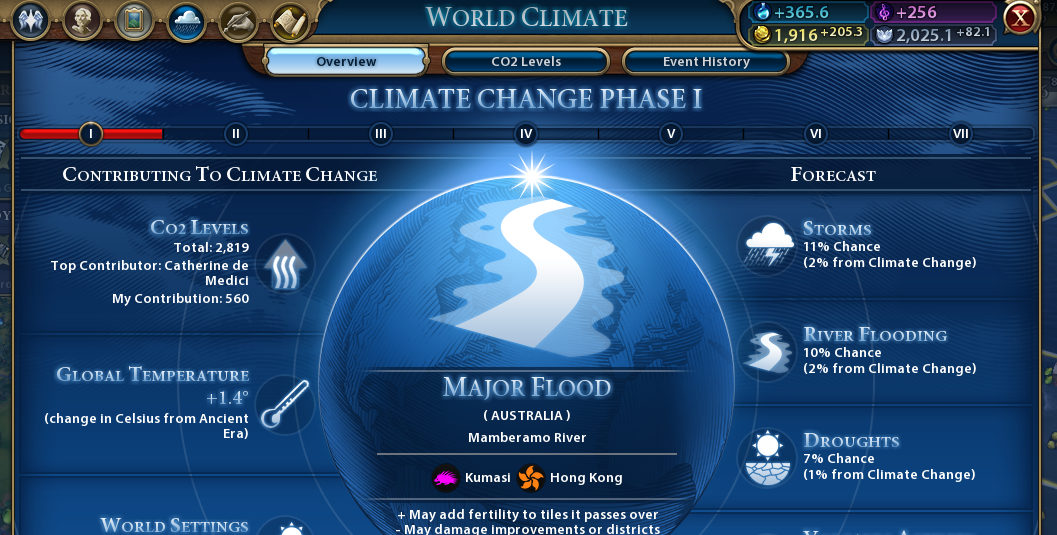
God simulator fans have been busy for the past three months, thanks to the release of the second expansion to Sid Meier’s Civilization VI. Titled Gathering Storm, the expansion offers a number of new mechanics relating to climate. Unfortunately for us is the fact that, insofar as the Civilization games are history simulators, this one suggests that humanity is all but guaranteed to destroy the planet.

The fact that humanity is all but guaranteed to destroy the planet becomes clear if one considers the game theory logic of Gathering Storm.

A game of Civilization normally starts in 4000 B.C. At this point your empire will consist of one small village, a rudimentary knowledge of agriculture, and a gigantic, unknown map full of rivals to be explored. From here, you will be presented with a near-infinitude of different decisions. If you make the correct ones, your civilisation will survive against the military and economic threats posed by the others.

As the scientific knowledge of your civilisation progresses, it will advance through the Classical Era to the Medieval Era, and then to the Renaissance Era. Through each era, your empire’s military power increases, but nothing you do affects the global environment until you discover industrialisation. Once you get to the Industrial Era, your scientists are beginning to grapple with the uses of coal.

This means three major things. The first is that it makes naval vessels like ironclads and battleships possible. The second is that it makes coal power plants possible. The third is that the world atmosphere starts to become polluted as these units and buildings consume fossil fuels.

Let’s say you’re at war with someone (and, let’s face it, you probably are). The inexorable logic of war in the industrial age is that victory mostly comes down to getting the most and the biggest guns onto the field. This means that war is mostly a matter of production. Whoever has the most factories can produce the most guns, whoever has the most shipyards can produce the biggest navy, whoever has the best railway network can get the most nitre to the ammunition factories etc.

In Gathering Storm, it’s possible to harness the power of coal to not only create a more powerful range of naval vessels, but also to fuel power plants that greatly increase the productivity of the empire’s workshops, factories and arsenals. This also has the effect of spewing pollution into the atmosphere, measured in-game by CO2 levels.

In the Civilization series, technological advancement tends to proceed at roughly the same speed for everyone. This means that any technological and military advantages are usually slim and sometimes short-lived. So it’s very possible that, when the player discovers industrialisation, they are in a war that they are losing or which has stalemated. The increased power that comes from harnessing coal, then, is often enough to break the deadlock.

So the imperatives to burn coal and oil at the expense of the global environment are inescapable. If you don’t do it, your enemy will, and then they will destroy you. He who rapes the planet the fastest gets the edge on his enemies – and stays alive. As above so below: the kill-or-be-killed logic of the animal world applies at all levels of human organisation.

This is not just a matter of game-world logic either.

By 1903, British Admiral John Fisher had realised the strategic imperative to switch the British Navy from coal to oil. A navy that was fueled by oil was many times more efficient than one fueled by coal. Its ships, compared to coal-powered ships, had greater range, greater speed, lighter weight, required a smaller crew – and could carry more guns.

Fisher encountered some difficulty in persuading his higher-ups to agree to the change. Eventually, however, the iron logic prevailed, and the Royal Navy switched to oil just in time for World War One. The British strategic victory at the Battle of Jutland underlined the degree to which the switch to oil had created a distinct naval advantage. A failure to have done so would have meant defeat.

Of course, this profound naval advantage had to be maintained – which meant that military control over Middle Eastern oil fields had to be maintained, which meant that a massive navy had to be maintained. In other words, the Empire became irrevocably committed to the logic of maintaining a perpetual advantage on their enemy by controlling more energy.

At this point, the extreme difficulty of taking measures to preserve the Earth’s environment by way of not burning too many fossil fuels becomes apparent. If the Royal Navy had remained on coal, it’s possible that the Germans would have switched to oil and then won a military advantage. This could have led to the destruction of Britain itself, for that is the nature of military advantages.

Why would one side sit back and allow their enemies to obtain a strategic advantage over them? They wouldn’t. In the same way that no Civilization player will refuse to build battleships and power plants and allow the other players to destroy him, no real-life leader would refuse a military advantage that kept their people safe.

What emerges, from a game theory perspective, is a global tragedy of the commons-style scenario. The payoff to the people burning the fossil fuel is that they keep all the benefits of harnessing the energy. The drawback is the environmental damage done by burning the fossil fuels, which are mostly spread out across the entire world.

We do have one great factor in our favour. On our planet, technological advancement occurred in an extremely unequal manner, unlike in a game of Civilization. The Industrial Revolution began in Britain, and by the time the rest of the world had caught up, the British had built a global empire.

This made it possible for a minority of nations to develop so far economically that they were able to produce scientists who could foresee the danger of burning too many fossil fuels, and before we had burned so many that the planet was on an unavoidable path to disaster. And here we are today, but at a crossroads.

It’s not clear what the path away from this situation is. However, as this newspaper has mentioned before, the average person will eventually have to cut their consumption to a level roughly equal to that of a New Zealand beneficiary. This is not optional, as the planet simply cannot support more than this. The only thing certain is that a turn away from materialist consumption is necessary.

*

If you enjoyed reading this essay, you can get a compilation of the Best VJMP Essays and Articles of 2018 from Amazon for Kindle or Amazon for CreateSpace (for international readers), or TradeMe (for Kiwis). A compilation of the Best VJMP Essays and Articles of 2017 is also available.