Don’t Throw The Spiritual Baby Out With The Abrahamic Bathwater!

The Western World is atheist today. This is presented as a natural development, religion being considered a remnant of a by-gone age. But the development of religious belief in the West is anything but natural.

It’s not natural for anyone to be atheist. Atheism is, in fact, a degeneracy. Plato, in Laws, prescribed the death penalty for atheism, reasoning that it was a form of spiritual corruption that threatened to rot society. The more corrupt a nation’s spiritual practice is, the more atheists it has. In ancient Athens, there were so few atheists they could be put to death with little disruption. In the West of 2026, there are so many atheists that anyone who expresses a genuine belief in God is diagnosed with schizophrenia and medicated.

Historically considered, this is a highly unnatural situation. It has come about because atheism is a natural reaction to having spiritual lies forced on a people. If people grow up being told spiritual lies, a certain proportion of them will instinctively reject those lies, and, without finding spiritual fulfillment in something else, will regress into atheism.

The Western World had its own native religions before Christianity. The Greek, the Roman and the Nordic pantheons were the natural expressions of European spirituality for millennia. These pantheons served us well during the ages of Alexander and Trajan. Unfortunately, because of the degeneracy that inevitably follows success, Rome submitted to Abrahamic religion in the form of Christianity. The Dark Ages ensued.

After the Dark Ages, it proved impossible to shake off the remnants of Christianity. Superstition ensured that the cult survived and maintained its death grip over Europe. Eventually, with the Renaissance, Christianity began to weaken. People started to question it.

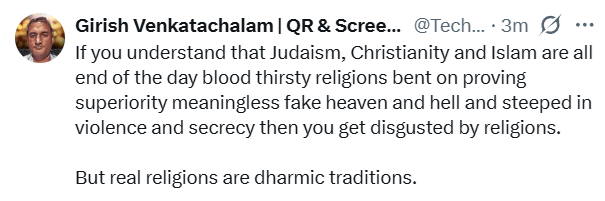
The horrors of Christianity led to an over-reaction against anything perceived to be religious. As the image at the top of this article suggests, many people are so disgusted by the violence and lying of Abrahamic religions that they have been turned off spirituality altogether. Many have concluded, understandably but in haste, that if Abrahamism is what religion is, then religion is evil.

The truth is that proper religion is a great and wonderful thing. It liberates beings from their suffering by returning them to God, the only true source of happiness. As such, it often makes life bearable in cases where it would not have been. It’s only the Abrahamic religions that have perverted this beauty, turning religion into a vehicle for political control.
Growing up in the West, people are presented with Christianity as if it were “their” religion. Then they grow up a bit more, and read about the Inquisition, the French Wars of Religion, the Thirty Years’ War, then learn about Christian support for circumcision, the War on Drugs, endless Middle Eastern wars, and realise that Christianity is evil. Some people realise before then, as an instinctive reaction against the brainwashing and sadistic pressure to submit and conform. It’s true that Christianity is evil. But the problem is, when people realise this, they often reject spirituality full stop, and become atheists.

Many people in the West today are unable to think about morality or ethics at all, because they associate such things with Christian hectoring and badgering (not to mention Christian hypocrisy and lying). Having been told that all morality comes from Rabbi Yeshua, the tendency is for people, when they reject the Magic Rabbi, to reject morality also. The end result: they follow animal impulses instead. The societal consequences of throwing the spiritual baby out with the Abrahamic bathwater are obvious.

Abrahamism is evil, and must be eradicated for the human race to thrive. But, before this can be possible, people must understand that the Abrahamisms are political religions and not spiritual ones. Spiritual religions cannot be judged on the flaws of political religions. Spirituality existed before the Abrahamisms and will exist afterwards. It stands alone, sufficient.

The Abrahamisms may have conquered a large proportion of the world, and in doing so normalised themselves to billions of people, but that doesn’t make them honest depictions of spiritual truth. They are dying, all around the world, as the Internet has made truth freely available. As they disappear, and get replaced by atheism and other beliefs, the Dharmic religions will return.

The Dharmic religions include Hinduism, Buddhism, Sikhism, Taoism, Confucianism, Shintoism, Elementalism and many others. These religions are variations on what Aldous Huxley called the perennial philosophy: the eternal spiritual truth that has been passed down throughout history in many forms. In the future, the world will see the return of these religions. This is as inevitable as night turning back to day.

The most important lesson Westerners need to learn right now: spirituality is real, Abrahamism is false, and true spirituality will return as Abrahamism dies.

*

For more of VJM’s ideas, see his work on other platforms!
For even more of VJM’s ideas, buy one of his books!

*

If you enjoyed reading this piece, buy a compilation of our best pieces from previous years!

Best VJMP Essays and Articles of 2024-25
Best VJMP Essays and Articles of 2023
Best VJMP Essays and Articles of 2022
Best VJMP Essays and Articles of 2021
Best VJMP Essays and Articles of 2020
Best VJMP Essays and Articles of 2019
Best VJMP Essays and Articles of 2018
Best VJMP Essays and Articles of 2017

*

If you would like to support our work in other ways, make a donation to our Paypal! Even better, buy any one of our books!
Natural And Unnatural Religions

There are many different ways to classify the world’s religions. The usual way is by reference to their group origin: Dharmic, Taoic, Abrahamic etc. Others make the division into Western and Eastern religions, or esoteric and exoteric. A previous VJM Publishing essay made a distinction between spiritual and political religions. This essay will try a new approach: a distinction between natural and unnatural religions.

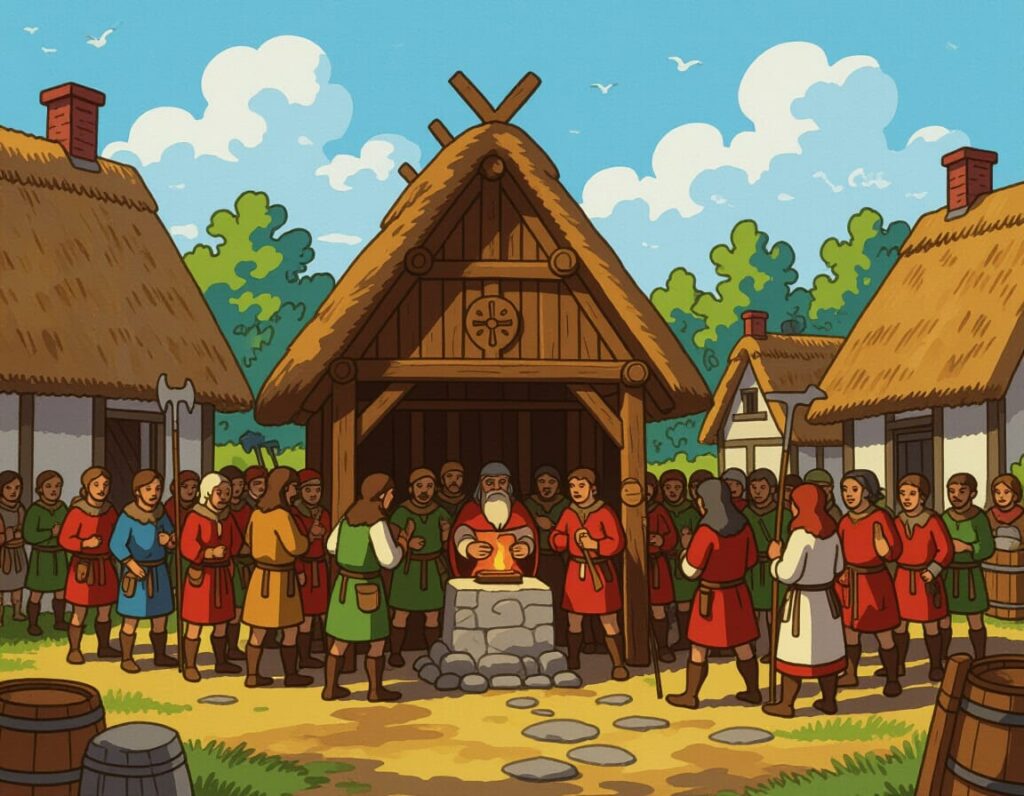
The central contention of this essay is that there is a natural religious tradition common to the entire human race, and that the many deviations from this are mostly unnatural. In this sense, religion is an inherent behaviour, like making music or building shelter. These natural religions follow a typical path, with some local flavour.

The natural religions start with ancestral veneration. This itself begins with the understanding that the ancestors are the reason why you yourself occupy the societal niche you do. Those who came before you battled the elements and outside enemies in order to defend the space that you now subsist in. Gratitude for this is the first spark of natural spirituality.

Ancestral veneration leads to the understanding that those who follow you will venerate you. As they enter into the niche you have saved for them, if this niche is a good place in which they can thrive, them venerating you is natural. A person who understands this will steward society into a better future instead of acting selfishly and exploiting it.

An appreciation of both those who came before and those who come after leads to an appreciation of natural cycles. In the same way that the Sun rises in the morning and sets in the evening, the human being rises in their youth and declines in later adulthood. These cycles are a fundamental part of life. Knowing this, a naturally religious person will – without needing to be prompted by an authority – celebrate the high points of the solar cycle: the solstices and equinoxes. The fact that the world will get darker (or lighter) after a certain date is imbued with a deep spiritual significance.

An appreciation of natural cycles leads to an understanding of reincarnation. If the Sun rises every morning after setting every evening, and if the Spring comes after every Winter, it’s logical to believe that a new birth occurs after every death. This is essentially The Cyclical Argument given for the immortality of the soul in Phaedo.

When Socrates made this argument, he was not stating something he came up with himself. Because Greece of the time followed a natural religious tradition, he was simply stating a widely-believed fact. The ancestral veneration of the Greeks had developed into a pantheon of gods, much as it had in India, China and other places that followed natural religious traditions. This had led to the celebration of the high points of the yearly cycle. From there, the priests among the Greeks (as those in other places) came to understand the truths of reincarnation and karma, as described in Phaedrus, Republic, Timaeus and other dialogues.

Thus it can be seen that the natural religions develop naturally. The unnatural religions, by contrast, are made up for a particular purpose.

For example, Christianity was invented by Jews to place themselves at the centre of the lives of anyone who adopted it. Much of the New Testament was written by Paul, who acted intentionally to bring this Jewish religion to Rome, knowing that Rome could serve as a springboard to spread it to the ends of the Earth. His success has centred Western life around Jews ever since Constantine.

As a result, the Crusaders were more concerned about liberating Jerusalem from Muslim rule than Spain. This is a highly unnatural state of affairs, but, being Christian, Jerusalem was at the centre of their lives, with Europe decentred. Unnatural religions devote the attention of their followers away from their ancestors and towards the creators of those religions.

The Baha’i religion is a transparent attempt to bring all world religion under an Abrahamic umbrella. The deeply unnatural quality of Baha’i is seen in its insistence, against all evidence, on the equality of all human races. Only someone with a desire to subjugate the entire world under one rule would insist on the equality of all its peoples. It’s typical for an unnatural religion to claim to be universalist, but to be arranged so that one particular group is central and thus inevitably in charge, even if informally. In the case of Baha’i, like the other Abrahamic religions, this is Semites.

Unnatural religions do not generally believe in reincarnation and karma, instead pushing a “one judgment for all eternity” narrative in order to create maximum fear, this in order to maximise control. Neither do they use spiritual sacraments, knowing them to decondition people from the brainwashing unnatural religions depend on for power.

Also characteristic of unnatural religions is a rejection of one’s natural allies. The subjugation of women was not a religious principle before Abrahamism, because it was understood that a husband and wife are on the same team. Rabbi Yeshua preached “I have come to ‘set a man against his father, a daughter against her mother, and a daughter-in-law against her mother-in-law’; and ‘a man’s enemies will be those of his own household.’ He who loves father or mother more than Me is not worthy of Me. And he who loves son or daughter more than Me is not worthy of Me”. Yeshua, like any psychopathic cult leader, demanded that followers put him above their own families.

Natural religions, by contrast, emphasise the importance of one’s own ancestors.

Unnatural religions also hate and fear the natural world. Covering all women in burkas is exceptionally unnatural, but Abrahamist sexual prudishness considers anything related to sex to be sinful. In fact, all of biology is denied in the unnatural religions: Abrahamists today deny both evolution and racial differences, an echo of how they used to deny heliocentrism. Perhaps the most invidious aspect of this hatred of the natural world is the hatred of natural spiritual sacraments, especially cannabis and psilocybin mushrooms. This is one of the major causes of the world’s spiritual ignorance today.

Elementalism is a hybrid of natural and unnatural religions. It’s unnatural in the sense that it was deliberately created and not a development of inherent spiritual instinct. However, it is natural in its emphasis on appreciating the cycles of life, on the use of plant-based spiritual sacraments, on the importance of fighting evil and on the truths of reincarnation and karma.

*

For more of VJM’s ideas, see his work on other platforms!
For even more of VJM’s ideas, buy one of his books!

*

If you enjoyed reading this piece, buy a compilation of our best pieces from previous years!

Best VJMP Essays and Articles of 2023
Best VJMP Essays and Articles of 2022
Best VJMP Essays and Articles of 2021
Best VJMP Essays and Articles of 2020
Best VJMP Essays and Articles of 2019
Best VJMP Essays and Articles of 2018
Best VJMP Essays and Articles of 2017

*

If you would like to support our work in other ways, make a donation to our Paypal! Even better, buy any one of our books!
The Five Types Of Power

Traditionally, power theory divides power into hard and soft forms, as proposed by Joseph Nye in 1991. The hard form relates to the common use of the word power, which means capacity for force. The soft form relates to more subtle forms of power, which aren’t about force as commonly understood, but rather influence.

The distinction has come into prominence in geopolitical discourse, e.g. when the hard power of America is contrasted with the soft power of Britain. But many of those into alchemy would prefer a more sophisticated breakdown of the potential power spectum. So this essay attempts just that.

In this essay, the “potential power spectrum” consists of the five highest stages of the Mithraic Ladder: iron, copper, silver, mercury and gold. Tin and lead are not considered because they are too passive to count as powerful, and are better considered part of that which power acts upon.

“Hard power” in the sense proposed by Nye covers what an alchemist would describe as the realm of iron. This is, in actuality, the least subtle form of power. In a geopolitical sense it refers to military power. In an alchemical sense it refers to gross physical force and violence. The realm of iron is the realm of the hard edge of the blade. Everything people understand by martial arts or war falls under the realm of iron and hard power.

Nye’s conception of hard power also covers economic power. This includes actions such as trade sanctions or tariffs. Such a power is like a medium power inbetween hard and soft. It’s analogous, in an alchemical sense, to copper. As my friend Fro once said: “money makes people move”. Buying and selling people, whether permanently or by the hour, is the realm of copper magic.

Copper is the metal of basic currency, which is itself the power of arranging force. A trade sanction is to a country much like a strangehold is to an individual. The use of debt to trap people also falls under copper magic – usurers can be considered copper magicians, perhaps the most powerful and dangerous ones of all.

The essential aspect of hard power is that it can be used to force people to do what you want them to do. Soft power, by contrast, is used to make people want to do what you want them to do.

“Soft power” in Nye’s meaning relates to silver, mercury and gold magic in the alchemical sense. These are not about forcing people into doing things, but influencing them into doing things. Sometimes that involves trickery, deception, enchantment, persuasion, bedazzlement or charm. In every case, it’s more subtle than hard power.

Silver magic is how the ruling class maintains its position as the ruling class. To a major extent, this silver magic is just public relations: how one brings allies to the negotiating table. As such, there’s a lot of psychology to it. The art of oratory, in which a politician convinces people to follow them through speech, is silver magic in action. So is organising a propaganda campaign through the mainstream media.

Softer than soft power exists in the form of willpower. This is so subtle a power that it’s hard to measure. The closest mainstream psychology comes to it is the concept of ego depletion. This is the name given to the phenomenon where a person finds it harder to achieve certain tasks if they have already exerted self-control on a previous task.

There are various ways to keep one’s willpower high. The foremost is to keep morale high through positive self-talk and the avoidance of blackpills. Another way is to avoid distractions, whether somatic or sensory. The most important is practice: anyone with truly high levels of willpower will have built up those powers through many years of practice.

This mercury magic can be just as much a form of military power as iron magic. B. H. Liddell-Hart once wrote “In war, the chief incalculable is the human will,” explaining how a larger force can lose to a much smaller one if it loses the will to fight (see the capture of Belgrade in 1941). Many Americans claim that their guns keep them free from tyranny, but outsiders readily point out that the American Government has committed countless crimes against their own people over the past century, without anyone taking up arms against them. Absent the will to use them, all weapons are useless.

The softest power of all is spiritual power. This is represented by the realm of gold and is very similar to moral authority. This is the power of having one’s will aligned with the will of the divine. If a person or group of people have such a will, it is impossible to righteously oppose them. They have what the Confucianists call ‘The Mandate of Heaven’.

India possibly has the strongest levels of gold power of any country today, on account of that many consider the religions from there to be good ones. Then again, possibly it doesn’t, on account of that its people have a reputation for dishonesty in many circles. Who holds the most gold power can be very hard to determine. It’s also ethereal: America lost a great deal of gold power with their invasion of Iraq, and those who supported refugee resettlement to the West lost much in the wake of the Muslim child rape gangs.

Moral authority is the softest of all powers because anyone can claim to have it. But viewed from another perspective, it’s also the strongest because it can be used without rest. The big drawback with physical weapons is that you can’t actually use them the vast majority of the time. Spiritual weapons can be employed on a permanent basis.

These five types of power constitute an alchemical breakdown of the various ways that people can subjugate others to their will. In short, Joseph Nye’s concept of hard power covers the realms of iron and copper, and his concept of soft power covers the realms of silver, mercury and gold.

*

For more of VJM’s ideas, see his work on other platforms!
For even more of VJM’s ideas, buy one of his books!

*

If you enjoyed reading this piece, buy a compilation of our best pieces from previous years!

Best VJMP Essays and Articles of 2023
Best VJMP Essays and Articles of 2022
Best VJMP Essays and Articles of 2021
Best VJMP Essays and Articles of 2020
Best VJMP Essays and Articles of 2019
Best VJMP Essays and Articles of 2018
Best VJMP Essays and Articles of 2017

*

If you would like to support our work in other ways, make a donation to our Paypal! Even better, buy any one of our books!

Some Important Dates In Elementalism

07 FEB – Summer Thermistice

21 MAR – Autumn Equinox

25 APR – Anzac Day

07 MAY – Autumn Equitherm

21 JUN – Winter Solstice

07 AUG – Winter Thermistice

30 AUG – Ernest Rutherford Day

21 SEP – Spring Equinox

12 OCT – First Day of Battle of Passchendaele

07 NOV – Spring Equitherm

17 DEC – Simo Hayha Day

21 DEC – Summer Solstice