
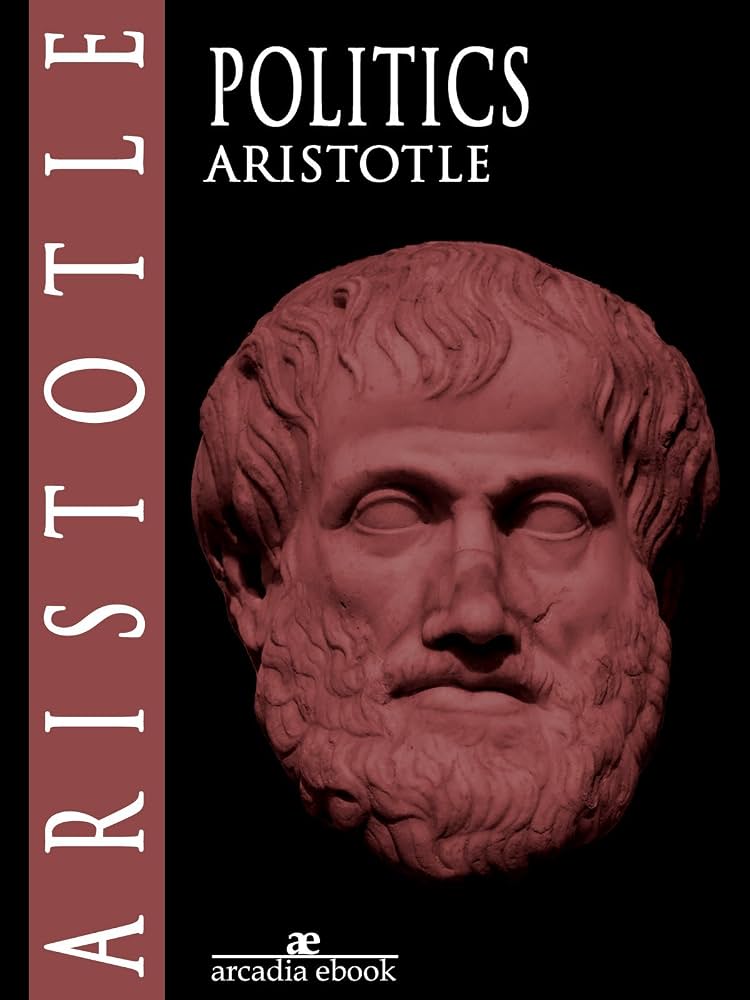
Next for the VJMP Reads column: Politics by Aristotle. This naturally follows on from Nicomachean Ethics, which I read earlier in the year. This reading is of Book I.
This section is from where we get the quote “man is a political animal”. Aristotle writes that people naturally form political associations for the sake of securing some good, usually ready access to the means of life. Surprisingly, if one considers how individualistic the West is, Aristotle considered the city-state to be the basic political unit. This is because smaller units are not self-sufficient.
Book I also gives us the banger “Man, when perfected, is the best of animals; but if he be isolated from law and justice he is the worst of all.” This is an incredibly deep insight into human and animal nature. The worst humans really are the worst beings imaginable.
Much of Book I is about slavery, which is hard to make sense of from a modern Western viewpoint.
For example, Aristotle writes “The element which is able, by virtue of its intelligence, to exercise fore-thought, is naturally a ruling and master element.” He goes to argue that those capable of reason are naturally masters, and those incapable naturally slaves. The argument that some people are naturally slaves is extremely unfashionable today.
He discusses the possibility that people are enslaved by war, i.e. by force, and considers it illegitimate. Slavery is good and natural when a rational element enslaves an irrational element, but when slavery merely rests on law and force it is not natural: “Just as some are by nature free, so others are by nature slaves, and for these latter the condition of slavery is both beneficial and just.” Aristotle discusses and rejects the might makes right theory of justice.
This fact, when considered, shows that Aristotle was not as pro-slavery as is often believed. Aristotle would likely see a modern workplace, with a boss who presumably knew more about the subject than his employees, and consider it an example of successful slavery.
One idea in particular appears central to European culture. Aristotle considers the relationship between men and women, in barbarian culture, akin to the relationship between master and slave. The woman is subjugated as the slave. But for the Greek, the relationship between men and women is more akin to the relationship between statesman and his fellow citizens. Thus the woman is intermediate between man and slave.
Aristotle is certainly not a feminist. He writes “The male is naturally fitter to command than the female, except where there is some departure from nature.” But his philosophy is vastly more pro-feminine than equatorial culture.
Aristotle speaks out about usury in this section: “Of all modes of acquisition, usury is the most unnatural” and “The trade of the petty usurer is hated with most reason.” This is very interesting if one considers how totally commercialised life is today thanks to usury.
Being pro-slavery and anti-usury marks Aristotle as an utterly unmodern philosopher.
*
For more of VJM’s ideas, see his work on other platforms!
For even more of VJM’s ideas, buy one of his books!
*
If you enjoyed reading this piece, buy a compilation of our best pieces from previous years!
Best VJMP Essays and Articles of 2024-25
Best VJMP Essays and Articles of 2023
Best VJMP Essays and Articles of 2022
Best VJMP Essays and Articles of 2021
Best VJMP Essays and Articles of 2020
Best VJMP Essays and Articles of 2019
Best VJMP Essays and Articles of 2018
Best VJMP Essays and Articles of 2017