
The Alt Centrist Approach To Welfare

In Nicomachean Ethics, Aristotle introduced the concepts of corrective and distributive justice. Corrective justice is the form that we’re used to: commit a crime, and you get corrected with punishment. Distributive justice relates to who justly gets how much of the boons of society. Aristotle believed that people ought to get rewards and honours in proportion to their contribution to society. He was emphatically not a communist, believing that those who contributed more ought to get more. But neither was he a capitalist, preaching that the poor deserve suffering. He promoted the Golden Mean between the two extremes.

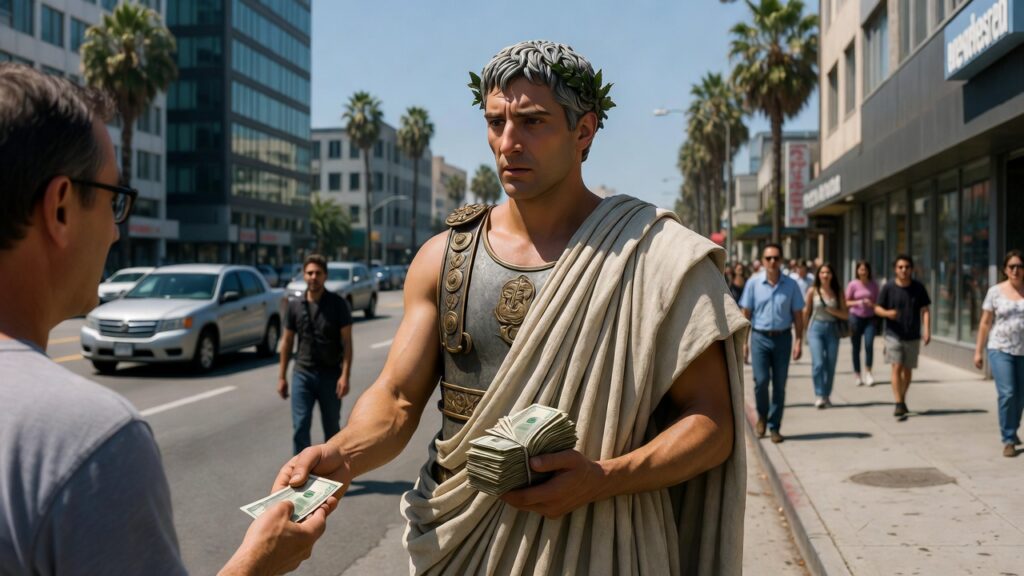
Ancient Rome is often characterised as a cruel, sink-or-swim system, but they had an institution known as the annona, or the grain dole. After centuries of military expansion, many wealthy landowners had replaced Roman workers with foreign slaves. The resulting impoverishment led to constant rioting and civil unrest. So Gaius Gracchus introduced the grain dole in 123 BCE, resulting in free food for the Roman citizenry. Later emperors added pork and wine.

The concept of distributive justice barely exists in the modern West. In our system, which can be called whorehouse economics, whoever has the money decides. People are conditioned to believe that a person is entitled to what the money men give them, and no more. Anyone who doesn’t work for a capitalist deserves to starve. This is because the merchantry have long since driven the Establishment Right out of effective control, so concepts like noblesse oblige are long forgotten.

This approach is transparently cruel and therefore is rejected under the Fourth Rejection.

The Establishment Left’s argument for welfare is that it maximises freedom. The logic here is that poverty itself is the first and primary source of enslavement. Poverty makes people desperate, which enslaves them to landowners and other wealthy people in the hope of a paycheck. So raising the floor of poverty through welfare promotes freedom generally.

The Establishment Right counters with the observation that if the masses are allowed to vote themselves infinity free money, they will do it, and the economy will collapse. Tiberius is recorded as stating that if everyone would be granted everything they petitioned for, the treasury would soon be empty, and the state would have to extort or steal money to stay operational.

Therefore, distributive justice needs to find the mean between impoverishing the masses and impoverishing the treasury.

The Prussian statesman Otto von Bismarck was one of the first Establishment Centrists. He championed a welfare state as a way of ensuring peace between the various classes of Prussian society, and to forestall the rise of Communism. His reasoning was that if people who couldn’t work had a safety net to fall back on, society would be much stronger.

Over time, other countries adopted similar systems. As decades passed, and more and more was handed out in exchange for votes, these systems became bloated. Tiberius’s warning applies to society in 2026 as well as to his time.

By today, disability insurance fraud in America is estimated by the FBI to cost USD40 billion per year, and in Australia is believed to cost up to AUD4.6 billion per year. These vast sums require further vast sums to investigate and police. This is one of the fundamental problems with the current approach to welfare: if you only give it to the “deserving”, following the belief that everyone is obliged to work unless disabled, it costs billions to determine who is deserving and who isn’t.

A universal basic income is an elegant solution. It maximises freedom and minimises cruelty (as well as expense).

The alternative centrist doesn’t buy the right-wing argument that everyone needs to “earn” a living. For one thing, that kind of moralising is the exact kind of slave morality that alternative centrism exists to oppose. For another thing, the UBI will not provide a high standard of living. Elon Musk’s idea of a universal high income is not realistic, because so much of wealth is about controlling other people, and that’s a zero-sum affair.

The UBI would be low, not generous, and there would be very little government largesse over and above this. Private charity would still be available, as it is today, but there would be no accommodation allowances, temporary additional support, disability bonuses or any other spending over and above the UBI (one might consider paying a half-UBI to mothers of under-18s for nationalist reasons).

The UBI would lead to all of order, freedom and peace for a variety of reasons.

One is because it would enable forward planning. Even if a UBI recipient only got $500 per week, they would know they were getting $2,000 in the next month and $25,000 in the next year, and could plan accordingly. This would open up opportunities for securing rental tenancies or business financing that did not exist previously.

The second is that it would minimise resentment. As of right now, young Westerners working the average job in their locale cannot afford housing. They watch half of their wages disappear in rent and are left with little after food and transport are paid for. It feels like a bitterly cruel rip-off. A UBI would let younger people also feel like they were getting a share of the bounties of modern society.

The third is less pressure on desirable housing. Most young people, upon finishing their education, find themselves forced to move where the jobs are. This is usually the big cities. The enormous demand for housing in urban areas is the prime driver of the housing affordability crisis. A UBI would make it possible to survive in low-cost, low-opportunity areas. This would release pressure on urban housing and make it more possible for younger people to afford the housing they need to raise families in, even if it meant taking a less ambitious job.

The fourth, and perhaps major reason, is that it would remove the desperation that is often the cause of crime. No-one would wonder where their next dollar was coming from: they’ll get $500 next Wednesday evening. This would promote orderly conduct. It would also make it politically feasible to introduce severe punishments for antisocial behaviour, the reasoning being that, absent desperation, people would only commit crimes out of malice. Therefore it’s justified to bring the hammer down on criminals.

It might be argued that a UBI will lead to degeneracy, as it pays people to do nothing, but that is countered in other ways (see The Alt Centrist Approach To Society).

The alt centrist approach to welfare is simple, neat and long-sighted: a moderate amount of distributive justice plus a high amount of efficiency.

*

This chapter is from The Alternative Centrist Manifesto, the upcoming work of political philosophy that offers the answers to the political problems of the West.

*

For more of VJM’s ideas, see his work on other platforms!
For even more of VJM’s ideas, buy one of his books!

*

If you enjoyed reading this piece, buy a compilation of our best pieces from previous years!

Best VJMP Essays and Articles of 2024-25
Best VJMP Essays and Articles of 2023
Best VJMP Essays and Articles of 2022
Best VJMP Essays and Articles of 2021
Best VJMP Essays and Articles of 2020
Best VJMP Essays and Articles of 2019
Best VJMP Essays and Articles of 2018
Best VJMP Essays and Articles of 2017
*

If you would like to support our work in other ways, make a donation to our Paypal! Even better, buy any one of our books!

Economic Zone Mentality

Social observers in places like New Zealand, America, Australia, South Africa, Argentina etc. have noticed that the mentality of the New World is different to the Old World when it comes to co-operation. Although individuals in the New World are at least as friendly as individuals in the Old, the societies of the New World are much nastier. How to explain?

The usual story is that people in the New World are rugged, pioneering settlers and homesteaders. Although they might be willing to lend a hand personally, they are suspicious of government assistance, which they see as a loss of independence. People in the Old World, in comparison, are a bit soft and lazy. Hence they vote for a generous safety net.

In truth, New Worlders vote for low levels of government assistance because they are afflicted with something known as Economic Zone Mentality.

This essay contends that Economic Zone Mentality is a manner of approaching politics and justice that is characteristic of economic zones and not true nations, and is particularly common in the New World. It’s not necessarily selfish, but usually is, reflecting an every-man-for-himself psychology that is anathema to true civilisation.

An actual nation is like an extended family. Examples are Japan or Finland. In an actual nation, the logic is that the Establishment exists to provide for the people. The people might have to pay into the Establishment in the form of taxes, but they can expect to get out more than they put in, because the Establishment will provide services at scale. Thanks to economies of scale, members of actual nations get to enjoy high standards of living, even if they’re poor.

An economic zone is like a plantation. The people who live in it aren’t family. Some of those people are the owners, and the others are there on the graces of the owners. In an economic zone, the Establishment exists to facilitate wealth extraction. The happiness of the people who live there is not an important factor.

In an economic zone, all that matters is economic production. The logic is that the Establishment exists to take, not to give. There may or may not be economies of scale, but it doesn’t matter if those living in economic zones enjoy high standards of living. They are there to work. As a result of all this, there is massive economic inequality.

In actual nations, governments do a lot more to take care of their own people in comparison to economic zones. Welfare support is much higher in Europe than in America, Australia or New Zealand. Higher education is usually free, and when it isn’t student loans are usually interest-free. Healthcare tends to be universal. The logic is that public goods benefit the nation, and therefore are universal goods.

Actual nations take measures that are unthinkable in economic zones, such as the upcoming Swiss referendum on whether to cap the population. In economic zones, it’s well understood that the size of the economy is primarily a function of the size of the population. To cap the population, in Economic Zone Mentality, is like throwing money away. Only people in actual nations could see the merit in it.

A particular characteristic of economic zones is that production of anything non-industrial is considered worthless. Cultural production is worthless; you can’t eat literature or music. Intellectual production likewise, unless it has direct industrial applications. Spiritual production has the least value. Anyone engaged in these three pastimes is considered a thief of actual production. This attitude is the main reason why New World countries are considered cultureless by Old World ones.

In Economic Zone Mentality, a person’s job is their identity. Engineers are the highest status, because they do the most resource extraction. Healthcare workers are the lowest status, because the well-being of people is not important. And without a job, you are no-one. To be unemployed is to be a criminal. It is a violation of the social contract. In a nation, the social contract is that sometimes you give, sometimes you take. In an economic zone, the social contract is that you work in exchange for being allowed to exist.

In Economic Zone Mentality, all criminals are forgiven as soon as they get jobs, and all decent people are criminals as soon as they stop working. Crying about one person on the dole, and ignoring landlords sucking out a hundred times more unearned income, is typical.

Much confusion arises when people expect natural, national mentality in an economic zone.

In all societies, your right to criticise society comes from your social status. In proper nations, many social critics are artists, who have high social status. But in Economic Zone Mentality, artists are low status. So when Eleanor Catton won the Booker Prize, many expected that she would have earned a certain degree of respect for the achievement, and that this would have conferred some right to comment on society. But media maggots like Sean Plunket just called her a “traitor” and an “ungrateful hua” (ironically, Catton was criticising Economic Zone Mentality in New Zealand). She now lives overseas.

Economic Zone Mentality is to act as if a person’s net worth and their merit are the same thing. In proper nations, a person gets respect for being wealthy, but no more than they get for being honourable, or educated, or physically fit, or disciplined. In economic zones, a person’s portfolio value is like a scorecard. Honour, education etc. have no value in and of themselves, only to the extent that they enable resource extraction.

It’s becoming apparent to many Westerners that they live, not in actual nations, but in economic zones. Their countries are workplaces and not homes. This is why housing is severely unaffordable in New Zealand and Australia: rather than being homes for the Anzac people, these countries are workplaces for international banking and finance interests. Housing is becoming severely unaffordable in America and much of Europe for similar reasons (Europe didn’t start with Economic Zone Mentality, but is developing it as it becomes more multicultural).

The end result of Economic Zone Mentality is to turn everywhere into a pile of slag and garbage. The only solution is to develop and support genuine cultural initiatives.

*

For more of VJM’s ideas, see his work on other platforms!
For even more of VJM’s ideas, buy one of his books!

*

If you enjoyed reading this piece, buy a compilation of our best pieces from previous years!

Best VJMP Essays and Articles of 2024-25
Best VJMP Essays and Articles of 2023
Best VJMP Essays and Articles of 2022
Best VJMP Essays and Articles of 2021
Best VJMP Essays and Articles of 2020
Best VJMP Essays and Articles of 2019
Best VJMP Essays and Articles of 2018
Best VJMP Essays and Articles of 2017
*

If you would like to support our work in other ways, make a donation to our Paypal! Even better, buy any one of our books!

Free Range Slavery

For most of human history, slavery has been central to all economies. Ownership of human livestock has always been the single most profitable endeavour of all, as it allows the owners to claim the productivity of the slaves. Countless wars have been fought both to capture slaves and to free them. But a number of misconceptions have arisen about the practice of slavery, both in the past and in the present.

The story we are given is that slavery has existed forever, and continued up until the British Empire banned the trade in 1807. From there it was gradually banned throughout the rest of the world. Except for one particularly violent disagreement in America in the 1860s, the world was happy to get rid of slavery, and in doing so we all moved forwards into a more equitable and respectful future. Today we are all equals, born with the same opportunities.

In reality, slavery continued, it just switched from the plantation slavery model to the free range slavery model.

In the old days, slaves were usually bound to a particular plot of land. This was because the demand for their labour initially came from landowners, who wanted someone to work their farms without payment. The origin of this practice can be seen in the behaviour of the alphas of chimpanzee troops, who control access to food and sexual resources. In the same way subordinate chimpanzees must obey the alpha or face physical violence, the slaves must obey their masters.

The landowners in such cases were often plantation owners. This is the model of slavery most common to the New World, a.k.a. the hacienda model. In the antebellum American South, slaves would often spend their entire lives on the same plantation. The problem with this model is that the slaves are obviously slaves. Therefore, they are liable to rebel.

Free range slavery is the solution to the problem of rebellion. Permit the slaves some freedom of movement, and the freedom to choose the plantation upon which they will labour, and they won’t get discontented enough to rebel. This is doubly true if you also have a gigantic propaganda apparatus brainwashing everyone into thinking they’re as free as they could ever wish to be. It’s triply true if you also have a security apparatus devoted to destroying anyone who realises any of the above.

The new ruling class of the Industrial Age were factory owners, not plantation owners. This ruling class had the insight that enclosing the commons, making it impossible for many to sustain themselves, would create a large number of desperate people willing to work for very little. Free range slavery began with the enclosure of the commons in acts such as the Highland Clearances. The people so cleared had to move to the cities and take work in factories, where they were regularly put to work for 70-80 hours per week.

In spirit, free range slavery is enslavement on the class level, something made more possible by modern technology. This technology allows for an unprecedented level of co-operation among the slave-owning classes. These ruling classes co-operate closely through two-way technology such as the telephone, while the middle and working classes are divided and conquered through one-way technology such as the television.

In the free range slavery model, each slave is free to choose the plantation on which they work. But the system is rigged so that, no matter which plantation they choose, they can never overcome slave status. No matter how high their wage, they have to pay so much in taxes, rents and other expenses that they are just as incapable of improving their position as the plantation slave.

A man who works 60 hour weeks, 250 hours/month, making $10/hour, will make about $2000/month after tax. Average rent for a one bedroom apartment is $1000/month in many American states. His bills for groceries, healthcare, electricity and other utilities will come to at least $500/month. This will leave him at most $6,000/year to put towards a house – and the average American house price is now above $370,000, so it will take him at least 60 years to get there. In practice, he will never get there, because working 60 hour weeks for 60 years is not realistic. But he will probably put in a lot of effort before he realises this.

Those who already own all the land are laughing all the way to the bank at this arrangement.

There are several advantages to the free range slavery model, which essentially maximises horizontal freedom at the same time as minimising vertical freedom.

The first, and most obvious, is that the slave owners no longer have to bother with the feeding, shelter and upkeep of the slaves. Those things are now the slaves’ problems. This is much more efficient for the slave owners, who now only have to manage the slaves during working hours. Outside of working hours, the free range slave manages itself.

A second advantage is that the free range slave can be manipulated into believing that his difficulties are his own fault. This makes him much less likely to blame the slave owners and landlords. If a free range slave can’t afford housing, he can simply be told that he isn’t working hard enough. Likewise if he can’t afford decent food. If he gets killed by rent, he can be blamed for choosing to live in a high cost-of-living area. Can’t or won’t relocate? Then he doesn’t really want freedom enough.

The main advantage to the model is that the slaves never figure out that they are slaves. If they were forced to wear shackles, or if they were whipped by overseers, they would figure it out in short order. But because they are free range slaves, any of them who complains about their conditions is met with “You can always get another job somewhere else.” Because they’re always scrambling to find or to keep employment, they never figure out that they are structurally enslaved in a way that individual action cannot overcome.

Free range slavery is, therefore, correctly understood as an ingenious system of mass enslavement with minimal resistance.

*

For more of VJM’s ideas, see his work on other platforms!
For even more of VJM’s ideas, buy one of his books!

*

If you enjoyed reading this piece, buy a compilation of our best pieces from previous years!

Best VJMP Essays and Articles of 2023
Best VJMP Essays and Articles of 2022
Best VJMP Essays and Articles of 2021
Best VJMP Essays and Articles of 2020
Best VJMP Essays and Articles of 2019
Best VJMP Essays and Articles of 2018
Best VJMP Essays and Articles of 2017

*

If you would like to support our work in other ways, make a donation to our Paypal! Even better, buy any one of our books!

Trickle-Up Economics

Since the 1980s, the solution to all questions of distributive justice has been “trickle-down economics”. The logic is that if we give all the money to the rich, they will spend it, and in doing so the money will trickle-down to the poor.

In actuality, the rich hoard the money, and use it as leverage to further impoverish and enslave the poor. They mostly do this by buying housing that the working class would otherwise have bought, and then charging rent to people who would otherwise have owned property freehold. The term ‘trickle-down economics’ has thereby taken on bad connotations for working-class Western people. It invokes visions of being pissed on.

After almost half a century of trickle-down economics, housing has never been more unaffordable. The average house in New Zealand costs ten times the average household income, and Australia, Britain and Canada are almost as bad. Wealth has become so generationally entrenched that many people now feel they’re living under a feudal-style system – except neo-feudalism has none of the community warmth and connection, nor any protection from a liege. In neofeudalism your village is the planet and your lord is the invisible government.

This outcome is inevitable. The rich already have enough money to meet their own needs. If they get more money, then, there’s nothing to spend it on except assets. These assets will usually draw rent in some form, so the rich end up with even more excess money, which buys more assets, capturing even more of the economy etc. The poor see more and more of their money going on rents; eventually they have to go into debt to meet rent obligations. At that point many of them reason that they have nothing to lose through political revolution.

So far, the existing arrangement in the West has not broken out into violence against the ruling class. This is possibly because Huxley was correct when he predicted the ruling class would have us too drugged up and confused to resist them. It’s possibly because the will to violence is still building. I believe that resentment has built to such a point that mass violence is only avoidable if drastic measures are taken soon. This is a similar situation to the one headed off by Franklin Roosevelt’s New Deal.

What I am proposing is a complete and total inversion of trickle-down economics: a universal basic income.

Because trickle-down economics has failed so totally, the reasoning is that the opposite of it is most likely to succeed.

The logic of trickle-up economics is that poor people have to spend everything they get in order to survive. I’ve been poor – you aren’t hoarding any money, because you needed to spend it already yesterday. Any windfall you might have is already earmarked for something else. That money gets spent on goods and services, which are usually sold by companies, which redistribute profits to shareholders. Much as with rent, the poor can’t avoid spending money on goods and services. Thus an upwards flow of money is unavoidable.

Therefore, if money was given to the people at the bottom of society – the poorest – it would “trickle up” to the wealthy again. The assets (not labour) of the wealthy would then be taxed to pay for the next round of universal basic income. The greedy among the wealthy will object to this, with the usual whinging about laziness, but the intelligent among them, being fully aware of the risk of civil war, will understand that only trickle-up economics is sustainable in the long term.

A universal basic income would have the practical advantage of relieving a great deal of personal economic stress. In the past there was much less such stress; a part-time job was often enough to make rent in a major city. Today the average worker works long hours with little left over after rent. With a universal basic income it would be possible to move to areas of cheaper housing and find part-time work, alleviating much of the demand pressure on housing in urban areas.

Other advantages are economic stability and efficiency. Businesses would be able to count on a set level of spending per unit of time from the communities they service. They could then deploy their goods and services to match.

Perhaps the best advantage of this system is that it would dampen the endless whining about who deserves what. The idea that someone “deserves” to eat and someone else doesn’t is antiquated, a remnant of the days when an excess love of leisure threatened the viability of communities. It’s tiresome to hear wealthy Boomers argue they have earned endless free money when young people are stressed to the limit just making ends meet. Let’s simply declare that everyone deserves enough money to meet their basic needs.

Our current system is set up to make the worker dependent on the employer. This is the logic of trickle-down economics, which continues because people continue to accept it. It’s time to stop accepting it, and demand something suited for the 21st Century: trickle-up economics!

*

For more of VJM’s ideas, see his work on other platforms!
For even more of VJM’s ideas, buy one of his books!

*

If you enjoyed reading this piece, buy a compilation of our best pieces from previous years!

Best VJMP Essays and Articles of 2023
Best VJMP Essays and Articles of 2022
Best VJMP Essays and Articles of 2021
Best VJMP Essays and Articles of 2020
Best VJMP Essays and Articles of 2019
Best VJMP Essays and Articles of 2018
Best VJMP Essays and Articles of 2017

*

If you would like to support our work in other ways, make a donation to our Paypal! Even better, buy any one of our books!