Why All The Rapists Can’t “Just Be Deported”

The whole world is now aware that England is full of Muslim rape gangs that prey on white children. The total numbers of raped girls are uncertain, but colossal, at least several hundreds of thousands. And these gangs are still operating all over England.

Many wonder why the English don’t just get rid of these people. It seems obvious that the Muslims are going to keep raping children in England – after all, they do it everywhere else as well. This essay explains.

Before any political action can be possible, consent for it has to exist among the executive. In a democracy, that executive is the masses (at least, in theory). If consent doesn’t already exist, it has to be manufactured. In practice, political action only happens if it’s first made psychologically possible by conditioning the masses to accept it. The World Wars, Vietnam, Afghanistan, Iraq: all were only made possible thanks to mass brainwashing through the newspapers and radio.

The big problem is that the Western ruling class has now spent 80 years manufacturing consent for the exact opposite of mass rapist deportations, namely mass rapist importations. There has been 80 years of brainwashing to make us believe that all racial groups are precisely the same on all behavioural and intellectual measures (despite the evidence of our own eyes and ears), and that those who deny this equality are the greatest evil on Earth.

In order for mass deportations to become psychologically possible, this 80 years of brainwashing will have to be reversed. It will have to be conceded that the peoples of the world are actually very different, and for genetic reasons that can’t simply be overcome through education. But the equalitarian dogma is at the very core of our culture. So it will take decades, at least, and will require many people to die of old age.

If mass deportations were attempted while it was still believed that human populations were substantially the same, there would be mass resistance from Western populations. The architects of the deportations would be decried as Nazis. Mass rioting would be certain. Young Westerners, Antifa and women would fight tooth and nail to prevent deportations being carried out. It would be carnage.

Consent would have to be manufactured over an extended length of time before any mass deportations could be possible. This would involve a dedicated propaganda campaign which not only drew attention to all the violence and sex crimes committed by certain groups of immigrants, and not only laid out the true costs (economic or otherwise) of Third World immigration, but which decried open borders politicians as traitors. And it would have to do this in a sober, calm, balanced and persuasive manner.

All of this would require a reckoning with the lies of the past. This means a public acceptance that men like Enoch Powell accurately predicted the future when they predicted rivers of blood. It means being taught in schools that the Blank Slate Theory was a colossal mistake. It means an understanding among the ruling class that the demonisation of hereditarians was a shameful collective error that should never be repeated.

The only way this can even begin to be possible is through taking control of the media. The media tells the people what they believe, what their history is and what their future is. Only if honest people take control of the media is it possible to promulgate the narratives necessary to create consent for the mass deportations of rapists.

This is much harder than it sounds.

For one thing, the media is a big institution. Even in a tiny country like New Zealand, the media employs over a thousand journalists and has a total market capitalisation of close to a billion dollars. A rival enterprise might have to raise ten million dollars to start with a one percent market share. Even after spending that ten million, the investment could get attacked by lawfare or propaganda.

For another thing, the globalists are aware of the opinion-shaping power of the media and will fight to not lose control of it. They have long known that whoever controls the mass media controls the masses. Thus they have long been prepared for any contingency in which the masses themselves tried to take control of that media. They will launch propaganda campaigns against any alternative media, and if that doesn’t work they will pay politicians to ban it.

Removing the hordes of rapists is therefore much more complicated than anyone would first believe.

*

For more of VJM’s ideas, see his work on other platforms!
For even more of VJM’s ideas, buy one of his books!

*

If you enjoyed reading this piece, buy a compilation of our best pieces from previous years!

Best VJMP Essays and Articles of 2023
Best VJMP Essays and Articles of 2022
Best VJMP Essays and Articles of 2021
Best VJMP Essays and Articles of 2020
Best VJMP Essays and Articles of 2019
Best VJMP Essays and Articles of 2018
Best VJMP Essays and Articles of 2017

*

If you would like to support our work in other ways, make a donation to our Paypal! Even better, buy any one of our books!

Trickle-Up Economics

Since the 1980s, the solution to all questions of distributive justice has been “trickle-down economics”. The logic is that if we give all the money to the rich, they will spend it, and in doing so the money will trickle-down to the poor.

In actuality, the rich hoard the money, and use it as leverage to further impoverish and enslave the poor. They mostly do this by buying housing that the working class would otherwise have bought, and then charging rent to people who would otherwise have owned property freehold. The term ‘trickle-down economics’ has thereby taken on bad connotations for working-class Western people. It invokes visions of being pissed on.

After almost half a century of trickle-down economics, housing has never been more unaffordable. The average house in New Zealand costs ten times the average household income, and Australia, Britain and Canada are almost as bad. Wealth has become so generationally entrenched that many people now feel they’re living under a feudal-style system – except neo-feudalism has none of the community warmth and connection, nor any protection from a liege. In neofeudalism your village is the planet and your lord is the invisible government.

This outcome is inevitable. The rich already have enough money to meet their own needs. If they get more money, then, there’s nothing to spend it on except assets. These assets will usually draw rent in some form, so the rich end up with even more excess money, which buys more assets, capturing even more of the economy etc. The poor see more and more of their money going on rents; eventually they have to go into debt to meet rent obligations. At that point many of them reason that they have nothing to lose through political revolution.

So far, the existing arrangement in the West has not broken out into violence against the ruling class. This is possibly because Huxley was correct when he predicted the ruling class would have us too drugged up and confused to resist them. It’s possibly because the will to violence is still building. I believe that resentment has built to such a point that mass violence is only avoidable if drastic measures are taken soon. This is a similar situation to the one headed off by Franklin Roosevelt’s New Deal.

What I am proposing is a complete and total inversion of trickle-down economics: a universal basic income.

Because trickle-down economics has failed so totally, the reasoning is that the opposite of it is most likely to succeed.

The logic of trickle-up economics is that poor people have to spend everything they get in order to survive. I’ve been poor – you aren’t hoarding any money, because you needed to spend it already yesterday. Any windfall you might have is already earmarked for something else. That money gets spent on goods and services, which are usually sold by companies, which redistribute profits to shareholders. Much as with rent, the poor can’t avoid spending money on goods and services. Thus an upwards flow of money is unavoidable.

Therefore, if money was given to the people at the bottom of society – the poorest – it would “trickle up” to the wealthy again. The assets (not labour) of the wealthy would then be taxed to pay for the next round of universal basic income. The greedy among the wealthy will object to this, with the usual whinging about laziness, but the intelligent among them, being fully aware of the risk of civil war, will understand that only trickle-up economics is sustainable in the long term.

A universal basic income would have the practical advantage of relieving a great deal of personal economic stress. In the past there was much less such stress; a part-time job was often enough to make rent in a major city. Today the average worker works long hours with little left over after rent. With a universal basic income it would be possible to move to areas of cheaper housing and find part-time work, alleviating much of the demand pressure on housing in urban areas.

Other advantages are economic stability and efficiency. Businesses would be able to count on a set level of spending per unit of time from the communities they service. They could then deploy their goods and services to match.

Perhaps the best advantage of this system is that it would dampen the endless whining about who deserves what. The idea that someone “deserves” to eat and someone else doesn’t is antiquated, a remnant of the days when an excess love of leisure threatened the viability of communities. It’s tiresome to hear wealthy Boomers argue they have earned endless free money when young people are stressed to the limit just making ends meet. Let’s simply declare that everyone deserves enough money to meet their basic needs.

Our current system is set up to make the worker dependent on the employer. This is the logic of trickle-down economics, which continues because people continue to accept it. It’s time to stop accepting it, and demand something suited for the 21st Century: trickle-up economics!

*

For more of VJM’s ideas, see his work on other platforms!
For even more of VJM’s ideas, buy one of his books!

*

If you enjoyed reading this piece, buy a compilation of our best pieces from previous years!

Best VJMP Essays and Articles of 2023
Best VJMP Essays and Articles of 2022
Best VJMP Essays and Articles of 2021
Best VJMP Essays and Articles of 2020
Best VJMP Essays and Articles of 2019
Best VJMP Essays and Articles of 2018
Best VJMP Essays and Articles of 2017

*

If you would like to support our work in other ways, make a donation to our Paypal! Even better, buy any one of our books!
Good Riddance Jim Bolger, You Evil Bastard

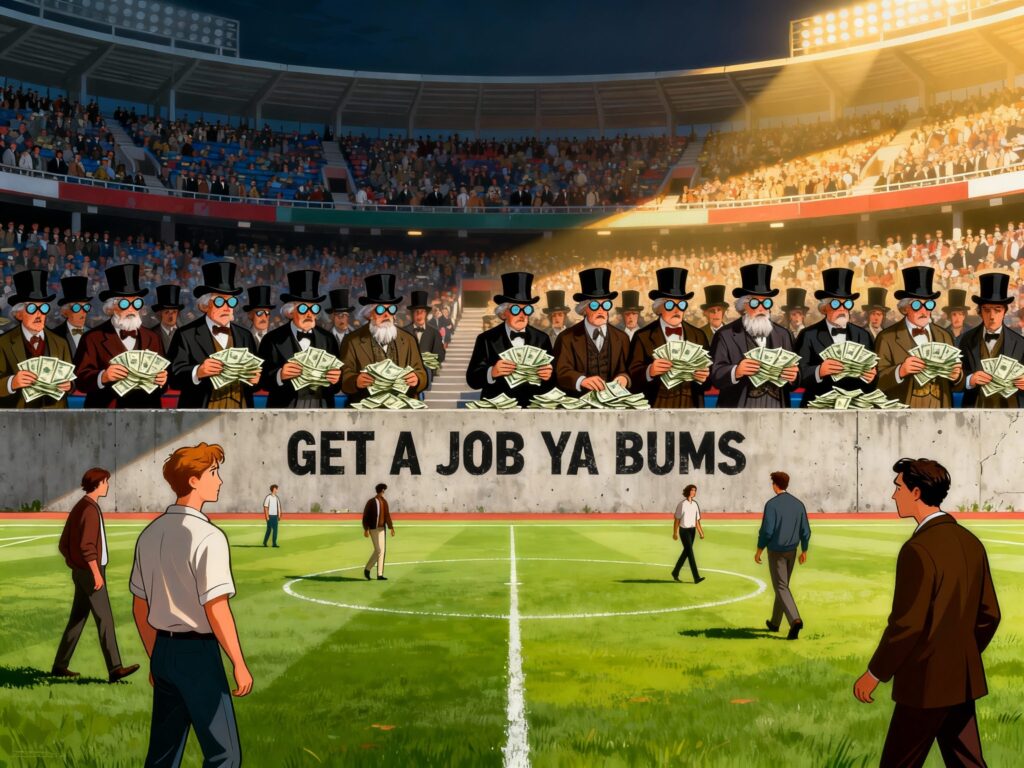
I was overjoyed this week by the news that former New Zealand Prime Minister Jim Bolger finally did something decent and died. Predictably, the hagiographies have already begun to flow, the most absurd of which claiming that he was a champion of the underdog. I want to state the viewpoint from the bottom of society.

I was nine years old in 1990, when Bolger came to power. I supported National in that election because their logo was blue, and blue was my favourite colour. Some of my family voted for him because the television told them to. We soon regretted it.

Because my family was working-class, we were impacted heavily by the reforms of the Fourth National Government. My father abandoned our family when I was two, and so my mother had to raise my brother and I on welfare. This wasn’t much. When Bolger and the Fourth National got in, they gave us Ruthanasia. This involved cutting welfare support, including the Family Support, which was the difference between our family making it and not making it. The stress of balancing the household budget drove my mother into a mental institution a few months after the cuts.

The stress of my mother being in a mental institution caused my own latent psychiatric problems to break out as insomnia. This was at age nine and my nervous system is yet to recover at age 44. There are thousands – perhaps tens of thousands – of us whose lives were destroyed in such ways by Bolger and his government of neglect.

Bolger personified everything evil about Anglos in general and New Zealand in particular: titanic greed mixed with indifference to human suffering. His Fourth National Government taught me that National voters and supporters get off on cruelty. Like a child pulling the wings off a fly, causing harm to the vulnerable makes them feel powerful, and that’s why they do it and will keep doing it.

I do not hate Bolger completely, however, because he taught me a lot of valuable lessons.

The most valuable lesson I learned was my value to New Zealand’s ruling class, which was nil. The Fourth National Government’s utter indifference to the poor, like we were an inconvenience the country would be better off without, is something I never forgot. Thus I have always done what I felt like in my life, with little consideration for wider society. This has not been criminal, but only because I did not want to be a criminal. Many other people I know from families that got Ruthanasiaed (including my own) became criminals. They, like me, reasoned that they don’t live in a society, just a big snake pit, so why not put their own needs above everyone else’s?

Schooling and media, together with government, create the impression that we’re all on one great team, and therefore sacrifices you make for the collective will be repaid by the collective. But in reality we’re cattle on one great tax farm. The system tolerates you as long as you’re paying in, but, when you need a payout, the system would rather you disappeared.

Many people read about events like World War One, and read about how working-class men were fed to enemy machine guns, and assume that things are different now and that no such thing could happen again. Thanks to Jim Bolger, I am aware that the contempt of the ruling class for the working classes is a permanent fixture of politics. The ruling class truly do hate the poor. They would feed us to machine guns tomorrow if they thought they would profit from it.

Thanks to these lessons, I have not been surprised by the actions of other National Party governments. I was not surprised when John Key slashed funding to mental health care, consigning hundreds of Kiwis to deaths by suicide and thousands of others to lives of despair. Neither was it any shock to me when Judith Collins forced the other National MPs to bloc vote against cannabis law reform at the referendum. I knew that the harm caused to medicinal cannabis users was a feature, not a flaw, of cannabis prohibition. And when Luxon got in and cut benefits under urgency, shovelling billions into the pockets of wealthy landlords, it was about what I expected.

Because of my opposition to mass Third World immigration, I am often pegged as right-wing. But, because of Jim Bolger, I have never voted for a right-wing party in my life, and I never will. I will never even vote for a centrist party that I suspect might support National (such as New Zealand First). I may or may not vote for the mainstream left either, but they aren’t automatically ruled out like National and co. are. The thought that my vote might help another Fourth National Government come to power evokes horror.

There is a wave of dark nihilism passing through New Zealand because of Jim Bolger. Many of the under-40s feel that society doesn’t exist, and that life is every man for himself. These people are essentially psychopathic in orientation, and the blame for this lies on Bolger and the harm he caused to this country. These youngsters have just internalised the selfishness of their elders.

*

For more of VJM’s ideas, see his work on other platforms!
For even more of VJM’s ideas, buy one of his books!

*

If you enjoyed reading this piece, buy a compilation of our best pieces from previous years!

Best VJMP Essays and Articles of 2023
Best VJMP Essays and Articles of 2022
Best VJMP Essays and Articles of 2021
Best VJMP Essays and Articles of 2020
Best VJMP Essays and Articles of 2019
Best VJMP Essays and Articles of 2018
Best VJMP Essays and Articles of 2017

*

If you would like to support our work in other ways, make a donation to our Paypal! Even better, buy any one of our books!
Thoughts On Suicide From Someone Who Hasn’t Done It Yet

I have endured a lot of suicidal ideation in my life. As I have written and spoken about at length previously, I have a traumatic stress disorder that has damaged my nervous system. This has led to constant hyperarousal of the hypothalamic-pituitary-adrenal axis, which is deeply unpleasant to experience. Symptoms of this include nausea, insomnia, anxiety and depression. This has involved a lot of vomiting, a lot of migraines, and a lot of deep breathing until the pain has passed. Although I strive always to say Yes to life, and although I have never made a suicide attempt, I am very tired and will be relieved when this life is over.

This essay has been inspired by the passing of Shane Christie, former Tasman Makos captain, who was well-known in Nelson. I now know a handful of people who have died by suicide, and many others who have made a genuine attempt to die. Many VJMP readers will know at least one suicide victim. The New Zealand nation suffers some 600 suicides every year. Despite our familiarity with the subject, it’s not well understood.

The first thing that people ought to know about suicide is that it’s done because people want the suffering to end.

I was about 13 the first time I felt true suicidal ideation. I had been having a bad time as a result of my mother getting institutionalised for an acute psychotic episode (again). This was the first time it occurred to me that death would solve my problems (I did not believe in reincarnation at this time). I was walking through town, and I realised that I could permanently liberate myself from physical suffering by throwing myself under a truck.

Since then, I have always suffered suicidal ideation to some degree or other, although much less in recent years. It was worst at particular times. 2003, when I realised the West was committing suicide; 2006, when my marriage fell apart; 2013/14, when my grandparents were dying. At these times, the thought of anything in the future evoked the deepest dread. The future itself seemed to be an infinitude of misery, inescapable, an ocean in which I had already drowned and sunk to the bottom. Often I would walk across a bridge and wonder if it could really be so painful to dive head-first onto the road below.

These are typical thoughts for a person tempted by suicide.

I have kept going for mostly two reasons – one, I received unconditional love from my grandparents, which created a large part of me, deep inside, that thought the world was maybe a sort of okay place, despite the bountiful misery elsewhere; two, I was lucky enough to be born really smart and I wanted to see where this could lead. It seemed like an egregious waste to throw that away. In recent years there has been a third reason: the Elementalist imperative to live in a manner that entertains the gods, which involves overcoming suicidal ideation.

People who have more-or-less decent lives usually don’t appreciate how unwelcoming life is for those at the bottom of society. If you were abused as a child, you learn that the world would be better off without your presence. If you were abandoned by one or both parents (and over 20% of New Zealand children grow up without a father in the home), you learn as a child that the world doesn’t want you. Add on top of this the confusion that comes from sexual abuse (this didn’t happen to me, but it happens to many), and it’s understandable why so many make the decision to exit.

I actually hope to die by suicide, which might sound strange. But this is only because I would like to go out on my own terms, mentally prepared. The way Hunter S Thompson did it – just as the decline into old age began – strikes me as ideal (this is still at least 25 years away). Dying in such a manner would not necessarily be a tragedy.

In my religion, Elementalism, there are tragic and understandable suicides. An understandable suicide is when there was, rationally considered, no quality of life remaining. A typical example is an elderly person with terminal cancer. Only sadists would demand that such a person carry on when they don’t want to.

A tragic suicide is when there was significant quality of life remaining. Many tragic suicides are when people surrendered to a bout of depression. These are cases when a person might have gone on to live a decent life, but succumbed in the moment to what should have been a temporary impulse. These cases are truly tragic because of all the lost opportunity they represent.

It’s important to me to reduce the amount of tragic suicides. I support this in my personal life by keeping a friendly ear open for depressed friends and family. I support this in my civic life by advocating for investment in mental health care, particularly for treating depression. Many people don’t realise that a large proportion of suicides are effectively depression deaths. It’s also not well known that depression is usually treatable to a major extent.

The biggest problem with depression is that, when you have it, you don’t think rationally. You become deluded. It’s entirely possible, when depressed, to think that everyone hates you and wants the worst for you. In reality, even if you have a lot of enemies, you don’t have that many. But when depressed, you can feel hate oozing out of every face you see. It’s easy to convince yourself that you’re not wanted on Earth.

Another big problem with depression is that if you ask your doctor about it they will throw you on antidepressants and tell you to get back to work. These antidepressants probably won’t be very effective and will probably come with awful side effects. The doctor won’t do the most helpful thing, which is explain to you what depression is and why you have it. So you will have to learn about it from somewhere else.

What I plan to do is to keep informing people about the reality of depression in particular and of mental illness in general. I feel like my own life has been saved thanks to being able to access useful and accurate information about the condition. I feel great joy at the thought I could save another life by popularising such information.

*

For more of VJM’s ideas, see his work on other platforms!
For even more of VJM’s ideas, buy one of his books!

*

If you enjoyed reading this piece, buy a compilation of our best pieces from previous years!

Best VJMP Essays and Articles of 2023
Best VJMP Essays and Articles of 2022
Best VJMP Essays and Articles of 2021
Best VJMP Essays and Articles of 2020
Best VJMP Essays and Articles of 2019
Best VJMP Essays and Articles of 2018
Best VJMP Essays and Articles of 2017

*

If you would like to support our work in other ways, make a donation to our Paypal! Even better, buy any one of our books!