
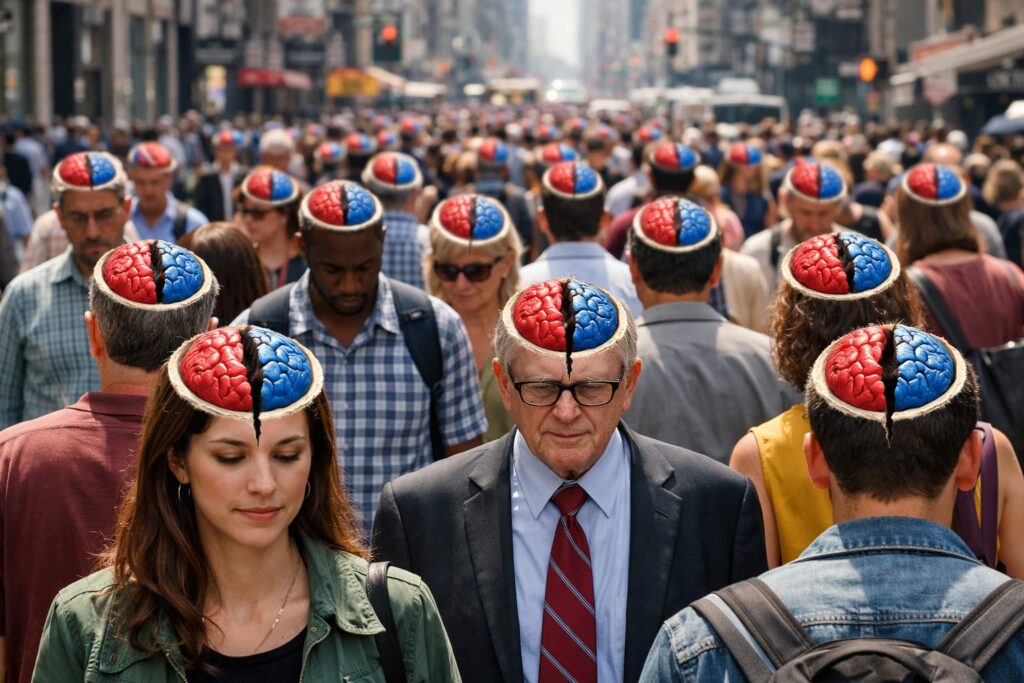
Schizophrenia is one of the most devastating mental conditions in existence. The term means “split mind” and refers to a condition in which the patient – or a large part of the patient – appears to be working against themselves. It’s a terrifying condition for both sufferers and their friends and family. This essay argues there’s a lot more of it in existence than most people realise.
In the same way that physical trauma from a knife or axe can cause a person’s body to split, psychological trauma from abuse or neglect can cause a person’s mind to split. The difference is that physical trauma is well understood, whereas psychological trauma is not.
For one thing, psychological trauma is often hidden. If a person cuts their arm open, it’s obvious to everyone that they’re injured. But if a person’s mind splits, they can often convincingly pretend to be well. Even so, the trauma exists, and if it is not treated it can manifest as all kinds of mental illness. Undiagnosed schizophrenia – schizophrenia that has not yet come to the attention of the mental health services – is one of the most common of these.
This condition is on the rise today because society is naturally traumatising. It’s naturally traumatising to work a full-time job for minimum wage, just to see most of it disappear in taxes and rents, or to live in a media environment where it’s not okay to be white, and, if you say that it is, you get a visit from the cops, or to live in a culture where spirituality is reduced to either worshipping an idol of a dead rabbi or nothing. Thus, there are a lot of people out there who are damaged.

Because society is so traumatising, and because there are so many damaged people in it, schizophrenia has come to appear more and more normal. In a vicious cycle, this leads to it getting diagnosed less. So there are a lot of people out there with split minds who are completely unaware that their minds are so split. Many of them have extremely difficult lives emotionally and socially, but are never able to figure out why.
These wretched masses are the undiagnosed schizophrenics.
The first sign of undiagnosed schizophrenia in another person is extreme moodiness. If a slight irritation causes so much rage that it feels like another personality has been brought out, chances are a split mind underlies them both. Schizophrenia and multiple personality disorder (dissociative identity disorder, or DID) are different conditions, and borderline personality disorder is different still, but they all overlap to some degree. If excessive moodiness is not part of DID or borderline personality disorder, it could be undiagnosed schizophrenia.
A deeply traumatised person will often react strongly to reminders of the trauma, even if those reminders are only subconsciously perceived. Thus, being asked to do something, even politely, can provoke a powerful anti-social reaction because it reminds the hearer of being ordered around by their parents. Such reactions are typical of undiagnosed schizophrenia.
Perhaps the most telling sign is self-contradiction. If a person claims to hold a certain moral value one moment and then deny it the next, something isn’t stitched together right in their mental fabric. This is also true if they say one thing and do another. This is especially true if a person doesn’t keep their promises, which often happens because they feel that one part of the mind made the promise and another part is being asked to keep it.
Another sign is substance abuse to deal with the suffering. As mentioned above, schizophrenia is a deeply unpleasant condition to live with. It’s common for people with the condition to use drugs in an effort to alter their emotions into something more tolerable. If someone’s natural state is so unpleasant that they need substances to cope, it’s very possible they’re an undiagnosed schizophrenia case.
The popular narrative is that people get “addicted” to drugs on account of that the drugs are inherently pleasurable. But this narrative misses the reality that some people are much more susceptible to habitual drug use, because their natural state is unhappiness. For the people who have schizophrenia, undiagnosed or otherwise, it costs enormous emotional and mental energy trying to figure out what’s going on. Without release in the form of substances, many of these people would crack.
Perhaps the most salient sign of undiagnosed schizophrenia is poor decision making. If a person consistently makes truly bad decisions, as if sabotaging themselves, there’s a very high chance they’re an undiagnosed schizophrenia case with one part of their mind working against the other. This goes double with the point above about substance abuse: if they keep sabotaging themselves with hard drugs, for no obvious reason, undiagnosed schizophrenia is very possible.
Taken together, these four signs often reveal an underlying pseudo-schizophrenic condition.
Undiagnosed schizophrenia is a vastly underestimated problem in our society. Only by taking trauma and mental health seriously can we hope to overcome it.
*
For more of VJM’s ideas, see his work on other platforms!
For even more of VJM’s ideas, buy one of his books!
*
If you enjoyed reading this piece, buy a compilation of our best pieces from previous years!
Best VJMP Essays and Articles of 2023
Best VJMP Essays and Articles of 2022
Best VJMP Essays and Articles of 2021
Best VJMP Essays and Articles of 2020
Best VJMP Essays and Articles of 2019
Best VJMP Essays and Articles of 2018
Best VJMP Essays and Articles of 2017
*
If you would like to support our work in other ways, make a donation to our Paypal! Even better, buy any one of our books!