
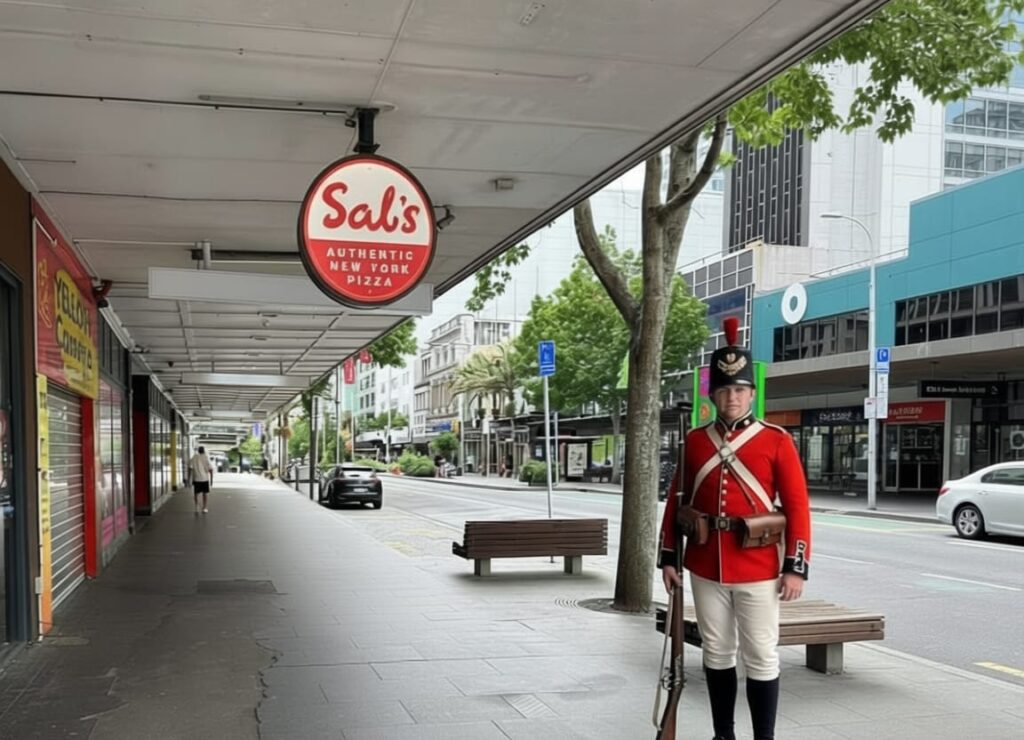
Living on the South Island, I am often frustrated by the North Island-centrism of our mainstream media. Thanks to some combination of arrogance and insularity, the New Zealand media acts as if New Zealand is just the North Island. This has led to it espousing a number of narratives that don’t reflect life for those of us in the South Island. This essay explains.
Perhaps the stupidest North Island narrative is that gangs and gang culture are inherently brown. People join gangs, this narrative has it, because of colonisation, which destroyed the natural social structure of Polynesian peoples.
Leaving aside that a lot of Tongans are in New Zealand gangs – and Tonga was never colonised – the vast majority of gang members on the South Island are white. So when the New Zealand media harps on about how gangs are a consequence of colonialism, those of us on the South Island are left shaking our heads. All the white guys in the Hells Angels are presumably perpetrators of colonisation, not victims of it. So how did they get to be gang members? This narrative makes no sense at all.
The North Island narrative that does the most damage is the stolen land one. Large swathes of the North Island were confiscated in relation to the Maori Land Wars, probably unfairly. Areas such as Wellington were probably swindled from Maori ownership; the acquisition of Port Nicholson was dodgy even by 19th Century standards. But this does not mean that the same guilt-dripping narratives apply to the South Island.
The New Zealand Settlements Act was never applied in the South Island, thus there were no confiscations. So the whole narrative around unjustly confiscated land is a North Island narrative. Those of us on the South Island are tired of hearing about it.
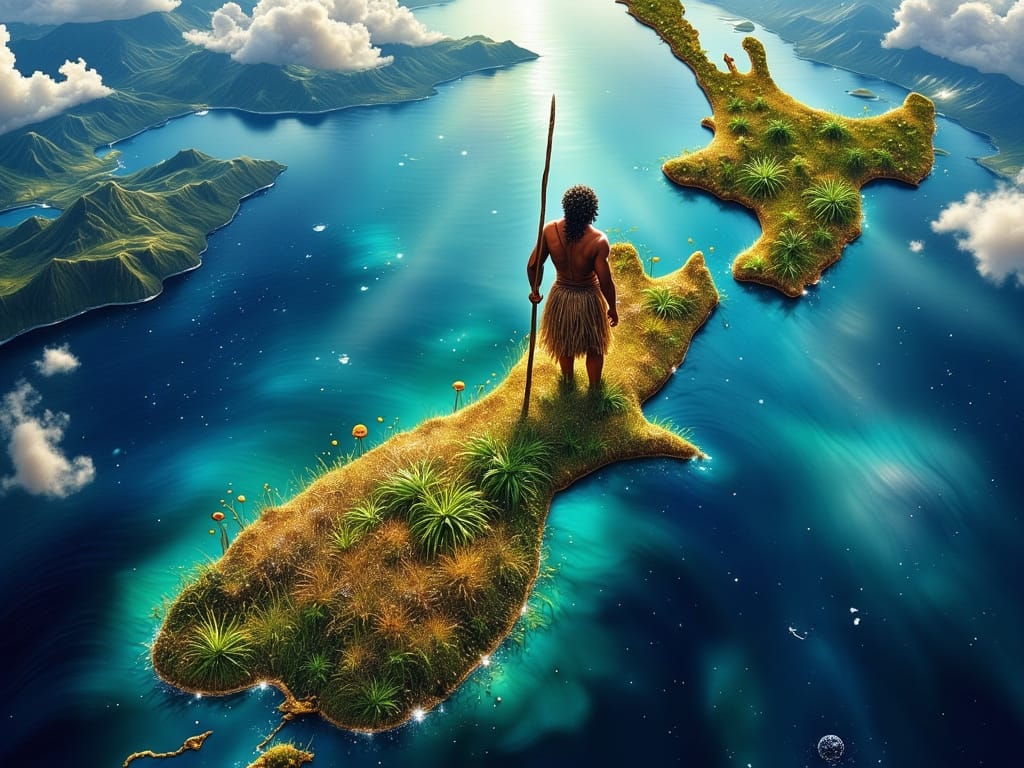
In fact, Treaty-based narratives in general are North Island narratives. The British declared sovereignty over the North Island on the basis of the Treaty of Waitangi, but they declared sovereignty over the South Island on the basis of discovery. This is an established historical fact.
Therefore, on the South Island there is no relevance to any of the narratives about how white Kiwis owe Maori Kiwis this and that because of Treaty breaches. The Treaty isn’t relevant here. The idea that the Treaty of Waitangi is the “foundational document” of New Zealand is pure North Island narrative. The people pushing it are either North Islanders or globalists.
Related to this is the idea that the Maori word for ‘New Zealand’ is ‘Aotearoa’. In fact, ‘Aotearoa’ was originally used to refer to the North Island only. The term for the North and South Islands together was ‘Aotearoa me Te Waipounamu’. ‘New Zealand’ is translated as ‘Nu Tireni’ in the Treaty of Waitangi, not ‘Aotearoa’.
In the North Island mind, the North Island is New Zealand. Therefore, whatever applies to the North Island (such as the name ‘Aotearoa’) also applies to New Zealand. This is naturally objectionable to those of us on the South Island. But, because the New Zealand media is North Island-based, our concerns get sidelined.
Related to these ideas is the idea that New Zealand is Polynesian. Perhaps the North Island qualifies by climate as part of Polynesia, but the South Island is simply too cold. Nothing like the Mount Cook National Park exists anywhere in Polynesia, and nor could it, given that the South Island is 3600km south of Samoa and 7100km south of the Big Island of Hawai’i.
In truth, the South Island should be considered a Subantarctic Island like the Auckland Islands.
Another common, but false, North Island narrative is that the song ‘Tutira Mai Nga Iwi‘ is a defacto national anthem on account of its supposed universality. Apparently everyone learns all the lyrics to this song at school. But I went to primary, intermediate and secondary school on the South Island, and I never heard this song once. This song is not the only element of North Island culture to be conflated for New Zealand culture, but is perhaps the most conspicuous.
The funniest North Island narrative is the idea that Auckland is a major world city. Aucklanders in particular have the delusion that Auckland is a second Sydney. In truth, Auckland is not even another Brisbane or Perth, but rather another Adelaide. Yeah, it’s bigger than Christchurch. But so what? We don’t pretend that Christchurch is anything other than perfectly moderate-sized.
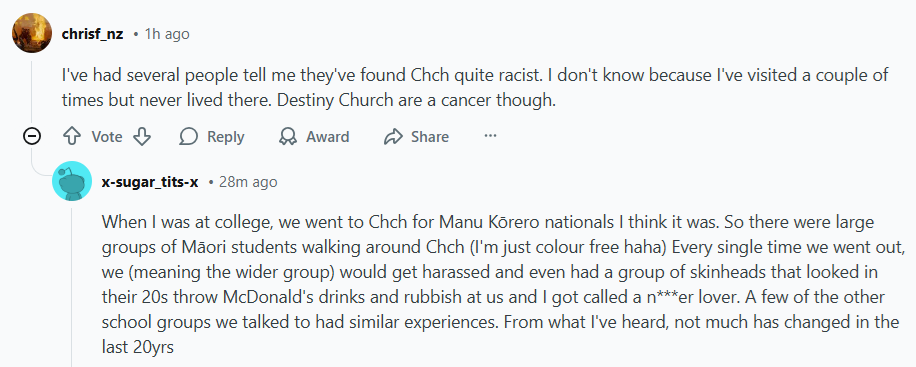
The most egregiously self-righteous and arrogant North Island narrative is the one that holds the South Island is racist. This is downstream from the presumption that whites are inherently racist: the South Island is much whiter than the North, therefore, the logic follows, it must be more racist.
There might be a minority of social outcasts in Christchurch who take out their frustrations on anyone unlucky enough to look like an outsider. But on a Saturday night when people have been drinking, I would rather walk through Cathedral Square as a brown person than Otahuhu as a white person.
These North Island narratives might not, by themselves, constitute enough disrespect that South Island independence becomes preferable. But they are at least a call for an independent South Island media that can promote South Island narratives.
*
For more of VJM’s ideas, see his work on other platforms!
For even more of VJM’s ideas, buy one of his books!
*
If you enjoyed reading this piece, buy a compilation of our best pieces from previous years!
Best VJMP Essays and Articles of 2023
Best VJMP Essays and Articles of 2022
Best VJMP Essays and Articles of 2021
Best VJMP Essays and Articles of 2020
Best VJMP Essays and Articles of 2019
Best VJMP Essays and Articles of 2018
Best VJMP Essays and Articles of 2017
*
If you would like to support our work in other ways, make a donation to our Paypal! Even better, buy any one of our books!