The Case For Cannabis: Quality Control

Libertarians like to complain about government regulation, claiming that it leads to stifled innovation and more expensive products. Although this is true of mature markets, regulation for emerging markets of any good or service usually keeps cowboys out of the industry. An argument for cannabis law reform is that it would maintain a certain level of quality within cannabis products.

The black market means a lot of things. It means shady characters, violence, turf wars, unbelievable amounts of bullshit and prison sentences. It also means a variable quality of product – and this has a number of adverse consequences for people’s health.

Black market alcohol still regularly kills people in places like Norway, where legal alcohol is extremely expensive, because it doesn’t have the same quality controls as the commercial product. As a result, the person making it often has little idea of how strong their product really is. Sometimes it’s as strong as absinthe.

Despite the fact that legal alcohol still kills a lot of people, most people can understand the quality control argument against alcohol prohibition. Although legal cannabis would be much less likely than alcohol to kill people, there is still a quality control argument to be made for cannabis law reform. If one approaches the subject of cannabis law reform from a harm reduction point of view, then legalisation makes a lot more sense than prohibition.

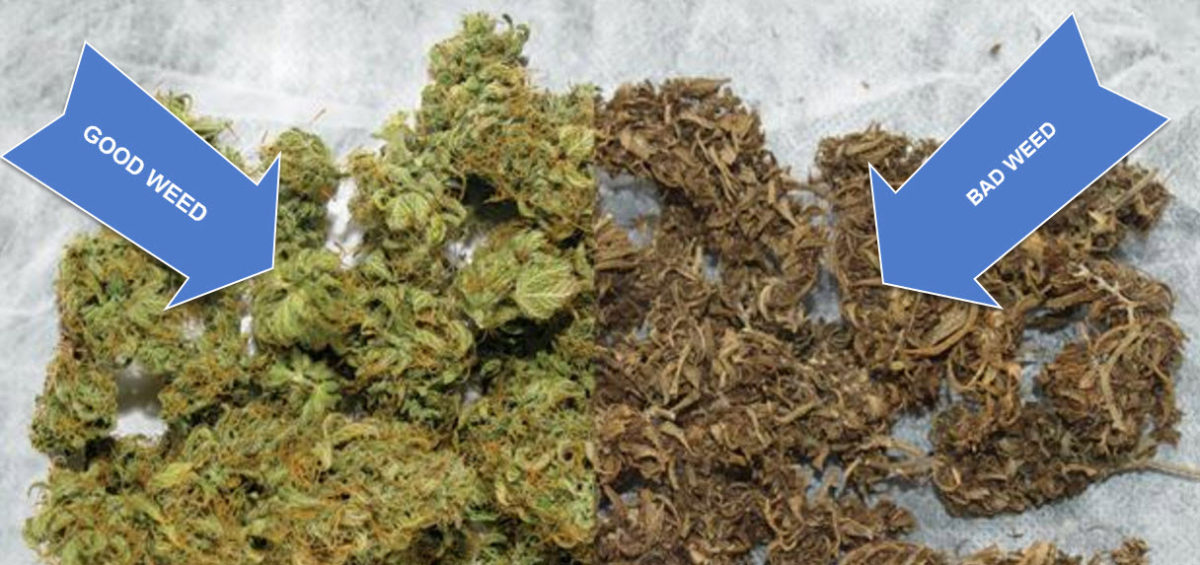
When growing cannabis, there’s not too much that can go wrong. It’s called weed for a reason. Nevertheless, it’s still possible to grow buds that have mold on them, especially because of the fact that they are often grown indoors in moist environments, or grown outdoors in places where the rainfall can’t be controlled. This mold can easily lead to lung conditions if the bud containing it is smoked.

Much worse is that sometimes black market cannabis is sprayed with various substances that make it appear more sticky or provide more of a “hit”. This can be anything from legal highs to fly spray. It might be hard for some people to believe that anyone selling cannabis could be so unscrupulous, but that’s what people are exposed to when cannabis is on the black market. It’s complete chaos.

None of these things would happen if cannabis was commercially grown, at least not any more often than you’d buy moldy bread from the supermarket. If it ever did happen, it would trigger a review of quality control procedures at the place of manufacture, and new procedures would be put in place to make sure it didn’t happen again.

Quality control is not simply a matter of physical safety. The more science advances, the more we are coming to appreciate how many active cannabinoids there are in the cannabis plant, and how different amounts of various ones can have entirely different effects to others.

We’re starting to learn that cannabinoids like delta-9 THC, while immensely enjoyable in the right context, are not necessarily helpful from a pain relief perspective. We’re also learning that cannabinoids like CBD have a wide range of medicinal uses, but that it’s difficult to gather useful scientific data about how to prescribe them, because it’s hard to get hold of accurately calculated doses.

A regulated cannabis industry would allow for manufacturers to create products that had precise and known amounts of each ingredient cannabinoid. This would make it possible for doctors to prescribe a regular supply of the right cannabinoid at the right dose. In this context, the right dose means a dose that is strong enough to achieve the desired therapeutic effects without being so strong that it causes other problems.

Neither is quality control simply a matter of health.

Perhaps the worst examples of a lack of quality control can be found in the various ripoffs that occur on the black market. There are many elderly people who are desperate to get hold of cannabis medicine for conditions that cause them to suffer, and for who legal medicines are unsuitable. These elderly patients are then forced into the black market, and often get tricked into giving money to someone who supplies a substandard product – or even no product at all.

That vulnerable people can get ripped off to the tune of thousands of dollars by clowns who don’t know how to manufacture quality cannabis products, or by criminals who are happy to supply rubbish that doesn’t work, is one of the cruelest outcomes of cannabis prohibition. Some of these people are trying to find solace to deal with the pain of the last days of their lives, and cannabis prohibition leaves them exposed to the most exploitative elements of the black market.

This has been a common occurrence on various FaceBook groups, where old people are given a small amount of CBD oil as a sample and then asked to pay thousands for a low-grade oil that confers no therapeutic advantage. Because cannabis is illegal, these old people have no chance of getting justice through Police action. Of course, the scammers are fully aware of this, because prohibition is a criminal’s best friend.

Cannabis should be made legal so as to make sure that the cannabis that people use, and which they are going to use regardless of the law, is of an adequate quality. This will not only avoid the occasional physical illness that comes from buying black market cannabis, but it will also decrease the suffering caused by criminal activity in the cannabis market.

*

This article is an excerpt from The Case For Cannabis Law Reform, compiled by Vince McLeod and due for release by VJM Publishing in the summer of 2018/19.
Is New Zealand Now A Tyranny?

In the Greco-Roman world, tyranny was defined as a form of government in which the rulers were unrestrained by laws. If the rulers are unrestrained by laws, then they are capable of inflicting any amount of cruelty upon the people, without there being any obvious way to stop them. This is widely agreed to be a terrible and evil form of government. This essay asks: is New Zealand now a tyranny?

One of the clearest examples of a tyranny is the presence of arbitrary and seemingly random punishments. New Zealand man Philip Arps is facing 14 years imprisonment for sharing a video of the Christchurch mosque shootings last month, on the grounds that the video was “objectionable content”. This is an incredible potential punishment if one consider the seven years imprisonment that Myron Robert Alf Felise got earlier this year for punching teenager Eli Holtz to death.

If New Zealand would bring in a 14-year maximum sentence for common assault or petty theft, it would be an obvious case of tyrannical overreach. So how can it be possible for them to introduce equally as severe a punishment for an action that did not harm anyone? It seems especially bizarre if one considers that New Zealanders are sharing and viewing videos of murderous terror attacks every day, but none of these are likewise criminalised.

A second example of tyrannical behaviour is the numerous laws and actions carried out by the New Zealand Government without the consent of the people, or even in cases when the people had explicitly withdrawn their consent. A current and ongoing example of these is the campaign of harassment currently being conducted by the New Zealand Police against anyone thought to be right-wing.

There are several anecdotal reports on social media about people having Police officers come to their house, often without warrants, in order to intimidate them and to gather intelligence (and one hilarious recording of such by New Zealand alt-media legend Vinny Eastwood). According to these reports, Police officers are demanding information about other right-wing people, and demanding to know if people are racists or if they supported Branton Tarrant.

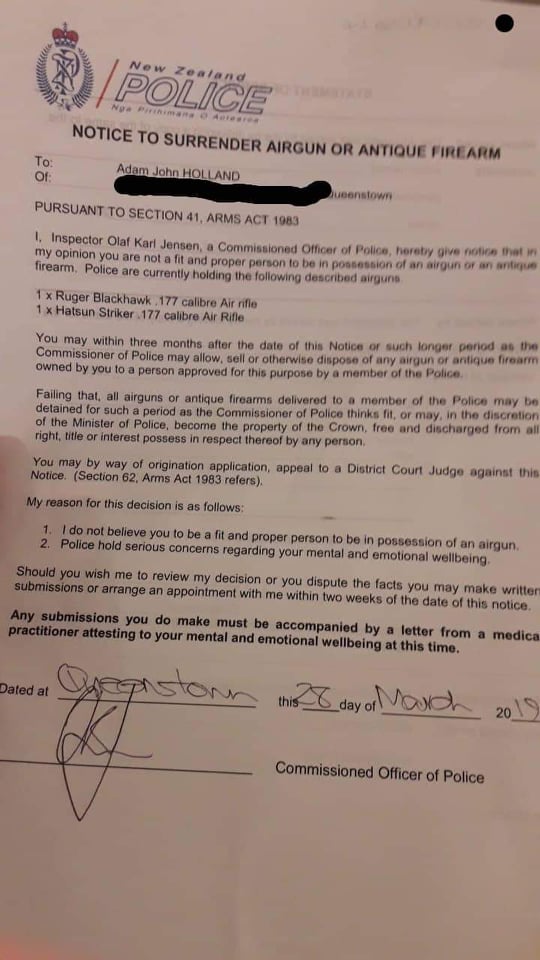
One of the worst examples was what happened to Adam Holland in Queenstown (see image at top of article). Holland had two airguns and a crossbow removed from his possession on the grounds that Inspector Olaf Jensen had personally decreed Holland was “not a fit and proper person to be in possession” of such, and that “Police hold serious concerns regarding [Holland’s] mental and emotional wellbeing”.

Police officers have zero psychological education to justify any serious concern about anyone else’s wellbeing, and their whimsy is nowhere near a sufficient basis to remove possessions from a private citizen who has not used them in commission of a crime. What sort of country strips citizens of possessions on the basis of one Police officer’s judgment? How long until they take machetes and kitchen knives away?

Holland’s experience is just a further example of a process that started before the Sixth Labour Government. The Fifth National Government was happy to sell national assets, despite a referendum that explicitly declared the public unwillingness to do so, and all recent Governments have refused to acknowledge the clear public desire for cannabis law reform.

If a clear and direct expression of the public does not constrain our rulers, then what does?

A third example is the ongoing free speech violations. Justice Minister Andrew Little currently has a giant warboner over the possibility of introducing so-called “hate speech” laws, in which criticism of certain power structures becomes a criminal offence. As has been seen in Austria, where a woman was given a criminal conviction for saying that Muhammad was a pedophile, hate speech laws soon lead to the criminalisation of dissent.

The Government hasn’t started stripping our rights to speak away quite yet, because they are currently in the process of sounding out how much they think they can get away with, but the process of using propaganda to soften public resistance to such tyrannical laws is in full swing. The mainstream media is busy acclimatising the public to no longer being allowed to speak freely.

The really frightening thing is that such laws directly violate Section 14 of the New Zealand Bill of Rights Act, which guarantee New Zealanders the right to impart opinions of any kind in any form. If the Government is not bound by the New Zealand Bill of Rights Act when taking our rights to speak away, what are they bound by? And if they are bound by nothing, as appears to be the case, then how are they any different to the literal definition of tyranny?

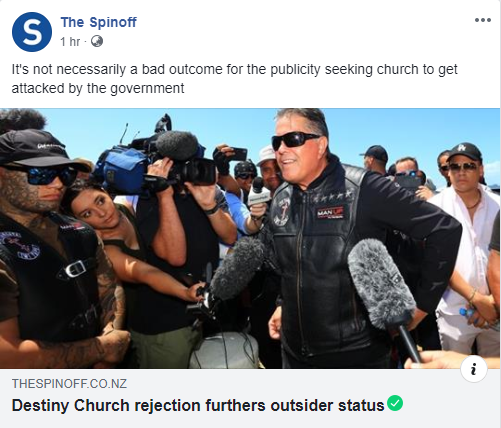
A fourth example is given in the image above. The Spinoff regularly runs articles attacking the enemies of the Government and making apologies for unpopular Government actions (although rarely are they so blatant as in the example above). The worrying thing is, as they admit on their company page, The Spinoff “works with NZ on Air and Creative New Zealand to fund our work” – in other words, they take Government cash to produce propaganda.

When the Government works hand-in-hand with the free press to create propaganda pieces, you don’t have a free press. In fact, the need for an authoritarian government to totally control the narrative was even mentioned by Josef Goebbels in his Principles of Propaganda. So the Government funding a media enterprise that pretends to be independent, but which in reality attacks enemies of the Government and propagandises for Government policies, is something fully in line with tyrannical Nazi principles.

The only way New Zealand can get out of this is to come together as individuals, ignoring the government, and to decide on a set of our rights that are inviolable and which must be respected by anyone who wishes to rule us. A starting point could be the essay published here expounding a seven-fold conception of inherent human rights. If all Kiwis agreed that every other Kiwi possessed such rights, we would be free of tyrannical measures.

If this doesn’t work then we’re left with anarcho-homicidalism.

*

If you enjoyed reading this essay, you can get a compilation of the Best VJMP Essays and Articles of 2018 from Amazon for Kindle or Amazon for CreateSpace (for international readers), or TradeMe (for Kiwis). A compilation of the Best VJMP Essays and Articles of 2017 is also available.

How FaceBook Censorship Radicalises Young Men Into Violence

My first ban from FaceBook was for writing the phrase “But Hitler didn’t do anything wrong”, which in context was obviously a joke response to a troll. It lasted 24 hours. I then got a three-day ban for quoting someone else who said the word “faggot” and then a 7-day ban for posting an image of an SS soldier with the caption “Begone Degenerate” in response to someone advocating pedophilia. During this 7-day ban I discovered a place called /pol/.

Having grown up in a generation where everyone called each other “faggot”, and where it was taken in good humour, getting banned from FaceBook for it generated some resentment. Although it was only a small amount, it emphasised the open welcome I got from /pol/. Whereas FaceBook made me feel like a morally defective subhuman that needed to go into a gulag, /pol/ made me feel normal and among friends.

The same sentiments that got me excommunicated from Mark Zuckerberg’s platform were expressed by many on /pol/. I naturally, therefore, decided that it was a great place full of honest, brave and intelligent people. Others will no doubt disagree – most will say that /pol/, like 4chan, is a cesspit. Anyone who does think this, however, might want to think about how FaceBook censorship drives people to places like it.

What happened to me is far from unique. Many people who like to discuss politics, but who got banned from FaceBook, came to feel the same way about /pol/ as I did. If free speech is censored on the grounds that certain political opinions make other people feel bad, this will lead inevitably to those banned people finding company in places where they feel welcome.

Let’s not forget that censorship isn’t just the banning of ideas. It’s also the banning of the people who express those ideas. Censorship doesn’t merely say that a particular idea is unwelcome; it also says that people who express those ideas are unwelcome. If you have those ideas, no logical argument is entered into. You are simply banned.

For paranoid individuals like an Anders Breivik or a Brenton Tarrant, it’s not easy to handle getting banned from FaceBook for making a joke, when openly genocidal comments go unpunished if made by the right people. This is precisely the kind of thing that convinces people that an overarching leftist conspiracy to destroy white people exists.

There appears to be a great and terrible delusion on the part of many leftists.

The delusion is that they are entrusted with some kind of teacher role and the rest of the world are moral reprobates in need of correction. They seem to imagine that getting banned from FaceBook for 30 days means you have to sit in the naughty corner and think about what you have done. In reality, it’s closer to getting kicked out of the classroom and smoking cigarettes with the truants behind the bike sheds.

Banning people from FaceBook has a similar effect to banning people from civil society and sending them to prison. In much the same way that prisons often serve as “universities of crime”, so can the darker regions of the Internet serve as centres of radicalisation. Censoring social media, far from inspiring people to investigate themselves for moral weaknesses, simply pushes them into the company of people who make no effort at all to hide their hatred.

The worst thing, however, isn’t that naughty people might be forced into the company of other naughty people and have their naughtiness normalised. It’s the resentment that such heavy-handed tactics create among those rejected. This resentment is truly dangerous.

There’s an African saying that has it “If a child is not embraced by the village, he will burn it down to feel its warmth.” For all the damage that might be done by exposing young shitposters to radical Nazis, it’s much worse for those young men to get jettisoned from the arena of public debate, because this makes them hateful.

In such an atmosphere, a person banned from FaceBook could come to see genuine Nazis as fellow victims. Worst of all, they might come to relate to the kind of resentment that inspired the Christchurch mosque shooting. If honest people get banned and end up on /pol/, and then end up shooting people, then maybe shooting people is the path that honest people get forced down?

FaceBook censorship plays a direct role in the radicalisation of young men like Tarrant and Poway Synagogue shooter John Earnest. This censorship plays a direct role in feeding the sentiments that make these young men feel that they have the whole world against them. The sense that free-thinking people are being persecuted by an inhumane and tyrannical neo-Communist shadow regime becomes entirely believable when FaceBook bans people for making slightly off-colour jokes.

The answer is not to ban places like /pol/. For one thing, that could never work in the age of VPNs and Tor browsers. The answer is to normalise the idea of free, intelligent and respectful political discussion in all places. This way, men like Tarrant, who have legitimate grievances and fears about the way his nation is going, can express those grievances instead of feeling forced to pick up a rifle.

If it’s possible to lay out the welcome mat to Islam, an ideology of hate that has killed hundreds of millions of people, then it must also be possible to allow discussion about controversial political topics such as ending Third World immigration. It must surely be possible to lay out the welcome mat to our own working class, and listen to their misgivings about the way the world is going. This would work much better than more bans.

*

If you enjoyed reading this essay, you can get a compilation of the Best VJMP Essays and Articles of 2018 from Amazon for Kindle or Amazon for CreateSpace (for international readers), or TradeMe (for Kiwis). A compilation of the Best VJMP Essays and Articles of 2017 is also available.

The Case For Cannabis: It’s Easier To Stop Using Cannabis If It’s Legal

Many people take an overly simplistic approach to cannabis law reform and assume that cannabis prohibition leads to less use and less desire to use. In truth, much like the fact that people don’t use more cannabis in places where it is legal, cannabis prohibition doesn’t even help addicts. As this article will show, it would be easier for people to stop using cannabis if it was legal.

The logic appears to be that making cannabis illegal will make people decide to stop using it. If it’s not possible to openly grow and sell cannabis, some people reason, then it won’t be as easy for a person to maintain a cannabis habit, and therefore people will be incentivised to quit.

Many people who support this theory seem to assume that cannabis users, many of who are using the substance for medicinal reasons, will just sit and mope for a while and then go and do something more productive. Not only does this ignore the obvious fact that it’s easy to get hold of cannabis pretty much anywhere in New Zealand, it also ignores human psychology.

The reality is, thanks to the wonders of something called variable interval reinforcement, prohibiting cannabis actually makes addicted cannabis users more addicted. Under prohibition, because a person can never be sure if they can maintain a supply, they come to cherish cannabis a lot more when they do get it. So when they do use it, the reinforcing effect is much more powerful.

There are two major reasons why legal cannabis would make it easier for those who are cannabis addicts to quit.

It might not be easy for the average educated, middle-class person to appreciate, but not everyone trusts their doctor or mental health worker. Just because the average Normie considers their doctor to be an intimate confidante doesn’t mean that the average cannabis user feels the same way.

Attitudes have changed sharply compared to some decades ago, but there’s still a lot of distrust on the part of many cannabis users towards health professionals. So if they are honestly advised to quit cannabis for good reasons, they are less likely to pay heed, because they can’t be sure if the advice is coming from a place of honesty or is a formality due to the law.

It’s not easy for a doctor to say that cannabis would be beneficial if it is not legal. For one thing, they don’t want to get a reputation for being the local cannabis doctor. For another thing, there are potential professional consequences. None of them want to explain to a professional board why they recommended an illegal drug to a patient.

If cannabis were legal, it would be possible to trust your doctor if they would say that you wouldn’t benefit from using medicinal cannabis. As it is, if your doctor does not recommend medicinal cannabis, it’s impossible to know if they say this because they believe cannabis would be harmful, or if they believe cannabis would be beneficial but are afraid of potential professional or legal consequences for saying so.

The second major reason is that legal cannabis would make it easier for a user, who accepted that they were addicted, to taper down their use with the intent of stopping.

This relates to the reinforcement schedules referenced above. In the same way that it’s better to use variable interval reinforcement to strengthen a response, it’s better to use fixed interval reinforcement to weaken one. This is because it leads to a gradual weakening of the craving, rather than taking it full force and risking a relapse.

Anyone who has tried to suddenly stop using tobacco or alcohol knows how difficult it is to just make a clean break with it. In most cases, if there is not an immediate threat of death, a person will be advised by their doctor not to quit cold turkey but rather to taper down over a few weeks or a month. As mentioned above, this is partly to avoid relapse, but it’s partly because this is less painful.

People who were interested in stopping their cannabis use could, if we had a sane system, get a prescription for a fixed amount of cannabis with a view to tapering off. They could be given a number of joints and told to smoke x for the first week, x-1 for the second week, x-2 for the third week – or whatever worked.

This would prevent the disaster scenario familiar to people who have tried to stop smoking tobacco or drinking alcohol, in which one sits there while the craving for the drug rises and rises, until one finally caves, at which point using it feels like a divine gift. As mentioned above, this variable interval reinforcement only makes it much harder to quit.

Legal cannabis would be much better for those addicted than prohibition is. It would encourage addicts to trust their doctors when they suggested that cannabis had no medicinal value for them, and it would enable those doctors (or psychologists) to provide a schedule of decreasing fixed reinforcement that would allow for a relatively painless transition to sobriety.

*

This article is an excerpt from The Case For Cannabis Law Reform, compiled by Vince McLeod and due for release by VJM Publishing in the summer of 2018/19.