

How Absolutely Fucked Young Kiwis Are

Everyone knows that the housing situation is bad, but few realise exactly how bad it is. Politicians only propose tinkering around the edges; no-one is willing to propose fundamental change. However, as this article will show, the situation is bad enough that only fundamental change can fix it.

Statistics nerds were overjoyed by the release of the updated Parliamentary profiles last month. These profiles contained information from the 2018 Census, allowing us to update our knowledge of each electorate.

One important thing the Parliamentary profiles tell us is how wealthy each electorate is. We know that 648,537 people out of 3,776,355 aged over 15 in the General Electorates and 66,126 people out of 597,498 aged over 15 in the Maori Electorates make over $70,000 a year. This equals 714,663 people out of 4,373,853, or slightly more than 16%.

Being in the top 16% means that anyone making $70,000 a year is creaming it in comparison to the average Kiwi worker. They’re getting paid much better, and will likely have a commensurately harder job. Either they’re working much longer hours than average, or they have a job with a greater than average level of responsibility, or they are applying much greater than average human or industrial levels of capital.

However, even on this top 16% income, it’s all but impossible to own a house.

If you earn $70,000 a year in New Zealand, you will pay about $15,000 in taxes. That will leave you with $55,000 a year – assuming you opt out of KiwiSaver, otherwise you’d be down to $52,000 a year. That isn’t a lot of money once the high cost of living is factored in.

The cost of living in New Zealand can be estimated by the New Zealand Government’s own cost of living calculator. New Zealand isn’t a cheap country to live in. It can be seen from using the calculator that the average Auckland family of two adults and two dependent children has living expenses of around $2,000 a week.

This means that one working adult in the top 16% of Kiwi wage-earners only makes half of what they need to keep the average family running. If that sounds paradoxical, that’s an indicator of how fucked young people in New Zealand are now.

If we change the calculations to two working adults, each earning a wage in the top 16%, things become a bit easier. But even with two working adults both earning such a wage, it’s extremely difficult for a family with two children to save any money. According to the cost of living calculator, a family of two parents and two children can expect that their living expenses will be in the neighbourhood of $2,000 a week.

This means that a family with two parents and two children, where both parents are in the top 16% of wage-earners, saves no money on a weekly basis. All that work is just to stand still. The family will never own its own home, not even with two adults working and only two children. And that is even if both adults are earning in the top 16% of wages.

Now let’s consider a family with a special talent for living frugally. Let’s say both adults have unusually high levels of determination, willpower and resourcefulness, and they are capable of making do with considerably less than the average family of two children.

In this case, we can take the cost of living calculator and reduce the expenses to the lowest 25% or so of all families of four. This involves taking the sliders and setting them halfway between the average expenditure and the absolute minimum required to survive.

This gives us expenses of $200 per week for food and alcohol, $30 for clothing and footwear, $360 for housing and household utilities, $38 for household contents and services, $13 for health, $121 on transport, $22 on communication, $62 for recreation and culture, $25 for education, $81 for miscellaneous spending and $124 for other expenditure.

This gives us a total of $1,080 per week in expenses for a family of four. So our husband and wife duo of professional workers, both in the top 16% of Kiwi wage earners, if they cut their family expenses down to the bottom 25%, can expect to save around $950 a week, or close to $50,000 a year.

The average house price in New Zealand as of July this year was $739,000. So if a family can manage to have two breadwinners both earning in the top 16% of all wages, and if they can manage to cut their expenses down to the lowest 25% of all families of four, they can expect to own the average house after 14.8 years.

Let’s say, more realistically, that the partner of the main breadwinner works part-time in order to look after the two children, and so makes $30,000 a year. This would leave them $400 a week after expenses, or around $20,000 a year. At such a rate of saving they could expect to own their own home after 37 years.

Let’s say, even more realistically, that their expenses are at the average level for a family of four in Auckland. In such an instance, they will be unable to save money even if both parents are working and earning in the top 16% of wage earners. According to the cost of living calculator, a family of four in such circumstances will have to borrow $50 a week to be able to live. Saving will be impossible.

And that’s for people in the top 16% of earners.

Even if a person and their partner are in the top 16% of earners, they will have to cut their expenses down to less than average merely to save any money at all. They will have to cut those expenses to far less than average to save enough to own a home. Anyone earning less than this, or anyone whose expenses are higher than this, will never own a home, not even if they worked to age 100.

Simply put, you have to earn far, far more than average if you want to own your own home in New Zealand. The dream of home ownership is now only a reality for a fraction of the population. The rest of us are effectively serfs, doomed to labour our whole lives without ever owning land.

To compare this with how the previous generations had it, in 1992 the average New Zealand house price was $105,000. Also in 1992, the average wage was $15. So in 1992, the average house could be purchased for the equivalent of 7,000 hours of labour. Today, with an average house price of $739,000 and an average wage of $34, buying the average house requires the equivalent of over 21,000 hours of labour.

There simply aren’t enough years in one lifetime for the average Kiwi to save enough money to own their own house. Either you inherit, or, failing that, become a professional worker with an income of $150,000+ per year.

Another way of looking at it is that if house prices had only increased in proportion to the increase in the average wage between 1992 and 2020, i.e. 2.25 times instead of 7 times, the average house price today would be around $236,000.

The grim reality is that we are some two-thirds poorer than our parents were. This conclusion is inescapable unless one denies the maths.

In summary, the Millennials and the younger generations have been effectively enslaved by the Boomer generation. The Boomers own everything, and they pay such pitiful wages that we have no chance of bettering our positions. Only two outcomes can give the young of New Zealand basic dignity: wait 30 years for the Boomers to die, or revolution.

*

If you enjoyed reading this essay, you can get a compilation of the Best VJMP Essays and Articles of 2019 from Amazon for Kindle or Amazon for CreateSpace (for international readers), or TradeMe (for Kiwis). A compilation of the Best VJMP Essays and Articles of 2018 and the Best VJMP Essays and Articles of 2017 are also available.

*

If you would like to support our work in other ways, please consider subscribing to our SubscribeStar fund. Even better, buy any one of our books!
Will The ACT Party Eventually Replace National?

The New Zealand National Party has been a monolith on the New Zealand political scene ever since 1936, when it was formed to safeguard the privilege of ownership and to keep wages low. Its enduring and dominating presence is taken for granted by most, but not in this article.

In Sweden, the neo-Nazi Sweden Democrats have gone halfway to replacing the original right-wing party, the Moderates. Opinion polls since the last general election have mostly put the Sweden Democrats ahead. In several polls, the Sweden Democrats even scored higher than the Social Democrats, Sweden’s de facto ruling party.

In the Netherlands, a similar far-right-wing populist party, the Forum for Democracy, came from nowhere in 2017 to become the most popular party a year ago. They have since fallen back to around 10% support, but continue to pose a threat to the mainstream parties.

In Germany, a similar thing has happened, but on the opposite wing. There, the Green Party has grown to a higher level of support than the social democratic SPD, who have ruled Germany for 36 of the 75 years since World War II ended. The Greens are now the most popular party on the German left.

The reason why new parties in Europe are replacing the old ones is because the old ones have let themselves get horrendously out of touch with the peoples they claim to be representing. Young people on both the left and the right are deeply dissatisfied with their rulers. Immigration is one of the major causes of this dissatisfaction.

The social democrats in Sweden and Germany both played instrumental roles in opening the borders of those countries to mass Muslim and African immigration, a move that has had severe and lasting consequences for the young people already there. Given the enormous number of sex and violence crimes that followed, many of the most affected young people have started to look for electoral alternatives.

New Zealanders, whose experiences with immigrants have generally been much more positive than European people’s experiences with immigrants, don’t really care about mass immigration. But there are other ways in which the New Zealand ruling class have neglected the will of their people.

As generations shift, moral values shift with them. Old prejudices fall by the wayside; new prejudices arise. The National Party moved with the times when it came to hating Asians and homosexuals, but they clung to their hate for cannabis users. This is a function of both the large number of Christians within the National Party fold and the intensity of the anti-cannabis brainwashing that Boomers endured in school.

This small-mindedness is motivated primarily by cruelty, and National don’t pretend otherwise. It appeals perfectly to the grossly narcissistic and sadistic sentiments of the average Boomer. But, at the same time, it revolts the younger generations who don’t share the viciousness of the Boomers. This has created a demand for a right-wing alternative.

The ACT Party has a different approach to issues like drug law reform. They do not overtly appeal to malice like the National Party does. David Seymour’s policy book, Own Your Future, is generally positive towards cannabis law reform, if cautious. This approach is much more in line with the values of younger generations.

ACT already appeal to the younger generations more than National do. This was shown by Dan McGlashan in Understanding New Zealand. In this book, McGlashan found significant positive correlations between being in younger age brackets and voting for the ACT Party, as well as significant negative ones between being in those age brackets and voting National.

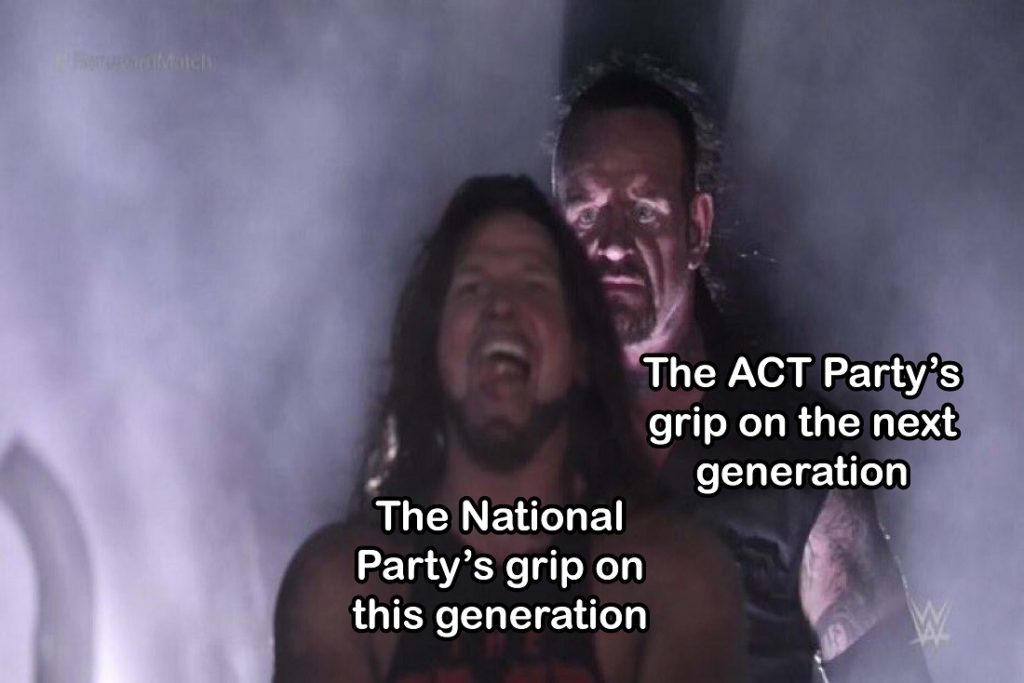
The right wing is split, between the older voters who prefer National and the younger ones who prefer ACT. The problem for National is that their voters are dying off, and the young ones aren’t necessarily switching to them from the ACT Party.

As time moves on, and as cannabis inevitably becomes legal and as people inevitably come to realise that the War on Cannabis was a complete waste of human life, voters will remember that National moved to perpetuate the suffering of the New Zealand people, and that ACT moved to end it. This will lead them to see National as the party of bad decisions, and ACT as the party of good decisions.

This has already started to happen to some extent. ACT have increased to 6% in recent polling, while National is scoring around 27%. This contrasts sharply with the 0.5% and 44.4% that ACT and National respectively scored in the 2017 General Election. ACT have gone up some 5.5% since then, while National have gone down some 17.4%.

There are many reasons for the change in fortunes, but one of the major ones is National’s refusal to accept the argument for cannabis law reform. This column has gone as far as to argue that National cannot win while it’s their policy to oppose reform. Stubborn support for cannabis prohibition appalls a large proportion of young people, and they see a clearly less appalling alternative in the ACT Party.

As time goes on, many of the young people who got in the habit of voting for ACT instead of National because of the cannabis referendum will continue to do so. This will lead to ACT taking an ever larger share of the right-wing vote. If the examples of Europe are anything to go by, it’s possible that this might continue until the ACT Party grows to replace National as the default leaders of the right wing.

*

If you enjoyed reading this essay, you can get a compilation of the Best VJMP Essays and Articles of 2019 from Amazon for Kindle or Amazon for CreateSpace (for international readers), or TradeMe (for Kiwis). A compilation of the Best VJMP Essays and Articles of 2018 and the Best VJMP Essays and Articles of 2017 are also available.

*

If you would like to support our work in other ways, please consider subscribing to our SubscribeStar fund. Even better, buy any one of our books!
The Bread And Circuses Are Winding Up

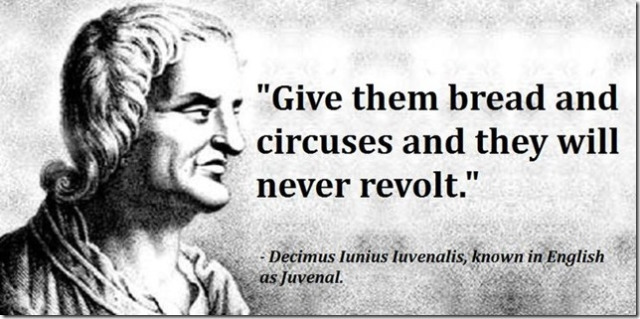
Panem et circenses is an ancient Roman phrase, attributed to the poet Juvenal, that means “bread and circuses.” The idea is that a degenerate society, once it has abandoned all higher values, has nothing left but bread and circuses. Take that away, and the society will fall apart. Our bread and circuses are in the process of being taken away.

The Roman Empire discovered that paying for public circuses was a great way of preventing civil unrest. If the people had an upcoming gladiatorial games to look forward to, they were much more likely to be content. When they didn’t have anything to look forward to, they tended to entertain thoughts of rebellion.

Eventually, the Romans found themselves unable to pay for more games, and that was the tipping point. The cessation of the circuses meant that the citizens got their entertainment from wrecking society instead, and that was the end of the Roman Empire.

The Western World appears to be going through a similar process.

Professional sports have replaced the circuses in the West, and most professional sports leagues have been severely impacted by the coronavirus pandemic. The English Premier League season lost three months, the Major League Baseball season lost 100 games, and Dr. Anthony Fauci, member of the White House’s coronavirus task force, predicted that running the NFL later this year would be impossible.

In New Zealand, there hasn’t been a single All Blacks match so far in 2020, and it looks like there won’t be. There hasn’t been a Black Caps match since March, and there is no news of upcoming fixtures (although a tour to Bangladesh has supposedly been planned).

Even worse, the increasing politicisation of professional sport has seen many turn their televisions off. NBA viewership is down some 20% compared to this time last year. Although the linked article suggests injuries to star players may be the cause of the decline, the truth is that many viewers are sick of having political issues shoved in their faces.

People watch sport to be entertained. They don’t care about the political opinions of professional sportsmen, any more than they care to watch Donald Trump play basketball. They know the sportsmen are not educated intellectuals who study history and human nature. As such, their political opinions don’t need to be taken seriously.

Compounding the problem are blatant double standards when it comes to the political issues being pushed.

In an NBA match earlier this month, Los Angeles Clippers player Montrezl Harrell called Dallas Mavericks player Luka Doncic a “bitch ass white boy“. Although a white player calling a black player a “bitch ass black boy” would be a worldwide scandal, it appears that Harrell is going to avoid sanction entirely.

There might be an inherent demand for entertainment once a person’s basic survival needs are met, but it’s hard to be a white person and keep watching a sports league when you know that league explicitly endorses anti-white racial abuse. It’s a direct humiliation, and many sports fans have found themselves switching off instead.

As in ancient Rome, the lack of easily-available entertainment has led to people seeking it elsewhere, in more destructive ways. There is a direct link between the winding up of the American circuses and the widespread civil unrest there. Instead of finding entertainment in sport, people are finding it in other people getting shot and beaten to death.

More worryingly, the bread is also winding up.

When Juvenal spoke of “bread” he was referring to the grain dole, another Roman invention for defraying rebellious sentiments. Because of the psychological effect of starvation, hungry populations soon become violent. The Roman masses were pacified with free grain, then free bread, wine and pork.

When this food dole wound up, people started going hungry, and this led to even more trouble than the boredom. A bored person can get entertained quickly by setting something on fire; a hungry person won’t be satisfied until they kill someone. For the Roman ruling classes, to not dole out bread meant the collapse of their society.

The West doesn’t have a grain dole, but we do have a system of social welfare which has much the same effect. It’s also being scaled back.

In America, negotiations for a second stimulus check are in doubt, because Republicans and Democrats cannot agree on terms. The first stimulus check was granted because the coronavirus pandemic had destroyed many American jobs, but those jobs are yet to return, and therefore the economic stress has not gone away.

In New Zealand, the COVID-19 Resurgence Wage Subsidy – designed to have a similar effect to the American stimulus checks – is expiring later this week. The likely outcome is a high volume of job losses. Already the New Zealand economy has been hit hard by the near-total annihilation of our international tourism sector; further major job losses would cause widespread despair.

It’s possible that Donald Trump and Jacinda Ardern will extend welfare benefits, at least for now. But the largesse cannot be continued indefinitely. The New Zealand national debt was $US 59.6 billion in March this year, but has already blown out to $US 81.1 billion by September. They can’t keep borrowing money to keep the party going forever.

When these special coronavirus payments are stopped, the inevitable result will be an increase in the number of people taking to the streets in protest. Given how ugly sentiments already are, with multiple protesters having been shot dead in America over the past week, a wider collapse of order is a very realistic prospect.

In summary, society is held together by bread and circuses, and both of those are winding up thanks to the coronavirus pandemic. This phenomenon is occurring across the Western World, which suggests that we’re all in for some difficult times over the next 12 months or so.

*

If you enjoyed reading this essay, you can get a compilation of the Best VJMP Essays and Articles of 2019 from Amazon for Kindle or Amazon for CreateSpace (for international readers), or TradeMe (for Kiwis). A compilation of the Best VJMP Essays and Articles of 2018 and the Best VJMP Essays and Articles of 2017 are also available.

*

If you would like to support our work in other ways, please consider subscribing to our SubscribeStar fund. Even better, buy any one of our books!

Billy Te Kahika And The Donald Trump Effect

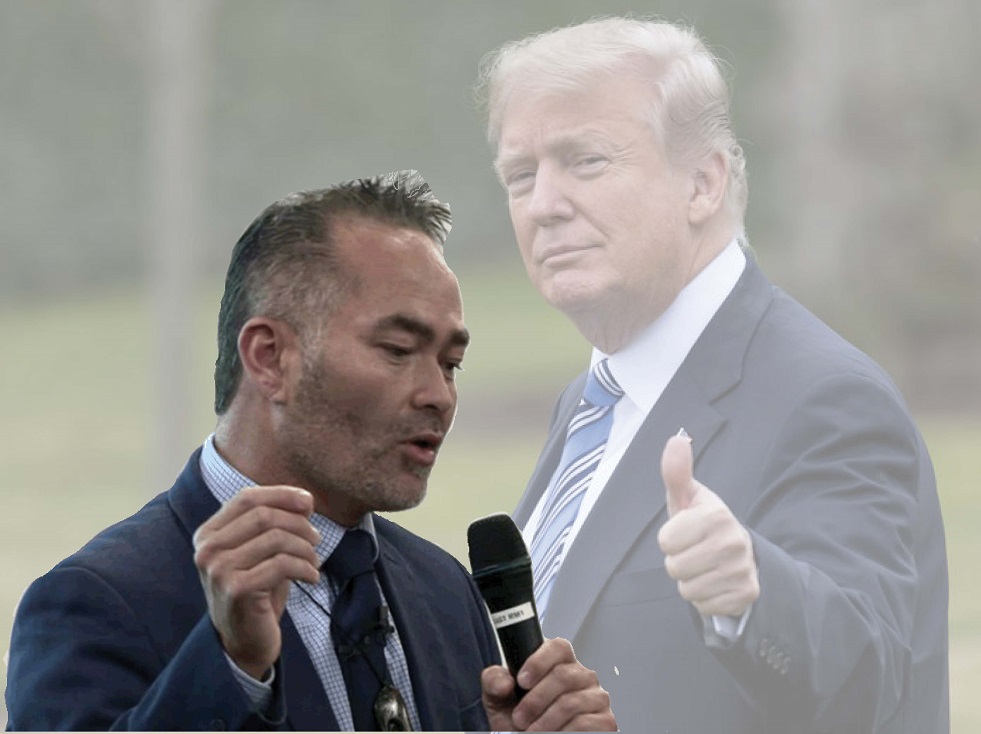
The rise of Billy Te Kahika continues to confound many. An article in E-tangata magazine described it as “The rise of Maori MAGA“. As this article will examine, what Te Kahika is trying to achieve with the New Zealand Public Party is not original. He is walking a similar path to that taken by American President Donald Trump.

The parallels between Te Kahika and Trump are many. The most obvious parallel is that both are despised by the mainstream media.

The mainstream media savaged Trump from the beginning. From the moment Trump won the Republican nomination they ripped into him, declaring him a menace to human civilisation. The major news shows became the Two Minutes’ Hate from 1984, only directed at Trump instead of Emmanuel Goldstein.

The reason for this mainstream media hate was that, being a nationalist, Trump was a genuine outsider. All nationalists are outsiders in today’s system, because today’s system represents the complete victory of globalist interests. Globalist narratives, especially around foreign investment, trade and mass immigration, are now standard.

In New Zealand, the mainstream media has turned its guns on Te Kahika. The New Zealand Herald wrote a hitpiece smearing him as a conspiracy theorist, The Spinoff wrote a hitpiece smearing him as a conspiracy theorist and Stuff called this “the conspiracists’ election“. Chris Trotter’s column for The Daily Blog this week howled for the Government to keep an eye on the maverick Maori.

Astute observers will have noted that Billy Te Kahika is hated by the same people who hate Donald Trump.

Vinny Eastwood is entirely correct when he says that the New Zealand mainstream media is owned by international banking and financial interests. These interests own almost every media outlet, apart from the independents like The Vinny Eastwood Show and VJM Publishing (who are, predictably, written off as “conspiracy theorists” by the mainstream).

Ownership of the mainstream media by international banking and financial interests is why those media are always pushing globalist narratives. The reason why they keep pushing mass immigration and refugee resettlement is because banking and finance interests profit from increased housing demand. The reason why they excoriate nationalists and freethinkers is because they threaten this extremely profitable arrangement.

Like Trump, Billy Te Kahika speaks honestly about how the mainstream media lies, and how it works with the Government to manipulate public opinion. Like Trump, the mainstream media treats the nationalist Te Kahika as a direct enemy. The international banking and financial interests hate nationalists above all.

All this explains why Te Kahika has so much support among Maoris. The E-tangata article linked at the top of this page, in its hysteria about white supremacists, neglects to mention the powerful nationalist sentiments held by Maori people. It is these sentiments that make people fall in behind Te Kahika.

Despite the relentless and enduring attempt made by mainstream political and media interests to divide the New Zealand people into a Maori part and a white part always at each other’s throats, the vast majority of Maoris have rejected separatist narratives. They think primarily in terms of roots. This means that they feel strong bonds of solidarity with white people who also have deep roots in New Zealand.

Dan McGlashan proved in Understanding New Zealand that Maoris are strong supporters of the nationalist New Zealand First party, more so than the supposed “old white racist” demographic (who tends to vote National). This, more than any other factor, explains why a nationalist like Te Kahika has so much support among Maoris.

At this point it could be countered that Te Kahika is a long way from winning, so it doesn’t matter anyway. His best result in any preferred Prime Minister poll so far was 1%, and even then he rounded up. But Trump was himself once a rank outsider.

Before he won the Republican nomination, Trump was priced at $100 to win the Presidential election on BetFair. To say he was an outsider is an understatement. He was an outsider among outsiders, perhaps even a joke candidate. But what he said resonated.

The public felt that Trump was brave enough to speak truths that had been kept from them by the corrupt political and media establishments. Although Trump was sometimes wrong – as when he accused Barack Obama of being born in Kenya – he was right enough of the time for people to see him as an alternative to the Establishment. In a time when the Establishment is hated, that was enough.

Every intelligent person knows that the political and media establishments lie all the time. The lies they told to justify the War on Drugs are exemplary. The lies they told to justify the Iraq War are obscene. The lies they continue to tell, in order to prop up a financial system that sees so many young people without hope of owning a home and raising a family, are murderous.

These lies are effective when the entire apparatus of propaganda is under globalist control. The problem today is that people like Trump and Te Kahika can use social media to evade that control. Josef Goebbels’s second principle of propaganda states that “Propaganda must be planned and executed by only one authority”. Te Kahika’s livestreams, like Trump’s tweets, get around all the gatekeepers.

When a people deprived of truth finally gets to hear some, the effect is like rainfall on a parched landscape. It makes the entire world come to life. This is the main reason why Te Kahika has got so much traction: he offers truth to those who have been deprived of it by the mainstream media. Te Kahika could go as far as Trump did: all the way to the highest position in the land.

The real Trump Effect was that the mainstream media’s hatred for Trump increased his support. Because the mainstream media are a collection of the most wretched, most shameless liars to ever exist, it stands to reason that if they tell you someone is bad, that person is probably good. As the mainstream media now turns itself to destroying Te Kahika, they might find that they propel him to victory instead.

*

If you enjoyed reading this essay, you can get a compilation of the Best VJMP Essays and Articles of 2019 from Amazon for Kindle or Amazon for CreateSpace (for international readers), or TradeMe (for Kiwis). A compilation of the Best VJMP Essays and Articles of 2018 and the Best VJMP Essays and Articles of 2017 are also available.

*

If you would like to support our work in other ways, please consider subscribing to our SubscribeStar fund. Even better, buy any one of our books!