
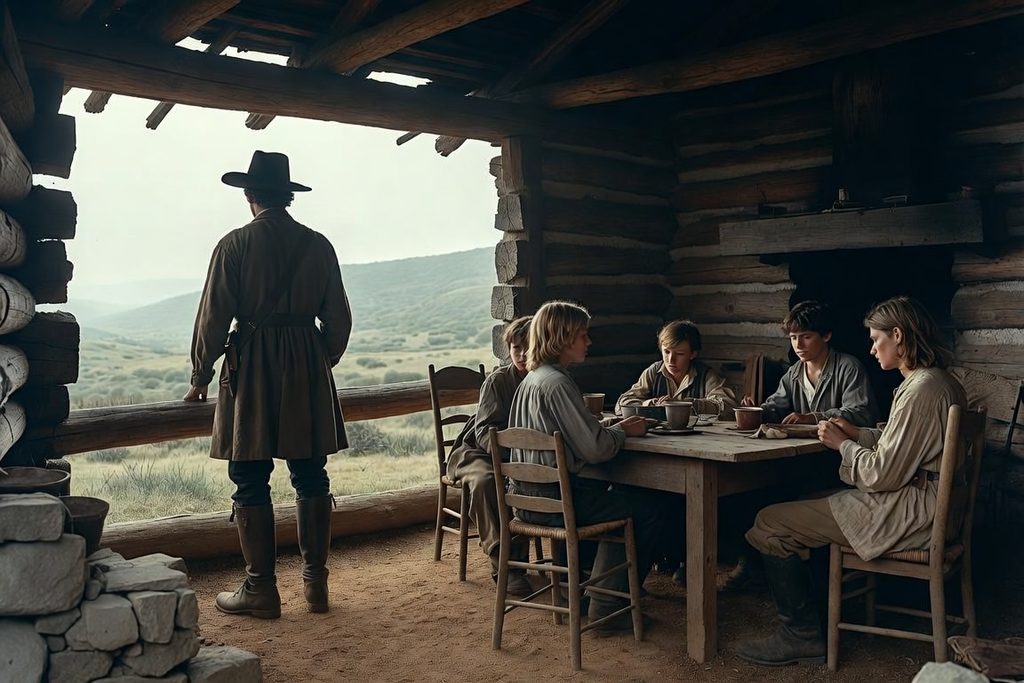
Without owning land, it’s hard for a person to feel like they have a stake in society. It can be argued that the people who own land own the society itself. Land owners can force anyone who wants to use their property to pay rent. If you don’t own land, your choices are: pay rent or die of exposure to the elements. Thus, landowners are the true ruling class of every society. This is why people have historically fought so hard over land.
The basis of the social contract in the West since the end of feudalism has been: work hard, and you will get enough money to buy some land. This was accepted as a fair deal for a long time. It was enough to keep revolutionary sentiments suppressed. This social contract has now been shattered by unaffordable housing.
The main problem is the Boomer strangehold over land ownership. Boomers grew up in an era of cheap housing, and realised they could get extremely wealthy if they bid up the price of land to the point where younger people couldn’t afford it. The Boomer near-monopoly on land ownership has made them the wealthiest generation in history – and the following generations much poorer.
This can be clearly seen in the ratios of average house price to average wage. In 1986, the ratio of median existing house price to median household income was 3.2 in America. By today, it is 4.8. In Australia and New Zealand the situation is even worse: the ratio was 3.5 in Australia in 1986 compared to 8.1 today, and it was 4.0 in New Zealand in 1986 compared to 10.0 today. This means that the average young person today has to do 50-150% more work to own a home than Boomers did. Many young people have thus now been consigned to a permanent renter class.
It’s popular on the left to promote rent controls as a way of dealing with skyrocketing housing prices. The alternative centrist rejects such proposals under the First and Fifth Rejections. Rent controls lead to stagnation as it disincentivises new building construction. They are also stupid because they lead to subletting.
The Chinese solved their landlord problem in the early 1950s with mass executions. Anyone greedy enough to be a landlord was simply shot. 70 years later, China now has a 96% homeownership rate, compared to only 65% in America and Britain. The alternative centrist is not entirely against mass executions of parasitic elements, such as landlords. However, this runs the risk of violating the First Acceptance.
For the sake of justice and freedom, the alternative centrist would bring in a Georgist-style land tax on the ground rental value of investment properties. For the sake of order, the family home would be exempt from this land tax. Grok estimates that such a tax would bring in between $300 billion and $700 billion per year in America. This would also have the effect of reducing demand for rental property, driving down the price and making housing more affordable (see The Alt Centrist Approach To Taxation for more).
The alternative centrist state would closely monitor the ratio of median existing house price to median household income. Instead of being ignored, and instead of pretending it doesn’t exist, the alternative centrist state would consider it a key statistic of the country’s well-being, of the same tier of importance as interest rates, unemployment rates and GDP growth. It would be measured and reported at least quarterly.
With this information, certain provisions would be triggered if the ratio rose above 4. For one, the supply of housing would be increased through mass building programs, even if the new builds had to be commieblocks (modular designs would be created such that it was possible to build large amounts of high-quality housing at a low cost). For another, the demand for housing would be decreased by slashing the immigration intake. Raising supply of housing and lowering demand for it would reduce prices. These measures would remain in place until the ratio returns to under 4. The state would try to keep this ratio below 4 in the same way that it tries to keep inflation below a set figure.
Realistically, demand for housing in top tier cities will always be extreme. Therefore, this will mostly be left to the free market. What the alternative centrist state will not do is provide social housing in ultra-high demand areas. The current situation in Britain, where 72% of Somalis live in social housing, many of them in high-demand areas in major cities, is madness. Major cities are supposed to be places where members of the nation can access greater opportunities for careers and education through networking and economies of scale. To fill spaces in them with unproductive refugees is suicidal.
The alternative centrist state would encourage rural land grants to young married couples. This would accord with the Third Rejection, because it would open an avenue to escape the degeneracy of the cities. The cities are excellent places to get educated, to advance a career or to meet a romantic partner. With a romantic partner secured and children planned, the rational thing is to move away to the provinces to escape the degeneracy. Under this proposal, the government would develop rural areas into affordable housing for young families.
The alternative centrist approch to housing would have manifold benefits to physical and mental health. The foremost of these would be less stress. Currently, housing stress is ruining people all over the West, and this is a consequence of deliberate policy choices made by Western governments over several decades. Building more houses and allowing less immigration, among other measures, would alleviate most of this stress.
*
This chapter is from The Alternative Centrist Manifesto, the upcoming work of political philosophy that offers the answers to the political problems of the West.
*
If you enjoyed reading this piece, buy a compilation of our best pieces from previous years!
Best VJMP Essays and Articles of 2024-25
Best VJMP Essays and Articles of 2023
Best VJMP Essays and Articles of 2022
Best VJMP Essays and Articles of 2021
Best VJMP Essays and Articles of 2020
Best VJMP Essays and Articles of 2019
Best VJMP Essays and Articles of 2018
Best VJMP Essays and Articles of 2017