
The Alt Centrist Approach To Education

The existing model for the education systems of the West is the Rockefeller education model. Based around the workings of the General Education Board, a Rockefeller-funded vehicle, it systematically dumbed down education for multitudes of American students, and, through American soft power, for multitudes of non-American students as well.

Rockefeller was not interested in developing the natural capacities of the students. He wanted an education system that pumped out robots to serve an industrial machine. He summarised his aims with the statement “I don’t want a nation of thinkers, I want a nation of workers.” He didn’t want artists and philosophers; he wanted men who could build steam trains, aeroplanes, skyscrapers, artillery pieces, and who could work the machines needed to manufacture and transport goods.

This meant that education lost its classical focus. No more was it considered important to know Greek and Latin; now it was just numbers, mass, quantity, volume, speed, distance. Teaching students to reason through philosophical positions was abandoned in favour of a focus on simple obedience. The end result is today’s Clown World: a population terrified into believing whatever the television tells them, too afraid to read and come to their own conclusions.

Any education system that discourages students from reaching their full potential is cruel. It’s also stupid, because the economic consequences cause everyone in society to suffer a lower standard of living. It’s therefore rejected under the Fourth and Fifth Rejections.

A former teacher, John Taylor Gatto, wrote the book ‘Dumbing Us Down‘ to explain the workings of the American education system. Gatto’s central thesis was that the education system was primarily intended to teach submission and obedience, mostly by breaking the students’ self-esteem and making them psychologically dependent on approval from authority.

Running an education system in this manner is highly orderly, in a sense, because it maintains and solidifies the existing class structure. This approach, however, leads to stagnation.

Alternative centrism recognises that children are created different by Nature, and that the souls placed in them by God are also different. Therefore, justice is the right schooling for the right soul.

This results in different schools for the different grades of soul. For the purposes of the education system, these would be fivefold: clay, iron, copper, silver and gold. Primary schools would be of clay and iron; secondary schools would be of iron, copper and silver; tertiary schools would be of copper, silver and gold.

Clay schools would teach simple trades and arts. Iron schools would teach trades, sports and military science. So the focus for young children would always be on basic trades, life skills and survival skills, but in iron school there would also be a heavy sporting component. This would also exist in clay school, as arts would exist in iron school, but to a lesser extent. There would be no emphasis on forcing hated subjects on students on the grounds it “builds character” or similar. Education must be made to seem a universal public good.

Copper schools would teach arts and commerce. In early years, the commercial focus would be on running small enterprises, and in later years on multinationals and corporates. So the scope of teaching would become more macroeconomical as time progressed. The arts component would be heavy as the copper schools should produce the bulk of the artists, performers and entertainers, i.e. those who don’t need to be grounded in physical reality.

Silver schools would teach business, administration and military science. The business element would overlap with the copper schools to some extent, but in the silver schools the focus would be more on the organisation of human society rather than profit. The graduates of these schools would be expected to become the administrators of the governments of the future.

Gold schools would teach science, philosophy and military science. This would cover the most advanced subjects and be where the majority of society’s original research is generated. If the graduates of the silver schools are to be the managers of the governments of the future, the graduates of the gold schools are to be the leaders. These graduates would be the philosopher-kings of the alternative centrist utopia.

The students would be sorted thusly.

At age five, they would be tested for physical health and strength. Essentially the deciding question would be whether they enjoyed playing sports. They wouldn’t need to be good at sports, but those who enjoyed playing them could be expected to develop the fundamental grounding in reality that is absent in those who are uncomfortable in the physical. Those students are also more likely to be prosocial. So the ones that are good at sports go to iron school, and the ones that are not go to clay school.

At age eleven, the children would be tested again, only this time for intelligence.

The ones of clay, if they prove intelligent, would move to copper school (secondary) for the remaining years until age 17. If unintelligent, they move to clay school (secondary). The ones of iron, if they prove intelligent, would move to silver school (secondary) until age 17. If unintelligent, they move to iron school (secondary).

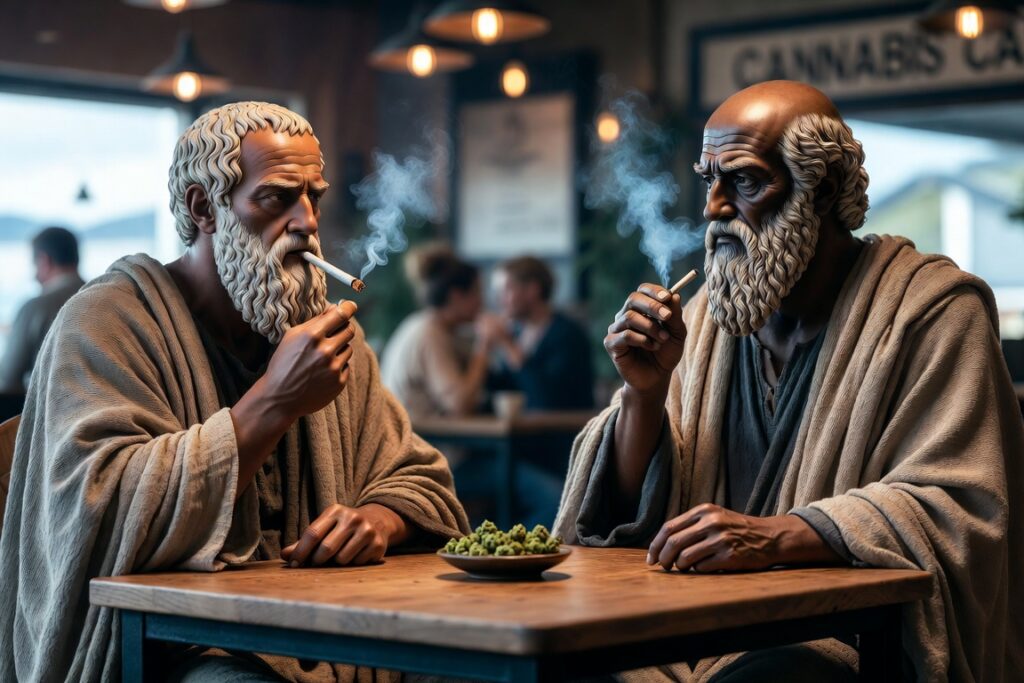
Then the ones in silver school (secondary), upon reaching age 17, either move to copper school (tertiary), silver school (tertiary), or to gold school, which is only tertiary. The qualification for gold school is that one is interested in taking a transformative dose of a psychedelic, as per the Eleusinian and Elemental Mysteries. Anyone who freaks out upon encountering their own soul is prohibited from attending gold school. This means that spiritual acumen is the major qualification for entrance.

The logic behind this system would be to educate students for the societal niche that they naturally belong to. The fashionable modern idea that any student can be made into anything is utterly rejected. Humans are far from blank slates. Biology and karma both work to limit choice. The most just and least stupid education system would identify the social niche a child belonged to as early as possible, and then tailor the child’s education for success in that niche.

This system would also have the immense benefit of keeping the merchant class out of the ruling elite, thereby resisting much of the degeneracy that has consumed the West.

Not all schools are available to all ages. Thus, the youngest children will end up in either the clay or iron schools, the intermediate ones in the secondary schools and young adults in the tertiary schools. Older adult students could attend any tertiary school they qualified for.

To maximise freedom, it would be possible for students to move to any different school they qualified for, perhaps after special qualifying examinations at the end of each school year.

Teachers in these schools will be graduates of the gold, silver and copper schools. The idea is that they would be the best examples of their metal, paragons that the students could model themselves after. Some of the sporting instructors could be graduates of the iron schools.

As with the other features of school life, discipline would depend on the school and the nature of the students: iron schools could use corporal punishment, copper schools could use social exclusion and shame, silver and gold schools could use reason. Perhaps lead schools could be instituted to deal with the antisocial students.

The underlying logic of this system is a total rejection of the “No Child Left Behind” logic of George W Bush. The end result of the alternative centrist system would be young people able to contribute to their niche in society. Those capable of further education would be able to receive it; those incapable of further education should at least have the base skills to make themselves useful.

*

This chapter is from The Alternative Centrist Manifesto, the upcoming work of political philosophy that offers the answers to the political problems of the West.

*

For more of VJM’s ideas, see his work on other platforms!
For even more of VJM’s ideas, buy one of his books!

*

If you enjoyed reading this piece, buy a compilation of our best pieces from previous years!

Best VJMP Essays and Articles of 2024-25
Best VJMP Essays and Articles of 2023
Best VJMP Essays and Articles of 2022
Best VJMP Essays and Articles of 2021
Best VJMP Essays and Articles of 2020
Best VJMP Essays and Articles of 2019
Best VJMP Essays and Articles of 2018
Best VJMP Essays and Articles of 2017

*

If you would like to support our work in other ways, make a donation to our Paypal! Even better, buy any one of our books!

How We Will Lose Our Free Speech Rights

Because we’ve had peace and prosperity for so long now, it’s a common belief that both states are natural and no special effort is required to maintain either. This is a grievous delusion. It’s possible that, as per Phaedrus, the natural state of consciousness is incarnated in a higher dimension where there is no suffering. But down here on Earth, the natural state of life is brutish, nasty and short.

The tribal and violent nature of pre-civilisational life has been ameliorated, post-civilisation, chiefly through the invention of marriage, which has allowed supertribal consciousness to manifest through homogenising existing tribes in their shared offspring. The more tribes that married into each other, the more this higher consciousness was brought into being. Eventually clans formed, and then city-states.

These city-states had plenty of what Aristotle called philia. This was a kind of neighbourly solidarity that served as the mortar holding the edifice of society together. This philia created a sense that people were on the same team, moving in the same direction, and this goodwill allowed them to agree on things, e.g. that free speech would be important.

For most of human history, there has been a widespread understanding that the standard of living afforded by this homogeneity was a good thing, and so that homogeneity ought to be defended. So when new blood was introduced from the outside, it was married in to the existing stock so as to avoid factionalisation. Aristotle wrote, in Politics, that “heterogeneity of stocks may lead to faction – at any rate until they have had time to assimilate.”

This factionalisation is what destroys freedoms, as freedoms only exist when everyone can agree on their importance. Absent this agreement, any and all freedoms can and do become banned on the grounds they are destabilising, corruptive or degenerate influences. The sad truth about the human animal is that we are panicky, skittish beings prone to contagions of fear and hysteria. Hence we like to ban things, especially if we don’t understand them. If there isn’t general agreement that a particular freedom is important, it tends to get banned.

The freest country in the world, America, is the way it is because of general agreement on the importance of free speech, free assembly, free trade and various other freedoms. Children are taught at the earliest school that freedom is a foundational American virtue, and that only America’s enemies oppose freedom.

Unfortunately, this mentality is not universal.

New Zealand had a referendum on freedom with the cannabis referendum in 2020. NZ-born voters voted Yes, for freedom. Those born outside of New Zealand voted No. Their cultures don’t have freedom, they don’t understand it. So they voted ours away.

Kiwis responded with a shrug, and just got on with life. Another freedom gone, who cares?

We will lose our free speech rights the same way.

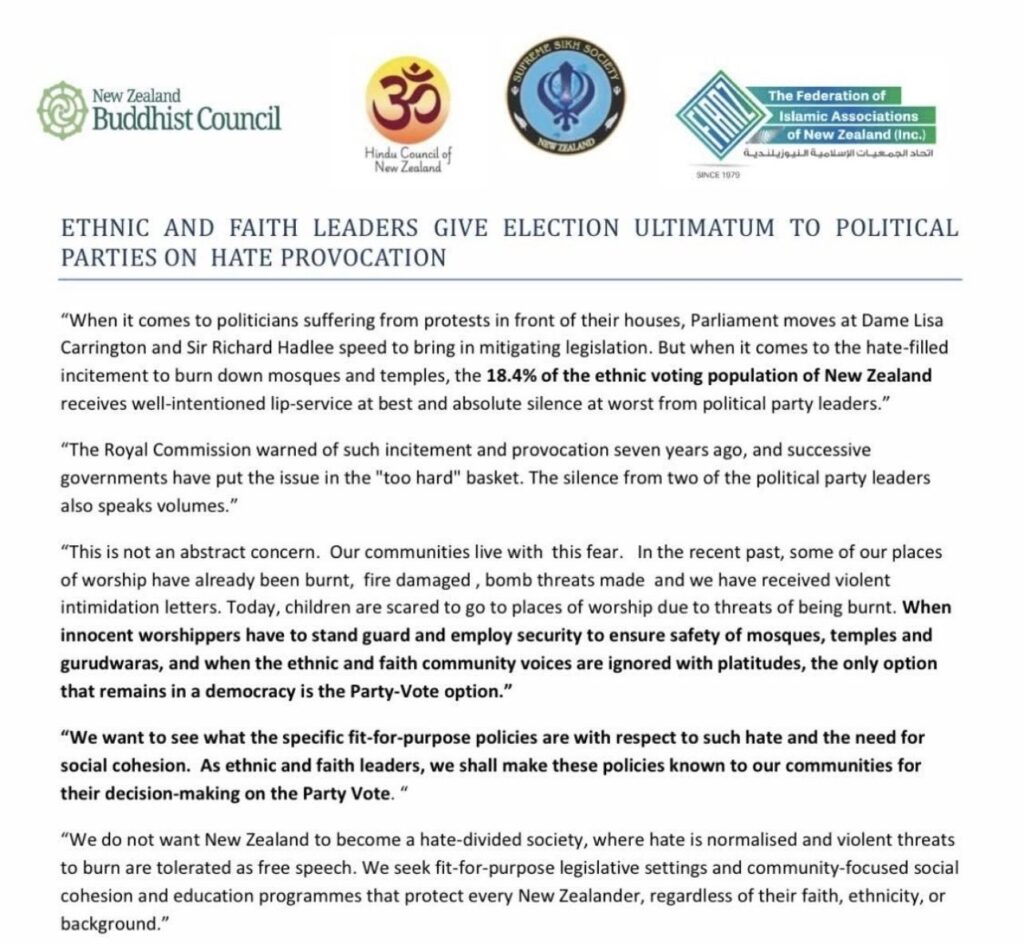
The image at the top of this article is a screenshot of a recent press release from a coalition of religious groups in New Zealand: the highest authorities for each of Muslims, Buddhists, Hindus and Sikhs in this country. They have combined forces to agitate for further free speech crackdowns. This is in response to some of the statements made by Brian Tamaki (see 2:00 in this video for examples), in particular claims that Modi was purging India of Christians and that New Zealand ought to retaliate in kind, burning down mosques and temples and purging New Zealand of Hindus, Sihks and Muslims.

Tamaki has said several heinous things, and could rightly be charged with being a nuisance to public order. But if hate speech laws are introduced, they will soon become blasphemy laws. It’s no secret that some religions, particularly the Abrahamisms, would like to make criticising them illegal. Adherents of these religions will tirelessly push to widen any hate speech law that gets passed.

The main long-term danger is that, as New Zealand becomes less Kiwi through mass immigration, the population becomes less interested in freedom.

Free speech became a core Western value in the 1950s, as neither the Nazi opponents in World War II nor the Commie opponents in the Cold War believed in it. We were told that free speech was why our societies were better: it allowed them to self-correct, thereby avoiding the extremes of the totalitarian systems.

This worked out excellently for some decades, up until the end of the 20th Century. After then, there was mass immigration from countries with no traditions of free speech. Consequently, popular support for free speech started to waver. Having little of value to say, the immigrants could not see the value in free speech. So support for free speech is now declining. It will continue to decline as the West continues to muttify.

There might not be a referendum in New Zealand about free speech per se, but about a free speech-related issue. It might be about a proposed hate speech law. In any case, the Chinese, Muslim and Pacific Islander voters who voted away our cannabis freedom will (in all likelihood) vote away our free speech rights as well. They can’t be expected to vote for freedom because it’s not valued in their cultures.

If New Zealanders lose our free speech rights, it will be through the mass immigration of people who don’t value them.

*

For more of VJM’s ideas, see his work on other platforms!
For even more of VJM’s ideas, buy one of his books!

*

If you enjoyed reading this piece, buy a compilation of our best pieces from previous years!

Best VJMP Essays and Articles of 2024-25
Best VJMP Essays and Articles of 2023
Best VJMP Essays and Articles of 2022
Best VJMP Essays and Articles of 2021
Best VJMP Essays and Articles of 2020
Best VJMP Essays and Articles of 2019
Best VJMP Essays and Articles of 2018
Best VJMP Essays and Articles of 2017

*

If you would like to support our work in other ways, make a donation to our Paypal! Even better, buy any one of our books!
The Alt Centrist Approach To Taxation

Taxation is symbolic of the imposition of order, and therefore of the Establishment Right. Everywhere there was a king, there was also a taxman. For a political body to operate on a higher level, there have to be taxes, as anyone who doesn’t successfully collectivise gets wiped out by those who do. Thus, the kind of natural selection that operates at the human group level has selected for groups that can successfully levy taxes.

Without taxation, it’s impossible for a political entity to impose the order that it needs to survive at the collective level. Thus the Alternative Centrist has no time for the argument that taxation is theft. This is the narrative of a child who doesn’t want to share its toys. It’s a fundamentally unserious narrative for people who have never thought about things.

Related to this, the Alternative Centrist believes that it’s morally impermissible to tick up a debt today and pass it down to one’s grandchildren. All the bleating about taxation being theft doesn’t mean it’s okay to pass the theft onto one’s descendants. Taxes must be high enough to cover government spending, currently some USD7.1 trillion in the case of America and NZD183 billion in the case of New Zealand.

The Fourth Acceptance of Alternative Centrism emphasises the importance of truth. The truth is that some ways of earning, investing and spending income are more prosocial than others. The Alternative Centrist buys the argument that taxation is a useful tool for modifying behaviour: in fact, it’s almost as good as the law. If some ways of gaining money are borderline criminal, there’s no shame in taxing them hard.

Most people can agree that working a normal job is prosocial. Some jobs are dirty or dangerous and the people doing them are really at the coal face of society. Many jobs are downright depressing, but need to be done. Other jobs are tedious in a manner that is harmful for mental health, but also need to be done. People who do these jobs generally don’t get paid much, so they also ought not to get taxed much.

The usual approach here is a progressive income tax system. The two problems with this are: progressive income tax systems are disorderly (i.e. expensive to administrate) and they tend to hammer the hardest workers.

The Alternative Centrist solves these problems in two ways.

The first is a moderate tax-free threshold, roughly equal to what a person would get on an unemployment benefit (i.e. the minimum one can live on). This is mostly for the sake of order: there is no point in taxing someone to just give the same money back in services that people wouldn’t have needed if taxation hadn’t impoverished them. Most Western countries do this, but it’s pointless and inefficient. Much better to have a tax-free threshold near the amount of money that a person needs to survive.

The second is a flat tax. Flat tax proposals appeal to the Alternative Centrist sense of justice, because they do not penalise hard workers and high achievers. A so-called progressive income tax system penalises working long hours, which is in theory the sort of prosocial activity that ought to be encouraged.

The argument that low taxes (a typically right-wing concern) are pro-freedom (a typically left-wing concern) is rejected as money worshipping. However, the Alternative Centrist approach is to tax labour lightly, on the grounds that it is the most prosocial way to make an income. This is in accordance with the Fifth Acceptance.

The Alternative Centrist approach also suggests that unearned income should be taxed much more than earned income, on the grounds that earning an income is more prosocial than receiving one without earning it.

Unearned income in the form of rent is the most antisocial. The French economist Jean-Baptiste Say observed that “Landlords’ right has its origin in robbery.” The argument that landlords “provide” housing is summarily rejected: it’s like claiming that armed robbers provide health. As the most antisocial legal way to make money, rental income needs to be taxed heavily.

The Georgist solution to rental income is excellent.

Residential and commercial rents in the United States are estimated to bring in USD$2.2 trillion every year. If we assume that the ground rental value of these rents is about a third of that, an 80% tax on those ground rents ought to yield some USD$600 billion p.a.

Existing land tax proposals (c.f. that of New Zealand’s Opportunity Party) often make the error of taxing the family home. The error here is in destroying security of household tenure. If the household is the basis of society, then security of household tenure is the basis of the order of that society. This goes against the First Acceptance. The Alternative Centrist would rather see massive taxes on income from ground rents than taxes on a family home.

Wealth taxes are discouraged by the Alternative Centrist. Unlike land taxes, wealth taxes can be avoided by taking the wealth overseas. Thus they are rejected on the grounds they lead to disorder. Inheritance taxes on family homes are rejected for the same reason: breaking up family homes to pay inheritance taxes is grossly disorderly (inheritance taxes on investment properties would be severe though).

Earning money from investments is still prosocial, but not as much as working. Thus, dividends on stocks and shares would be taxed moderately under an Alternative Centrist system. Capital gains would also be taxed moderately under this logic. To get around the problem of tax havens, the Alternative Centrist approach is to work towards international minimum corporate tax agreements.

Moderate consumption taxes are supported by the Alternative Centrist. Consumption isn’t antisocial, but an excess of it is, and therefore taxes on consumption ought to be moderate. They can also bring in significant amounts of money, lightening the burden on workers. Transaction taxes are also considered good when and if they are workable. The concern is that they can be easily avoided, which is both disorderly and stupid.

Following the reasoning that taxation can guide behaviour, the Alternative Centrist approach to taxation involves heavy vice taxes.

Alcohol taxation brings in USD11 billion for the American federal treasury every year. Texas brings in USD1.6 billion in alcohol taxation annually for a state with around 9% of America’s population, and this revenue is generally considered typical per capita alcohol tax revenue for an American state. Extrapolating that across 50 states, and adding federal revenue, suggests some USD30 billion p.a. is currently gathered through alcohol taxes.

The examples of American states that have already legalised cannabis suggest that every million people can yield USD50 million in annual cannabis taxes. So a population of 350 million could yield over USD17 billion p.a. Taxes on cannabis consumption could bring in NZD490 million p.a. in the case of New Zealand, according to the New Zealand Institute of Economic Research.

Significant gambling wins would also be heavily taxed. There is no need to tax gambling wins below a certain threshold, but professional gamblers would be taxed moderately and those receiving huge windfalls would be taxed heavily.

These vice taxes would not bring in that much money, perhaps 2% of government spending at most. The point of them is primarily to use the tool of taxation as a way of imposing good order upon society; there is more to taxation than just government revenue.

Realistically, even with all of these measures, much of the tax burden will have to fall on workers. Even with AI and mass automation, this is inescapable. On account of the sheer volume of the masses, the bulk of economic activity consists of everyday workers. This will have to be taxed to some extent to keep the national machine running. But, with all the measures outlined above, the tax burden on workers should be minimal.

The general principle is threefold: light taxes on labour, moderate taxes on investment and consumption, heavy taxes on vices and unearned income.

*

This chapter is from The Alternative Centrist Manifesto, the upcoming work of political philosophy that offers the answers to the political problems of the West.

*

For more of VJM’s ideas, see his work on other platforms!
For even more of VJM’s ideas, buy one of his books!

*

If you enjoyed reading this piece, buy a compilation of our best pieces from previous years!

Best VJMP Essays and Articles of 2024-25
Best VJMP Essays and Articles of 2023
Best VJMP Essays and Articles of 2022
Best VJMP Essays and Articles of 2021
Best VJMP Essays and Articles of 2020
Best VJMP Essays and Articles of 2019
Best VJMP Essays and Articles of 2018
Best VJMP Essays and Articles of 2017

*

If you would like to support our work in other ways, make a donation to our Paypal! Even better, buy any one of our books!

In Defence Of Mike King, And Of Alcohol

New Zealand mental health awareness campaigner Mike King copped mountains of abuse for saying that “alcohol has prevented more young people from taking their own lives than it makes them take their own lives.” This provoked outrage from the usual wowsers, psychopaths and control freaks. But there is great truth behind this hard-earned wisdom.

I worked as a bartender for eight years. In that time I saw alcohol ruin many people. I was assaulted several times and no doubt the alcohol I sold contributed to countless acts of domestic violence. It might have caused a million dollars of physical health damage, and a million dollars of lost productivity from hangovers or absentee days.

It also had some great effects.

In those eight years I saw a lot of people who were barely hanging on come through the doors. People who were deeply depressed, stressed, anxious, even despairing. And I saw that, for a lot of these people, the promise of getting a buzz from alcohol was helping to keep them going. The daily life was unpleasant, but it could be endured because, after it, a good time could be had with a few drinks.

Some of the patrons would even admit as such. For them, a drink was the finish line of the day, time to celebrate and say Yes to life again. I am certain that the alcohol I sold prevented several million dollars’ worth of depression thanks to providing the sociability that led to great mirth and great memories for hordes of people. The average bartender, in my experience, does as much good for mental health as the average psychiatrist.

Mike King has been close enough to suicide to know that, when you’re on the edge, it’s often small things holding you back, like an occasional moment of mirth.

This might be impossible to understand for anyone who has never been mentally ill. But if you have ever felt enduring suicidal ideation, you may have also discovered that getting drunk can stop those thoughts for a while. I have broken multiple bones, and the suffering of suicidal ideation tops them all. It doesn’t take much of it before one starts thinking about a permanent solution. Alcohol can provide blessed relief from such thoughts.

Sometimes, when your mental health is so low that you know you can’t endure the suffering forever, the promise of the next drink can be what’s stopping you ending your life. Just the simple knowledge that solace can eventually be had, in the form of a pint, can be enough to keep taking one step after the next. Drinking alcohol can reclaim enough power over your own mental health to make you say Yes to life again.

Mike King understands this, because he’s been low enough to need to find reasons to stay alive. He ought to be respected for the insight that he has brought back from the psychiatric underworld. Instead of ripping down someone who has stood so close to the edge, we ought to listen (if with scepticism). This is especially true for people with no personal experience of depression.

This defence is not intended to excuse my own conduct. For many years now, I have hardly used alcohol at all – only for celebrations once every few months, and even then in moderation. I am therefore not a drinker but neither am I an abstainer. I argue that this middle way, plus my bartending experience, makes my opinions more objective.

I also have extensive experience with antidepressant use – I have taken five different ones, off and on, for 30 years. What people need to realise about antidepressants is that they, at best, only mildly alleviate depression, and even then they work as a background substance. You can’t take an antidepressant as an emergency fix for an acute suicidal mood. If you’re going to attempt suicide in the next half an hour, and only an antidepressant or alcohol can save you, alcohol will be by far the most effective short-term fix.

That’s not to say alcohol is a long-term fix; in the long term, drinking alcohol will make you more depressed. Not only is it an actual depressant, but it causes an astonishing range of physical health ailments (see Prof. David Nutt’s Drink? for more).

Alcohol is definitely a second-rate drug. But the popular claim (often repeated in the mainstream media) that it only causes harms, and has no benefits, is ridiculous. In any case, most people who chimp out on it could have been encouraged to use weed or MDMA, if only either were legal. Most of the harms of alcohol would be ameliorated if people had access to less harmful recreational drugs, because those would serve as exit drugs for alcohol users to transition away. It’s hypocritical to complain about alcohol harms while also criminalising all the exit drugs from alcohol.

The ideal arrangement would be a properly-funded mental health system, which would include training people in trauma-based therapy and de-emphasising the biomedical model, and a sensible drug policy based on scientific evidence of relative drug harms.

*

For more of VJM’s ideas, see his work on other platforms!
For even more of VJM’s ideas, buy one of his books!

*

If you enjoyed reading this piece, buy a compilation of our best pieces from previous years!

Best VJMP Essays and Articles of 2024-25
Best VJMP Essays and Articles of 2023
Best VJMP Essays and Articles of 2022
Best VJMP Essays and Articles of 2021
Best VJMP Essays and Articles of 2020
Best VJMP Essays and Articles of 2019
Best VJMP Essays and Articles of 2018
Best VJMP Essays and Articles of 2017

*

If you would like to support our work in other ways, make a donation to our Paypal! Even better, buy any one of our books!