
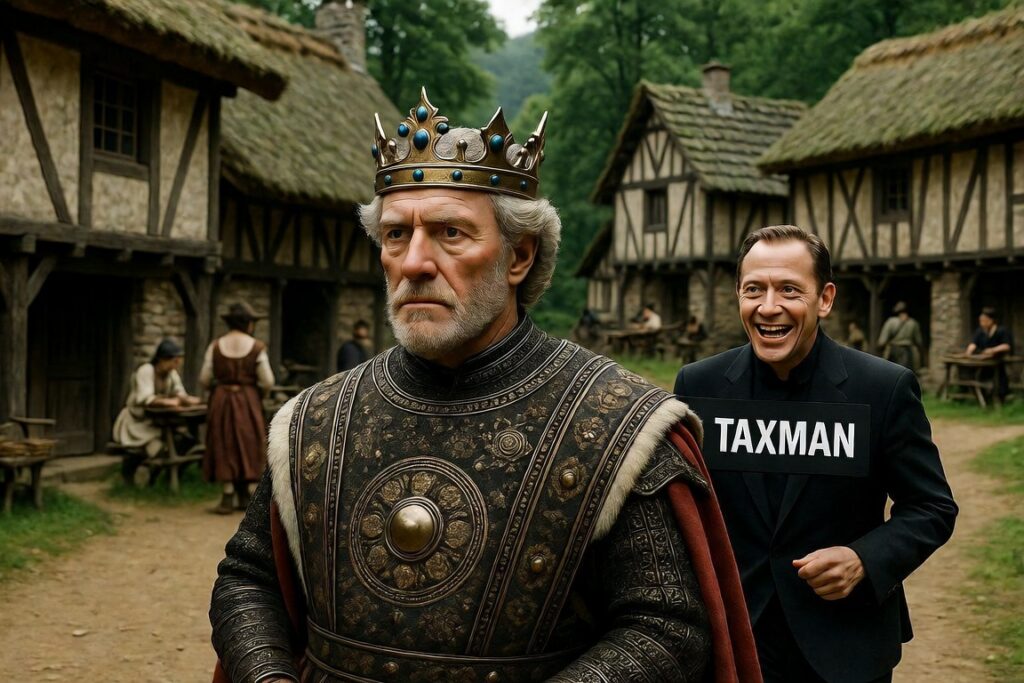
Taxation is symbolic of the imposition of order, and therefore of the Establishment Right. Everywhere there was a king, there was also a taxman. For a political body to operate on a higher level, there have to be taxes, as anyone who doesn’t successfully collectivise gets wiped out by those who do. Thus, the kind of natural selection that operates at the human group level has selected for groups that can successfully levy taxes.
Without taxation, it’s impossible for a political entity to impose the order that it needs to survive at the collective level. Thus the Alternative Centrist has no time for the argument that taxation is theft. This is the narrative of a child who doesn’t want to share its toys. It’s a fundamentally unserious narrative for people who have never thought about things.
Related to this, the Alternative Centrist believes that it’s morally impermissible to tick up a debt today and pass it down to one’s grandchildren. All the bleating about taxation being theft doesn’t mean it’s okay to pass the theft onto one’s descendants. Taxes must be high enough to cover government spending, currently some USD7.1 trillion in the case of America and NZD183 billion in the case of New Zealand.
The Fourth Acceptance of Alternative Centrism emphasises the importance of truth. The truth is that some ways of earning, investing and spending income are more prosocial than others. The Alternative Centrist buys the argument that taxation is a useful tool for modifying behaviour: in fact, it’s almost as good as the law. If some ways of gaining money are borderline criminal, there’s no shame in taxing them hard.
Most people can agree that working a normal job is prosocial. Some jobs are dirty or dangerous and the people doing them are really at the coal face of society. Many jobs are downright depressing, but need to be done. Other jobs are tedious in a manner that is harmful for mental health, but also need to be done. People who do these jobs generally don’t get paid much, so they also ought not to get taxed much.
The usual approach here is a progressive income tax system. The two problems with this are: progressive income tax systems are disorderly (i.e. expensive to administrate) and they tend to hammer the hardest workers.
The Alternative Centrist solves these problems in two ways.
The first is a moderate tax-free threshold, roughly equal to what a person would get on an unemployment benefit (i.e. the minimum one can live on). This is mostly for the sake of order: there is no point in taxing someone to just give the same money back in services that people wouldn’t have needed if taxation hadn’t impoverished them. Most Western countries do this, but it’s pointless and inefficient. Much better to have a tax-free threshold near the amount of money that a person needs to survive.
The second is a flat tax. Flat tax proposals appeal to the Alternative Centrist sense of justice, because they do not penalise hard workers and high achievers. A so-called progressive income tax system penalises working long hours, which is in theory the sort of prosocial activity that ought to be encouraged.
The argument that low taxes (a typically right-wing concern) are pro-freedom (a typically left-wing concern) is rejected as money worshipping. However, the Alternative Centrist approach is to tax labour lightly, on the grounds that it is the most prosocial way to make an income. This is in accordance with the Fifth Acceptance.
The Alternative Centrist approach also suggests that unearned income should be taxed much more than earned income, on the grounds that earning an income is more prosocial than receiving one without earning it.
Unearned income in the form of rent is the most antisocial. The French economist Jean-Baptiste Say observed that “Landlords’ right has its origin in robbery.” The argument that landlords “provide” housing is summarily rejected: it’s like claiming that armed robbers provide health. As the most antisocial legal way to make money, rental income needs to be taxed heavily.
The Georgist solution to rental income is excellent.
Residential and commercial rents in the United States are estimated to bring in USD$2.2 trillion every year. If we assume that the ground rental value of these rents is about a third of that, an 80% tax on those ground rents ought to yield some USD$600 billion p.a.
Existing land tax proposals (c.f. that of New Zealand’s Opportunity Party) often make the error of taxing the family home. The error here is in destroying security of household tenure. If the household is the basis of society, then security of household tenure is the basis of the order of that society. This goes against the First Acceptance. The Alternative Centrist would rather see massive taxes on income from ground rents than taxes on a family home.
Wealth taxes are discouraged by the Alternative Centrist. Unlike land taxes, wealth taxes can be avoided by taking the wealth overseas. Thus they are rejected on the grounds they lead to disorder. Inheritance taxes on family homes are rejected for the same reason: breaking up family homes to pay inheritance taxes is grossly disorderly (inheritance taxes on investment properties would be severe though).
Earning money from investments is still prosocial, but not as much as working. Thus, dividends on stocks and shares would be taxed moderately under an Alternative Centrist system. Capital gains would also be taxed moderately under this logic. To get around the problem of tax havens, the Alternative Centrist approach is to work towards international minimum corporate tax agreements.
Moderate consumption taxes are supported by the Alternative Centrist. Consumption isn’t antisocial, but an excess of it is, and therefore taxes on consumption ought to be moderate. They can also bring in significant amounts of money, lightening the burden on workers. Transaction taxes are also considered good when and if they are workable. The concern is that they can be easily avoided, which is both disorderly and stupid.
Following the reasoning that taxation can guide behaviour, the Alternative Centrist approach to taxation involves heavy vice taxes.
Alcohol taxation brings in USD11 billion for the American federal treasury every year. Texas brings in USD1.6 billion in alcohol taxation annually for a state with around 9% of America’s population, and this revenue is generally considered typical per capita alcohol tax revenue for an American state. Extrapolating that across 50 states, and adding federal revenue, suggests some USD30 billion p.a. is currently gathered through alcohol taxes.
The examples of American states that have already legalised cannabis suggest that every million people can yield USD50 million in annual cannabis taxes. So a population of 350 million could yield over USD17 billion p.a. Taxes on cannabis consumption could bring in NZD490 million p.a. in the case of New Zealand, according to the New Zealand Institute of Economic Research.
Significant gambling wins would also be heavily taxed. There is no need to tax gambling wins below a certain threshold, but professional gamblers would be taxed moderately and those receiving huge windfalls would be taxed heavily.
These vice taxes would not bring in that much money, perhaps 2% of government spending at most. The point of them is primarily to use the tool of taxation as a way of imposing good order upon society; there is more to taxation than just government revenue.
Realistically, even with all of these measures, much of the tax burden will have to fall on workers. Even with AI and mass automation, this is inescapable. On account of the sheer volume of the masses, the bulk of economic activity consists of everyday workers. This will have to be taxed to some extent to keep the national machine running. But, with all the measures outlined above, the tax burden on workers should be minimal.
The general principle is threefold: light taxes on labour, moderate taxes on investment and consumption, heavy taxes on vices and unearned income.
*
This chapter is from The Alternative Centrist Manifesto, the upcoming work of political philosophy that offers the answers to the political problems of the West.
*
For more of VJM’s ideas, see his work on other platforms!
For even more of VJM’s ideas, buy one of his books!
*
If you enjoyed reading this piece, buy a compilation of our best pieces from previous years!
Best VJMP Essays and Articles of 2024-25
Best VJMP Essays and Articles of 2023
Best VJMP Essays and Articles of 2022
Best VJMP Essays and Articles of 2021
Best VJMP Essays and Articles of 2020
Best VJMP Essays and Articles of 2019
Best VJMP Essays and Articles of 2018
Best VJMP Essays and Articles of 2017
*
If you would like to support our work in other ways, make a donation to our Paypal! Even better, buy any one of our books!
I have a slightly different view. I don’t believe there should be any tax on labour as this introduces complexity and is just a hand in the workers pocket, almost all tax should fall on land and resources. A combination of straight land tax and unearned income tax.
I don’t think there is a need for moral taxes just effective justice for the times when personal choices impose on society.
In our current money system the main purpose of tax is to create demand for the country currency.
There is also no need for government debt as they can print money interestingly the benefit of this is that the people alive today would pay through inflation for infrastructure built so no debt would pass on.
> I don’t believe there should be any tax on labour as this introduces complexity and is just a hand in the workers pocket, almost all tax should fall on land and resources
I actually agree with this. I just don’t think it’s politically feasible. It will seem to many like you’re asking the wealthy to subsidise the poor.