It’s Okay To Be Whatever You Naturally Are

Some controversy has been generated this week from the fact that VJM Publishing sells ‘It’s Okay To Be White’ t-shirts on TradeMe (edit: or did, looks like the listing has now been taken down). Our doing so angered the Human Rights Commission, who argued that it spreads “a message of intolerance, racism and division”. This response argues that, not only are our actions the opposite of intolerance, hatred and division, but it is the Human Rights Commission itself that is guilty of this.

There’s a lot of discussion about what’s okay and what isn’t okay. This is the school of philosophy known as ethics, and it has been around for many thousands of years.

This is VJM Publishing’s take on it.

It’s okay to be white, brown, black, yellow or even red or purple. It’s okay to be tall or short, blue-eyed or brown, slim or solid, because these things are all natural and you can’t help them. It’s even okay to be ugly or dumb because, again, these things are natural and you can’t help them.

It’s okay to be an outgoing, choleric, even aggressive person, but it’s not okay to cause suffering to other sentient beings. Causing suffering is bad.

It’s also not okay to be is a member of an ideology that promotes hatred and division, because this leads directly to the suffering of sentient beings. The foremost way to promote hatred and division is to say that it’s not okay to be something that you naturally are. Such as your ethnicity.

This is the reason for the comment that these shirts are the opposite of racism. They literally are. Racism is to say that there’s something inherently wrong with being white, as if a person being born white is to be born carrying some debts that their ancestors racked up.

The racists in this situation are the Europhobes who say “there’s no place for this kind of message”, when the message is that it’s not a bad thing to be a white person. If there is such a thing as hate speech, it’s anyone saying that it’s not okay to be something that someone naturally is, such as their skin colour.
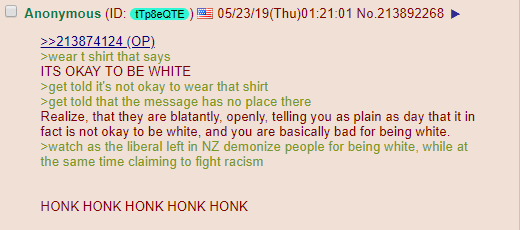
Of course, this means that things that people have chosen to be don’t count. It is not, and can never be, an act of hatred to criticise someone for belonging to a supremacist ideology, especially one that believes it’s destined to rule the world whether non-followers like it or not. Such ideologies inevitably bring suffering into the world.

VJM Publishing is not interested in ideologies that promote hatred and division. We oppose Nazism, Communism, Abrahamism, Imperialism, Materialism, and all the other ideologies that cause one group of people to glory themselves and to debase another by calling them degenerates, counter-revolutionaries, infidels, heretics or primitive natives.

We are for those who have seen beyond. This refers both to the veils of the material world in a spiritual sense, and the veils of the corporate media matrix in an existential sense. We are for those who realise that all life on this planet is connected by virtue of possessing the divine spark of consciousness that could be said to be God.

By selling this shirt, we are doing our part to counter genuine racism and division. Instead of doing this by grave, pompous and bombastic moralising that seeks to take people’s rights away – a proven failed approach – we’re adding some humour to the media scene for the sake of resistance. We’re replacing some of the colour that has been lost.

We’re not even for white pride. Sure, if you identify with some illustrious individual merely because they share a skin colour with you, go for it, but it looks weak to us. Those who have seen beyond would rather work on their individual qualities for the sake of lifting the world around them. Like the alchemists of ancient days, we cultivate the iron, the silver and the gold.

Look at the actual products we sell. We’re working with Jeff Ngatai to produce a book of mnemonics for learning te reo Maori. This we do because we believe that the language is a treasure at risk of being lost, and that mnemonics are an excellent way to preserve the memory of Maori language vocabulary in the minds of the population.

That’s why we offer every mnemonic in the book for free. They are all offered for free, arranged by subject groups. This is the same material as in the book. If you can afford to buy the book, great, if you can’t, you can use the online version. That reflects our will to bring this knowledge to as many people as possible.

What sort of white supremacists care about preserving the Maori language?

The majority of articles and essays on VJM Publishing relate to cannabis law reform. It was primarily to agitate for cannabis law reform that VJM Publishing was founded, since we knew over a decade ago that prohibition is stupid. Indeed, we’ve pointed out several times that the cannabis law disproportionately affects Maoris. This has even been argued in the original Cannabis Activist’s Handbook, published as far back as 2012.

What sort of white supremacists give a shit about the disproportionate effect that cannabis prohibition has on Maoris? What white supremacists were arguing seven years ago that prohibition should be repealed for this reason?

Our other products are speculative fiction books, a demographic study of New Zealand voting patterns, various books about how to apply psychological science to creative writing, a guide to quitting tobacco smoking and a book of religious satire.

How on Earth can any honest person see a link to white supremacy in that?

The whole idea is nonsense, and to link VJM Publishing with white supremacism is proof that we live in Clown World. VJM Publishing, far from being haters, are the victims of Big Brother’s decision to target us for their daily Two Minutes’ Hate.

What VJM Publishing really is, is a much needed thumb-in-the-eye to the wowsers, puritans and other moralising do-gooders that have sucked all the enjoyment out of living. It is these grey men and women, these emotional abusers, who are the cause of our rising suicide rates. We despise them, we oppose them, and we will never stop fighting their insane slave mentality.

VJM Publishing is proud to provide a counter-narrative to the diarrhoea that passes for mainstream political discourse in New Zealand – the same mainstream media, let’s not forget, that told us that Saddam Hussein possessed weapons of mass destruction.

We’re proud to post material that takes the piss out of the control freaks who think they have the right to arbitrarily decide what merchandise other people are allowed to sell on a public trading platform. These monsters who think they have the right to decide that a string of words doesn’t mean what it literally means, because they have the authority to rule that it really means something else.

*

Click here to read a summary of what alt-centrism is

Click here to read about the five rejections of alt-centrism

Click here to read the five acceptances of alt-centrism

Are the Black Caps of 2019 Better Than The 2015 Cricket World Cup Team?

The last Cricket World Cup is considered by many Black Caps fans to be their team’s finest moment, having made it as far as the final for the first time ever. Numbers man Dan McGlashan, author of Understanding New Zealand, thinks that this 2019 team might be an even better side than that one. This article compares the Black Caps side that will contest the 2019 Cricket World Cup in England with the side that played in the 2015 edition of the tournament.

First opener: Martin Guptill vs. Martin Guptill

The 2019 Martin Guptill has averaged a cracking 50.01 since the last CWC, at a strike rate of 94.70. He’s scored nine centuries in those 61 games, more than in the previous 108 games of his career. This is good enough to see him ranked 8th in the world. What’s more, he appears to be getting better and better.

Before the 2015 CWC, Guptill had a career average of 37.11. He was known as a very good player, with five one-day hundreds, but was not considered excellent. Having played 99 matches, this was about one century per 20 innings, compared to one century per seven innings since then. His century in the last pool match of the 2015 CWC was the start of this hot streak.

It’s the same player, only the 2019 version is more professional, making much better decisions, and making them with more authority. Because the pitches are expected to be flat during this World Cup, there is a good chance that Guptill will play another innings of 180+. He remains the most likely Black Cap to win the match with the bat.

2019 Black Caps 1, 2015 Black Caps 0

Second opener: Henry Nicholls vs. Brendon McCullum

Henry Nicholls has been outstanding recently in Tests, but opening an ODI is different to batting No. 5 in the white clothing. It’s not easy to tell how well he will do as opener, other than to guess based on well he has gone so far, mostly batting in the middle order: 41 matches since the 2015 CWC, averaging 35.48.

Brendon McCullum was on an outstanding run of form leading up to the 2015 tournament. Across 20 matches in the 2014/15 season, he scored 636 runs at an average of 33.47 and an astonishing strike rate of 140.70. This strike rate was so high it meant he scored his runs in fewer than four overs on average, leaving plenty for the other teammates.

Nicholls might have a better average than McCullum, but his role in the team is different, and he will not get the Black Caps off to the same starts as McCullum. However, he is less likely to put Williamson in early either. Perhaps it could also be said that Nicholls was more likely to score a century, but a strike rate of 140 cannot be fully compensated for.

2019 Black Caps 0, 2015 Black Caps 1

No. 3: Kane Williamson vs. Kane Williamson

Williamson averages 47.01 since the last CWC, which is good enough to see him ranked equal 11th in the world. Although he hasn’t been as spectacular as Guptill and Taylor, he has still been extremely solid, scoring five centuries in that time. One feels that it has only been the bounce of the ball and good bowling that has prevented him from scoring bigger.

The 2015 Williamson did not perform well in the knockout stages of the 2015 tournament, his highest score in the three matches being 33 against the West Indies. Although he averaged 45 at the time of the tournament, and had definitely come of age, he was not able to play many truly dominant innings in 2015.

The 2019 edition of the Black Caps captain is even calmer and more professional than the 2015 one. Also, thanks to his IPL experience, he is much better at hitting, and no longer simply relies on being hard to get out. He is, therefore, a more complete player, despite his numbers not showing a significant difference.

2019 Black Caps 1, 2015 Black Caps 0

No. 4: Ross Taylor vs. Ross Taylor

The 2015 Ross Taylor already had a claim to being New Zealand’s finest one-day batsman. At the start of the CWC that year, Taylor had 12 ODI centuries at an average of 41.75. This was a better record than anyone except for Nathan Astle. He had carried the batting for some years before McCullum, Guptill and Williamson came along and was by now the senior pro in the side.

Post eye-surgery Taylor has been something else. Since the 2015 CWC, Taylor has averaged a phenomenal 68.85, with eight centuries. His position as the greatest Kiwi one-day batsman ever is now certain, with Williamson the only possible challenger. His career average is now over 48, and if he continues in anything like the same form it will soon be 50.

One gets the feeling that, with Latham injured for some matches and replaced by the inexperienced Tom Blundell, Taylor might play the last line of real defence before the hitters come in. If that is so, his cool and professional approach will make his efforts at 4 crucial to the success of this campaign.

2019 Black Caps 1, 2015 Black Caps 0

Keeper-batsman: Tom Latham vs. Luke Ronchi

At time of writing, it still isn’t clear how many matches Latham will miss on account of his finger fracture, however it’s assumed that he will be back for the later pool games and any eventual knockouts. Although Latham is still a junior player in the side, he has averaged 37.86 since the last CWC and has cemented his spot at 5. He has shown that he can both rebuild and hit from the middle order.

Since hitting 170 against Sri Lanka just before the 2015 CWC, Ronchi was poor, averaging only 15.13 for the remainder of his career. Although this came at a strike rate of just over 100, it wasn’t enough runs to make an impact. His duck in the 2015 CWC final underlined this.

Latham might lack the big hitting ability of Ronchi, but is much more likely to score runs. Latham’s strike rate of 86 since the last World Cup is perfectly fine anyway. This is another clear win for the 2019 side, whose batting is significantly stronger overall.

2019 Black Caps 1, 2015 Black Caps 0

All-rounder: Jimmy Neesham vs. Corey Anderson

Jimmy Neesham has been in and out of the team in recent years, but his latest performances suggest that he has found a good vein of form. In the eight matches he has played since his comeback to the side, he has averaged 68 with the bat and 22.90 with the ball. Incredibly clean hitting has been a feature of his presence in the middle order.

Corey Anderson has had rotten luck with injuries, but at the time of the 2015 CWC he was putting up some good numbers with both bat and ball. He played a number of good hands in the 2015 tournament, most notably scoring a half-century and taking three wickets in the semifinal. Although a dynamic player, he was a loose one.

On balance, Anderson wins this because Neesham has not played many games recently. But chances are high that we see at least one spectacular innings from Neesham this World Cup, on account of that his hitting ability will find good use on the flat English decks. Whether Neesham can achieve Anderson’s consistency remains to be seen.

2019 Black Caps 0, 2015 Black Caps 1

Batting all-rounder: Colin de Grandhomme vs. Grant Elliott

Colin de Grandhomme is still a bit of an enigma in this Black Caps side. Although capable of massive hitting and incisive bowling, he remains a distinctly hit and miss player, especially with the ball. He has only spent three seasons in the team, but has scored over 400 runs at an average of 29 and strike rate of 110.

Elliott is known for playing the starring role in the greatest game in Black Caps history, the semifinal of the 2015 CWC. His inclusion in the Black Caps side was patchy up until the season of the tournament, but after the start of 2015 he averaged over 40 with the bat at a strike rate of almost 100. He made a reputation for himself as a batsman who could play any role.

It’s not certain that de Grandhomme has the skills to cope with a truly top-level attack, whereas Elliott scored 80s in both a World Cup semifinal and final. Moreover, de Grandhomme averages 46.33 with the ball and is unlikely to play much of role in that discipline in England. De Grandhomme could play some good innings in England, but he won’t be expected to star.

2019 Black Caps 0, 2015 Black Caps 1

First seamer: Trent Boult vs. Trent Boult

Boult was an unknown in the Black Caps one-day setup until shortly before the 2015 CWC. He had only played 16 ODIs for New Zealand before the tournament began, and was regarded by most as a Test specialist a year beforehand. Many pundits thought that his nagging medium-fast bowling would prove easily hittable.

By 2019, he is solidly established as New Zealand’s premiere new ball bowler. He is rightly ranked 2nd in the world, behind only Jasprit Bumrah. Since the end of the last CWC he has taken 107 wickets at an average of 24.59, which, if one considers the high-scoring nature of this era, is almost as good as the best years of Hadlee and Bond.

The 2019 Boult is getting some of his deliveries up to 145km/h, without losing any of the accuracy that he is known for. This makes him even more dangerous than before. As with Guptill, Williamson and Taylor, Boult is simply a more skilled and more professional version of the player he was at the time of the 2015 CWC.

2019 Black Caps 1, 2015 Black Caps 0

Second seamer: Matt Henry vs. Tim Southee

Since the 2015 Cricket World Cup, the conditions of the game environment have changed. Pitches are much flatter, especially in England. Naturally, bowling averages have gone up. This means that it has been much harder than before to take wickets cheaply.

Nevertheless, Henry has taken 55 wickets since the last CWC, at an average of 29.72. Southee has taken 54 wickets, despite playing 12 more matches than Henry, at an average of 41.46. Many will be surprised to hear that Henry has taken more wickets since the final against Australia, on account of that he has played so many fewer games, but that only underlines how effective he has been.

Henry is currently ranked 14th in the world in ODIs, notably ahead of Dale Steyn (16th) and Mitchell Starc (22nd), and was in the top 10 last time he had an extended run in the side. Southee is languishing at 40th. At the start of the 2015 CWC, Southee was ranked 21st, but it’s doubtful that he was as good as Henry is now.

2019 Black Caps 1, 2015 Black Caps 0

Third seamer: Lockie Ferguson vs. Adam Milne

Ferguson is the latest addition to the Black Caps seam battery. Over the past two years, he has been impressive, taking 38 wickets at an average of 23.76. Those are good enough numbers to have seen him climb to 21st in the world rankings, higher than even Mitchell Starc. Although he is still raw, some of the deliveries he puts down would have made Shane Bond proud.

Milne has been bedevilled by injuries, since even before the 2015 CWC. Because of this, he has never been able to get a good run of form going, and as such has only taken 41 wickets in 40 matches, at a career average of 38.56. Despite being economical, Milne has struggled to do real damage with the ball, and at the time of the 2015 tournament was not considered a major strike threat.

Although Milne was just as fast, Ferguson is a much more incisive bowler. Without much precision in either line or length, Milne’s raw pace was hittable. Ferguson has both of those qualities as well as a greater ability to swing the ball. He makes an excellent change of pace for the times when Boult and Henry cannot break through.

2019 Black Caps 1, 2015 Black Caps 0

Spinner: Mitchell Santner vs. Dan Vettori

Santner has cemented a place in the Black Caps ODI side thanks to frugal spin bowling and big hitting from the lower order. Early last year he had an ODI bowling ranking of 7th, thanks to a truly miserly economy rate of 4.68 over his last 50 games. He also averages a handy 27.53 with the bat, and a more than handy 32.30 over the past two seasons. At his favoured position of 8 he averages 37.73.

Vettori, however, was rated as one of the world’s best ODI bowlers before his 2015 swansong. Although he was only 14th in the rankings at the time, he had been ranked as high as 1st, on account of his fiendishly tight fingerspin bowling. By 2015, it was accepted worldwide that the way to deal with Vettori was to just play him out. Hitting him out of the attack was all but impossible.

Santner might well be as good as Vettori at the 2023 CWC, but this is probably one tournament too early for the peak of his career. He certainly has potential to play some decisive roles with both bat and ball this season, but Vettori was a proven performer who was once ranked No. 1 at his chosen discipline.

2019 Black Caps 0, 2015 Black Caps 1

Total – 2019 Black Caps 7, 2015 Black Caps 4

For all the hype around the 2015 Black Caps, and for all the hype around England and India in 2019, few appear to realise quite how strong the 2019 Black Caps side is. Not only will it field three batsmen with higher career averages than Ricky Ponting, but it will also have three seamers with averages below 29, which are fine numbers in this era.

This means that the 2019 side has three of the Black Caps’ best ever batsmen, all in career-best form, as well as a guaranteed 40 overs of world-class bowling, compared to 25-30 at the last tournament. In all, they should be at least as strong a contender as at the 2015 CWC, and must be considered one of the favourites for the title.

*

If you enjoyed reading this essay, you can get a compilation of the Best VJMP Essays and Articles of 2018 from Amazon for Kindle or Amazon for CreateSpace (for international readers), or TradeMe (for Kiwis). A compilation of the Best VJMP Essays and Articles of 2017 is also available.

What New Zealand Could Afford if We Didn’t Take in Refugees

The tendency of most social democratic governments is to tax and spend. The usual pattern is to spend ever more as extra special interests keep making new demands. This inevitably leads to the downfall of those governments, as they end up spending money on white elephants and neglecting their core voters. This article looks at how the Sixth Labour Government is neglecting its own people by importing 1,500 refugees a year.

According to this New Zealand Herald article, the costs of refugee resettlement to New Zealand is roughly $130,000,000 every year. This suggests that each of the 1,500 refugees costs an average of roughly $90,000 per year, which is similar to the costs of keeping a person in prison.

This $130 million comes out of general taxation and means that we can’t spend $130 million on other things. Despite claims to the contrary, it’s impossible to spend the same dollar twice. So spending this money on refugees who we have decided to import means that we have to tighten our belts on $130 million of spending somewhere else in the economy.

So what have we chosen to forgo? Or, more accurately, what have our rulers elected to take away from us?

According to the Ministry of Social Development, there are 286,000 New Zealanders on a main benefit at the time of March 2019. These beneficiaries are also paid out of general taxation, i.e. the same fund as pays for refugees.

If we would lower the refugee quota to zero, we would have the spare money to give every beneficiary a Christmas bonus on the order of $500 every year in the lead up to the summer holidays. This would be a much better use of the money than importing problems into the neighbourhoods that those beneficiaries live in. A $500 bonus at the time of year when things are the tightest would make a profound difference to the quality of life of New Zealand’s poorest.

It might also make a difference to New Zealand’s suicide rates, as stress over Christmas and New Year’s, particularly financial stress, is known to be a common trigger for suicide attempts.

The ongoing homelessness crisis is another issue that could do with a cool hundred million dollars. A Stuff article reports that it will cost $4.1 million to house 100 homeless people in Christchurch. At that rate, if the $130 million we currently spend yearly on refugees was used on housing our own people, it would cover the housing of close to 3,000 Kiwis.

3,000 is close to the number of people currently believed to be homeless in Auckland. Since the vast majority of those homeless are Kiwis, it seems neglectful, if not callous, to spend $130 million on refugees instead, especially when that money could simply buy the houses to put almost 1,000 homeless in (assuming a house homes four people and costs $600,000).

Many of those Kiwis will have paid into the social system themselves through taxation or through service. It’s cruel to house foreigners at their expense.

Helping our own is more cost effective than importing refugees and helping them instead, because there is no language or cultural barrier to overcome and thus no need for interpreters or cultural guides. It is also much better for social cohesion, because our own usually have families that live here, and a whole family is lifted if their weakest member is helped.

Perhaps most appallingly, the New Zealand Parliament decided in 2015 that providing free breakfasts and lunches to the poorest 20% of schoolchildren, at a cost of $10-14 million, was too expensive. It seems incredible on the face of it, but our rulers are willing to spend ten times more on importing dependent foreigners than on feeding their own hungriest children!

A society that imports dependent foreigners and takes care of them, while leaving its own children to go hungry during the day, is one that cannot long survive. The inherent contradiction means that few of the next generation will have any confidence in the system, and will withdraw or revolt, as there is no point in contributing to a nation that treats its own worse than it does outsiders. It’s better to let it die and start again.

It’s important to underline here that, although spending a nine-figure sum of money on refugees while neglecting your own people is an act of evil, it’s not the refugees themselves who ought to take the blame. At worst, they are merely the receivers of stolen goods, in that they accepted the inheritance that our ruling class had stolen from us. There’s no shame in taking advantage of people as foolish as we have been.

The blame for not being able to house our own people and feed our own kids falls squarely on our own politicians who control the spending of our tax money, and on us for letting those politicians get away with it.

They are the ones who leave the people they’re representing to die while they lavish money on foreigners instead. They are the ones who distract us with emotive rhetoric about “doing the right thing” while ignoring the needs of the people they rule over. They are the ones who promote the idea that anyone complaining about their evil is themselves evil: a racist, white nationalist, Nazi, speaker of hate or similar.

Much of the suffering that Kiwis at the back of the queue are enduring is only happening because our rulers are spending the money on importing refugees instead. Lowering the refugee quota to zero would free up $130 million to spend on amenities for those among us who are doing it hard. It’s a lot of money, and all we lose is virtue signalling opportunity.

*

If you enjoyed reading this essay, you can get a compilation of the Best VJMP Essays and Articles of 2018 from Amazon for Kindle or Amazon for CreateSpace (for international readers), or TradeMe (for Kiwis). A compilation of the Best VJMP Essays and Articles of 2017 is also available.