

How Kieran McAnulty Could Become Prime Minister In 2026

The 2026 New Zealand General Election looks like it’s anyone’s game. Recent polling has suggested that Labour is only a few points behind National now, with the second-tier parties winning 35%+ of the vote collectively. A number of interests could potentially seize power after 2026. But some of them would need to make a move soon.

It’s very hard for a previously deposed Prime Minister to become the Prime Minister again. A previously deposed Prime Minister has the taint of failure about them – people are afraid to back them openly incase of another failure. Therefore, current Labour Leader Chris Hipkins is a losing proposition. This is over and above the fact that Hipkins is about as personally appealing as leftover fish and chips.

The question is not who might replace him. That’s obviously Kieran McAnulty. Kiwis don’t want nice anymore, because we had that with Jacinda Ardern and we all saw how utterly ineffective it was. Smiles don’t build houses. We want a strongman who will get something done.

McAnulty has enjoyed a lot of publicity recently, and the public seem to appreciate his no-nonsense aggression. The stars seems to be aligning for him to take over from the ineffective Hipkins, sooner rather than later. The question is under which platform McAnulty would run under in the 2026 election if he is to beat Chris Luxon (who will presumably run for National as incumbent).

This article makes a few suggestions.

If we look at overseas trends, we can see what’s coming New Zealand’s way in 5-10 years’ time. This has long been the case technologically and culturally, and it’s true politically as well. In other Western countries, two major trends are obvious.

The first is the increase of anti-immigration sentiments. Morgoth wrote on Substack this month that “There’s been a noticeable hardening in rhetoric regarding mass immigration in Britain recently.” This was proven to be a Europe-wide phenomenon in the European Parliament elections a few days later, when nationalist parties surged ahead in comparison to the previous election.

It’s becoming obvious to all Westerners now that the story our rulers sold us – of the cheap labour imports being people just like us who would turn out the same if we spent money on their education and welfare – was a total lie. Although some immigrants make a positive contribition, the vast majority of them are lower IQ than the average white person, and thereby cause similar levels of social carnage as low-IQ whites.

Because New Zealand has run a relatively intelligent points-based immigration system, instead of a brainless refugee resettlement-based one, New Zealanders don’t have the same disdain for immigration that Europeans do – yet. But it’s coming. The Sixth Labour Government doubled the refugee quota, bringing in twice as many Muslims and Africans as before. These Muslims and Africans have, predictably, set about committing the enormous numbers of violent, sexual, and property crimes that they’re infamous for everywhere else. As such, anti-immigration sentiments are rising sharply in New Zealand.

British nationalist Nigel Farage has declared the upcoming British general election an “immigration election”. Farage’s Reform UK party has polled as high as 17% in recent days. If McAnulty was willing to tap into similar nationalist sentiments in New Zealand, he could position himself and Labour to benefit from the coming surge.

The second obvious trend is cannabis law reform. In America by 2022, the number of people who used cannabis daily had increased 15 times since 1992. Now more Americans use cannabis daily or near-daily than use alcohol. This is a cultural change like the transition from newspapers to the Internet. It is seismic.

It’s not just cannabis use that is rising, but also support for cannabis use. Germany legalised cannabis this year, as did Luxembourg the year previous. Slovenia just voted for legal cannabis in a referendum a few days ago. Some 70% of American adults now support legal cannabis, with elderly Christians the last major holdouts. The War on Cannabis is being won by cannabis.

Some argue that Labour cannot run on this because of the failed cannabis referendum in 2020. But Arizona had a cannabis referendum in 2016 that failed with only 48.7% of the vote, and that was followed by another referendum in 2020 that passed with around 60%. Sentiments are shifting so fast in favour of cannabis that, if there was another cannabis referendum in New Zealand today, it might pass with 60% as well.

The statistics from 2020 showed that the majority of pro-cannabis supporters were young and well-educated – precisely the sort of person that New Zealand needs to appeal to in order to maintain economic viability into the future. Cannabis law reform is an open goal. If McAnulty wants to kick it into the net, he needs to campaign in 2026 to legalise cannabis.

If McAnulty would lead Labour into the 2026 General Election on a nationalistic, pro-cannabis ticket – along with all of the usual concerns that Labour stands for – he would ride two extremely powerful waves of popular support currently sweeping the West. This would be Labour’s best chance of making the Sixth National Government a one-term affair.

*

For more of VJM’s ideas, see his work on other platforms!
For even more of VJM’s ideas, buy one of his books!

*

If you enjoyed reading this piece, buy a compilation of our best pieces from previous years!

Best VJMP Essays and Articles of 2023
Best VJMP Essays and Articles of 2022
Best VJMP Essays and Articles of 2021
Best VJMP Essays and Articles of 2020
Best VJMP Essays and Articles of 2019
Best VJMP Essays and Articles of 2018
Best VJMP Essays and Articles of 2017

*

If you would like to support our work in other ways, make a donation to our Paypal! Even better, buy any one of our books!
The Collapse Of The Electoral Cycle And Its Consequences

Previous VJM Publishing articles have described something known as the electoral cycle. This is the process by which the right wing and the left wing of the ruling class take turns at ruling. In New Zealand, this is usually an 18- or 15-year cycle, and its continuation tends to bring political stability. But it’s starting to break down all over the Western World.

When the National/ACT/NZFirst coalition won the 2023 General Election, the expectation among most was that they would rule for their half of an electoral cycle, i.e. nine years. At the least, they would enjoy an extended honeymoon, as Jacinda Ardern, John Key and Helen Clark all did. The reality has been like a bucket of cold puke to the face.

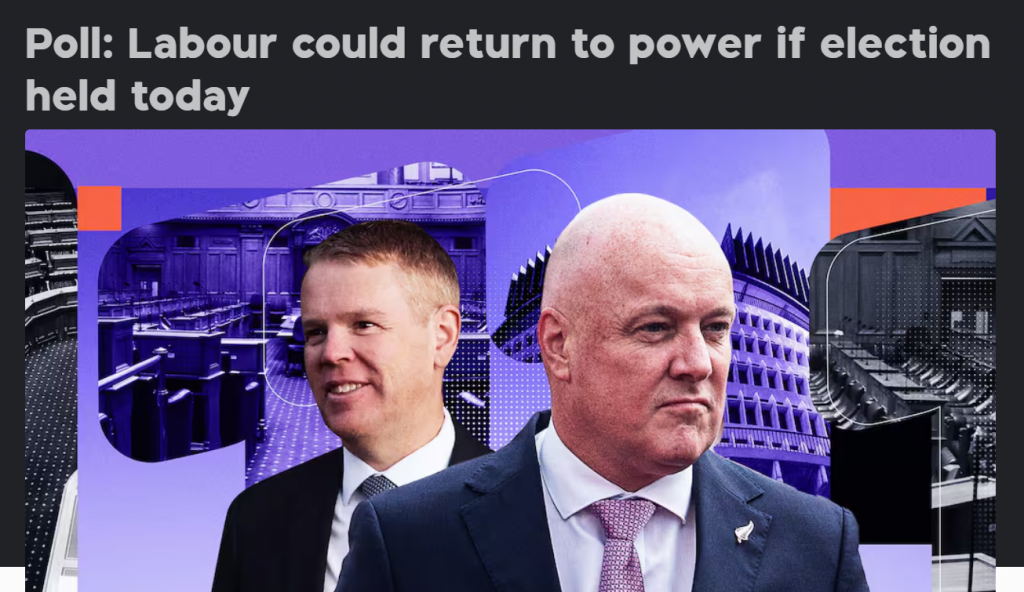
Because of the electoral cycle, a New Zealand Government winning a second term has been a likelihood, and a third term very possible, ever since the end of World War II. But this can no longer be taken for granted. According to recent polling, the 2026 General Election will be very close. If New Zealand First dips below 5%, Labour would easily win that year.

If they do, the comfortable electoral cycle – which is ultimately based on trust and consensus – will have collapsed. Anyone could realistically fancy their chances for 2029: Labour again, National again, or anyone else.

The implications of an open field are tremendous.

For one thing, it could lead to the coming of a truly anti-Establishment force. Currently, anti-Establishment sentiments are channeled into New Zealand First, or absorbed into fringe movements like NZ Loyal and the ALCP. They don’t actually impact the Establishment or their operations.

If dissident voices felt like they actually had a chance to change things, on account of that the Labournational stranglehold was broken, they could enter the political stage in great numbers, and with great enthusiasm. A charismatic leader, backed by committed and competent people, could hope for 20% or more of the vote, as we have seen alternative movements achieve in some European countries.

For another thing, it will all but certainly lead to the further dissolution of support for mainstream politics. The strongest impetus for alternative politics is the sentiment that the Establishment doesn’t know what it’s doing. The political world is comprised of such sentiments. If (or when) the electoral cycle collapses, it would become widely realised that the masses no longer have much confidence in the Establishment. That would open the emotional floodgates to more support for alternative politics.

The collapse of this typical, conservative-to-social democrat electoral cycle has already been observed in some European countries. This has led directly to the 20%+ support for alternative politics mentioned above. In some cases there are multiple genuine alternatives. This is now the case in Germany, with the Alternative for Germany polling around 18% and the Sahra Wagenknecht movement polliing around 7%.

The ultimate theoretical implications of this collapse vary greatly. The Establishment’s Plan B would be to introduce a technocracy ruled directly by bankers, as they achieved in Italy under Mario Draghi. The intent of this plan would be to forestall the Establishment’s worst nightmare, which is that the people take their power back for themselves. A technocracy would avoid any real change.

Another possibility is a stagnation so deeply entrenched that it can only be overcome by a dictator. Once people stop supporting mainstream politics, many of them will stop supporting democracy. After all, the reasoning goes, if democracy only delivers us a choice between two wings of the Establishment, what good is it? If democracy led us to this, then what value is democracy?

If future polls suggest that Labour has a realistic chance of winning in 2026, then we can officially declare the comfortable post-World War II electoral cycle shattered, and the New Zealand political scene truly open for a change to the consensus – or at least a change to what the Establishment wants.

Where that might lead in practice is really anyone’s guess, but we can draw some reasonable conclusions from the examples of other Western countries, almost all of which share our dissatisfaction with the ruling establishment.

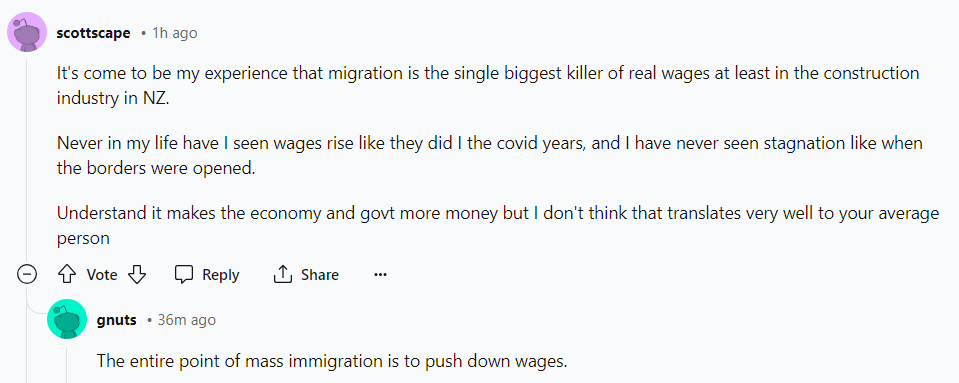
For one, it is likely to lead to a radical change to recent immigration policy. New Zealanders, like most Westerners, followed their mainstream media for decades when it told them that mass immigration would make us all wealthier. Now that the exact opposite has occurred, people are angry about having been lied to. Western rulers will be happy to blame outsiders if they can.

For another, it’s possible that it will lead to radical changes in housing policy. The Anglosphere has a tighter housing supply than other Western countries, which has led to the (intended) result of grossly inflated house prices. This has caused a commensurate amount of dissatisfaction among young people, who would love to redistribute some of the houses the Boomers have hoarded.

*

For more of VJM’s ideas, see his work on other platforms!
For even more of VJM’s ideas, buy one of his books!

*

If you enjoyed reading this piece, buy a compilation of our best pieces from previous years!

Best VJMP Essays and Articles of 2023
Best VJMP Essays and Articles of 2022
Best VJMP Essays and Articles of 2021
Best VJMP Essays and Articles of 2020
Best VJMP Essays and Articles of 2019
Best VJMP Essays and Articles of 2018
Best VJMP Essays and Articles of 2017

*

If you would like to support our work in other ways, make a donation to our Paypal! Even better, buy any one of our books!

VJMP Anzac Day Address 2024: The Common Enemies Of The Anzac Nation

It was recently shown in an IPSOS poll that populist sentiments are becoming common among New Zealanders. These sentiments are mostly shared by Australians as well. Both countries are suffering under a callously indifferent ruling class, who democracy seems only to entrench. One of the best arguments for the unity of the Anzac nation is that Australia and New Zealand have common enemies.

These common enemies are both external and internal.

Externally, the Anzac nation is beset by communists and capitalists, who have subjugated the West under their unholy alliance known as “globohomo”. This alliance is a globalist one. The people who make up the leadership of this alliance have no national home, but rather, like John Key, live wherever profits them the most at any given time.

The communists are a motley alliance of Western grifters, invariably middle-class, who have declared war on the working classes of Western nations on the excuse that those working classes refused to support globalist revolution. They are so lost in the labyrinths of their own ideology that they have lost touch with reality completely: they are willing to deny any science or history if doing so would further globalist revolution.

Communists, especially the brown communists, see Australia and New Zealand as settler nations, and therefore illegitimate constructs. If the lands cannot be handed back to the natives, then they must be converted into the common property of all of humankind. This means that infinite foreigners can be imported, and the Anzac people have no right to complain about it.

The global working class was prophecised to unite across national borders by Marx himself. This prophecy is being engineered by the world’s communists, who feel it their duty to destroy all national borders and all national consciousness, those being impediments to the rise of class consciousness.

The capitalists don’t care so much for ideology. They are chiefly concerned with the sober business of wealth extraction. Their main concern is keeping the immigration taps running on full bore, because that maximises rents and minimises wages. Because they own all the rental property, and because they hire all the workers, the capitalists are the major beneficiaries of mass immigration.

For this reason, the capitalists hate the nations: nations are icky things that tend to come together and form unions and enforce labour laws. Nations tend to care about their members not being able to afford housing. Nations tend to pass laws restricting cheap labour importation. Much better to break the nations up, the capitalists reason, into a mindless herd of individualised consumers, indifferent to each other’s suffering. More profit that way.

Both of these forces, both communist and capitalist, constitute a globalist alliance whose interests are implacably opposed to that of the Anzac nation. As globalists, they seek to disenfranchise and disempower the Anzac nation, to confuse us, to strike us ignorant of our history, and of the legacy our ancestors built with the intention that we would inherit it.

These forces couldn’t care less about the actual people with roots in the soil of the lands of the Southwestern Pacific. The actual Anzac nation. These forces have, in fact, done everything they could to impoverish and tyrannise us. Young Anzacs today have almost no chance of buying homes with money from their wages. Our younger generations today are worse off, in homeownership terms, than young people in countries that were Third World a few decades ago.

Qatar, by contrast to the Anzac countries, gives its citizens housing grants of up to 1,200,000 Qatari reals, about AUD500,000. There are no student loans in Qatar. The Qatari Government appears to operate on a logic similar to that of Scandinavian countries in the 1970s: that investing in their own people will produce great dividends in years to come.

We Anzacs, by contrast, are put to work for monkey wages that will never pay for houses. Forget housing grants – our ruling class imports hundreds of thousands of cheap labour units every year to compete with us for housing. Forget Scandinavian logic also. Investing in our people is considered a loss of profit for this quarter.

These external forces, however, would have very little influence had the Anzac nation not already been losing the battle to internal forces. These internal forces are spiritual ones. It’s as true for us as it was for Fight Club – our Great War is a spiritual war.

This spiritual war involves finding the right balance in all of the various realms of spiritual life. We must find the middle path between rashness and cowardice, between gluttony and melancholy, between pride and debasement. Finding that middle path has been difficult, because we have been pulled to and fro by the adharmic philosophies like Abrahamism and scientific materialism.

It’s time for the Anzac nation to forge our own spiritual path, and therefore our own moral path, through the morass of confusion that has befallen the West in the Post-Truth Age.

For anyone descended from the British, of course, our primary spiritual enemies are nihilism and greed.

The nihilism comes from the great void in the centre of our spiritual life. Young Anzacs are not interested in fables about Rabbi Yeshua, and the old myths about Wotan rising from the mist and fog are too distant for the warm lands of Anzac. The great Anzac spiritualities are yet to manifest; our gods are still, for now, dormant. When a true Anzac spiritual movement arises, and when the Anzac gods rise with it, this rising will banish nihilism from our souls.

The greed comes from the grandiosity that is the inheritance of the British Empire. As with all creations of the City of London, the Anzac countries are operated to turn a profit and not to help the Anzac nation meet their needs of life. A political revolution, on nationalist grounds, would allow us to assert a new set of values: one that puts our life quality higher than the mere generation of dollars.

The common enemies of the Anzac nation are not many, but they are powerful. Communists and capitalists, nihilism and greed provide both outer and inner enemies that we must wrestle with in coming decades. These are powerful foes, and their power incites us to come together, morally and spiritually, as one people.

*

For more of VJM’s ideas, see his work on other platforms!
For even more of VJM’s ideas, buy one of his books!

*

If you enjoyed reading this piece, buy a compilation of our best pieces from previous years!

Best VJMP Essays and Articles of 2023
Best VJMP Essays and Articles of 2022
Best VJMP Essays and Articles of 2021
Best VJMP Essays and Articles of 2020
Best VJMP Essays and Articles of 2019
Best VJMP Essays and Articles of 2018
Best VJMP Essays and Articles of 2017

*

If you would like to support our work in other ways, make a donation to our Paypal! Even better, buy any one of our books!

The Cruelty Is The Point

Many have been surprised by the decisions made by the Sixth National Government. Taking food away from hungry children and giving the money to landlords seems pointlessly cruel. So does ticking up an eleven-figure debt that our grandchildren will labour to settle, just for tax cuts. Perhaps the most egregious is maintaining cannabis prohibition in the face of the mountain of international evidence that it doesn’t work.

What motivates these decisions?

A cursory examination of New Zealand political history shows that previous National governments have also been motivated by cruelty. The Fifth National Government slashed the mental health system and continued to withhold medicinal cannabis. The Fourth National Government slashed the welfare system and destroyed unions. All of these measures were blamed on Labour at the time, but in reality were motivated by simple cruelty.

Cruelty is, in fact, one of the major human motivations. The rush of sadism can be one of the most powerful of all. Ted Bundy once said “When you feel the last bit of breath leaving their body, you’re looking into their eyes. A person in that situation is God!” Similar feelings of grandeur flow through the National MP who cuts food programs for children.

It can be seen from the way that bullies abuse each other at school, psychopathic bosses abuse workers in the office and spouses abuse each other behind closed doors, cruelty and sadism are powerful motivators for action in many different times and places. People wired up this way readily find an outlet in National and ACT party politics.

Once the central motivating role of cruelty in National party psychology is realised, it’s much easier to understand National party policy.

This was seen most evidently during the cannabis referendum. National party supporters, who generally opposed law reform in this area, were not moved by arguments around the immense alleviation of human suffering that easy access to cannabis would allow. To the contrary – National voters, who seldom use cannabis themselves (preferring booze, painkillers and television), understood that cannabis prohibition usually destroyed Other People.

This also explains why National party voters were seldom moved by appeals to the fact that Maoris suffer more heavily than other races from cannabis prohibition. Given that National voters hate Maori people and want them to suffer, why would they then care about Maoris getting locked up because of cannabis prohibition? To the National mindset, that’s more of an argument to support prohibition.

John Ehrlichmann, Presidential Advisor under Richard Nixon, once said: “We knew we couldn’t make it illegal to be either against the war or black, but by getting the public to associate the hippies with marijuana and blacks with heroin, and then criminalizing both heavily, we could disrupt those communities. We could arrest their leaders, raid their homes, break up their meetings, and vilify them night after night on the evening news. Did we know we were lying about the drugs? Of course we did.”

Same deal in New Zealand. Of course the National party and their lackeys like Mike Hosking and Bob McCoskrie know the science. The science has been established for decades: cannabis is medicinal, and any amount of misuse is less harmful than misuse of alcohol. But by lying about it, the National party can target their enemies. Not hippies and blacks, but hippies and Maoris.

National party policy cannot be understood unless it is appreciated that the intent of such policy is to destroy people the National party hates. This is primarily the poor. National hates Maori people more because they are poor than because they are Maori – proof for this assertion comes from the fact that National voters don’t seem to hate Asians.

The central motivating role of cruelty in National party policy can be seen in this year’s benefit cuts. The indexing of benefit increases to inflation instead of wages has cost the average beneficiary $6 per week, which saves the Government a pittance in comparison to what they’re paying out in landlord tax cuts. But it’s not the saving money that motivates such cuts – it’s tightening the stranglehold on beneficiaries.

Nietzsche wrote, in Thus Spake Zarathustra, to “distrust all in whom the impulse to punish is powerful”. There was excellent reason for this. The impulse to punish is fuelled by resentment, which is the basis of slave morality. This impulse is referred to as a “justice boner” in modern Internet parlance, reflecting the fact that its ultimately motivated by pre-human, even reptilian, brain structure.

Unfortunately, the stupidity of Labour and the Greens means that the cruelty of National and ACT is something the rest of us must endure for as long as the two-party democratic system exists.

As long as democracy exists, it will appeal primarily to the lowest common denominator and thereby enable the most bestial and sadistic impulses of humanity. This is why the National and ACT parties have produced, and continue to produce, a parade of sadistic beasts: Shipley, Richardson, Prebble, Key, Brownlee, Bennett, Collins, van Velden et al., ad infinitum.

*

For more of VJM’s ideas, see his work on other platforms!
For even more of VJM’s ideas, buy one of his books!

*

If you enjoyed reading this piece, buy a compilation of our best pieces from previous years!

Best VJMP Essays and Articles of 2023
Best VJMP Essays and Articles of 2022
Best VJMP Essays and Articles of 2021
Best VJMP Essays and Articles of 2020
Best VJMP Essays and Articles of 2019
Best VJMP Essays and Articles of 2018
Best VJMP Essays and Articles of 2017

*

If you would like to support our work in other ways, make a donation to our Paypal! Even better, buy any one of our books!