

The Alt Centrist Approach To Taxation

Taxation is symbolic of the imposition of order, and therefore of the Establishment Right. Everywhere there was a king, there was also a taxman. For a political body to operate on a higher level, there have to be taxes, as anyone who doesn’t successfully collectivise gets wiped out by those who do. Thus, the kind of natural selection that operates at the human group level has selected for groups that can successfully levy taxes.

Without taxation, it’s impossible for a political entity to impose the order that it needs to survive at the collective level. Thus the Alternative Centrist has no time for the argument that taxation is theft. This is the narrative of a child who doesn’t want to share its toys. It’s a fundamentally unserious narrative for people who have never thought about things.

Related to this, the Alternative Centrist believes that it’s morally impermissible to tick up a debt today and pass it down to one’s grandchildren. All the bleating about taxation being theft doesn’t mean it’s okay to pass the theft onto one’s descendants. Taxes must be high enough to cover government spending, currently some USD7.1 trillion in the case of America and NZD183 billion in the case of New Zealand.

The Fourth Acceptance of Alternative Centrism emphasises the importance of truth. The truth is that some ways of earning, investing and spending income are more prosocial than others. The Alternative Centrist buys the argument that taxation is a useful tool for modifying behaviour: in fact, it’s almost as good as the law. If some ways of gaining money are borderline criminal, there’s no shame in taxing them hard.

Most people can agree that working a normal job is prosocial. Some jobs are dirty or dangerous and the people doing them are really at the coal face of society. Many jobs are downright depressing, but need to be done. Other jobs are tedious in a manner that is harmful for mental health, but also need to be done. People who do these jobs generally don’t get paid much, so they also ought not to get taxed much.

The usual approach here is a progressive income tax system. The two problems with this are: progressive income tax systems are disorderly (i.e. expensive to administrate) and they tend to hammer the hardest workers.

The Alternative Centrist solves these problems in two ways.

The first is a moderate tax-free threshold, roughly equal to what a person would get on an unemployment benefit (i.e. the minimum one can live on). This is mostly for the sake of order: there is no point in taxing someone to just give the same money back in services that people wouldn’t have needed if taxation hadn’t impoverished them. Most Western countries do this, but it’s pointless and inefficient. Much better to have a tax-free threshold near the amount of money that a person needs to survive.

The second is a flat tax. Flat tax proposals appeal to the Alternative Centrist sense of justice, because they do not penalise hard workers and high achievers. A so-called progressive income tax system penalises working long hours, which is in theory the sort of prosocial activity that ought to be encouraged.

The argument that low taxes (a typically right-wing concern) are pro-freedom (a typically left-wing concern) is rejected as money worshipping. However, the Alternative Centrist approach is to tax labour lightly, on the grounds that it is the most prosocial way to make an income. This is in accordance with the Fifth Acceptance.

The Alternative Centrist approach also suggests that unearned income should be taxed much more than earned income, on the grounds that earning an income is more prosocial than receiving one without earning it.

Unearned income in the form of rent is the most antisocial. The French economist Jean-Baptiste Say observed that “Landlords’ right has its origin in robbery.” The argument that landlords “provide” housing is summarily rejected: it’s like claiming that armed robbers provide health. As the most antisocial legal way to make money, rental income needs to be taxed heavily.

The Georgist solution to rental income is excellent.

Residential and commercial rents in the United States are estimated to bring in USD$2.2 trillion every year. If we assume that the ground rental value of these rents is about a third of that, an 80% tax on those ground rents ought to yield some USD$600 billion p.a.

Existing land tax proposals (c.f. that of New Zealand’s Opportunity Party) often make the error of taxing the family home. The error here is in destroying security of household tenure. If the household is the basis of society, then security of household tenure is the basis of the order of that society. This goes against the First Acceptance. The Alternative Centrist would rather see massive taxes on income from ground rents than taxes on a family home.

Wealth taxes are discouraged by the Alternative Centrist. Unlike land taxes, wealth taxes can be avoided by taking the wealth overseas. Thus they are rejected on the grounds they lead to disorder. Inheritance taxes on family homes are rejected for the same reason: breaking up family homes to pay inheritance taxes is grossly disorderly (inheritance taxes on investment properties would be severe though).

Earning money from investments is still prosocial, but not as much as working. Thus, dividends on stocks and shares would be taxed moderately under an Alternative Centrist system. Capital gains would also be taxed moderately under this logic. To get around the problem of tax havens, the Alternative Centrist approach is to work towards international minimum corporate tax agreements.

Moderate consumption taxes are supported by the Alternative Centrist. Consumption isn’t antisocial, but an excess of it is, and therefore taxes on consumption ought to be moderate. They can also bring in significant amounts of money, lightening the burden on workers. Transaction taxes are also considered good when and if they are workable. The concern is that they can be easily avoided, which is both disorderly and stupid.

Following the reasoning that taxation can guide behaviour, the Alternative Centrist approach to taxation involves heavy vice taxes.

Alcohol taxation brings in USD11 billion for the American federal treasury every year. Texas brings in USD1.6 billion in alcohol taxation annually for a state with around 9% of America’s population, and this revenue is generally considered typical per capita alcohol tax revenue for an American state. Extrapolating that across 50 states, and adding federal revenue, suggests some USD30 billion p.a. is currently gathered through alcohol taxes.

The examples of American states that have already legalised cannabis suggest that every million people can yield USD50 million in annual cannabis taxes. So a population of 350 million could yield over USD17 billion p.a. Taxes on cannabis consumption could bring in NZD490 million p.a. in the case of New Zealand, according to the New Zealand Institute of Economic Research.

Significant gambling wins would also be heavily taxed. There is no need to tax gambling wins below a certain threshold, but professional gamblers would be taxed moderately and those receiving huge windfalls would be taxed heavily.

These vice taxes would not bring in that much money, perhaps 2% of government spending at most. The point of them is primarily to use the tool of taxation as a way of imposing good order upon society; there is more to taxation than just government revenue.

Realistically, even with all of these measures, much of the tax burden will have to fall on workers. Even with AI and mass automation, this is inescapable. On account of the sheer volume of the masses, the bulk of economic activity consists of everyday workers. This will have to be taxed to some extent to keep the national machine running. But, with all the measures outlined above, the tax burden on workers should be minimal.

The general principle is threefold: light taxes on labour, moderate taxes on investment and consumption, heavy taxes on vices and unearned income.

*

This chapter is from The Alternative Centrist Manifesto, the upcoming work of political philosophy that offers the answers to the political problems of the West.

*

For more of VJM’s ideas, see his work on other platforms!
For even more of VJM’s ideas, buy one of his books!

*

If you enjoyed reading this piece, buy a compilation of our best pieces from previous years!

Best VJMP Essays and Articles of 2024-25
Best VJMP Essays and Articles of 2023
Best VJMP Essays and Articles of 2022
Best VJMP Essays and Articles of 2021
Best VJMP Essays and Articles of 2020
Best VJMP Essays and Articles of 2019
Best VJMP Essays and Articles of 2018
Best VJMP Essays and Articles of 2017

*

If you would like to support our work in other ways, make a donation to our Paypal! Even better, buy any one of our books!

In Defence Of Mike King, And Of Alcohol

New Zealand mental health awareness campaigner Mike King copped mountains of abuse for saying that “alcohol has prevented more young people from taking their own lives than it makes them take their own lives.” This provoked outrage from the usual wowsers, psychopaths and control freaks. But there is great truth behind this hard-earned wisdom.

I worked as a bartender for eight years. In that time I saw alcohol ruin many people. I was assaulted several times and no doubt the alcohol I sold contributed to countless acts of domestic violence. It might have caused a million dollars of physical health damage, and a million dollars of lost productivity from hangovers or absentee days.

It also had some great effects.

In those eight years I saw a lot of people who were barely hanging on come through the doors. People who were deeply depressed, stressed, anxious, even despairing. And I saw that, for a lot of these people, the promise of getting a buzz from alcohol was helping to keep them going. The daily life was unpleasant, but it could be endured because, after it, a good time could be had with a few drinks.

Some of the patrons would even admit as such. For them, a drink was the finish line of the day, time to celebrate and say Yes to life again. I am certain that the alcohol I sold prevented several million dollars’ worth of depression thanks to providing the sociability that led to great mirth and great memories for hordes of people. The average bartender, in my experience, does as much good for mental health as the average psychiatrist.

Mike King has been close enough to suicide to know that, when you’re on the edge, it’s often small things holding you back, like an occasional moment of mirth.

This might be impossible to understand for anyone who has never been mentally ill. But if you have ever felt enduring suicidal ideation, you may have also discovered that getting drunk can stop those thoughts for a while. I have broken multiple bones, and the suffering of suicidal ideation tops them all. It doesn’t take much of it before one starts thinking about a permanent solution. Alcohol can provide blessed relief from such thoughts.

Sometimes, when your mental health is so low that you know you can’t endure the suffering forever, the promise of the next drink can be what’s stopping you ending your life. Just the simple knowledge that solace can eventually be had, in the form of a pint, can be enough to keep taking one step after the next. Drinking alcohol can reclaim enough power over your own mental health to make you say Yes to life again.

Mike King understands this, because he’s been low enough to need to find reasons to stay alive. He ought to be respected for the insight that he has brought back from the psychiatric underworld. Instead of ripping down someone who has stood so close to the edge, we ought to listen (if with scepticism). This is especially true for people with no personal experience of depression.

This defence is not intended to excuse my own conduct. For many years now, I have hardly used alcohol at all – only for celebrations once every few months, and even then in moderation. I am therefore not a drinker but neither am I an abstainer. I argue that this middle way, plus my bartending experience, makes my opinions more objective.

I also have extensive experience with antidepressant use – I have taken five different ones, off and on, for 30 years. What people need to realise about antidepressants is that they, at best, only mildly alleviate depression, and even then they work as a background substance. You can’t take an antidepressant as an emergency fix for an acute suicidal mood. If you’re going to attempt suicide in the next half an hour, and only an antidepressant or alcohol can save you, alcohol will be by far the most effective short-term fix.

That’s not to say alcohol is a long-term fix; in the long term, drinking alcohol will make you more depressed. Not only is it an actual depressant, but it causes an astonishing range of physical health ailments (see Prof. David Nutt’s Drink? for more).

Alcohol is definitely a second-rate drug. But the popular claim (often repeated in the mainstream media) that it only causes harms, and has no benefits, is ridiculous. In any case, most people who chimp out on it could have been encouraged to use weed or MDMA, if only either were legal. Most of the harms of alcohol would be ameliorated if people had access to less harmful recreational drugs, because those would serve as exit drugs for alcohol users to transition away. It’s hypocritical to complain about alcohol harms while also criminalising all the exit drugs from alcohol.

The ideal arrangement would be a properly-funded mental health system, which would include training people in trauma-based therapy and de-emphasising the biomedical model, and a sensible drug policy based on scientific evidence of relative drug harms.

*

For more of VJM’s ideas, see his work on other platforms!
For even more of VJM’s ideas, buy one of his books!

*

If you enjoyed reading this piece, buy a compilation of our best pieces from previous years!

Best VJMP Essays and Articles of 2024-25
Best VJMP Essays and Articles of 2023
Best VJMP Essays and Articles of 2022
Best VJMP Essays and Articles of 2021
Best VJMP Essays and Articles of 2020
Best VJMP Essays and Articles of 2019
Best VJMP Essays and Articles of 2018
Best VJMP Essays and Articles of 2017

*

If you would like to support our work in other ways, make a donation to our Paypal! Even better, buy any one of our books!
Low-IQ Morality Vs. High-IQ Morality

All of the debates around morality can be summarised by reference to one of two schools of thought. There is a low-IQ morality, and a high-IQ morality.

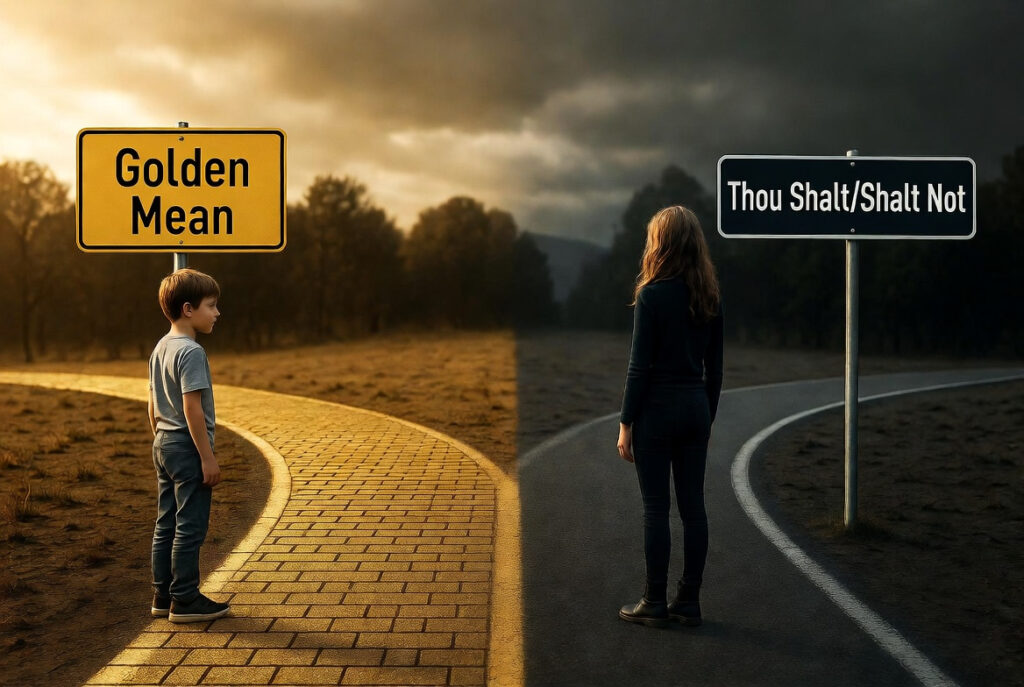
Low-IQ morality is binary. It is “thou shalt” and “thou shalt not”. No thought is required to follow it – children and slaves could both easily understand. The essence of low-IQ morality is simplicity. The fear is that, if morality was too complicated, it would just be ignored.

Those following low-IQ morality speak as if life was a battle between their morality and evil. Everything outside of themselves and their mindset is evil. They even consider high-IQ morality evil, on the grounds that the nuance of high-IQ morality fails to provide a sufficiently firm defence against the dark forces of the world.

High-IQ morality is ternary, with an extra dimension compared to binary morality. High-IQ morality is “deficiency”, “mean” and “excess”. This is the morality of Aristotle, Buddha and Confucius: the Doctrine of the Mean or the Middle Way. It is moral philosophy for adults.

Those following high-IQ morality understand that life is more subtle than low-IQ people can appreciate, and that black-and-white thinking is usually low-resolution and inaccurate. Worse, the us-and-them mentality inherent to binary morality leads to vendettas, bloodfeuds and all-out wars as people hunker down against the out-group.

Despite this, high-IQ morality doesn’t see low-IQ morality as necessarily evil. Socrates, for example, argued that human misdeeds were the result of ignorance rather than evil. The low-IQ are considered more in need of guidance than punishment.

The most common low-IQ moralities in the world are the Abrahamic religions. These are the archetype of “thou shalt” mentality. They threaten eternal hellfire and brimstone, in contrast to the subtle punishments of the high-IQ moralities, which warn of less happiness. There are billions of followers of Abrahamic religions, mostly in low-IQ scumholes.

Wokism is also a form of low-IQ morality, in that it has an endless list of things that people aren’t allowed to do or say (or even think). The exaggerated sense of caution that people are forced to adopt today is common to both the wokist regime and the Soviet Union. One must live in constant fear of moral judgment, for the slightest error might see one, like Solzhenitsyn, sent to the gulag (the wokist equivalent being cancellation).

Atheist materialism is also a binary morality, because it amounts to following the herd. The morality can be summed up as “The herd is natural, and therefore the herd is good”. Atheists consider themselves to have transcended low-IQ morality, but in reality they have just exchanged one form of it for another: the “thou shalt” comes from groupthink instead of a priest.

High-IQ moralities are rare in the West. Very few people have read the Nicomachean Ethics, much less applied it. Many high-IQ people are aware that Buddha promoted a philosophy called the Middle Way, but not many have tried meditating every day for a month. Those who do apply a high-IQ morality to their lives, however, are the world’s true master race.

The West generally acts as if “more is always better”, which is, in fact, a low-IQ morality. It’s presented to us as masculine and assertive, but is really the mentality of a baby grasping for the tit. A high-IQ morality would resist mindless consumption while still saying Yes to life. Unfortunately, it’s not easy to see the rise of a movement that can achieve this before the system collapses.

Many people stumble upon something like the doctrine of the mean, but make little use of it. After all, children often learn with their first bee sting that too much bravery is as bad as too little. But high-IQ morality will never become popular, because the masses are low IQ. Perhaps 5% of the population can fully apply high-IQ morality under normal circumstances. This may have been as high as 25% in Aristotle’s time and might be as low as 1% in today’s Clown World.

Binary morality is better for low-IQ people because it’s simpler to apply. The difficulty with ternary morality is that it requires a lot of thought to know where the right middle ground is (as Aristotle wrote in Nicomachean Ethics, the correct middle ground is sometimes closer to one extreme than to the other). Trying to teach ternary morality to low-IQ people would just confuse them.

Perhaps the best approach is to teach binary morality to children, and then teach ternary morality once the children hit about 15 years of age. If a person isn’t smart enough to understand ternary morality, they can be taught a binary form until the end of their schooling. The difficulty is that existing low-IQ moralities (e.g. Christianity) are no longer persuasive, so a new one will have to be invented.

People ought to adopt a high-IQ morality if they can, but there are so many low-IQ people that humanity has to make do.

*

For more of VJM’s ideas, see his work on other platforms!
For even more of VJM’s ideas, buy one of his books!

*

If you enjoyed reading this piece, buy a compilation of our best pieces from previous years!

Best VJMP Essays and Articles of 2024-25
Best VJMP Essays and Articles of 2023
Best VJMP Essays and Articles of 2022
Best VJMP Essays and Articles of 2021
Best VJMP Essays and Articles of 2020
Best VJMP Essays and Articles of 2019
Best VJMP Essays and Articles of 2018
Best VJMP Essays and Articles of 2017

*

If you would like to support our work in other ways, make a donation to our Paypal! Even better, buy any one of our books!

Don’t Throw The Spiritual Baby Out With The Abrahamic Bathwater!

The Western World is atheist today. This is presented as a natural development, religion being considered a remnant of a by-gone age. But the development of religious belief in the West is anything but natural.

It’s not natural for anyone to be atheist. Atheism is, in fact, a degeneracy. Plato, in Laws, prescribed the death penalty for atheism, reasoning that it was a form of spiritual corruption that threatened to rot society. The more corrupt a nation’s spiritual practice is, the more atheists it has. In ancient Athens, there were so few atheists they could be put to death with little disruption. In the West of 2026, there are so many atheists that anyone who expresses a genuine belief in God is diagnosed with schizophrenia and medicated.

Historically considered, this is a highly unnatural situation. It has come about because atheism is a natural reaction to having spiritual lies forced on a people. If people grow up being told spiritual lies, a certain proportion of them will instinctively reject those lies, and, without finding spiritual fulfillment in something else, will regress into atheism.

The Western World had its own native religions before Christianity. The Greek, the Roman and the Nordic pantheons were the natural expressions of European spirituality for millennia. These pantheons served us well during the ages of Alexander and Trajan. Unfortunately, because of the degeneracy that inevitably follows success, Rome submitted to Abrahamic religion in the form of Christianity. The Dark Ages ensued.

After the Dark Ages, it proved impossible to shake off the remnants of Christianity. Superstition ensured that the cult survived and maintained its death grip over Europe. Eventually, with the Renaissance, Christianity began to weaken. People started to question it.

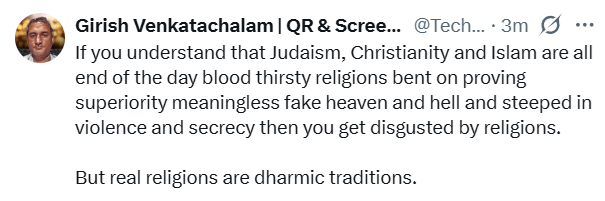
The horrors of Christianity led to an over-reaction against anything perceived to be religious. As the image at the top of this article suggests, many people are so disgusted by the violence and lying of Abrahamic religions that they have been turned off spirituality altogether. Many have concluded, understandably but in haste, that if Abrahamism is what religion is, then religion is evil.

The truth is that proper religion is a great and wonderful thing. It liberates beings from their suffering by returning them to God, the only true source of happiness. As such, it often makes life bearable in cases where it would not have been. It’s only the Abrahamic religions that have perverted this beauty, turning religion into a vehicle for political control.

Growing up in the West, people are presented with Christianity as if it were “their” religion. Then they grow up a bit more, and read about the Inquisition, the French Wars of Religion, the Thirty Years’ War, then learn about Christian support for circumcision, the War on Drugs, endless Middle Eastern wars, and realise that Christianity is evil. Some people realise before then, as an instinctive reaction against the brainwashing and sadistic pressure to submit and conform. It’s true that Christianity is evil. But the problem is, when people realise this, they often reject spirituality full stop, and become atheists.

Many people in the West today are unable to think about morality or ethics at all, because they associate such things with Christian hectoring and badgering (not to mention Christian hypocrisy and lying). Having been told that all morality comes from Rabbi Yeshua, the tendency is for people, when they reject the Magic Rabbi, to reject morality also. The end result: they follow animal impulses instead. The societal consequences of throwing the spiritual baby out with the Abrahamic bathwater are obvious.

Abrahamism is evil, and must be eradicated for the human race to thrive. But, before this can be possible, people must understand that the Abrahamisms are political religions and not spiritual ones. Spiritual religions cannot be judged on the flaws of political religions. Spirituality existed before the Abrahamisms and will exist afterwards. It stands alone, sufficient.

The Abrahamisms may have conquered a large proportion of the world, and in doing so normalised themselves to billions of people, but that doesn’t make them honest depictions of spiritual truth. They are dying, all around the world, as the Internet has made truth freely available. As they disappear, and get replaced by atheism and other beliefs, the Dharmic religions will return.

The Dharmic religions include Hinduism, Buddhism, Sikhism, Taoism, Confucianism, Shintoism, Elementalism and many others. These religions are variations on what Aldous Huxley called the perennial philosophy: the eternal spiritual truth that has been passed down throughout history in many forms. In the future, the world will see the return of these religions. This is as inevitable as night turning back to day.

The most important lesson Westerners need to learn right now: spirituality is real, Abrahamism is false, and true spirituality will return as Abrahamism dies.

*

For more of VJM’s ideas, see his work on other platforms!
For even more of VJM’s ideas, buy one of his books!

*

If you enjoyed reading this piece, buy a compilation of our best pieces from previous years!

Best VJMP Essays and Articles of 2024-25
Best VJMP Essays and Articles of 2023
Best VJMP Essays and Articles of 2022
Best VJMP Essays and Articles of 2021
Best VJMP Essays and Articles of 2020
Best VJMP Essays and Articles of 2019
Best VJMP Essays and Articles of 2018
Best VJMP Essays and Articles of 2017

*

If you would like to support our work in other ways, make a donation to our Paypal! Even better, buy any one of our books!