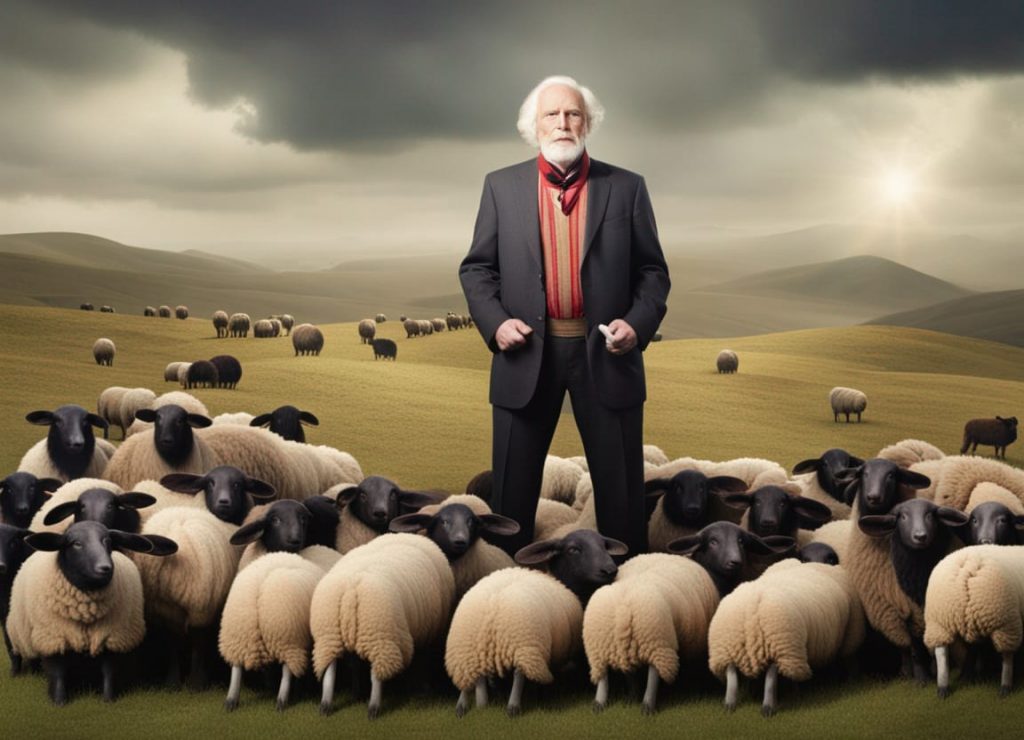
Xu Xiaodong is a Chinese MMA fighter and wind-up merchant who has gained fame for making fools out of bullshit artists. This has made him a target for the ire of the CCP, who have punished him through use of the Chinese social credit system. Xu’s example provides a cautionary tale about what might be coming the way of New Zealand dissidents.
In particular, Xu has made a fool out out of several supposed martial artists, who claimed to be teaching useful martial skills but who were really just fraudsters. He has challenged several of them to bouts, which he invariably wins within 30 seconds.
This has upset the CCP because they consider the promotion of kung fu and tai chi to be in China’s cultural interests, and therefore that Xu’s actions are harming those interests by making people take kung fu and tai chi less seriously. Xu echoes the master morality of preferring the painful truth to the comfortable lie, in contrast to the slave morality of the CCP.
The most egregious thing about the CCP’s actions here is that Xu is revealing and destroying falsehood. He isn’t telling lies or making outrageous moral pronouncements. He isn’t going around saying that the CCP are evil and should be overthrown. He’s just telling the truth about the ineffective nature of certain traditional martial arts.
Xu Xiaodong is of the same spirit as the men who said that the Earth rotates around the Sun, and who were persecuted for it.
Simply for exposing the truth, Xu is suffering social credit penalties that have a significant impact on his life. One story holds that Xu had to travel for 36 hours without rest to get to the location of one of his fights, because he had been banned from planes and trains. He has also been forbidden from renting rooms in certain hotels.
If New Zealand ever introduces a central bank digital currency (a.k.a. a CBDC), they will have a similar power to suppress dissenters.
The Chinese system already allows the CCP to, for example, switch off a person’s ability to buy alcohol. A New Zealand social credit system based on a CBDC could easily achieve the same ends. Criticise the Government? No alcohol, tobacco or flights for you. No renting a room outside of your delegated containment zone.
A CBDC-based social credit system in New Zealand would also mean that, in the case of a repeat of last year’s Parliament Lawn protests, the New Zealand Government could simply shut off the bank accounts of anyone observed protesting. They could also pre-empt protests from starting by blocking known protesters from accessing the transport necessary to take them to Wellington.
It could mean that the people running alternative media channels like CounterSpin and VJM Publishing could be prevented from owning property, as is currently the case in China for people with the lowest ratings. We could even be prevented from legally accessing the Internet.
New Zealand is already getting close to a situation where a Kiwi cannot hold a government office unless they parrot known lies about the Treaty of Waitangi being a partnership agreement. A social credit system in New Zealand would mean that you have to agree with the Government, even when it’s wrong, or face a penalty.
Imagine not being allowed to take domestic flights because you disagreed with co-governance, or the mass importation of cheap labour, or cannabis prohibition, or any one of the numerous evils that the New Zealand Government inflicts upon its long-suffering people.
The control freaks that forced the Covid mandates on us would love nothing more than to have another go. We already know that they’re planning a CBDC that central governments could use as a social credit system to silence dissenters. Some likely proposals are based on carbon credits, such that each person is allocated a set number of credits per set time period and can lose credits for displeasing the Government.
There are two major ways that freedom-lovers can fight against this.
The first is to raise awareness that it is happening. It’s not schizophrenia to say that powerful ruling-class interests are conspiring to strip rights and freedoms away form the masses. Ruling classes have always done that, all throughout history. The CBDC is just another step towards a Chinese-style social credit system. Make people aware of this.
The second is to explore alternative economies. Sometimes (but not always) this includes criminal ones. The black market has always existed to meet the needs of those who have been ostracised by tyrants. As entheogen users could tell you today, it still does. In any case, people can practice barter or trade for silver bullion without needing to become criminal.
What the case of Xu Xiaodong teaches us is that the tyrannical impulse on the part of the world’s ruling classes never goes away – it simply takes new forms depending on the technology available to it. The Covid mandates showed that the will to totalitarianism still exists among our ruling class. Letting them control us through a social credit system is the last thing the New Zealand nation needs.
The Advance NZ Party was one of the most interesting phenomena of the 2020 General Election. We at VJM Publishing were among the first to document the rise of Billy TK and Jami-Lee Ross’s populist vehicle. Ultimately, they won 28,429 party votes, giving them 1.0% of the total, and did not win an electorate seat, and therefore failed to get into Parliament.
In short, most Advance NZ voters were poorly-educated Boomers.
Variable
Advance NZ vote 2020
No qualifications
0.65
Level 1 certificate
0.74
Level 2 certificate
0.71
Level 3 certificate
-0.04
Level 4 certificate
0.78
Level 5 diploma
0.56
Level 6 diploma
-0.12
Bachelor’s degree
-0.71
Honours degree
-0.63
Master’s degree
-0.66
Doctorate
-0.54
There were very strong positive correlations between voting Advance NZ in 2020 and belonging to any of the three lowest educational groups. The correlation between having no academic qualifications and voting Advance NZ in 2020 was 0.65, and with having only NZQA Level 1 or 2 the correlations were even more strongly positive.
The correlations between voting Advance NZ in 2020 and having a university degree, by contrast, were all -0.54 or greater. The correlation between having a Bachelor’s degree in particular and voting Advance NZ in 2020 was -0.71, revealing that very, very few people from this demographic found any appeal in AdvanceNZ.
Advance NZ actually had the most poorly educated voters of any party. Even ALCP, New Zealand First, ONE Party and Vision NZ voters were more likely to have advanced past the lowest NZQA levels, as well as being more likely to have a university degree.
The obvious explanation for this is that the Advance NZ campaign appealed specifically to the gullible and easily manipulated. Those capable of telling truth from lies were generally aware that Billy TK and Jami-Lee Ross were charlatans.
Variable
Advance NZ vote 2020
20-24 years old
-0.43
25-29 years old
-0.47
30-34 years old
-0.55
35-39 years old
-0.65
40-44 years old
-0.49
45-49 years old
-0.24
50-54 years old
-0.00
55-59 years old
0.28
60-64 years old
0.30
65-69 years old
0.33
70-74 years old
0.29
75-79 years old
0.22
80-84 years old
0.11
85+ years old
-0.04
Boomers supported Advance NZ more than any other demographic did. All of the age brackets in the Boomer generation (i.e. those aged between 55 and 74 years old) had a significant positive correlation with voting Advance NZ in 2020. By contrast, all of the age brackets under 50 years of age had a significant negative correlation with voting Advance NZ in 2020.
It may seem strange that support for Advance NZ was so strong among Boomers but much weaker among those in older generations. The reason for this is because Advance NZ mostly recruited online, and therefore recruited many of the “terminally online” Boomers that have voted for anti-Establishment parties in other countries.
The reason for this is probably education. There are a lot of Boomers in New Zealand who are poorly educated but who lack the humility to understand that. As such, they are especially vulnerable to hysteria, especially of the religious kind that Billy TK was pushing.
Variable
Advance NZ vote 2020
No religion
0.33
Buddhism
-0.69
Christianity
-0.29
Hinduism
-0.54
Islam
-0.55
Judaism
-0.49
Maori religions
0.63
Spiritualism and New Age
0.44
Perhaps surprisingly, then, given the correlations between voting Advance NZ in 2020 and being poorly-educated and old, and given Billy TK’s preacher’s persona, there were relatively few Christians among Advance NZ voters. The correlation between voting Advance NZ in 2020 and being Christian was, in fact, significantly negative, at -0.29.
There was a significant negative correlation between voting Advance NZ in 2020 and being any of Christian, Buddhist, Hindu, Muslim or Jewish. By contrast, there were significant positive correlations between voting Advance NZ in 2020 and having no religion (0.33), being a Spiritualist or New Ager (0.44) or following one of the Maori religions (0.63).
What explains these correlations is that most Christians, Buddhists, Hindus, Muslims and Jews are foreign-born, and most Spiritualists, New Agers or followers of Maori religions are New Zealand-born, and Advance NZ voters were very likely to be New Zealand-born.
Variable
Advance NZ vote 2020
New Zealand-born
0.72
Advance NZ had the highest proportion of New Zealand-born voters of any party in 2020, even more than the ALCP. The main reason for this is probably that Advance NZ had two Maori leaders. As New Zealand First has shown for a few decades, foreign-born voters don’t like to vote for Maori leaders.
Given that the immigration system favours young and well-educated people, it follows naturally that a party with a poorly-educated and old demographic will have disproportionately many New Zealand-born voters.
Variable
Advance NZ vote 2020
ACC or private work insurance
0.78
NZ Super or Veteran’s pension
0.33
Jobseeker Support
0.55
Sole Parent Support
0.49
Supported Living Payment
0.32
Student Allowance
-0.33
There are significant positive correlations between voting Advance NZ in 2020 and being on any main benefit apart from the Student Allowance. The most extreme was between voting Advance NZ in 2020 and being on ACC or private work insurance, which was 0.78. There was a significant negative correlation between voting Advance NZ in 2020 and being on the Student Allowance, however.
These correlations can be easily explained by degree of disenfranchisement.
As previous analyses in this volume have shown, people who receive the Student Allowance recipients are unlike other beneficiaries.
People on the Jobseeker Support, the Sole Parent Support or the Supported Living Payment are some of the most disenfranchised in all of society. People on the Student Allowance, by contrast, tend to be from middle-class families, as it’s mostly middle-class families who produce the sort of children who aspire to tertiary education.
As a result, Student Allowance recipients often vote like highly educated and highly productive people, despite being beneficiaries, who are usually neither. This explains why there is a significant negative correlation between receiving a Student Allowance and voting Advance NZ in 2020, at the same time as a significant positive correlation between receiving any other benefit and voting Advance NZ in 2020.
Variable
Voting Advance NZ 2020
Voting Labour 2020
-0.19
Voting National 2020
-0.13
Voting Greens 2020
-0.36
Voting ACT 2020
0.02
Voting New Zealand First 2020
0.71
Voting New Conservative 2020
0.12
Voting TOP 2020
-0.36
Voting Maori Party 2020
0.47
Voting Sustainable NZ 2020
-0.17
Voting ALCP 2020
0.68
Voting TEA Party 2020
-0.47
Voting Heartland NZ 2020
-0.01
Voting Social Credit 2020
0.30
Voting NZ Outdoors Party 2020
0.51
Voting ONE Party 2020
0.39
Voting Vision NZ Party 2020
0.34
The outsider nature of the Advance NZ movement can be easily seen from the fact that voting Advance NZ in 2020 was not significantly positively correlated with voting for any of the four major parties in 2020. Voting Advance NZ in 2020 and voting Greens in 2020 was significantly negatively correlated, at -0.36. The only positive correlation of these four was between voting Advance NZ in 2020 and voting ACT in 2020, which was not significant at 0.02.
These four correlations underline the extent to which Advance NZ was a protest movement that looked for votes from otherwise disenfranchised people.
Supporting this conclusion are the strong correlations between voting Advance NZ in 2020 and voting for any of the other traditionally protest parties. With voting NZ First in 2020 the correlation was 0.71, with voting ALCP in 2020 it was 0.68, with voting NZ Outdoors Party in 2020 it was 0.51 and with voting Maori Party in 2020 it was 0.47.
The parties whose voters were least like Advance NZ voters were the highly urbanised ones. The correlation between voting Advance NZ in 2020 and voting for another party in 2020 was -0.47 in the case of the TEA Party, and -0.36 in the case of either TOP or the Greens.
Variable
Voting Advance NZ 2020
European
0.19
Maori
0.63
Pacific Islander
-0.21
Asian
-0.69
The four correlations in the table above demonstrate that support for Advance NZ in 2020 was more complicated than just education.
The fact that Advance NZ voters tended to be poorly educated might explain why there is a strong positive correlation between voting Advance NZ in 2020 and being Maori (who tend to be poorly educated) and a strong negative correlation between voting Advance NZ in 2020 and being Asian (who tend to be well educated).
However, if education level was the only predictive factor, it would be impossible to explain why the correlation between voting Advance NZ in 2020 and being European (0.19) was positive whereas the correlation between voting Advance NZ in 2020 and being a Pacific Islander (-0.21) was negative.
The truth is that Advance NZ voters tended to come from the disenfranchised nationalist underclass that also produces a lot of New Zealand First voters. Hence, the presence of Advance NZ in the 2020 General Election may have been one of the reasons for the relatively poor New Zealand First result that year.
Variable
Voting Advance NZ 2020
Living in an urban electorate
-0.56
This chapter so far has already established the outsider nature of Advance NZ voters. Given that, it’s little surprise to see a strong negative correlation between voting Advance NZ in 2020 and living in an urban electorate. Advance NZ voters are as physically outside of society as they are emotionally outside it.
Indeed, the strongest negative correlation between living in an urban electorate and voting for any party in 2020 was with voting Advance NZ, at -0.56. This was even stronger than the correlations between living in an urban electorate and voting for other outsider parties such as New Zealand First or Outdoors NZ in 2020 (both parties -0.43).
This, perhaps more than any other statistic, underlines the extent to which Advance NZ voters live far away from the levers of power. Their sudden rise could be taken as a sign that there is significant dissatisfaction with the way New Zealand is being run, and their fall is good news for the other protest parties and for New Zealand First in particular, who stand to pick up the voters.
Variable
Voting Advance NZ 2020
Working as a manager
0.04
Working as a professional
-0.61
Working as a technician or trades worker
0.31
Working as a community or personal services worker
0.38
Working as a clerical or administrative worker
-0.48
Working as a sales worker
-0.36
Working as a machinery operator or driver
0.31
Working as a labourer
0.63
Fitting with the picture of Advance NZ voters as poorly educated, there was a strong negative correlation of -0.61 between voting Advance NZ 2020 and working as a professional. However, there was also a significant negative correlation between voting Advance NZ in 2020 and working as a clerical or administrative worker (-0.48) or a sales worker (-0.36), which are not typically highly-educated professions.
The explanation for this apparent paradox is that Advance NZ did poorly among typically urban professions in general, because urbanites tend to be “in” (the system) whereas rural dwellers tend to be “out” of it.
Consequently, there was a significant positive correlation between voting Advance NZ in 2020 and working in a number of typically disenfranchised professions, such as labourer (0.63), community or personal services worker (0.38), machinery operator or driver (0.31) ot technician or trades worker (0.31).
The most difficult correlation to explain is that of voting Advance NZ in 2020 and working as a manager (0.04). On the one hand, managers are not disenfranchised, and are therefore unlike the typical Advance NZ voter. But on the other hand, managers don’t usually need to be well-educated, rather determined and stress-tolerant. So in comparison to those who work as professional, managers are more likely to fall for huckstering.
Variable
Voting Advance NZ 2020
Working in agriculture, forestry or fishing
0.54
Working in mining
0.38
Working in manufacturing
0.25
Working in electricity, gas, water or wastewater
0.20
Working in construction
0.45
Working in wholesale trade
-0.45
Working in retail trade
0.06
Working in accommodation or food services
-0.04
Working in transport, postal or warehousing
0.14
Working in information media or telecommunications
-0.58
Working in financial or insurance services
-0.64
Working in rental, hiring or real estate services
-0.21
Working in professional, scientific or technical services
-0.63
Working in administrative or support services
-0.03
Working in public administration or safety
-0.20
Working in education or training
-0.11
Working in healthcare or social assistance
0.15
Working in arts or recreation services
-0.10
When it comes to industry, the most powerful predictive factor is once again relatively poor education of the average Advance NZ voter.
There are strong negative correlations between voting Advance NZ in 2020 and working in a typically high-skilled industry such as financial or insurance services (-0.64), professional, scientific or technical services (-0.63) or information media or telecommunications (-0.58).
By contrast, there are significant positive correlations between voting Advance NZ in 2020 and working in a typically low-skilled industry such as agriculture, forestry or fishing (0.54), construction (0.45), mining (0.38) or manufacturing (0.25).
There’s more to this than being rural, New Zealand-born and poorly educated. There’s a certain type of person who is disenfranchised enough that they turn to wild conspiracy theories (as opposed to accurate conspiracy theories) in order to explain their lot. These unfortunates are prone to paranoid distrust, which can make them see saviour figures in men like Billy TK and Jami-Lee Ross.
Variable
Voting Advance NZ 2020
Married (not separated)
-0.17
Divorced/separated/widowed
0.56
Never married
-0.04
There was a strong positive correlation of 0.56 between voting Advance NZ in 2020 and being divorced/separated/widowed. Voting for a particular party in 2020 was also strongly positively correlated with being divorced/separated/widowed in the case of New Zealand First (0.64), NZ Outdoors Party (0.52) and New Conservative (0.47).
This points to a moderate to high level of disagreeability among Advance NZ voters. This disagreeability could contribute to the sense of outsidership that motivates a person to vote for an outsider party like Advance NZ.
All these correlations fill in our picture of the average Advance NZ voter. The sort of person who votes Advance NZ is the sort of person who spends a lot of time on the Internet, and who doesn’t have much in the way of competing interests such as a job or an education. A correlation of 0.56 between voting Advance NZ in 2020 and being divorced, separated or widowed paints a picture of a reasonably unhappy, reasonably socially isolated Boomer.
*
This article is an excerpt from the upcoming 3rd Edition of Understanding New Zealand, by Dan McGlashan and published by VJM Publishing. Understanding New Zealand is the comprehensive guide to the demographics and voting patterns of the New Zealand people.
I, like many others, I imagine, am in the midst of strategising how to unite the minor parties. I will write a proper document in due course. However, I want to share some of my thoughts to perhaps provide encouragement and thought to others working on how to bring unity amongst the minor parties.
The 2023 election is fast approaching, and we have a crisis of faith amongst the freedom parties we are trying to unite for one reason or another. I won’t go into detail. I’m certain if you’re reading this and you are wracking your brain trying to work out ways to bring unity, then you already know of them.
I will discuss two main barriers I propose which have to be sorted in quick order for a unified front against the establishment parties. They are the following:
1. Saviour Mentality 2. Sunken Cost Fallacy
Saviour Mentality
Don’t lie. I sense you reading this, believing you are the one, the one to save the world, the one perhaps chosen by God or whoever you claim to serve, to be the shepherd of the people. There are many, and who you serve is who you serve. We all want to be the one to save the Earth, to quell the darkness, to restore love and light back to the earth, and our egos want the glory that comes with it.
But is it so important to be the one that we would jeopardise our chances of victory to accomplish it? Would we prefer to hold off defeating them if we could claim the glory of victory for ourselves, so our names would shine brightest in the history books?
Let’s cut to the chase. Our objective is 5% of the vote. That gives us at least two candidates. Let’s aim a bit higher and go for 7% for good measure. This gives us three champions to push for the party vote, with a champion selected to campaign in each electorate. The collective must decide on which three champions to push specifically as potential MPs for Parliament.
And no, I won’t tell you who I think the champions are. Perhaps one could run a poll to see who the champions should be. The entire point is that leading up to the final showdown in about three months’ time is that we have this sorted, so have the discussion, who should the three champions be, and don’t forget these three champions can’t do it without our help.
This is a GROUP effort. It can be done alone, but certainly, it is much easier to work as a team. To restore order and light on the earth as one heart and one mind, we must work together and put our egos aside. Otherwise, history will repeat itself yet again.
Sunken Cost Fallacy
This is somewhat similar to the Saviour Mentality but from a different angle. Instead of believing that they are the one, these individuals foster the belief of being “The only one”. The only one because they claim experience and investment into their political party of 9-12+ years and believe they have an entitlement to hold a leadership position based on that alone.
Those in the Freedom movement need to stop being so attached to their political parties. Your parties are REGISTERED with the Government, meaning your party is ultimately a vehicle in their motorway, a cog in the electoral machine, bound by the same rules and regulations as the big parties.
Hence, I want to make a point about those that are of the mindset of “I’ve been with this party for years and I don’t want to unite to lose its identity” or “I’ve led and stood with this party for years. I won’t unite with some random newcomers”. Your party is part of their system. In fact, I want to call out those that believe “Well, I’ve been doing this for years. You should just join my party.” Well, you seem to have forgotten the part where you did not achieve the goal of getting into Parliament. You need to try something different.
A political party is merely a vehicle. I felt the energy shift once a party becomes registered. It is part of the Government’s design once you register a party. It is a tool, a ship, a means to an entry, but please stop making it more than that.
I believe in attacking the system that yearns and begs to control us from both from inside and outside and support all freedom parties. But remind yourselves that a registered political party is just a conduit to attack certain parts of the system, and all the rules that the party must follow are part of that system.
I will save my direct criticisms of the other parties for after the election, assuming we can all get along publicly. I will do my best to unite the minor parties but I emphasise that I will struggle alone, we must work together. I will end with a simple message to the freedom parties: “Drop your Pride.” We need to win this election and to do that takes the best of all of us. Drop your Pride and let’s enjoy ourselves, for we shall never be here again!
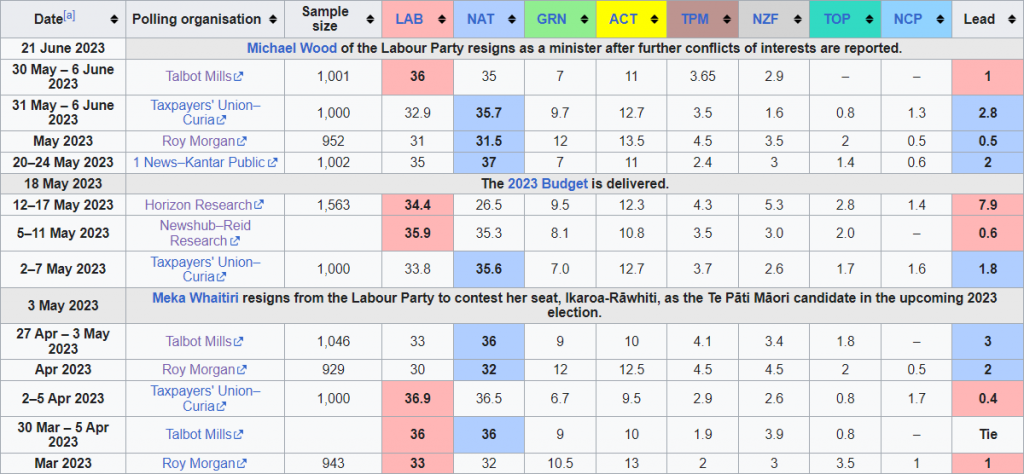
A recent Horizon Poll found that combined support for Labournational has now fallen to less than 61%, the lowest ever. Never before have Kiwis had less confidence in the two biggest parties. The electoral ramifications of this fall in support are major.
The mathematics of building a ruling coalition are simple, but are becoming more complex. According to the Horizon poll, Labour and the Greens together would win 61 seats with almost 40% of the vote. National and ACT together would win only 54 seats, with the Maori Party taking five. This would mean that Labour and the Greens could govern by themselves.
Complicating matters is the unprecedented level of support for the parties currently outside Parliament.
New Zealand First polled at 4.8%, which means that they are on the verge of overcoming the 5% threshold. They have been rising rapidly since 12 months ago, when they were polling around 2-3%. In fact, if one removes the undecided voters from the Horizon poll, New Zealand First gets 5.3% of the remainder.
Should New Zealand First poll over 5% in the general election in October, they will win at least seven seats. Assuming they don’t go with Labour again – New Zealand First Leader Winston Peters having ruled this out – they will probably go with National, which would give the National-ACT-NZF coalition 58 seats.
Labour and Greens, in such a scenario, would have 57 seats, and would therefore need The Maori Party’s five in order to govern.
There are more complications in the form of The Opportunities Party (TOP) and DemocracyNZ. TOP polled at 2.8% in the Horizon poll, which means they’re closer to the 5% threshold than not. Almost as many of the polled voters supported “Another party”, which means that DemocracyNZ could be close to 2% support as well.
If either TOP or DemocracyNZ scored over 5% in the general election, forming a 61-seat coalition would become much more complicated.
Labour doesn’t really want to work with The Maori Party, for the obvious reason that The Maori Party are insane. A Labour-Greens-Maori Party coalition would be a nightmare of infighting. The unreasonableness of people like Rawiri Waititi would make stability impossible.
However, National doesn’t really want to work with New Zealand First either. New Zealand First may have fallen out with Labour, but that doesn’t make them great friends with National. New Zealand First are still primarily nationalist, which puts them in direct conflict with National’s globalist plunderer mindset. Peters and ACT Leader David Seymour are well known to despise each other.
This raises a possibility that some dare not whisper: Labour and National might go with each other.
A Labour and National grand coalition would send a shockwave through the New Zealand political scene. All Kiwis have been conditioned to see Labour and National as implacable enemies and two opposite poles of the political spectrum. For them to team up would force a mass change of perspective on New Zealand.
However, there is precedent for it, if not from New Zealand. Germany’s Angela Merkel was thrice involved in a grand coalition between her conservative CDU party and the social democratic SPD. In all three instances, the primary stated reason for this was keeping “extremists” out of power.
Labournational could easily make a similar justification, claiming that New Zealand First and The Maori Party were both ethnonationalist extremists. If they did, they’d have the full support of the globalist media, who would be more than happy to demonise anyone suspicious of globalism.
A grand coalition in which Chris Hipkins was the external face (dealing with the media and public) and Chris Luxon was the internal face (dealing with management), would make a lot of sense. It would mean the personable Hipkins could keep public sentiments under control, while the unpopular Luxon kept the grand coalition itself under control.
There are two major reasons why a grand coalition might not happen.
The first is pragmatic: a grand coalition would enable a party like New Zealand First to become the main opposition. If they did, they would mostly criticise the globalist establishment, which would see support for Labournational fall even further. It makes more sense for Labournational to trade opposition status between Labour and National, and thereby minimise the influence of the minor parties.
The second is more sinister: both Labour and National want to keep up the illusion that the voters actually have some choice. This is best achieved by them taking turns at ruling. If they would combine, people would realise – when nothing changed – that parliamentary democracy is just a massive scam. Their wealth and privilege depends on keeping up the charade that Kiwis have a say in their own governance.
One thing is certain: a grand coalition would make clear that it’s them against us.