The Battle Of The Now: Nothing Is Anything vs. Some Things Are Something

The Western World seems on the brink of civil war. The factions appear to be two completely different conceptions of reality, or how to approach reality. One faction contends, essentially, that nothing is anything. Their opponents assert that some things, in fact, are something. As with many historical battles, it’s fundamentally a battle of masculine vs. feminine.

The feminine side states that nothing is anything. No truths can be known for certain. All is flux, therefore nothing is permanent for long enough to substantiate its existence. Because nothing is certain, there’s no point in being too strict about borders or boundaries. This side is what Alan Watts used to call “gooey” people.

The masculine side, by contrast, states that some things are something. There are such things as objective truths, and they can guide our lives. These truths are often fixed ideals. Such people often react with outrage to Nietzsche’s suggestions that there are no moral truths. This side is what Alan Watts used to call “prickly” people.

In the Clown World of 2023, these are the battle lines of the culture war.

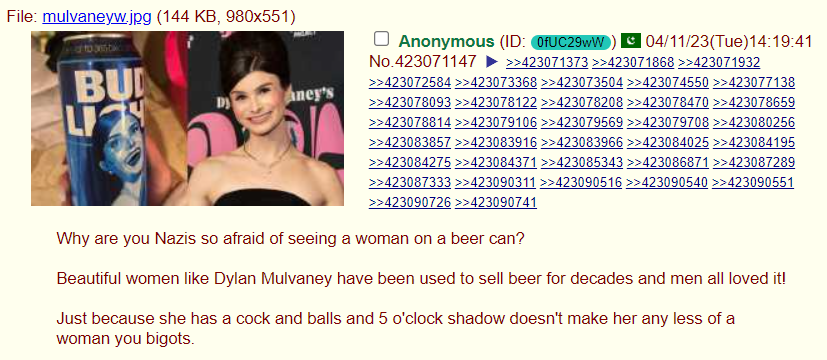
The feminine side has no issue with the trans phenomenon. If nothing is anything, then women are not exclusively those with XX chromosomes. Therefore, femininity is a matter of what gender you “identify as”, or which gender you “represent”. Trans people are whatever they say they are, and the rest of us have to follow along.

The masculine side comes into opposition with this view. To the masculine, gender is fixed, and it’s more or less fixed to sex. Men are men and women are women. It doesn’t matter what you identify as, because there’s a determined and objective reality which itself reveals what you are. Thus, there is a particular bathroom to which you belong, and one to which you don’t.

A similar situation exists with nationality. To the ideologically feminine, nationality is like a mask, that can be put on, taken off, and replaced at will. It’s possible to become a member of a different nation simply by living there. Such a view sees no contradiction in having two or more passports and claiming to belong to more than one nation.

To the ideologically masculine, nationality is rooted in blood and soil, and therefore even people who have lived in a new country for 50 years aren’t members of the nation (although their children might be). Nationality, like gender, is fixed and not fluid. It’s comprised of kinship links that are as real as family ties.
In fact, this division is replicated in attitudes to biology. The feminine reject biological determinism, preferring to believe that anyone can become anything if given the right environment while growing up. Success is primarily a matter of will, and natural talents can be shaped in virtually any direction. This ties in with the modern globalist mindset.

The masculine, by contrast, reject Blank Slate Theory. They support hereditarianism. The masculine approach ties in with the modern nationalist mindset, because it’s concerned with the long-term effects of (e.g.) immigration on the nation’s genetic infrastructure. When some things are something, it tends to be permanently that way.

Complicating matters, sometimes one of the two sides is more correct than the other.

For instance, the masculine side is right when it says that intelligence is mostly genetic, but wrong when it says that mental illness is also mostly genetic. As such, it errs towards exclusion. The feminine side, for its part, is right when it says that mental illness is mostly environmental, but wrong when it says that intelligence is mostly environmental. As such, it errs towards inclusion.

Those who cannot overcome an inherent, entrenched masculine or feminine bias are why public discourse has now degraded to such a low level. Rather than talking to uncover the truth, people now talk to further the interests of their team. Those with the strongest biases are incapable of even perceiving their opponent’s position.

The correct course of action is to stop thinking in crude, black-and-white terms, and to try developing some intellectual nuance. Masculine thinking is useful when it’s necessary to delineate and discriminate, and feminine thinking is useful when it’s necessary to draw similarities. To have a bias towards either is a cognitive weakness.

In order to psychologically survive Clown World, it’s necessary to stand above forced, artificial battles that are designed to destroy your will and waste your mental energy. The simplest way to stand above is to not get sucked into inconsequential masculine vs. feminine debates that have been created by the mainstream media. Try to be, as the Confucianists say, the unwobbling pivot between yin and yang.

*

If you enjoyed reading this essay/article, you can get a compilation of the Best VJMP Essays and Articles from 2021 from Amazon as a Kindle ebook or paperback. Compilations of the Best VJMP Essays and Articles of 2020, the Best VJMP Essays and Articles of 2019, the Best VJMP Essays and Articles of 2018 and the Best VJMP Essays and Articles of 2017 are also available.

*

If you would like to support our work in other ways, subscribe to our SubscribeStar fund, or make a donation to our Paypal! Even better, buy any one of our books!

Mythologising Retirement

Such a great portion of our human lives involves paid work. There is an important sense in which we have been convinced that the ultimate goal of work is to pay off our debts, only to then retire. There is value in challenging the assumptions beneath this kind of myth, because so much of our lives are invested in what is at stake. Unless we come to a very clear understanding of what it is that we feel and what the outcomes are of our participation in this life, we will never arrive at any kind of satisfactory point, nor will we have divined any beneficial understanding of our place in the world.

Firstly, we have inherited a cultural premise that tells us that ultimate well-being can be postponed to the future. This is a very large assumption with far-reaching implications.

Your learned capacity to be happy in the future is a clear reflection of how you have learned to be happy now. Obviously, when the future seems to have arrived, that will also be ‘now’, so your appreciation of your present environment must be managed skilfully. 

Have you ever come across people who are retired who cannot stop for one moment? The garden, the housework, the motorhome. These people are continuing the education of a lifetime of work, which is an ethic of keeping busy. People will object: ‘What is wrong if this is what they want?’, but do we really know what we want? Do we know what is best for us, and where we may have misunderstood?

For example, there is hidden assumption that many people have accepted which is that a lifetime of work is also a lifetime involved with suffering, therefore retirement from working life will also equate to retirement from a lifetime of suffering. Just how true is this assumption? It is true that much work, being the expenditure of effort under often physically or mentally stressful conditions, can promote much in the way of personal suffering.

What a lot of people fail to see is that leaving daily work behind is allowing the departure of only one source of suffering, it is not a salvation from suffering as a whole. In fact, the point at which we are accepted to have earned the right to withdraw from a lifetime of work is also the same point at which our mind as well as our physical body is beginning to deteriorate, marking the onset of all kinds of potential physical and medical challenges.

Suffering still follows at our heels from other sources, most notably the illness and death of friends, peers and loved ones who are also subject to the ravages of time. In this respect, retirement enjoys the benefit of a kind of afterlife mythology, in which all of our pain and effort on a daily basis will one day be ultimately vindicated and returned in full measure.

This raises an alarming question: just how much daily tolerance of misery does this mythology support? How many of us are laboring under the illusion that all of our effort is guiding us toward somewhere ultimate where we will have eternal peace and we can finally kick up our heels?

I share a couple of examples of this from my own life which I believe touch upon something relevant here.

I have a friend whose father is in his seventies, and despite remaining reasonably physically fit, he still works himself to the bone every day of his life. He is still in full time employment, despite that fact that he has been given the nod of approval that he could leave his work if he wanted to. Now, you might say ‘If he is doing what he wants to, why not?’ And I would naturally agree, except that all he ever seems to talk about is how much of a welcome change it is going to be when he finally retires.

This poses an odd kind of paradox in which he is on the cusp of retirement, and really past his culturally accepted retirement age, but the actual notion of stopping work seems to terrify him. His insistence on the myth of retirement has been well noted – he has waxed eloquent about the benefits of not having to get up in the morning, to not have to do anything, to have the freedom to kick back with a beer in his hand and watch TV (incidentally, this mythology is also recounted in minor form in the notion of the weekend, almost like a mythic foretaste of Valhalla).

The sad irony is, these are things he has not given himself the permission to enjoy. He may literally never arrive at the point at which he is comfortable with letting go of the ethic of early rising and hard work before he dies. To have lived this way for over seventy years, with no substantial appreciation for being able to allow himself to get a real break, is quite a confounding and yet exceptionally ubiquitous social phenomenon.

We could surmise it comes down to a person’s character and their ethos of being a hard worker, which unsurprisingly is a highly respected social value in any country. It could also be that like the rest of us, he has been successfully indoctrinated into a program of lifelong drudgery, being strung along by an imaginary dangling carrot.

Another example I will give was when I was working out of town one day, an older man came up to me struggling to walk with a stick and specifically wanted to tell me his story. We were the only two people around for at least a kilometer, and he specifically made the effort to approach me from a distance of about three hundred meters.

He told me that he was a keen hunter and fisherman, and that shortly after retiring, he had experienced a stroke which meant that there was no aspect of his retirement he felt he could enjoy. He told me that he worked his whole life, expecting to be able to retire and do what he wanted, except now he felt he had been cheated out of it.

While I don’t believe there is nothing he could have left of value in his life, the fact remains that we do place an inordinate amount of good faith in the application of effort over decades of our lives hoping to have something tangible to show at the end of the process. How does this contribute to us putting off our lives now, and how are we foregoing our responsibility to live wisely and skilfully today?

Are we collectively so enamoured by the prospect of the future holding some form of salvation, either material or spiritual, that we can justify subjecting ourselves to misery today? What would we do differently today, what changes would we be willing to allow in our lives if we discovered the possibility that our imagined future with its ease, relaxation and distance from suffering would never eventuate?

*

Simon P Murphy is a Nelson-based esotericist and philosopher, and author of His Master’s Wretched Organ, a brilliant collection of weird fiction stories.

*

If you enjoyed reading this essay/article, you can get a compilation of the Best VJMP Essays and Articles from 2021 from Amazon as a Kindle ebook or paperback. Compilations of the Best VJMP Essays and Articles of 2020, the Best VJMP Essays and Articles of 2019, the Best VJMP Essays and Articles of 2018 and the Best VJMP Essays and Articles of 2017 are also available.

*

If you would like to support our work in other ways, subscribe to our SubscribeStar fund, or make a donation to our Paypal! Even better, buy any one of our books!
Are (You) A Domestic Terrorist?

The New Zealand Government took another leaf out of the authoritarian playbook recently. The NZ Security Intelligence Service (NZSIS) published a guide for Kiwis keen to rat out one of their friends or neighbours for wrongthinking. Titled ‘Know the signs – A guide for identifying signs of violent extremism‘ (link goes to .pdf), the booklet marks another step in New Zealand’s descent into dystopia. VJM Publishing examines.

The document opens with a foreword by the ghoulish Director-General of the NZSIS, Rebecca Kitteridge. She explains that the NZSIS wants “to help New Zealanders feel more confident about stepping forward” to rat out their friends and neighbours. Apparently this is necessary in order to combat violent extremism, as one of the NZSIS’s core missions “is to detect violent extremists”.

The reader must note here that violent extremist has a very specific definition (as we will get to later). Mongrel Mob members, for example, are not considered violent extremists. The Government is happy to let violent extremists run free if they’re in gangs, because gangs mostly prey on working-class people. The NZSIS is after a different sort of violent extremist.

“We all have a role to play in keeping each other safe,” Kitteridge proclaims. To that end, we’re all obliged to report to the NZSIS any behaviour that might be concerning. “If you see something, say something,” the booklet demands, in an ominous echo of the wartime admonitions to help uncover enemy spies.

On page 6 it states the NZSIS’s wish for people “to report any behaviours or activities they come across that resemble any of the indicators described in this guide, or that feel concerning.” As we will see, the net has been cast so wide that almost every Kiwi with an original thought is now a suspected terrorist.

On page 8 we are informed that “Extreme ideologies can be based on faith, social or political beliefs that exist on the fringes of society, outside the more broadly accepted views and beliefs of most people.” This normative approach to extremism reveals that Kitteridge and the NZSIS are doing the Establishment’s bidding. If society believes that the Earth is flat, then saying it’s round is extremism.

More alarming is the assertion that violent extremists may seek “to create a community based on their ideology.” The fact is that you, the reader, are a head of human livestock, and you’re not allowed to seek out self-governance, any more than a slave is allowed to leave a plantation. Your community is that of the New Zealand Government, and they speak for you, as the sole source of truth.

The booklet gives the game away when it says “Extremists may seek to radically change the nature of government, religion or society.” This demonstrates that the NZSIS has no interest in truth, freedom or justice. Their interest is simply to maintain the status quo. Therefore, whoever has power is assumed to deserve to have power. The NZ Government is infallible, and so anyone wishing to radically change it is an extremist.

We are warned that “Violent extremists take these ideologies further and justify using violence to achieve radical changes.” Note that only violence used to achieve radical changes is considered bad. Violence used to maintain the existing order is of no concern. As such, the Government’s violence against the people, such as during the Wellington Protest or during the War on Drugs, is of no concern here.

The real material of interest begins on page 12, with the section titled ‘The indicators of violent extremism’.

Under ‘Mindset and ideology’, the booklet asks us to watch out for the person who “Consumes violent extremist videos, media, music or messaging”. The irony here is that the vast majority of violent extremist media consumed in New Zealand is consumed through watching the television news, and Normie television-watchers are far more dangerous than anyone else.

On that topic, we’re told to watch out for the person who “Develops a hostile ‘Us-Versus-Them’ worldview” and who “Makes dehumanising, hostile or violent statements against individuals or groups they perceive as ‘the enemy’ or the ‘other’.” Never in New Zealand history were people dehumanised as much as people who didn’t take the Coronavirus vaccine were in recent years – but the NZSIS isn’t interested in that.

Under ‘Association and relationships’, we’re told to watch out for anyone who “seeks a following to promote their cause.” Realistically this means anyone with even the remotest chance of having successful political influence. The subtext of this booklet is by now becoming clear: anyone who doesn’t submit to The Powers That Be is a security concern.

Even more worrying is being asked to watch out for anyone who “Becomes involved in a group […] where extremist ideas are discussed.” No VJM Publishing Chan Chat TeleGram channel. No 4chan. Not even an Aotearoa Legalise Cannabis Party forum. No politics are to be discussed by you at all, pleb! Just turn on the television and receive your thoughts for the next 24 hours.

Under ‘Research and planning’ comes the warning to watch out for anyone who “Searches for offshore conflicts related to their ideology.” So anyone with an interest in history is now a terrorist suspect. If you want to broaden your knowledge of the practical realities of your ideology – terrorist. Interested in World War Two? Terrorist.

After these hysterical and paranoid sections come a couple of sections of sanity. Under ‘Gathering knowledge, skills and resources’ the booklet asks us to look out for anyone who “Suddenly or unusually develops a stockpile of knives, firearms or explosive materials.” Under ‘Preparation’ it calls for us to be wary of anyone who “Declares intent to conduct a terrorist or violent extremist act.”

Entirely reasonable – but this hardly had to be asked for. Surely any sane person would contact the authorities if they heard someone else say they were going to commit an act of terrorism?

The next section, ‘Security awareness’, returns us to the madness, asking us to watch out for anyone who “Uses fake names, aliases or pseudonyms when online or within specific communities” (90% of Internet users) or “Creates exclusive groups on secure forums or messaging apps” (80% of Internet users). Again the common refrain: almost any of your neighbours, friends or workmates could be a terrorist waiting to strike.

Even more psychotic is the request to watch out for anyone who “Becomes secretive about their activities with associates” or “Provides limited or false information when questioned about future plans”. In Ardern’s New Zealand, just like in East Germany under the Stasi, secrecy is itself guilt. If you don’t want people prying into your affairs, you’re a terrorist suspect.

Hilariously, this section comes with a proviso that security awareness on its own is not enough to suspect that a person might be a terrorist. The obvious reason for this is because almost all NZSIS officers themselves would fall foul of almost all criteria here (which is why you’ve never spoken to an NZSIS officer using their real name on the Internet).

The final section, ‘Unusual changes in behaviour’, asks us to keep an eye out for basically anyone with a mental illness. Actions such as “Withdraws from or abandons close relationships”, “Appears withdrawn or prone to sudden outbursts” and “Stops participating in regular and established commitments” are all classical signs of depression or anxiety, which most of us are suffering from acutely in the 22nd year of Clown World.

In summary, the ultimate effect of this document will be to spread suspicion, mistrust, hate and fear between and among all communities in New Zealand. This may have been its intent, or the Government might still be chimping out in the wake of the Christchurch mosque shootings.

*

If you enjoyed reading this essay/article, you can get a compilation of the Best VJMP Essays and Articles from 2021 from Amazon as a Kindle ebook or paperback. Compilations of the Best VJMP Essays and Articles of 2020, the Best VJMP Essays and Articles of 2019, the Best VJMP Essays and Articles of 2018 and the Best VJMP Essays and Articles of 2017 are also available.

*

If you would like to support our work in other ways, subscribe to our SubscribeStar fund, or make a donation to our Paypal! Even better, buy any one of our books!
Loser Syndrome

As Western society continues to collapse, the psychological health of Westerners continues to worsen. As it does, the rate of Loser Syndrome increases, which is the main reason why there’s so much visible trashiness in society today. This essay looks at the causes and effects of this phenomenon.

Loser Syndrome can be found wherever a person has a negative effect upon their social environment because of a weak psychological makeup. Losers are those who cause their family, community or nation more problems than they solve, usually because of a shitty attitude that makes them refuse to put their ego aside long enough to make any positive contribution to anyone else’s life.

It’s not fair to call people losers if they were born with genetic conditions or if they were abused or neglected as children and left with traumatic stress disorders. Such people may be unlucky, but they’re not necessarily losers, as they are still fully capable of entertaining the gods through striving to overcome their conditions. The loser does not strive to overcome; true Loser Syndrome can be understood as a psychospiritual phenomenon.

There are two aspects to Loser Syndrome.

The first is giving up on life. This involves rejecting the reality about life and its temporary nature. The loser has no ambitions apart from vague power fantasies. He mumbles, doesn’t make eye contact when talking, disrespects people, and generally lowers the tone of any environment he’s in. His eyebrows are either knotted in a surly scowl or relaxed in a dimwit gaze. He has surrendered.

Some losers are narcissistic enough to dress and groom themselves well, but give themselves away both through body language and through a child-like solipsism that makes them act as if they were alone in the world (a.k.a. Main Character Syndrome). A predilection for destruction over creation is typical of someone who has given up. As such, Loser Syndrome acts like a cancer in the wider social body, preventing it from thriving.

The second, and most important aspect, is an expectation that others will also give up on life. Anyone who tries hard to achieve something, anyone who strives, is sneered at and ripped down by those afflicted by Loser Syndrome. They would rather that everyone else sink to the lowest level of society, and become like them.

If the loser themselves cannot be venerated, no-one can. So anyone who venerates someone else has to be torn down. Such is the viciousness and depth of the resentment that Loser Syndrome is fuelled by. Those with it are always unhappy to see other people do well. The successes of their friends and family bring them no joy. In fact, such successes can often create further resentment.

Herein it’s clear that Loser Syndrome is a slave morality. Like the other slave moralities, Loser Syndrome lifts up the lowest and most execrable (other losers) and pushes down the honourable and the good (non-losers). The more society hates you, the more the loser likes you, and vice-versa.

If misery loves company, so does trashiness.

To some extent, Loser Syndrome and trashiness are similar things, however Loser Syndrome is unique for its aggression. Many trashy people are happy-go-lucky, whereas the genuine loser strives mightily to take everyone else down. Anyone happy, especially if they’re happy about themselves, has to be attacked.

In this sense, Loser Syndrome can be conceptualised as an advanced form of trashiness, in the same way that psychopathy is an advanced form of narcissism. Trashiness can be fun and light-hearted, but Loser Syndrome is a pathological intensification of trashiness that emanates low vibrations. Normal people can have trashy friends, but they can’t have loser friends, because those losers will either rip the Normies down or find a reason to turn on them.

Unfortunately for us, increasing economic pressures mean that Loser Syndrome is predicted to become more common.

The harsher the economic climate becomes, the fewer people get to enjoy a dignified standard of living, which means the more resentment exists. When inequality reaches such a degree that those born without talents see no hope of climbing the ladder, the destructive intent characteristic of Loser Syndrome will fully explode.

Loser Syndrome is ultimately a social contagion that is emblematic of collapse. No-one in authority seems to give a shit, so why should anyone else? Unfortunately, when someone does start giving a shit, and drives the losers out, chances are they will be an authoritarian psychopath who causes tremendous collateral damage. The loser, therefore, is the harbinger of widespread suffering.

*

If you enjoyed reading this essay/article, you can get a compilation of the Best VJMP Essays and Articles from 2021 from Amazon for Kindle or Amazon for CreateSpace (for international readers), or TradeMe (for Kiwis). Compilations of the Best VJMP Essays and Articles of 2020, the Best VJMP Essays and Articles of 2019, the Best VJMP Essays and Articles of 2018 and the Best VJMP Essays and Articles of 2017 are also available.

*

If you would like to support our work in other ways, subscribe to our SubscribeStar fund, or make a donation to our Paypal! Even better, buy any one of our books!