The Creeping Normalisation of Political Violence

“Milkshaking” and “Egg Boy” are new terms in the popular mediascape, as minor political violence continues to become normalised. Both of these phrases refer to a spate of minor assaults on anti-Establishment politicians in Britain, Australia and elsewhere. This essay looks at how this phenomenon arose and where it might lead to.

In 2002, the European political Establishment had a serious challenger in the form of Pim Fortuyn. This flamboyant Dutchman was a ferocious opponent of mass Muslim immigration, stating that the Abrahamic cult was “an extraordinary threat”. His attitude was that, as a homosexual, he had a lot to lose from increased Islamic influence in Dutch society, as did women.

Like all anti-Establishment figures, Fortuyn believed strongly in free speech, stating that it was more important than any other freedom. This was probably driven by his (correct) perception that there were many who wanted him silenced.

The Dutch Establishment, addicted to the ready supply of cheap labour that the Muslims represented, responded by throwing all kinds of invective at him. Like Emmanuel Goldstein in 1984, Fortuyn was demonised every day in the Dutch media, compared to Hitler and described as a megalomaniacal psychopath. This steady stream of rhetoric had inevitable consequences.

On 14th March 2002, Fortuyn had a pie thrown at him. This was a minor incident, but it foreshadowed the next move. On the 6th May, he was shot dead by a deranged leftist, who stated at his trial that he didn’t want Muslims to become scapegoats for populism.

The murder of Fortuyn follows the blueprint for how the Establishment defends itself against ideological mavericks. They don’t need to send the Police to arrest men like Fortuyn and put them in concentration camps – those are crude and unsophisticated methods that provoke reactions. Much better to manufacture popular consent for that person’s destruction and let social forces do the dirty work.

The sophisticated, modern method is for the Establishment to use its control of the apparatus of propaganda, in particular mainstream media, to create the impression that the anti-Establishment target simply has to be destroyed for the sake of the greater good, and that anyone who does so will be a hero. It is by way of such encouragement that assassinations have been conducted ever since President McKinley was killed in 1901.

Make no mistake – the Establishment has always supported violence against its challengers. The Establishment has always demonised them, caricatured them as evil and dangerous, blamed them for the Establishment’s own failures and whipped up fear among the masses. It does this primarily through the mainstream media, which legitimises and normalises these sentiments.

They know that if they do this successfully enough, some weak-minded fool will let the propaganda get the better of them and strike out against one of the people that the Establishment has painted a target on. There will always be some young, impressionable idiot who doesn’t have the sense to understand how they’re being manipulated, and many of these are happy to do something obscene for the sake of fame.

So when anti-Establishment candidates in 2019 have milkshakes thrown over them and eggs cracked over their heads, and when the mainstream media lionises the people doing so and justifies their actions, we can observe that this is simply a repeat of the same pattern that the Establishment used to destroy Fortuyn. The Establishment are hoping that the mob will kill their enemies, and are shaping the mob’s behaviour in that direction.

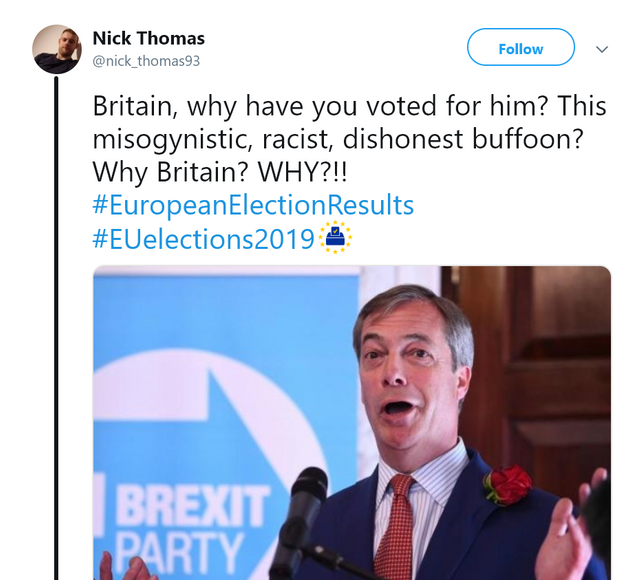
Although no-one has yet tried to kill Fraser Anning or Nigel Farage, there have been several violent attacks on Tommy Robinson, some involving mobs hurling bricks. With the hysteria about Brexit reaching fever pitch, it’s possible that the milkshaking attacks will lead to a murder attempt. The mentality that Farage is destroying Britain by scapegoating the oppressed is not far from the mentality that Fortuyn’s killer possessed.

The Establishment would love nothing more than for another far-left extremist to put a bullet in a Marine Le Pen, a Jimmie Akesson or a Thierry Baudet, because such acts of terror would discourage other nationalists from coming forward to represent their people. The Establishment is unashamedly globalist, and therefore nationalists are anti-Establishment by default.

What the rest of us can probably expect are increasing tensions that eventually lead to outright conflict. It’s as clear as day from the reactions to the milkshaking and egg cracking that the pro-Establishment masses are howling for the blood of those who challenge their masters. They bear massive resentment borne of their own weakness and ineptitude, and they hate to see anyone strong enough to challenge the system.

One can expect that this increase in tensions will lead to further violent actions. Whether this leads to any genuine acts of anarcho-homicidalism are unclear. So far, the attackers are only attacking those who challenge the Establishment, not the Establishment itself. The creeping normalisation of political violence will, however, put the idea in a lot of people’s heads.

Eventually, however, we can predict that something like the Freikorps vs. Communist street battles of 1920s Germany will return as tensions lead to people chimping out. At this point, either things will disintegrate into chaos or someone imposes a new philosophical order. If the former, the violence will be terminal; if the latter, a new Golden Age will arise.

*

If you enjoyed reading this essay, you can get a compilation of the Best VJMP Essays and Articles of 2018 from Amazon for Kindle or Amazon for CreateSpace (for international readers), or TradeMe (for Kiwis). A compilation of the Best VJMP Essays and Articles of 2017 is also available.

The Case For Cannabis: Cannabis Is A Medicine

Of all the ways that cannabis prohibition causes harm to people, maybe the worst is how it denies many people an effective medicine. The problem is not just limited to the effect that prohibition has on accessing the substance – prohibition also makes it harder to research it and to learn how to best use it. As this article will examine, this has the effect of causing a lot of needless suffering.

Cannabis has been used as a medicine for thousands of years. In fact, as Professor David Nutt wrote this year in the British Medical Journal, it’s probably the oldest medicine known to humanity. Its medicinal effects for treating conditions like depression were known to the scientific literature as far back as 1890.

The fact that cannabis is known to be a medicine today can be demonstrated by going to Google Scholar and typing in “medicinal cannabis”. This returns (at time of writing) 44,000 results, which means that there are over 40,000 medical journal articles and papers investigating medicinal cannabis.

Frustratingly, it’s possible to go back as far as 2008 and see that there are already 14,100 results for a Google Scholar search for “medicinal cannabis”. If one considers that medicinal cannabis was made legal in many American states when even less was known than this, it strikes one how glacial the pace of change has been in New Zealand.

The medical conditions for which cannabis has shown promise include eating difficulties, sleeping problems, Crohn’s disease, epilepsy, multiple sclerosis, nausea and vomiting, pain and wasting syndrome (cachexia) and even mental health conditions like anxiety, schizophrenia, depression, social anxiety disorder and psychosis. In chronic pain situations it can lead to less opiate use.

The problem is the law.

Because of the long-standing prohibitions on cannabis, it’s difficult to properly research the substance. For a university research program to conduct a proper study, they need to test the effects of cannabis on a large number of people, in a controlled and replicable environment. This requires getting hold of a large amount of cannabis – very difficult when cannabis is illegal.

Without being able to conduct large trials, it’s difficult to collect a sufficient amount of data to pass certain levels of proof. Because of the ever-present threat of charlatanism in the pharmaceutical industry, it has become necessary to demand rigourous testing before a prospective medicine gets governmental approval to be sold. Prohibition makes it harder to cannabis to get that approval.

Despite this, there is still a fair bit known about the medicinal effects of cannabis.

It’s acknowledged by honest researchers today that “therapeutic benefits of medicinal cannabis are well documented in the treatment of a variety of medical conditions”. The problem is that, because of prohibition, it’s impossible to arrive at standardised models of production, distribution and prescription.

This is more of a problem than it might first appear to be.

Without a standardised model of production, it’s difficult for doctors to have any confidence in what they’re prescribing. Because many medicines have dosage-dependent adverse side-effects, it’s important to know exactly what proportions of effective medicine are found in each pill that’s being dished out. Impurities are to be avoided. Absent this, it’s impossible for a doctor to know what to prescribe.

Without standardised prescription guidelines, it’s impossible to know how much to prescribe. It’s not just a matter of getting as much cannabis into the patient as possible. Responsible medical practice means being aware of potential side-effects and interactions with other medicines, and how these work with factors like age and body weight. If this knowledge is not present, it might seem wise to err on the side of prudence and ignore cannabis.

After all, even if cannabis prohibition was repealed tomorrow and doctors had access to all the cannabis in the world, they would still need to know how to use it safely before they could feel comfortable prescribing it.

Despite the presence of these hurdles, the fact remains that knowledge of the medicinal applications of cannabis are becoming ever-more widespread. Indeed, even Zimbabwe is aware that cannabis is medicinal. Not only has the impoverished Southern African state had medicinal cannabis since 2017, but their Health Minister is getting praise from other Southern African nations for their relatively forward-thinking stance on the issue.

Some might argue that the New Zealand medical establishment has shown itself to be more interested in toeing the legal and bureaucratic line than actually helping their patients, and that their reluctance to deal with what was clearly an important issue for many of their patients was cowardly. This might be true for many doctors. The point, however, is not to apportion blame, but to determine the correct path forward.

The major problem with unlocking the medicinal potential of cannabis is the law. It’s the law that keeps researchers and scientists from finding out which applications of cannabis make medicinal sense and which ones don’t. Since people are going to use cannabis anyway, it makes sense from a harm reduction perspective to expand our knowledge of the plant. This would make it possible to make better-informed decisions about its use.

Legalising cannabis would restore sanity to the situation. It would allow companies and universities to conduct full-scale trials of medicinal cannabis products. This would allow those medical professionals who are interested in learning about the therapeutic effects of cannabis to have more accurate data upon which to base their prescription decisions.

*

This article is an excerpt from The Case For Cannabis Law Reform, compiled by Vince McLeod and due for release by VJM Publishing in the summer of 2018/19.

It’s Okay To Be Whatever You Naturally Are

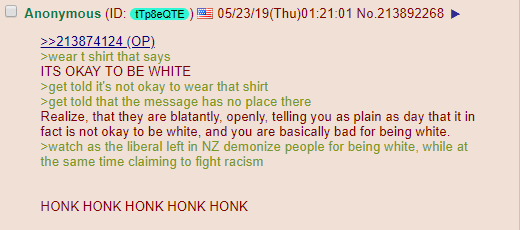
Some controversy has been generated this week from the fact that VJM Publishing sells ‘It’s Okay To Be White’ t-shirts on TradeMe (edit: or did, looks like the listing has now been taken down). Our doing so angered the Human Rights Commission, who argued that it spreads “a message of intolerance, racism and division”. This response argues that, not only are our actions the opposite of intolerance, hatred and division, but it is the Human Rights Commission itself that is guilty of this.

There’s a lot of discussion about what’s okay and what isn’t okay. This is the school of philosophy known as ethics, and it has been around for many thousands of years.

This is VJM Publishing’s take on it.

It’s okay to be white, brown, black, yellow or even red or purple. It’s okay to be tall or short, blue-eyed or brown, slim or solid, because these things are all natural and you can’t help them. It’s even okay to be ugly or dumb because, again, these things are natural and you can’t help them.

It’s okay to be an outgoing, choleric, even aggressive person, but it’s not okay to cause suffering to other sentient beings. Causing suffering is bad.

It’s also not okay to be is a member of an ideology that promotes hatred and division, because this leads directly to the suffering of sentient beings. The foremost way to promote hatred and division is to say that it’s not okay to be something that you naturally are. Such as your ethnicity.

This is the reason for the comment that these shirts are the opposite of racism. They literally are. Racism is to say that there’s something inherently wrong with being white, as if a person being born white is to be born carrying some debts that their ancestors racked up.

The racists in this situation are the Europhobes who say “there’s no place for this kind of message”, when the message is that it’s not a bad thing to be a white person. If there is such a thing as hate speech, it’s anyone saying that it’s not okay to be something that someone naturally is, such as their skin colour.

Of course, this means that things that people have chosen to be don’t count. It is not, and can never be, an act of hatred to criticise someone for belonging to a supremacist ideology, especially one that believes it’s destined to rule the world whether non-followers like it or not. Such ideologies inevitably bring suffering into the world.

VJM Publishing is not interested in ideologies that promote hatred and division. We oppose Nazism, Communism, Abrahamism, Imperialism, Materialism, and all the other ideologies that cause one group of people to glory themselves and to debase another by calling them degenerates, counter-revolutionaries, infidels, heretics or primitive natives.

We are for those who have seen beyond. This refers both to the veils of the material world in a spiritual sense, and the veils of the corporate media matrix in an existential sense. We are for those who realise that all life on this planet is connected by virtue of possessing the divine spark of consciousness that could be said to be God.

By selling this shirt, we are doing our part to counter genuine racism and division. Instead of doing this by grave, pompous and bombastic moralising that seeks to take people’s rights away – a proven failed approach – we’re adding some humour to the media scene for the sake of resistance. We’re replacing some of the colour that has been lost.

We’re not even for white pride. Sure, if you identify with some illustrious individual merely because they share a skin colour with you, go for it, but it looks weak to us. Those who have seen beyond would rather work on their individual qualities for the sake of lifting the world around them. Like the alchemists of ancient days, we cultivate the iron, the silver and the gold.

Look at the actual products we sell. We’re working with Jeff Ngatai to produce a book of mnemonics for learning te reo Maori. This we do because we believe that the language is a treasure at risk of being lost, and that mnemonics are an excellent way to preserve the memory of Maori language vocabulary in the minds of the population.

That’s why we offer every mnemonic in the book for free. They are all offered for free, arranged by subject groups. This is the same material as in the book. If you can afford to buy the book, great, if you can’t, you can use the online version. That reflects our will to bring this knowledge to as many people as possible.

What sort of white supremacists care about preserving the Maori language?

The majority of articles and essays on VJM Publishing relate to cannabis law reform. It was primarily to agitate for cannabis law reform that VJM Publishing was founded, since we knew over a decade ago that prohibition is stupid. Indeed, we’ve pointed out several times that the cannabis law disproportionately affects Maoris. This has even been argued in the original Cannabis Activist’s Handbook, published as far back as 2012.

What sort of white supremacists give a shit about the disproportionate effect that cannabis prohibition has on Maoris? What white supremacists were arguing seven years ago that prohibition should be repealed for this reason?

Our other products are speculative fiction books, a demographic study of New Zealand voting patterns, various books about how to apply psychological science to creative writing, a guide to quitting tobacco smoking and a book of religious satire.

How on Earth can any honest person see a link to white supremacy in that?

The whole idea is nonsense, and to link VJM Publishing with white supremacism is proof that we live in Clown World. VJM Publishing, far from being haters, are the victims of Big Brother’s decision to target us for their daily Two Minutes’ Hate.

What VJM Publishing really is, is a much needed thumb-in-the-eye to the wowsers, puritans and other moralising do-gooders that have sucked all the enjoyment out of living. It is these grey men and women, these emotional abusers, who are the cause of our rising suicide rates. We despise them, we oppose them, and we will never stop fighting their insane slave mentality.

VJM Publishing is proud to provide a counter-narrative to the diarrhoea that passes for mainstream political discourse in New Zealand – the same mainstream media, let’s not forget, that told us that Saddam Hussein possessed weapons of mass destruction.

We’re proud to post material that takes the piss out of the control freaks who think they have the right to arbitrarily decide what merchandise other people are allowed to sell on a public trading platform. These monsters who think they have the right to decide that a string of words doesn’t mean what it literally means, because they have the authority to rule that it really means something else.

*

Click here to read a summary of what alt-centrism is

Click here to read about the five rejections of alt-centrism

Click here to read the five acceptances of alt-centrism

Did The World End on December 21st, 2012?

Many people thought that the end of the calendar year 2012 would mark the end of the world. Not only had it apparently been predicted by ancient Mayan astronomers that the world would end then, but Terence McKenna’s Timewave Zero program supported those predictions. This essay examines a terrifying possibility: that the world actually did end on December 21st, 2012 – we just haven’t realised it yet.

People have been conditioned to believe that if an end of world scenario arose, it would look a particular way. Nuclear war, comet strike, zombie virus or mass tsunami are the most popular examples, but we have been made to think that it would be spectacular and cinematic. Chest-rattling explosions and flashes of light and fire come to mind.

Therefore, when December 21st 2012 came and went, and no-one got engulfed in a firestorm, most people assumed that the world did not end, and that it was business as usual. However, there are other, much subtler ways for the world to end.

Leading up to the end of 2011, televangelist Harold Camping ran an extensive fear campaign about an upcoming apocalyptic event called the Rapture. This event would involve all of God’s chosen being “raptured” up into heaven, leaving us sinners behind.

Could something like this really have happened?

Since the end of 2012, many people have been struck with a sense that something is going wrong. It seems like something took a dark turn at some point in the recent past. Since then, there has been less kindness in the world – less light, love and laughter. Things seem to have become unusually grim and serious.

This is reflected in the rising suicide rates. The suicide rate in America has increased by 33% since 1999, and the rate in New Zealand is the highest since records began. Not only suicide, but phenomena correlated to suicide have also increased. There is more depression, more opiate addiction, more loneliness throughout all levels of society.

Some commentators have chalked it up to the lingering financial effects of the Global Financial Crisis of 2008, something which bankrupted many businesses and created mass unemployment. The problem is, of course, that the unemployment rate has since recovered: in America it’s an almost nonexistent 3.6%, and in New Zealand it is 4.2%. The malaise has not.

Many feel like we have been forsaken by God. It’s possible that the world really did end in this manner: God’s presence may well have withdrawn from the material world.

It’s possible that the world ended in the sense that the forces that constrained the evil and chaos of the world are no longer present.

Something like Camping’s Rapture may really have happened at the end of 2012. It may be, however, that instead of being pulled into the sky in rapture, those of us who had pleased God enough simply disappeared, their consciousness returning to God’s embrace while the rest of us continued our lives.

After all, we don’t know which of our fellows are conscious and which are not. So it’s entirely possible the consciousness of many people, perhaps a large percentage of people, withdrew from the material world and reunited with God, leaving the rest of us here.

The effect that this would have on the remainder of the world would be subtle, but over time it would become clear.

Absent a divine spark, people will come to make decisions based on the raw programming of their bodies. This means instincts and conditioning, with no higher functions. Apart from sheer intelligence, such people have no tools with which to moderate their behaviour. Not being conscious, they are incapable of using empathy. Metaphysical gold is absent.

Consciousness is essential for empathy because, without it, it’s impossible to truly imagine that another person is conscious, and therefore it’s impossible to realise that causing harm to that person causes suffering to their consciousness.

This means that raw animal lusts, particularly for wealth, status and women, start to reign. When they take over, concern for suffering caused to other people is thrown by the wayside, and the world becomes a much nastier place.

It could be that, on December 21st 2012, a significant amount of consciousness was withdrawn from the world, leaving the rest of us here in a place that had essentially ended.

*

If you enjoyed reading this essay, you can get a compilation of the Best VJMP Essays and Articles of 2018 from Amazon for Kindle or Amazon for CreateSpace (for international readers), or TradeMe (for Kiwis). A compilation of the Best VJMP Essays and Articles of 2017 is also available.