

The Maths On The UBI Argument

This week’s release of the Sora text-to-video engine has reignited a recent debate. It seems to most well-informed observers that artifical intelligence is going to make a large number of occupations obsolete in a short number of years. This has got people talking about a universal basic income again. So VJM Publishing does the maths.

Let’s say our putative UBI is $385 per week, across 52 weeks, making it just over $20,000 per year. $20,000 times 4 million eligible Kiwis equals $80 billion per year. Where to find that?

There’s one really obvious source of finding half of that money: the existing benefit system. According to budget.govt.nz, existing benefit expenses are some $40 billion per year. A UBI would mean that there was no longer any need to maintain the existing welfare system.

This would also mean that WINZ itself could be completely scrapped. The welfare bureaucracy would no longer have any reason to exist once a UBI was in place. That would save another $3 billion (also as per budget.govt.nz above).

Many will be astonished to hear that WINZ spends about three billion a year just administering benefits. But that is the price of not having a universal income. With no universal income, welfare benefits have to be gatekept to the “truly worthy”. This means at least one WINZ office, usually with dozens of staff, in every major built-up area in the country, to deter the supposed hordes of bludgers.

That’s $43 billion of the $80 billion.

A second area of savings comes from church tax. Although figures for New Zealand are unclear, it’s estimated that Australia is missing out on some AUD10,000,000,000 per annum from not having church taxes. Given that Australia is over five times larger than New Zealand, that suggests that we could bring in at least $2 billion from a church tax.

The only reason why churches are already untaxed in Australia and New Zealand is thanks to an antiquated pre-colonial British law written under the then-common delusion that the Christian religion adds value to society. Now that Christians are a minority in New Zealand, and in the wake of mass Christian opposition to the cannabis referendum, it’s neither necessary nor possible to continue with this delusion.

A $2 billion annual church tax would bring us to $45 billion.

A third area of savings comes from a Georgist-style tax on ground rents. The New Zealand Property Investor’s Federation believes that the total size of the “rental economy” is about $15 billion. That’s fifteen billion dollars earned through sheer extortion, a parasitic form of income-gathering that causes innumerable harms to wider society – and which is otherwise untaxed.

A Georgist-style 80% tax on ground rents would therefore bring in some $12 billion. Perhaps this can be adjusted down to $10 billion on the basis that some of the rental economy consists not only of simple ground rents, but also rent on improvements, which remains untouched by a land tax under Georgist philosophy.

That brings us to $55 billion.

Empty or otherwise landbanked properties comprise a fourth area of savings. According to the Empty Houses Report, there are some 95,000 empty homes in New Zealand. Some of these are being kept empty because of landbanking, some as holiday homes, some as second homes, some as vacant rentals. In any case, if the ground rents of these empty homes were, on average, $500 per week, and if these ground rents were taxed at 80% as per the Georgist principles above, that would bring in another $2 billion, taking our total to $57 billion.

Note that these land taxes entirely avoid taxes on family homes.

New Zealand is one of the only countries in the OECD to not have a capital gains tax, which is a fifth area of savings. The overall effect of this is to stratify society, keeping the poor poor and the rich rich. The reasons for New Zealand not already having a capital gains tax are complicated, but they can be summarised as greed making the country a worse place to live.

According to the Tax Working Group, a capital gains tax in New Zealand would bring in some $6 billion per annum ten years after introduction. The vast majority of this money would otherwise be getting hoarded by the people who need it the least. Thus, with a capital gains tax we have accounted for $63 billion of the necessary $80 billion.

Then the rest of the cost of an UBI will be naturally clawed back by the tax system. If the median wage in New Zealand is $31.61 an hour, and if the average worker works 1,369 hours per annum, then the average already-employed person is bringing in some $43,274 per annum already.

Someone receiving $43,274 will pay $6,073 in PAYE, but someone receiving $63,274 will pay $12,002, almost $6,000 per annum more. So if a $20,000 UBI would raise the average worker’s income to $63,274, roughly $6,000 of that would immediately be taxed back. Multiply this by four million workers and you have an extra $24 billion in PAYE.

That would actually take us over the $80 billion by some margin, to $87 billion or so. For maximum efficiency, we might like to introduce a $20,000 tax-free threshold at this point – the logic being that if it costs $20,000 per annum to survive, taxing anyone making less than this is pointless, because it will have to come back to them in the form of government services anyway.

This would cost slightly over $10 billion, i.e. roughly $2,500 in foregone PAYE for each of the four million employed people.

The remaining shortfall can be accounted for by GST intake on increased spending. If the average person spends $5,000 extra per annum on account of their UBI, then some $750 of that will be recouped by the Government in the form of GST. Multiplied by four million workers makes for an extra $3 billion.

In summary, a $90 billion demand for a UBI plus a $20,000 tax-free threshold can be met by scrapping WINZ and the entire welfare system ($43 billion), a church tax ($2 billion), a land tax on the ground rents of rental property ($10 billion), a land tax on empty homes ($2 billion), a capital gains tax ($6 billion), naturally increased PAYE ($24 billion) and naturally increased GST ($3 billion). The numbers for a UBI in New Zealand add up.

*

If you enjoyed reading this piece, buy a compilation of our best pieces from previous years!

Best VJMP Essays and Articles of 2023
Best VJMP Essays and Articles of 2022
Best VJMP Essays and Articles of 2021
Best VJMP Essays and Articles of 2020
Best VJMP Essays and Articles of 2019
Best VJMP Essays and Articles of 2018
Best VJMP Essays and Articles of 2017

*

If you would like to support our work in other ways, make a donation to our Paypal! Even better, buy any one of our books!
Why People Aren’t Willing To Fight

The war drums are beating, and everyone can hear them. The Western powers are arraying themselves for a cataclysmic showdown with the Eurasian axis of Russia, Iran and China. This means they’re going to be looking for cannon fodder to help them kill Russians, Iranians and Chinese people. But it won’t be as simple as previous times.

The glib assumption made by the Western ruling class is that they can declare an eternal war against their Russian, Iranian and Chinese foes, and simply draft young Westerners to fight it. This is what they have done in previous wars, and it worked out great for them. Today’s ruling class, however, have lost touch with reality somewhat: they don’t realise that many of the old rules of mass manipulation no longer apply.

Recent mainstream media propaganda has pushed the concept of conscription on us. This has been especially true in Britain and in Australia. But the Establishment was not prepared for the reaction from the populace. Many young people (not just VJM Publishing) have expressed an extreme unwillingness to allow themselves to get conscripted to fight for the West.

Why?

Most young people today feel like the social contract has been broken. The intergenerational social contract, as has been understood for centuries, was that each generation leaves the following generation a better society, in return for getting a decent pension from that society. The elders were respected and given a cut of society’s proceeds because they had left a quality standard of living to the next generation.

Today’s young people aren’t getting a better society. By most honest measures of wealth and well-being, young people today are doing much worse than the Boomers did, sometimes several times worse. This is especially true when it comes to housing: young people today have to put in about four times as much effort to own a house. The Boomers are now extorting the younger generations to the maximum.

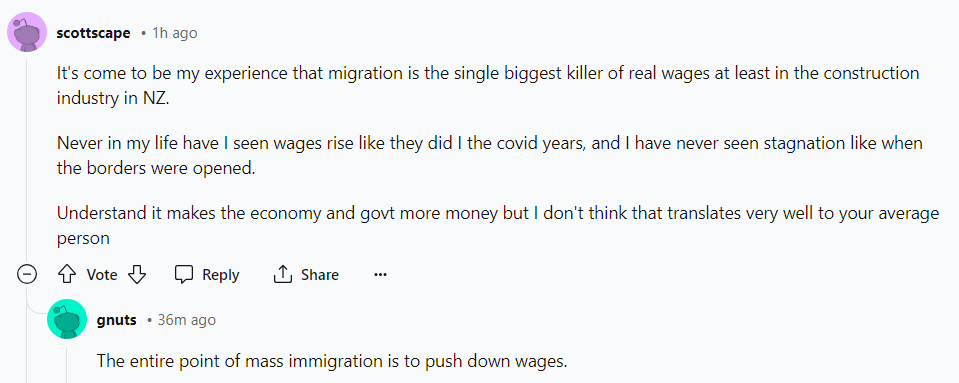
On top of that, the Boomers are mass importing cheap labour to compete with the Boomers’ own descendants on housing and wages. So those descendants are finding themselves having to scrap with half of the Third World just to get a quarter of what their parents had. It’s a rotten deal by any fair analysis.

So now many young people are saying to themselves: if the social contract was never upheld for us, why should we uphold it for anyone else? Why fight for an arrangement where we’re little better than slaves, sentenced to pay off mortgage debts to Boomers until we’re decrepit ourselves?

Why fight for a system that’s rigged against us? Young people in the trenches against China wouldn’t be fighting for a system that gave them a better chance of owning a house and raising a family than the Chinese system, but the opposite (the homeownership rate in China is close to 90%). They’d be fighting for a system of usurious enslavement that sought to suck the life energy not only from them but from their descendants for generations to come.

No young Westerner can, with a clean conscience, support the system that has enslaved them. It follows that they would only fight for it under the most extreme form of duress. Given the extent of the fragging that existed near the end of the Vietnam War, the ruling class could rightly be concerned that something similar would happen again if they brought conscription back, only on a bigger scale.

Moreover, some are asking: Fight for what?

It’s no longer clear that we even have nations anymore, at least not in the way that we’re used to thinking about them. The advent of multiculturalism has meant that the old in-group boundaries are now very fluid. The countries our ancestors fought for are now very different – some would argue categorically different.

Most young Westerners now understand that they’re being replaced by Third World cheap labour, and that this replacement is not a natural phenomenon. Rather, it is deliberately being orchestrated by the Western ruling class for profit. So what would we be fighting for in the case of getting conscripted to kill Russians? A McNation of cheap labour imports? An economic zone ruled by an ideology of “every man for himself” economics?

Our families would be better off if we didn’t go to war. The only beneficiaries of war today are the globalists who would not only get to destroy their rivals, but who would also profiteer from the killing. Realising this en masse, young people are no longer willing to fight as previous generations had been.

Some of the unwillingness to fight can be attributed to the influence of alternative media. For decades now, alternative media outlets devoted to the fight against evil have served to educate the public about the workings of the ruling class, and how they manipulate the rest of us into doing their bidding. VJM Publishing has been among those, and we will continue to do what we can to enlighten people about how the warmongers manipulate them into battle.

*

For more of VJM’s ideas, see his work on other platforms!
For even more of VJM’s ideas, buy one of his books!

*

If you enjoyed reading this essay/article, you can get a compilation of the Best VJMP Essays and Articles from 2021 from Amazon as a Kindle ebook or paperback. Compilations of the Best VJMP Essays and Articles of 2020, the Best VJMP Essays and Articles of 2019, the Best VJMP Essays and Articles of 2018 and the Best VJMP Essays and Articles of 2017 are also available.

*

If you would like to support our work in other ways, subscribe to our SubscribeStar fund, or make a donation to our Paypal! Even better, buy any one of our books!

Malinformation, Or How Facts Can Be Racist

Today’s authoritarian left have dreamed up three categories of things you’re not allowed to say. There is disinformation, wherein someone wilfully says something untrue; there is misinformation, wherein someone inadvertently repeats an untruth told to them by someone else; there is malinformation, wherein someone tells the truth but is still guilty of wrongthink. This essay explains.

According to the United Nations itself, malinformation is “information that is truthful but is slanted to mislead and cause potential harm”. The examples usually given are doxxing, swatting, catfishing etc. However, the term is broader than that, because it seems to include political harm, or at least the perception of political harm.

Malinformation is an exceptionally wide-ranging term, because harms (especially political harms) are often subjective. The Iona University website makes the astonishing claim that sharing truthful information about members of the British monarchy evading taxes is malinformation, because the sharing of that information can be decreed to be intended to harm that monarchy.

The truth is no defence.

The Iona University website also tells us that “Malinformation can become disinformation with enough social media virality”. In other words, the truth can become a lie with enough “social media virality”. Apparently the context in which a piece of information is shared now determines whether that information is true or false. One can hear Orwell’s mocking laughter from beyond the grave.

The concept of malinformation is an inevitable development of postmodernism. Once the concept of objective truth is thrown out the window, sharing information becomes a primarily moral decision. Whose interests are served by the sharing of this information? And are they oppressor or oppressed?

It seems that one person’s opinion is another person’s malinformation. So, perhaps ironically, it comes down to whoever can force the widespread acceptance of a definition of malinformation that suits them.

For instance, the Iona University website claims that “entire articles reducing a complex situation to an image” is a form of malinformation. But reducing a complex situation to an image is precisely what the corporatist media did when it reduced the mass immigration of Middle Eastern “refugees” to Europe to a photograph of a drowned Syrian boy. And yet, no misinformation expert seems to consider the sensationalisation of this photo in the mainstream media to be a form of malinformation.

Pointing out the incredible numbers of rapes and other crimes committed by Muslim and African immigrants is, apparently, malinformation. The fact that people from such countries commit certain crimes at a disproportionate per capita rate, sometimes ten or even 20 times that of native Europeans, is apparently not remarkable by itself. But if used as a supporting argument to build a case against immigration from Muslim and African countries, then it’s causing harm, and is malinformation.

Naturally, mainstream media stories about how one particular refugee got a job are not malinformation, because they’re not causing harm (harm being defined as harm to the interests of the globalist banking and finance concerns who own the mainstream media). Propaganda intended to make people more accepting of mass immigration is not harmful, according to this definition.

A Swedish study found that “In 2017, 58% among those suspected for crime on reasonable grounds are migrants. Regarding murder and manslaughter, the corresponding figures are 73%. These figures are interesting out of purely scientific reasons. Due to migration, murder rate in Sweden has quadrupled.” Mentioning this is also malinformation, if it’s intended to make open borders politicians look bad.

Presumably the correct context is to blame everything on white supremacy. Sharing information about colonial atrocities is, for this reason, not malinformation, because it harms the right people. So facts can be racist if they harm the interests of certain already disprivileged races (or at least the interests of those who claim to speak for those races).

Facts about how men commit far more violent and sexual crimes than women are not malinformation, because men are oppressors.

Here one starts to understand the political motivation behind the creation and promulgation of the concept of malinformation. The world is currently under globalist control, and therefore sharing of truthful information is a bad thing if it harms globalist interests. And those interests are primarily about keeping the rest of us fighting while they loot the place.

Note that the Government is never guilty of malinformation. The Government, seemingly by definition, never uses the truth to mislead or to cause harm. This reveals the reality of the concept of malinformation: just as with disinformation and misinformation, malinformation is whatever with the people with power say it is, and malinformation is never what the people without power say it is.

Essentially, there is little difference between something truthful the people in power don’t want their political opponents to say on the one hand, and malinformation on the other. Mentioning crime statistics is a form of malinformation because it does harm to the political establishment to point out measures of its incompetence. As does mentioning corruption on the part of the ruling class.

In principle, the sharing of any facts or evidence that goes against the political objectives of the globalists who own the world’s media and governments is malinformation. The only real counter to this is to develop networks and ecospheres of free-thinking people, outside of the control of the government or the influence of the mainstream media.

*

For more of VJM’s ideas, see his work on other platforms!
For even more of VJM’s ideas, buy one of his books!

*

If you enjoyed reading this essay/article, you can get a compilation of the Best VJMP Essays and Articles from 2021 from Amazon as a Kindle ebook or paperback. Compilations of the Best VJMP Essays and Articles of 2020, the Best VJMP Essays and Articles of 2019, the Best VJMP Essays and Articles of 2018 and the Best VJMP Essays and Articles of 2017 are also available.

*

If you would like to support our work in other ways, subscribe to our SubscribeStar fund, or make a donation to our Paypal! Even better, buy any one of our books!

What Lee Kwan Yew Might Have Said To Bronze Age Pervert (And To Us)

A recent tweet from Bronze Age Pervert has caused a shitstorm on Twitter. BAP wrote that “Only a myth of race blindness is workable.” The accompanying tweet thread (highly recommended reading) contains much controversy.

The logic that Bronze Age Pervert is describing is the logic that has ruled the West since World War II. It’s very close to the idea of Plato’s Noble Lie, in the sense that many understand it to be false, but it’s supported anyway for moral reasons (BAP states that supporting it is not his own preference but that avoiding this is politically impossible).

This logic claims that social harmony in the West depends on everyone believing in the myth that all races are equal. If certain races are told that their adverse collective outcomes are the result of their inferiority, they will get angry and destructive. It’s a matter of survival, therefore, that human biodiversity is denied, even as a concept.

If denying racial differences is the Anglo-Judaic approach post World War Two, Lee Kwan Yew supported a different approach.

Lee Kwan Yew was perhaps the most famous proponent of the race realist position. Being Chinese, he mostly managed to avoid accusations of being a Nazi. Lee was happy to state that different races had different average intellectual potentials, and that these different potentials were the reason for their different economic and academic outcomes.

Not only was Lee happy to state this, he was unrepentant. He had very good reason to be so.

Lee Kwan Yew pointed out, quite reasonably, that there were many great pitfalls to the race blindness approach. First and foremost, if we assume that all races are equal, then it logically follows that the lower economic and academic achievement of the less successful races is due to racist discrimination.

If a recipe for inter-racial resentment could be written, it would consist of claiming that wealth gaps cannot be explained by natural wealth-creating aptitude, and that they must be explained by structural discrimination, and that anyone who denies this is a racist. As Ibram X. Kendi’s writing reveals, raceblindness axiomatically assumes that if you aren’t raceblind, you’re a racist bigot.

Lee also pointed out, correctly, that if racist discrimination is widely believed to be the reason for the underperformance of certain races, then demands for quotas and affirmative action would inevitably follow. And then if those quotas and affirmative action programs did not result in equal outcomes, more demands for more of them would come.

The end result of “race blindness” is a never-ending cycle of increasing demands of equal treatment.

The resentment caused by this cycle is, as Lee realised, a major threat to social cohesion. When you have a large proportion of the population believing that the rest of the population has stolen something from them, social cohesion disintegrates. But this is the inevitable result of pushing the race blindness myth.

In the New Zealand mainstream media, one often sees articles decrying a supposed Pacific pay gap. The New Zealand Human Rights Commission’s “Pacific Pay Gap Inquiry” is ostensibly intended to discover the reasons for the fact that Pacific Islanders get paid less than white and Asian people. In reality, the reason for the inquiry is to fearmonger about white supremacism.

The reason for the Pacific pay gap is the same reason as for the working-class vs. middle-class pay gap: intelligence. It’s known that the average Pacific Islander IQ is considerably lower than the average white/North Asian IQ (see: Samoa 88, Tonga 86, Fiji 85). This is as predicted by Cold Winters Theory. So the pay gap simply reflects the gap in cognitive resources bestowed by Nature. It has nothing to do with discrimination.

The narrative that the pay gap necessarily implies structural discrimination, and that anyone who disagrees is a Nazi who sees others as racially inferior, is a narrative of pure resentment. It’s a slave mentality, designed to rabble-rouse and to destroy.

As Lee was aware, racial equality narratives are often pushed by Communists in particular, who push any and all anti-nationalist narratives. This is one of the reasons why he had to oppose them so hard. He knew that if a Communist narrative of Malays getting exploited by Chinese took hold, Singaporean society was liable to disintegrate.

If Lee Kwan Yew could give advice to those of us in the modern West, he would likely tell us to abandon the myth of racial equality. Promulgating it might make certain white people feel morally superior, and it might placate the egos of browns and blacks, but it creates a massive resentment that itself leads to an explosive social tension. He might argue that the “every man for himself” nihilism of the modern West was an inevitable consequence of this resentment.

Finally – and Lee made this same argument many times – races do not have to be intellectually equal for individuals from those races to be equally worthy of respect. There is no reason to disrespect an individual just because his race might have a lower IQ, not any more than there is to disrespect someone because his family is lower class. To do so is vulgar, a sign of low frequency.

*

For more of VJM’s ideas, see his work on other platforms!
For even more of VJM’s ideas, buy one of his books!

*

If you enjoyed reading this essay/article, you can get a compilation of the Best VJMP Essays and Articles from 2021 from Amazon as a Kindle ebook or paperback. Compilations of the Best VJMP Essays and Articles of 2020, the Best VJMP Essays and Articles of 2019, the Best VJMP Essays and Articles of 2018 and the Best VJMP Essays and Articles of 2017 are also available.

*

If you would like to support our work in other ways, subscribe to our SubscribeStar fund, or make a donation to our Paypal! Even better, buy any one of our books!