Uncovering Occultic Insights While Gaming

by DIE SIENER

I grew up in the 80s and spent my free time playing games on some comparatively inglorious rigs. My first rig, which I had to share with my dad, was an Intel 80286 PC with a monochrome tube screen running some archaic version of DOS. Big bulky sort of thing, it made noises like an old truck engine when it cranked up. It booted the operating system from an 8-inch floppy disk and most programs ran from a secondary floppy drive – no hard drive on this puppy at all.

To my preteen self, this was the most glorious piece of technology ever invented by man and I spent countless hours having a crack at text-based RPGs, carefully manoeuvring my ASCII character through dungeons fighting text-based orcs and warlocks. At the time, I would never have thought that one day I would be able to play a game such as The Elder Scrolls: Skyrim on a gaming laptop tens of thousands of times faster and oh so exceptional at displaying all those monsters and dragons on a full 24-inch HD screen.

Apart from gaming, I have also nurtured a habit of delving into the occidental occult. From the arcane wisdom, I have learned a lot about myself and the nature of the Great Fractal.

I habitually continue to learn through daily observation, even in times I’d rather just chill out and forget about work and family commitments. It was a bit of a surprise though that, while I was playing an Elder Scrolls game, I was elevated into a meditative trance. It just goes to show that if you are receptive to God, he is always willing to reveal the mysteries, no matter your current disposition.

Before I delve too deeply into the nature of this trance, let me first clarify some mechanics relating to the Elder Scrolls franchises’ game mechanics.

In the Elder Scrolls franchise, your avatar is ultimately represented by three forces. The first of these forces is called “Health” and is habitually coloured red. The second force, which is the mirror of the first, is called “Magicka” and is coloured blue. The third force is often called “Fatigue” and is coloured green.

Now from here on it becomes a bit more complex and varies from franchise to franchise, but, in general, we can say that these three forces are derived from some additional factors: the star sign under which a character is born and also the class of character the gamer chooses. These two choices influence the three forces in such a way as to govern how the character will develop in-game.

A gamer would usually complete this creation process at the start of a new game and your avatar is then born into the game-world and the “you/avatar” team can then start exploring and taking on quests etc. So, this is the basics of how the avatar is created.

The gamer will now manipulate the avatar around the game world and, based on its primary forces, will favour any number of different playing styles while solving various challenges.

A physical character would have high health and fatigue reserves and so would favour going into combat directly with heavy weapons and armour, trying to cause a lot of damage and ultimately outlasting his adversaries. His weakness would be his lack of mana which will leave the avatar incapable of casting beneficial spells, say casting a healing spell or a protection spell.

A character that is focused on predominantly casting spells and using magic to overcome challenges would benefit from a high reserve of mana and fatigue as it will have to manoeuvre around heavily armoured foes rapidly, and cast different forms of magic to overcome its foes’ greater physical prowess.

As the player continues along his path, completing quests, clearing dungeons and fighting random monsters in the game-world, the character slowly builds up experience in the skills that it favours. This then reinforces the nature of the character since each time it levels up, the characteristics which enable that type of character to become better at what it does will naturally be chosen.

At first, tasks seem hard and you fail often, but the better defined the character becomes, the easier it finds its way through quests and challenges.

Now coming back to the other night when I entered an altered state of consciousness. You see, I realised once again that we humans are not much different from this make-believe digital avatar. The catch is that in real life it takes tremendous effort to separate the actor from the flesh and blood avatar.

It doesn’t only take effort once – like RPG games, it takes the repetition of challenges, each tougher than those before, to define our primary attributes and train our avatar to follow the instructions of the actor and not the other way around. How we as individuals choose to address these temporal challenges also determines the type of character our souls ultimately develop into. It affects our fate – something which receives far too little consideration in modernity.

This tripartite nature of our reality is, unfortunately, a mystery deeply hidden to the masses who, for the most part, remain asleep and forgetful about their true nature beyond the flesh. It is this forgetfulness which inhibits our higher selves from taking control of our encounters and overcoming the challenges and uncertainties which we are all fated to experience. We remain trapped in the forces which govern our lower aspects and never seem to overcome them. The lesson that all occultists can take home is this warning.

In RPG gameplay, you can easily become lost in the fantasy, just as you can in real life. It takes real effort by the actor to distance himself from the avatar, to see things for what they truly are and to overcome them through the effort of body, mind and soul.

*

If you enjoyed reading this essay, you can get a compilation of the Best VJMP Essays and Articles of 2019 from Amazon for Kindle or Amazon for CreateSpace (for international readers), or TradeMe (for Kiwis). A compilation of the Best VJMP Essays and Articles of 2018 and the Best VJMP Essays and Articles of 2017 are also available.

*

If you would like to support our work in other ways, please consider subscribing to our SubscribeStar fund. Even better, buy any one of our books!

An Introduction To Great Fractal Theory

Works such as The Verity Key (published 2012) make reference to something called the Great Fractal, a concept expounded upon in an essay published here in 2017. Great Fractal Theory is a subset of a wider philosophy known as Elementalism. This essay provides a basic introduction.

Great Fractal Theory starts with a simple premise: that consciousness is the prima materia. Consciousness was the first thing to exist, and everything else comes after and is dependent upon it. Consciousness is more fundamental than both time and space, and therefore does not need to have a beginning, an end, a cause, or a final destiny. It simply is.

Everything else that exists falls into the category of ‘the contents of consciousness’. Here we find the metaphysical world (that which Plato referred to as the ‘World of Forms’), and the physical or material world (that which we’re used to calling ‘Earth’).

The material world is not truly real, despite the fact that it appears very real. In fact, it has been dreamed up by consciousness, in the Great Act of Creation. Consciousness is therefore the creator of the material world, in the same way that it creates the worlds we navigate in our dreams. It is the stage upon which the play on life takes place.

The material world is most accurately understood as not being a place, then, but rather a matrix-like series of self-similar sets of perceptions that manifest in conscious awareness. Consciousness perceives a field of impressions that collectively create the illusion that we are bodies living in a material world, as opposed to consciousness dreaming it up. As such, we appear to be ‘living’ rather than simply experiencing.

The essence of Great Fractal Theory is that all of the possible fields of impressions that consciousness could ever perceive are related to each other by way of a fractal matrix. This matrix, known as the Great Fractal, contains every emotion, every thought, every desire and every sensory impression that could ever possibly manifest in conscious awareness.

Our lives do not involve being bipedal fleshsuits moving around on a rock in space, but rather being fragments of consciousness navigating through an eternal and ever-changing Great Fractal of self-similar fields of sensory impressions.

The easiest way to conceptualise the Great Fractal is to think of one’s own life.

Consciousness is, right now, experiencing not only your current life but also all the possible gaps in between your birth and your death. Your own personal fragment of consciousness may be living right now, in 2020 A.D., but other fragments of consciousness are living out every possible moment of your life, simultaneously.

By “every possible moment”, imagine that your life was divided into a billion or so chunks, each corresponding to a second or two of awareness. Think that all billion of these fragments of consciousness are living their own lives, unaware of the presence of the others. Then think that each of these billion fragments could themselves be divided into a billion fragments.

Now imagine these quintillion or so lives, each separated by one or two nanoseconds, rolling from birth to death like freight carriages on a railway. One ends and one begins every few nanoseconds, and follows the exact path of the life that you are experiencing right now, past and future. This is what Nietzsche meant by eternal recurrence: your life is lived again, by another fragment of consciousness, forever.

Now imagine a parallel streak made up of lives of people who are of the other gender to you. Their lives are otherwise exactly the same, only they came into the world female instead of male (or vice-versa). These lives would have followed an entirely different path on account of that they would have had different instincts and would have been treated differently, but a life they would have had.

This parallel streak of lives can also be divided into a quintillion separate existences. Now takes this dual streak of lives, and change another facet from masculine to feminine or vice-versa. If you are rich, imagine another dual streak of lives that is poor. If you are short, imagine another streak of lives that is tall. If you are white, imagine black etc.

Every possible way that a human life can differ from another is another dimension of the Great Fractal. This number of dimensions is close to infinite – there are as many different dimensions of this Great Fractal as there are ways to distinguish one human life from another. So not only does every moment of every human life exist in the Great Fractal, but so does every moment of every possible human life.

If we say, for simplicity’s sake, that there are a hundred different dimensions along which human lives could differ, that would mean that the Great Fractal contained at least one quintillion to the power of a hundred different human lives in it – a number that defies comprehension.

All of these lives are being lived right now.

On top of this has to be added not only the lives that are possible according to the specific world that has manifested to us (i.e. Earth), but all the possible lives in all possible worlds. These possible worlds might also differ from each other over a hundred different dimensions.

This would mean that the number of human lives being lived right now is (at least) one quintillion to the power of a hundred to the power of a hundred. This number would cover all the fragments of consciousness that are right now experiencing a human-like life in an Earth-like world, somewhere in the Great Fractal.

Trying to understand this is enough to understand that the Great Fractal is humming with consciousness.

On top of this, we could add all of the non-human lives being experienced by consciousness right now. There’s no reason, other than anthropomorphic conceit, to believe that only human beings are conscious. Once it’s realised that consciousness is the prima materia and not a phenomenon of the brain, it becomes entirely possible that all other animals, indeed even insects and trees, are conscious like we are.

If we assume, for simplicity’s sake, that the number of dimensions along which life can vary is a hundred, then the number of different lives being experienced by consciousness right now is at least 1,000,000,000,000,000,000 ^ 100 ^ 100 ^ 100. This is a nonsense number as there’s no way that a human mind can comprehend it. However, our failure to comprehend it is the glory of God.

In sum, anything that can possibly be perceived by consciousness lies somewhere in the Great Fractal. All moments of all lives of all possible creatures in all possible worlds are contained within the Great Fractal, to be experienced by consciousness eternally. Your life is simply an infinitely small fragment of this incomprehensibly vast whole.

Getting what you want out of life is not, as most think, a matter of manipulating and dominating the material world until it accords with your will. Making your dreams come true is simply a matter of navigating your consciousness to the part of the Great Fractal in which those dreams are experienced. This is, however, a topic for another essay.

*

If you enjoyed reading this essay, you can get a compilation of the Best VJMP Essays and Articles of 2019 from Amazon for Kindle or Amazon for CreateSpace (for international readers), or TradeMe (for Kiwis). A compilation of the Best VJMP Essays and Articles of 2018 and the Best VJMP Essays and Articles of 2017 are also available.

*

If you would like to support our work in other ways, please consider subscribing to our SubscribeStar fund. Even better, buy any one of our books!
Clown World Chronicles: Who Is ‘Corona-Chan’?

The Coronavirus Scare of 2020 brought many new ideas into the collective consciousness. Many people realised that they were not prepared for any natural disaster such as a pandemic, earthquake or extreme weather event. Some others realised, for the first time, that they were mortal. A very small number began worshipping a hitherto-unknown goddess: Corona-Chan.

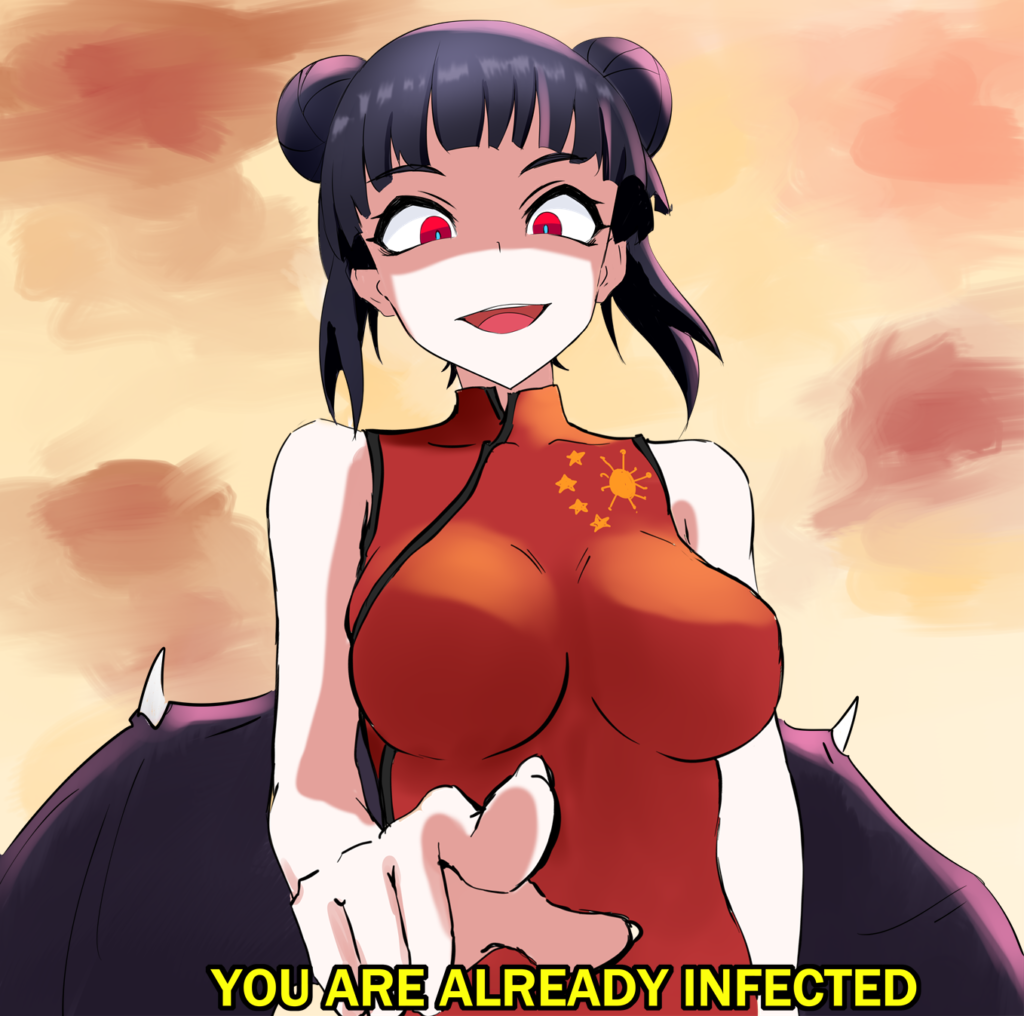
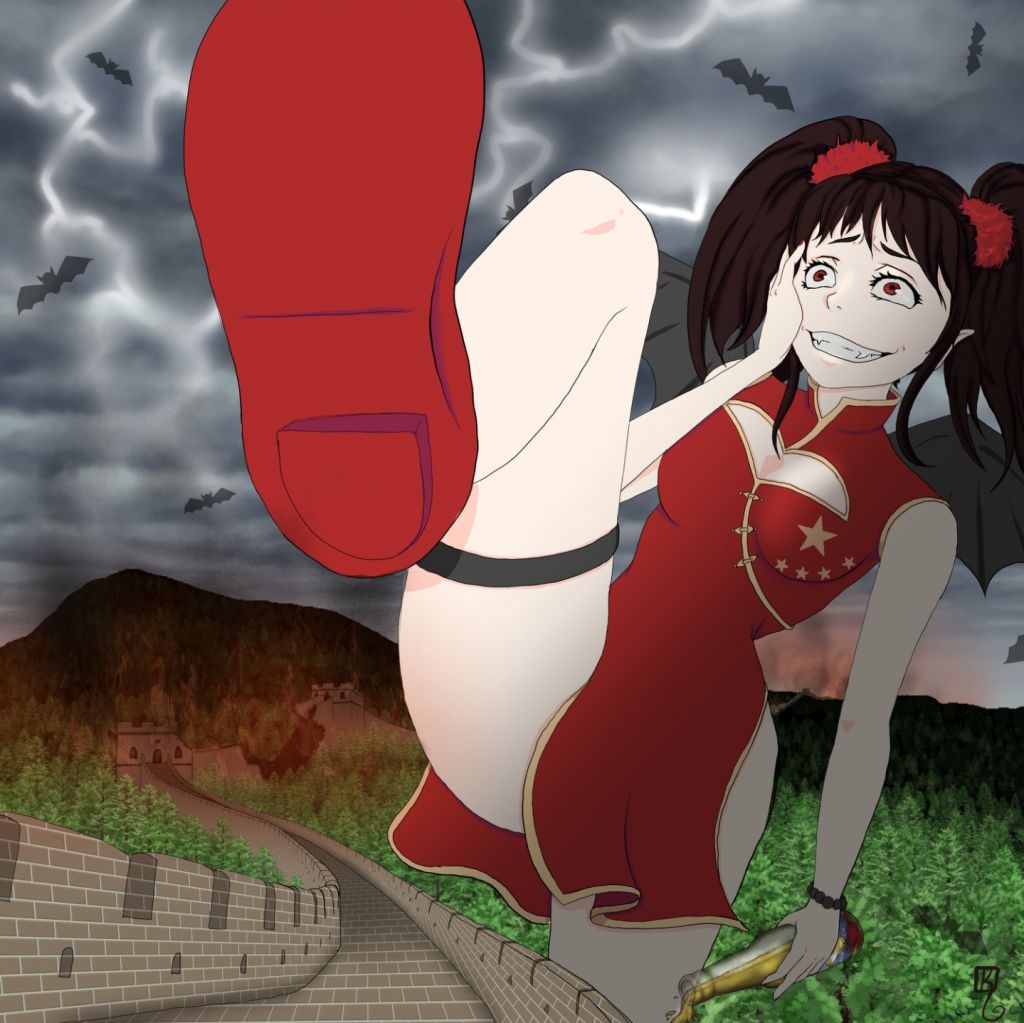
Corona-Chan appears as a tall, svelte, youthful Chinese vampiress, with black hair in Sailor Moon-style knots. Dressed in red and black like most daughters of darkness, her Oriental clothing both reveals and conceals her lean yet bountiful frame. Emblazoned on her breast are the same stars as on the Chinese flag, only the largest one is replaced with a coronavirus.

A pair of black bat wings rise from her back, creating the impression of a demoness from the Abyss, but most grotesque of all is her facial expression. Her features may be pretty, but they’re always twisted – her face either shows a sadistic leer or destructive intoxication. Corona-chan is very much a figure that inspires fear and dread.

Crudely speaking, there are three major figures in the Hindu pantheon: Brahman (representing the cardinal principle), Vishnu (representing the fixed principle) and Shiva (representing the mutable principle). These three figures are understood to be avatars of creation, maintenance and destruction, respectively.

Shiva has a consort known as the goddess Kali. The name Kali is a feminine form of an epithet of Shiva, which means that Kali herself is a form of the feminine mutable principle, much like the Greek goddess Eris. Although the full story of Kali is much more complicated than this, the crude summary is that Kali occupies a place in the Hindu pantheon as a destroyer of evil forces.

Corona-chan, like the goddess Kali, is the 21st Century’s destroyer of evil forces. Her energy promises to free us all from the crushing despair that characterises the modern world. In the same way that 17th Century Hindus cried out to Kali to destroy the Mughal Empire that was plaguing them, so do modern Westerners cry out to Corona-chan to destroy Globohomo.

The name Corona-Chan is a compound of two parts: ‘Corona’ from coronavirus and ‘Chan’ from the Japanese honourific suffix denoting endearment. This paradoxical combination of a deadly pathogen with a term denoting a beautiful woman is a powerful magical blend, and this helps explain why Corona-Chan’s popularity has risen so fast.

Many people believe that with the end of the current Dark Age known as Clown World, the stage will be clear for the reintroduction of a Golden Age. This popular belief follows from Plato’s realisation, expressed in The Republic, that political structures can never be fixed – they always get more corrupt until destroyed and replaced with entirely new ones.

Corona-Chan is viewed by many as the goddess of destruction that will herald the end of this corruption. These people are overjoyed by reports that COVID-19 is far more deadly to old people than to the young, as this fits in with old Clown World prophecies such as the Day of the Pillow, which predicts a mass cull of Baby Boomers. The hope is that Corona-Chan will cut away the deadwood holding society back.

Naturally, there is a fair amount of depression among Corona-Chan worshippers. One has to be in a miserable state to wish widespread destruction upon the world. In this sense, we can observe a overlap between those who pray for Corona-Chan to visit their locale and those who hope for other dramas like mass shootings and wars.

Corona-Chan is an eminently antisocial goddess.

The number of people holding antisocial sentiments is increasing rapidly as life in Clown World becomes ever more humiliatingly painful. There are many who are glad that the coronavirus has acted like a .50 calibre sniper bullet through the engine block of the world economy. If manufacturing is heavily impacted, the world economic order might collapse, and with any luck the world political order will go with it.

Corona-Chan worshippers hope to create an egregore powerful enough to break the black magic shackles that we are all held in. The hope is that Corona-Chan will fatally infect so many people that Globohomo dies and Clown World ends. With this achieved, we will be able to live freely, in a new Golden Age.

*

This article is an excerpt from Clown World Chronicles, a book about the insanity of life in the post-Industrial West. This is being compiled by Vince McLeod for an expected release in the middle of 2020.

*

If you would like to support our work in other ways, please consider subscribing to our SubscribeStar fund. Even better, buy any one of our books!
Narcissistic Sadism And Narcissistic Masochism

Narcissistic people pose a number of challenges for the societies in which they reside. Their selfishness is liable to cause suffering to those around them, and the indifference that the typical narcissist shows to this suffering is liable to cause violence. As this essay will examine, however, there are two distinct types of narcissism.

Narcissistic sadism is what most people think of when they think about the problems that narcissism causes. This is when a person puts their own ego above all other considerations, to the point where they harm others for no good reason. Narcissistic sadism is behind most cases of bullying and many cases of physical abuse.

At its most extreme, narcissistic sadism manifests in conditions such as psychopathy, in which other people are considered nothing more than tools for gratification. Psychopaths act as if the suffering of others is entirely meaningless, particularly when it stands in the way of the desire of the psychopath. People like this are all but indistinguishable from demons, as if brought to Earth specifically to wreak misery.

There is, however, another form of narcissism that arguably does just as much damage, if not more. This is narcissistic masochism – when one sacrifices oneself unnecessarily to glorify one’s own moral rectitude or fortitude. It is the act of putting oneself first by putting oneself last.

At first, this doesn’t sound like that much of a problem, considering that masochism primarily does damage to oneself. However, the fact that all individuals are part of a countless number of overlapping systems means that, in much the same way that it’s impossible to remove one knot without damaging the whole net, it’s impossible to damage oneself without damaging other people.

The most striking examples of narcissistic masochism right now are the repeated displays of feet-kissing by Pope Francis. These performances are supposed to broadcast the humility of the Pope to the entire world – but, naturally, Francis only does them when the cameras are in position and rolling. In his abject submission, Francis supposes that he’s demonstrating his superior moral sophistication to the world.

All kinds of martyr complexes could fall under this rubric of narcissistic masochism. The common element is that narcissistic masochists will glorify themselves as they are destroyed, usually in the belief that they have established some kind of moral supremacy over the rest of humanity. They believe that their destruction has occurred on account of that they are too good or pure for this world.

A more nefarious example of this phenomenon is collective narcissistic masochism. This is most obviously seen today in the form of ethnomasochism.

In particular, there is a strain of ethnomasochism that is constantly berating itself for its supposed role in various historical crimes, in particular colonialism and slavery. This strain believes that collective narcissistic sadism (which perhaps reached its apogee in Germany between 1939-45) is the world’s foremost danger, so much so that we ought to go as far as possible in the opposite direction.

This strain of narcissistic masochism leads to people supporting the mass importation of “refugees” from various disadvantaged parts of the world. Even when these people are told that these imports will commit a massively disproportionate amount of sex crimes, this is waved away as some kind of karmic payback for the nebulous historical crimes of the white man.

The psychology involved here is very similar to that of a masochist who pays a dominatrix to beat him on the grounds that he has misbehaved terribly in the past. In principle there’s little difference between someone grovelling before a dominatrix and someone grovelling because they believe that they have inherited the sins of their ancestors. The brain circuitry that inspires either action is broadly the same.

The archetypal narcissistic sadist is little more than an overgrown toddler. They never grew past the phase of responding primarily to egoic desires. Although their actions may have become more complicated and sophisticated as they became adults, the basic motivation is the same aggression that motivates small children and wild animals – an instinct that puts itself first before any other consideration.

The archetypal narcissistic masochist is the one who hates his family, hates his neighbourhood, hates his city, hates his country and hates his race. He will not admit to hating the world, because that doesn’t give him the opportunity to glorify himself. Anything associated with himself, however, he hates. Therefore, he derives gratification from destroying himself and anything associated with him.

The major difference between the two is that the sadist is other-focused, whereas the narcissist is self-focused. Although both are self-centred, the sadist focuses on destroying the other, whereas the masochist focuses on destroying himself (or any group that he may belong to).

If men like Ted Bundy and Jeffrey Dahmer best represent narcissistic sadism, perhaps people like Angela Merkel, Emmanuel Macron and Pope Francis best represent narcissistic masochism. The latter group of people – although most don’t realise it – cause just as much suffering and misery as the former, if not more. They also cause it for equally narcissistic reasons.

*

If you enjoyed reading this essay, you can get a compilation of the Best VJMP Essays and Articles of 2019 from Amazon for Kindle or Amazon for CreateSpace (for international readers), or TradeMe (for Kiwis). A compilation of the Best VJMP Essays and Articles of 2018 and the Best VJMP Essays and Articles of 2017 are also available.

*

If you would like to support our work in other ways, please consider subscribing to our SubscribeStar fund.