
The Case For Cannabis: Legalisation Will Not Lead to A Black Market

One of the fears of those who are against cannabis law reform is that a legal system would lead to the growth of the black market in cannabis production. Therefore, it would be better to keep cannabis illegal. As this article will examine, this reasoning is based on at least two major errors.

The logic goes like this: it costs X amount of dollars to buy an ounce of cannabis – let’s say 300. Cannabis is likely to be taxed in a manner similar to alcohol, and alcohol taxes are reasonably hefty, so let’s assume at least a 20% sin tax on cannabis, plus 15% GST – this is already over $400 an ounce.

This could mean that legal cannabis will cause so much tax to be added to the cost of an ounce that black market operators will be able to undercut it. Since cannabis growing will not be cracked down on because of its new legal status, large numbers of people will be able to grow and to enter the black market at no risk.

This reasoning is false in two major ways.

The first is that is doesn’t account for economies of scale. On the black market – which is currently where all cannabis is sold – producing cannabis isn’t cheap. As mentioned elsewhere, home cannabis grows suck up as much as 1% of the electricity production of nations such as America and New Zealand. These are incredibly inefficient compared to warehouse grows.

Moreover, cannabis sold in a legal market, from dispensaries, would not carry the risk premium associated with a product sold on the black market. The risk premium is very high in the case of cannabis, because a lot of product gets intercepted by Police action before it ever gets sold, and the losses from this have to be balanced against finalised sales.

Taking both of these things into account, we can see that the production cost of legal cannabis, manufactured by the ton and distributed to pharmacies without interruption, is going to be a fraction of what it is currently. This means that it will be possible to put GST on it and a sin tax on top of that, and still sell cannabis for $200 an ounce, or less.

No black market producer could compete with this and still make enough of a profit for it to be worthwhile. So, if anything, legal cannabis would sooner wipe the black market out completely by undercutting it. This was a principle understood in Uruguay when they made cannabis legal in 2013 – they set the price of cannabis at $1 a gram.

The second major reason why we need not be concerned about a black market is because we have the capacity ourselves to more-or-less set the final cannabis price through taxation.

There are really two kinds of prohibition: hard prohibition and soft prohibition. What we have right now is hard prohibition, where the Police will physically smash anyone in possession of cannabis, or cultivating it. This is hard because it uses the full power of the state, and will go as far as killing you to enforce it, or putting you in a cage for several years. We are simply not allowed it and no correspondence will be entered into.

But making something legal, and then taxing it to the point where it’s almost impossible to afford, is a kind of prohibition. The New Zealand Government is currently employing soft prohibition of tobacco, in that it has been raising the tobacco taxes every year, with the stated intent of forcing tobacco cessation through making it unaffordable. This it believes is in the greater good.

Soft prohibition shares many of the drawbacks of hard prohibition. In the case of cannabis in New Zealand, we can see that black market tobacco has made a comeback, to the point where trade in it is believed to cost the New Zealand Government tens of millions is lost taxes every year. So we can see that high taxes on legal cannabis is a bad idea, if the black market is to be discouraged.

If cannabis legalisation was done intelligently – which is to say that it was done with an entirely different mindset to how prohibition has been done so far – we would set the level of taxation such that the transition to a legal cannabis market was a soft transition. In other words, we could calculate what the expected average production cost of an ounce of cannabis should be, account for profits, account for GST, and tax that total at a rate that would still allow it to beat the black market. This would achieve all major objectives at once.

Not only would cannabis law reform not lead to more cannabis being sold on the black market, but it would be the best thing to fight the black market. Cannabis law reform would allow legal sellers to undercut the black market through economies of scale and the removal of the risk premium, driving criminal gangs out of business.

*

This article is an excerpt from The Case For Cannabis Law Reform, compiled by Vince McLeod and due for release by VJM Publishing in the summer of 2018/19.

Why Vaccination Should Never Be Made Compulsory

25 people have been infected by a measles outbreak in Canterbury, and one could predict from the degree of anti-anti-vaccination hysteria that there will soon be a social movement to make vaccination compulsory. Many people are calling for it, and the rhetoric demonising the anti-vaxxers is growing. This essay discusses why compulsory vaccination is the wrong approach.

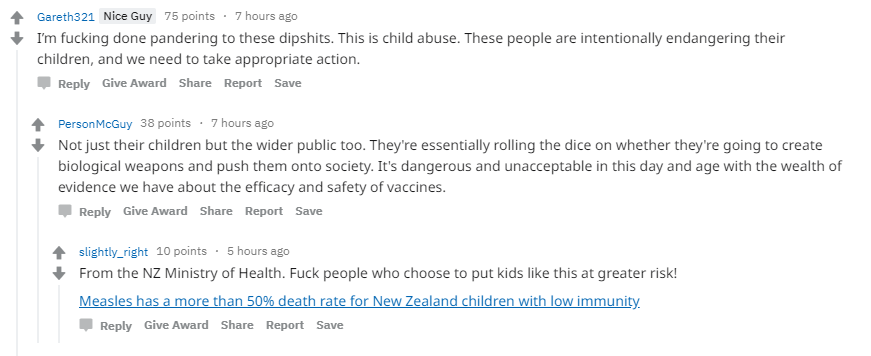
The joke goes that under totalitarianism, everything is either banned or made compulsory. The panic-based hysteria that fuels the various moral outrages that lead to totalitarianism can be seen in places like this thread on Reddit. Many New Zealanders are apparently happy to force compulsory medical treatment on others, despite it being a violation of Section 11 of the New Zealand Bill of Rights Act.

Compulsory vaccination would be a grossly draconian abuse of state power. But that isn’t why we should avoid it.

Let’s lay it out: vaccination is a good idea. Vaccination is a great idea, especially if the extremely minor side-effects are weighed up against the costs of being infected with measles, rubella, polio, whooping cough or the like. Some of these diseases are capable of crippling people for the remainder of their lives, leaving them in ghastly pain, or just killing them outright. Their presence as part of the human experience was a curse, and eradicating them would be excellent.

Vaccination is such a good idea that a parent ought to listen to their doctors when those doctors recommend vaccination. So if the necessary trust isn’t present in that relationship, something is wrong, and we ought to determine why.

The usual response is to call anti-vaxxers “nutters”, “loonies”, “schizos” and the like, and to attribute their lack of trust to an aggressive paranoia that can only be present on account of moral failure. But the responsibility isn’t on them to become more trusting. The responsibility lies on the Government and on the medical community to earn the trust of the population. It’s not merely an ideal that the population ought to trust that what their doctors is telling them is true – it’s a necessity.

The anti-vaccination movement is particularly strong in Nelson, which has been attributed to our unusually high proportion of nutters, loonies etc. The reality is that Nelson has a high number of anti-vaxxers for the same reason that California does: we were one of the first to understand the medicinal value of cannabis, and thereby one of the first to understand that the medicinal community was lying to us about it.

People know that they’ve been lied to about cannabis. We know that doctors have not been fully honest about the medicinal benefits of this substance for decades. Those who have done the research know that these lies are mostly the result of pressure from Government, disinformation from pharmaceutical companies pushing their product and the usual Kiwi slackness when it comes to doing your job properly.

So how do we know that we’re not being lied to about vaccines? Given the experience with cannabis, it’s entirely possible to suspect that Governments are putting pressure on doctors to ignore the risks of vaccination, or that the manufacturers of the vaccines aren’t honest about their side-effects, or that doctors simply haven’t bothered to research any side-effects.

Given that doctors have been lying about these things when it came to cannabis, it’s only natural that the trust that people had in them has sharply declined among some demographics. This is the error that needs to be corrected, and compulsory vaccination is a ham-fisted solution to something that can be achieved more elegantly.

Introducing compulsory vaccination is a foolish and short-sighted approach that will not only spur more suspicion and paranoia, but which will also help to justify future Governmental abuses. A much braver and wiser move would be for the Government and the medical community to earn back the trust that they have lost.

The best way to achieve this would be for politicians to make a frank and full apology for their parts in misleading the country about cannabis. They would have to not only admit that cannabis was medicinal, but that it was known to be medicinal and previous governments lied about it for whatever reason.

If the politicians would admit that many doctors only withheld the truth from their patients for fear of punishment from the Government, they would help to restore the faith in those doctors necessary for the more sceptical to get their children vaccinated. This is what needs to happen, not compulsory vaccination.

*

If you enjoyed reading this essay, you can get a compilation of the Best VJMP Essays and Articles of 2018 from Amazon for Kindle or Amazon for CreateSpace (for international readers), or TradeMe (for Kiwis). A compilation of the Best VJMP Essays and Articles of 2017 is also available.

The Case For Cannabis: Legalisation is Better For the Environment

Recent studies suggest that the future prospects for Earth’s environment are poor. The situation is dire enough that, finally, an awareness is growing that certain measures will have to be taken if the human species is to survive – and soon. This article explains how cannabis law reform is one of those measures (if a minor one).

Many people labour under the idea that cannabis prohibition stops people from using cannabis. Therefore, they assume, cannabis prohibition prevents it from being grown and used. The truth, of course, is that evil laws don’t prevent actions, because human nature is to defy evil laws, and so people grow cannabis everywhere anyway. In any case, cannabis is a medicine, and people will not simply go without a medicine because of the law.

Because of things like Police helicopters that go searching the hills and forests for outdoor grows, a majority of people who grow cannabis do so indoors, and most of these grows are simple setups under a 400 or 600 Watt bulb. These generally cost somewhere between $70 and $100 a month to run, and can produce several ounces of weed over a eight- or ten-week cycle.

This is a great outcome for an individual cannabis user who doesn’t want to deal with the black market, but it’s not the best outcome for the environment.

A study by American scientist Evan Mills found that indoor cannabis grows use up to 1% of America’s entire energy supply. If a similar proportion holds true in New Zealand, it would mean that indoor cannabis grows in New Zealand suck up electricity equivalent to that used by a city the size of Nelson every year. This represents some $60 million worth of electricity, every year.

Another way to put this is that a four-plant grows uses as much electricity as running 29 fridges. It’s a lot of energy being used for something that doesn’t really need to happen. After all, these grows are only done indoors for the sake of evading detection.

Legal cannabis would mean that cannabis growers could simply put a plant outside and let it grow in the Sun, without fear of being spotted by Police helicopters. There would be no energy requirements at all, and the cost of grow nutrients and the like would be minimal on account of that the plant would just be allowed to grow as large as possible.

Not all indoor cannabis growing could immediately be switched to outdoors. Many people simply don’t have the appropriate facilities. However, the vast majority of it could be, on account of that people would rather buy cannabis from a shop or get it from a pharmacy than grow it themselves, for a greater cost, and have to worry about watering, spider mites, replacement bulbs, buying potting mix, getting ripped off etc.

So legal cannabis would mean that companies would be able to build entire outdoor cannabis farms, and these farms would be much better for the environment than the current arrangement, in which everyone has a home grow operation because they can’t buy it legally and they need to avoid getting arrested. All of those highly inefficient home grows can be wound down in favour of commercial operations that achieve economies of scale.

The tricky thing about this argument is that the sort of person who cares about the environment already knows that cannabis should be legal. In much the same way that anyone who has bothered to look at the climate science knows that changes need to be made, anyone who has bothered to look at the science behind cannabis knew that cannabis prohibition should have been repealed 20 years ago.

The sort of person who genuinely believes that it’s a good idea to put people in cages for growing or using cannabis are, almost inevitably, the same kind of people who don’t care at all about the environment or what the state of it might be after we are gone. The characteristic feature of such people is an absence of empathy for others, and an inability to consider their suffering to be real. So the environmental argument will convince few who are not already convinced.

However, the fact remains that cannabis law reform is a better move for the environment. It would greatly reduce the carbon footprint of the cannabis cultivation industry, as well as reducing the amount of wastage in other areas. Given the pressing need to consider environmental impacts in all areas, we should make it legal for individuals to grow cannabis outside at home.

*

This article is an excerpt from The Case For Cannabis Law Reform, compiled by Vince McLeod and due for release by VJM Publishing in the summer of 2018/19.
Did Cannabis Prohibition Doom Humanity to Extinction?

Were the hippies right all along? The counter-culture that arose in response to the Cold War championed many things that made them hated: free love, a return to Nature, a rejection of materialism – and cannabis. This essay examines the possibility that we would have survived if only we had listened, and that cannabis prohibition doomed the human species to extinction.

A recent scientific report on climate data paints a grim picture for humanity’s future. Titled “Deep Adaptation: A Map for Navigating Climate Tragedy”, the paper lays out the stark fact that we have polluted the planet so badly that future chaos is inevitable. The truly baffling thing is we knew this all along. The science that explained what would happen to the planet if we continued to burn fossil fuels was established in the 90s – the 1890s.

So why didn’t we listen?

For the vast majority of human history, we lived in a close enough balance with the environment to not destroy it. Although there were certainly cases of localised destruction – the firestick farming method of the Australian Aborigines being perhaps the foremost – it was only recently that humanity developed the capacity to destroy the environment of the entire planet.

Somewhere along the line, we lost touch with the rest of the biosphere. Perhaps what initially kicked it off was following Descartes’s belief that only human beings were truly conscious. Maybe it was even further back, to Aristotle’s injunction that humans occupied the highest place on the food chain. In either case, what really pushed our ignorance into critical territory may have been the prohibition of cannabis.

Although the idea is commonly laughed at nowadays, cannabis is a spiritual sacrament, and has been used as such for thousands of years, particularly by the common ancestors of the Indo-European peoples. Evidence that ancient Scythians hotboxed tents with cannabis smoke predates writing in the area, Hindu and Vedic culture is replete with references to it, and even ancient Taoist alchemists considered it a major plant medicine.

An example of the kind of insights that people come to from cannabis use is that all creatures are part of one collective consciousness, which is more fundamental than time and space and is not constrained by them, and which is therefore eternal, and all of the other spiritual ideas that people nowadays consider to be mental illness. We’ve lost touch with these insights in the pursuit of ever more material wealth.

The real mental illness, it could be better argued, is on the part of those who don’t use cannabis.

It is the non-hippies, who don’t use cannabis, who buy expensive toys that are just plastic hunks of shit, and who drive around in enormously polluting vehicles, and who spend tens of thousands remodelling their house just for social status, who have wrecked the environment. A civilisation that destroys its own environment in pursuit of producing trivial, fleeting material pleasures could correctly be said to be insane.

If one understands that cannabis is a spiritual sacrament that used to keep humanity in touch with the natural world, and that this loss of contact with the material world has caused a climate crisis that may prove to doom us all, then it can fairly be argued that cannabis prohibition led to the destruction of humanity. If we’d just sat around smoking weed instead of working hard and aspiring to own ever-larger piles of crap, the planet might have survived.

If we had never contracted the disease of workism, we never would have thought it a good idea to drive miles to work, burning fossils fuels all the while, just to make three times more money than we actually need, and that just so we can buy piles of plastic crap and home improvements that never get used. We would have learned to appreciate the natural world more, instead of seeing it as something to be consumed on the road to economic growth.

Any hippie could tell you that the philosophy of eternal growth is the philosophy of the cancer cell. You don’t need an ecology degree to understand that an organism or group of organisms cannot keep growing indefinitely and stay in their niche. Either they stop growing or they expand into other niches. The ideology of eternal economic growth was inevitably going to hit its limit in one way or another.

If that hippie was of the more thoughtful kind, they might be able to tell you that such philosophies arose because people started to become afraid of death. Because cannabis has been a spiritual sacrament for our ancestors for so long, its prohibition in the early 20th century had the effect of, quite literally, separating us from God.

It’s possible that, if cannabis had never become criminalised, we never would have lost touch with Nature enough to even think about such a thing as building a strategic naval force that spanned the entire globe, sucking up enormous amounts of coal and oil as it did so, to the point where the biosphere collapsed. Ironically, if we had lived as the filthy, lazy, crazy hippies had suggested, we’d have had a better chance of passing through the Great Filter.

*

If you enjoyed reading this essay, you can get a compilation of the Best VJMP Essays and Articles of 2018 from Amazon for Kindle or Amazon for CreateSpace (for international readers), or TradeMe (for Kiwis). A compilation of the Best VJMP Essays and Articles of 2017 is also available.