Signs That A New Spiritual Order Is Arising

With every era that passes, old orders fall and new orders rise. Some of these old orders are military, some are technological and some are spiritual. With every Great Month that passes, a pre-existing spiritual order falls and a new spiritual order rises. This essay explains how we find ourselves now in such a time of change.

Some have described the changes upon us as the transition between the Age of Pisces, the old order, and the Age of Aquarius, the order to come. With the human entry into the Age of Pisces some 2,000 years ago, we moved out of the Age of Aries, which had been characterised by brutal militaristic sentiments. The Age of Pisces was, then, a reaction to the excesses of the age before it.

Pisces is the mutable water sign, which means that it has a double feminine energy. Arguably, the dominant spiritual ideology of the Age of Pisces has been Christianity, which also has feminine energies – it can be best understood as an attempt to reform Abrahamism from its brutal and hyper-masculine Arian frequency. Christianity has taken a watery form to counter the fiery nature of its predecessor, and the multiplicity of such forms reflects the mutable quality of Pisces.

In this Age of Pisces, people with this double feminine quality have done fairly well. This is not an age in which the strong conquer and dominate, but rather an age where the kind rule through the consent of the masses. The zeitgeist of the age has been to raise up those low down, and to pull down those up high.

Like everything else, however, it has become corrupted over time, and the form of it we now have is a degraded one. In its pure form, those unfairly cast down were lifted up, and those unfairly raised were pulled down. Now, a person is lifted up even if they were low down for natural reasons, or because of their own moral failings, while people who are high for just reasons are dragged down out of resentment.

It has been too long since the original spiritual revelations that began the Age of Pisces for them still to have power, and now a great counter-reaction against their present degraded forms is under way.

This means that the Age of Aquarius will involve a reaction against Christianity and against the ethos of passivity and agreeableness. Unlike the mutable water, the avatars of the Age of Aquarius will move ever-forwards. However, they will also be sure not to fall back into the patterns of the fiery ram-headed Arian aggression. Therefore, the Age of Aquarius will strike an airy balance between the watery Pisces and the fiery Aries.

Aquarius is the fixed air sign, which suggests a dogmatic and inflexible form of intellectualism. Combining this with the gentle masculinism of the age suggests that a kind of nerdiness might be the characteristic of coming centuries, perhaps an uncompromising kind of autism. This may be an outgrowth of today’s scientific materialism, the current dominant paradigm among the world’s ruling classes.

It might be that some kind of scientific materialism remains the dominant intellectual paradigm for the next 2,000 years, with all talk of the spiritual discouraged. It could also be that scientific materialism becomes the dominant paradigm for the ignorant masses only, while the enlightened and the initiated will be aware of the perennial truths that underpin the true philosophies of all times and places.

Certain phenomena predictably arise every time we near the end of a great age, as we now are. The foremost is a gross and paralysing apathy that drives all talk of the spiritual from public life. This can be seen with our current crop of atheistic rulers. However, this enormous apathy is necessary to wash away the vestiges of the old ways, and at its heart is the seed of a new spiritual order. The Age of Aquarius proper will begin when this new spiritual order begins to impose its will upon the world.

The first harbingers of this new spiritual order are those men and women who are rediscovering the spiritual sacraments that revealed the great wisdom that the ancients possessed. The vanguard of the new age of light returning to our benighted world is in those who have learned that psychedelics such as cannabis and psilocybin are capable of reconnecting a person to God and to the perennial wisdom.

There have always been small, clandestine groups of spiritual seekers who have kept the flame of genuine spiritual knowledge alive, despite the oppression from hate ideologies like Abrahamism, Nazism and Communism. These people have retained knowledge of the use of spiritual sacraments and techniques, even though the governments of recent decades have fought to suppress use of them. Most people now accept that the Governments are fighting a losing battle, so these groups have grown rapidly in number and influence.

However, it’s only now that a mass of people are starting to realise that these sacraments have revealed genuine spiritual knowledge to those brave enough to experiment with them. Bearers of light such as VJM Publishing are now able to publish information about spiritual alchemy without persecution – and we are far from the first or only ones. The spread of this knowledge will not stop until a new spiritual age exists upon the Earth.

It’s already possible to see magic mushrooms becoming legalised in places such as Denver. When magic mushrooms become legal more widely, it will become common for intelligent men and women to get together and use them sacramentally, to reconnect with God. When they do this, genuine spiritual knowledge will come to return to the Earth.

Although public sacramental use along the lines of the Eleusinian Mysteries are still some way off, in this general atmosphere of intellectual and spiritual exploration, it won’t be too long before there are some quasi-public rituals involving mass consumption of psychedelics. When this occurs, an entirely new consciousness will arise upon the Earth, involving new ways of relating to and identifying with each other.

If the Age of Aquarius means that scientific materialism completely destroys Abrahamism and the other superstitious cultures, this should clear the way for a return of those schools of thought that had been superstitiously attacked. This could very well lead to genuine spiritual revelation, and this could lead to a new spiritual era of human history and a new Golden Age.

*

If you enjoyed reading this essay, you can get a compilation of the Best VJMP Essays and Articles of 2018 from Amazon for Kindle or Amazon for CreateSpace (for international readers), or TradeMe (for Kiwis). A compilation of the Best VJMP Essays and Articles of 2017 is also available.
The Case For Cannabis: Prohibition Doesn’t Work

Although this book is full of arguments for cannabis law reform, all of them are technically forms of one great metaargument. All of the arguments for cannabis law reform, as the reader will discover, explore different facets of the failure of cannabis prohibition. This essay examines the fundamental argument at the core of the case for cannabis law reform – that prohibition doesn’t work.

Although there are a plethora of different kinds of cannabis law reform, all of them are based on the recognition that cannabis prohibition has a number of costs that could be saved. Although it’s denied by many, prohibition does have costs – the cost of law enforcement, the cost of prisons, the cost of faith in the Government, the Police and the medical establishment, among others.

Therefore, in order for this cost to be justified, cannabis prohibition has to do something good. There have to be profits somewhere to make up for all the costs. If there aren’t, then cannabis prohibition is a failed experiment and must be ended.

So let us ask: what is the objective of cannabis prohibition?

If the objective was to prevent people from using cannabis, that has failed. In 2008, 14.6 percent of the New Zealand population had used cannabis within the past 12 months, which is comparable to the prevalence rate of tobacco use. A decade later, cannabis is even more popular than before, and tobacco even less.

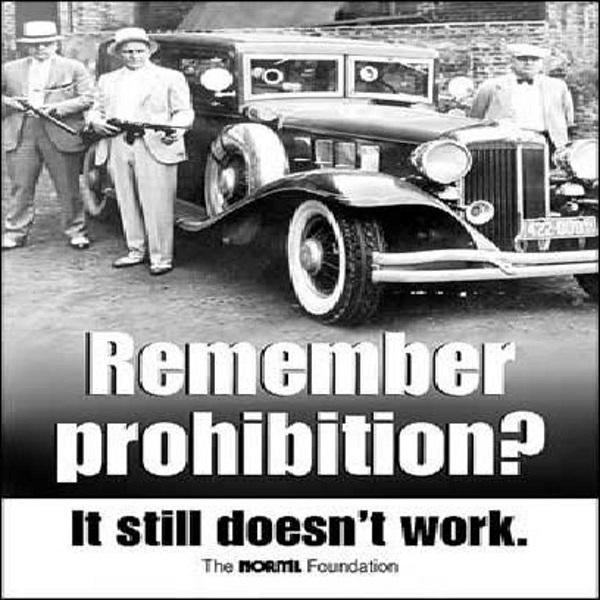
No intelligent person seriously believes that the law can override the people’s will to use cannabis. Exactly like alcohol prohibition, which failed to stop people from using alcohol, cannabis prohibition won’t stop people from using cannabis. Not only do people have a will to use it, but they feel that they have the right to do so. They’re going to keep using it forever.

If the objective was to protect people’s mental health, that too has failed. Not only is there no correlation between rates of cannabis use and prevalence of mental illness on the national level, but there is ample scientific evidence that cannabis does not cause psychosis or schizophrenia. The cannabis-psychosis link is best explained by the fact that cannabis is medicinal for many mentally ill people, and so they seek it out.

Instead of protecting people’s mental health, cannabis prohibition leads to the further social isolation of cannabis users by making them unwilling to speak candidly to mental health professionals, or to their friends or workmates. If cannabis is illegal, then confessing to using it is tantamount to confessing to criminal activity, so many mentally ill people who need help would rather just sit in silence.

If the objective was to protect children from psychoactive drugs while their brains are still developing, that too has failed. Because cannabis is on the black market, and therefore sold by criminals, there is nothing in the way of age checks between young people and the cannabis supply. Gang members will happily sell bags of cannabis to 12-year olds if they have the cash.

People often make the “think of the children!” argument when it comes to cannabis law reform, but the simple fact is that prohibition makes it easier for minors to get hold of cannabis. Proof for this is as simple as asking a minor if it’s easier to get hold of alcohol or cannabis. They’ll tell you that it’s harder to get hold of booze because those selling it are serious about keeping their liquor license.

If the objective was to instill respect for authority, that’s completely backfired. Cannabis prohibition is so stupid an idea that the people at large have lost respect for those pushing at and those enforcing it. Although the idea that one’s politicians are stupid and evil is far from new, these sentiments become problematic when they’re applied to other segments of society. Prohibition, however, makes this all but inevitable.

Many New Zealanders have now come to feel that the Police are their enemy, because Police officers have shown themselves willing to confiscate people’s medicine and to imprison them for using it. Far from being the trusted community servants that they are seen as in places like Holland, they’re seen as enemy soldiers waging an immoral war against an innocent people. To a great extent, this is the fault of cannabis prohibition.

All of these arguments (among others) are discussed at length in the various chapters of this book, but they all support the central thesis – that cannabis prohibition doesn’t work. It doesn’t achieve its stated aim of reducing the sum total of human suffering, and if it doesn’t achieve its stated aims, then it isn’t justified to continue with it any longer.

The men who pushed cannabis prohibition on a naive and unsuspecting public almost a century ago are now dead. Whether they knew they were speaking falsehoods or whether they were genuinely misled is no longer material. The right thing for us to do is to assess reality accurately, so that we can move forward in the correct direction.

If we look around the world honestly, it’s obvious that prohibition has failed. Not only is cannabis culture thriving, even in the most unlikely places, but support for cannabis law reform is rising almost universally, across all nations and demographics. The most striking sign is the ever-increasing number of states, territories or countries that have recently liberalised their cannabis laws.

The cynic might say that this is an example of the bandwagon fallacy, but that is not an accurate criticism. The reason why so many countries are changing their cannabis laws is because the evidence against cannabis prohibition has now mounted so high that it can no longer be ignored. There are now many countries liberalising their cannabis laws for the simple reason that the evidence suggests that it’s a better approach.

Cannabis prohibition simply doesn’t work. There is nowhere in the world that has prohibited cannabis and observed any result other than more poverty, distrust, misery and hatred. It’s fundamentally for this reason that the cannabis laws ought to be reformed.

*

This article is an excerpt from The Case For Cannabis Law Reform, compiled by Vince McLeod and due for release by VJM Publishing in the summer of 2018/19.

The Occult Background of The Magic: The Gathering Five-Colour System

The magical and mystical references and themes of Magic: the Gathering are a rich part of the background of the story world, and many play it for that reason. The reality is that Magic is not just occult in flavour and appearance but also in fundamental structure and gameplay. As this essay will describe, the layout of the five fundamental Magic colours maps out a space in occult philosophy.

Many people are familiar with the conception of four classical elements of earth, water, air and fire. These are said to represent various elemental forces, viz. being cold and dry in the case of earth, cold and wet in the case of water, warm and wet in the case of air and warm and dry in the case of fire. More precisely, these are what are known as the four feminine elements, because they all have equal value.

Being four elements of equal value, they can be distinguished on the basis of yin and yang. The yin elements are Earth and Water, because they are cold and passive. The yang elements are Air and Fire, because they are warm and active. Earth relates to inertia, Water relates to cohesion, Air to expansion and Fire to heat.

There are also such things as the four masculine elements, which all have differing value. These four elements collapse into a basic dichotomy between precious things that need to be guarded or defended and base things that do not. These precious things are usually characterised as white on account of the light nature of silver and gold, whereas base things are usually characterised as black on account of the dark nature of clay and iron.

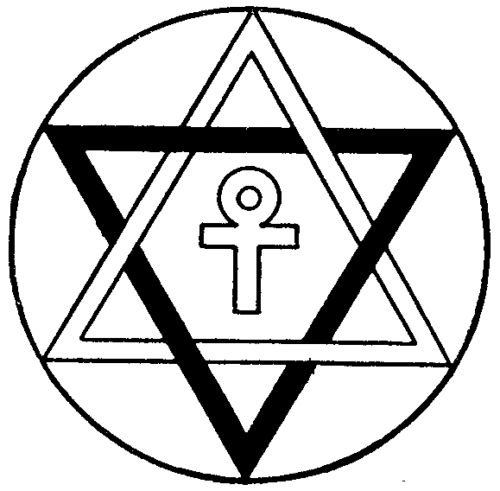
This masculine dichotomy and feminine quadrichotomy combine to give us a system based around six separate points – a system that the reader may have previously seen diagrammed (as below) in various occult symbols and drawings. 

In this model, Air and Fire are the bottom corners of the white triangle, because they are warm and therefore rise upwards. Earth and Water are the top corners of the black triangle, because they are cold and therefore sink downwards. The uppermost point of the white triangle represents spirituality, which seeks to rise above matter, and the bottommost point of the black triangle represents materialism, which indulges in it.

The masculine axis is represented by the vertical line of the central ankh, and the feminine axis by the horizontal line. So in this diagram all of creation is represented: all of the physical, the metaphysical, the feminine, the masculine, the spiritual and the material worlds can be found therein.

Where it gets interesting is how this esoteric diagram maps to the five different colour types in M:tG.

Blue represents both Air Magic and Water Magic. In this it combines the intellectualism of Air with the flexibility of Water to create a magic that tricks, deceives, binds and maddens. It’s also a magic that can open up new intellectual possibilities and mental realms. Air and Water are the two wet elements, and so it’s fitting that blue is a slippery and ephemeral colour. 

Red represents Fire Magic. This is encapsulated not only in the obvious fire, lightning and volcano-related imagery but also in red magic’s use of chaos. Fire is the most chaotic form of matter, because solids, liquids and even gasses all behave in reasonably predictable ways. This is why red uses cards like ‘Wheel of Fortune’.

Green represents Earth Magic. This refers to the natural world and to the procreative qualities of the natural world. The classic Green Magic strategy is to overrun one’s opponent, to crush them by sheer mindless mass or weight of numbers. Trample is the quintessential ability of Green Magic, as are magics that represent damage done by natural phenomena such as hurricanes and poisons.

White represents spirituality, or White Magic. To this end, most of the healing magic is white in nature (in this sense, M:tG lifts many of their concepts from existing esoteric philosophy). The point of White Magic is to banish the darkness or suffering, hence their use of wards and salves. White also plays on the idea of God acting upon the world through cards such as ‘Wrath of God’ and ‘Armageddon’.

Black represents materialism, or Black Magic. Perhaps the characteristic card of this colour is ‘Greed’. Elegant practitioners of Black Magic will use other people’s materialistic desires to exploit them, or to manipulate them into furthering the magician’s wishes. Life imitates art in the sense that Black Magic is essentially the same in M:tG as in real life.

So the five colours of a Magic game represent five alchemical positions on two fundamental axes: masculine on the masculine axis (white), feminine on the masculine axis (black), masculine on the feminine axis (red), feminine on the feminine axis (green) and neutral on the feminine axis (blue).

A game of Magic can be thought of as an alchemical battle, with the player who is greatest able to project power through their mastery of the elements the winner. Curiously, there is no guarantee that the forces of “good” will win any given battle, which is what gives the game its dramatic potential. The side with the angels and God on it can still be defeated by competent Black Magic or by any other alliance.

*

If you enjoyed reading this essay, you can get a compilation of the Best VJMP Essays and Articles of 2018 from Amazon for Kindle or Amazon for CreateSpace (for international readers), or TradeMe (for Kiwis). A compilation of the Best VJMP Essays and Articles of 2017 is also available.
Should New Zealand Reduce Pensions To The Level of Other Benefits?

When the pension system was introduced in New Zealand in 1898, the average life expectancy was less than 60. Today, it’s closer to 80. Consequently, pension expenses have ballooned. This article discusses whether New Zealand should lower the pension to bring it in line with other main benefits, and what we could afford if we did.

A lot of words are being written lately about universal basic income, but few realise New Zealand already has a universal basic income for the over 65s, known as National Superannuation.

The argument for paying out this universal benefit is that people older than 65 cannot reasonably be expected to earn a living through the workforce, and therefore would starve without a pension. That seems entirely fair. Not many people would argue that a person should be forced to starve, in this age of plenty, just because they were too old to work.

However, the amount of money paid in pensions is taking the piss. $360 per week to every person over 65, when a majority of them own their own house, is an obscenity, when we expect severely mentally ill people to survive on $273 per week, out of which they almost always have to pay rent.

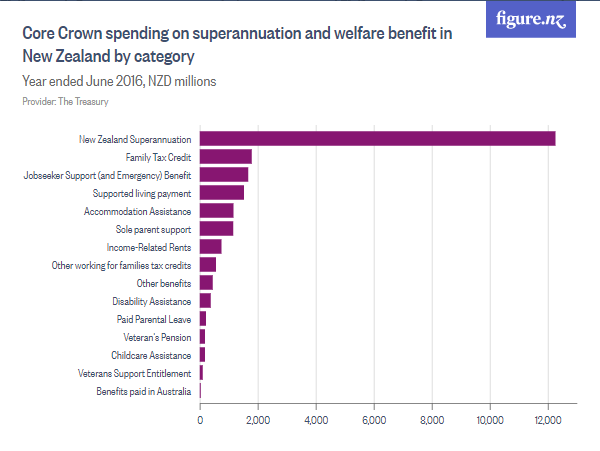
As of June 2019, the New Zealand Government spends over $12,000,000,000 every year on pensions (see table at top of article). This mostly consists of the $20,000 of yearly pension payments per recipient, multiplied by the 600,000+ eligible pensioners in New Zealand. Pension spending is projected to be $20,000,000,000 by 2031.

Although most people can agree that it’s cruel to leave people to starve on account of that they’re too infirm to work, there’s no reason for the Government to be granting pensioners a lifestyle that compares with what people make from working. Indeed, if they’re not working, why should they be paid any more than the unemployment benefit?

A fair compromise between the current luxury pension model on the one hand, and reducing the pension to the level of the unemployment benefit on the other, might be to reduce the benefit to a midway level. This would recognise both that current pension spending is an unsustainable and unfair burden on the under-65s, and that the infirmity of old age demands more expenses than the health of youth.

If the pension was cut by 25%, from its current $360 per week to around $270, this would bring it in line with other main benefits such as the Supported Living Allowance. This 25% reduction would equal a savings of $3,000,000,000 per year in pension expenses.

To give an example of how much money that is, it’s roughly equal to the $3,000,000,000 in tax revenue that the Government gets from the 10.5% tax on the first $14,000 of income. This tax works out to slightly less than $1,500 per person for each of New Zealand’s roughly 2,000,000 wage or salary earners.

So lowering the pension by 25% to bring it in line with other main benefits could be balanced by making all income up to $14,000 tax free. This would be a revenue-neutral move – there are plenty of other ways to spend $3G, but this would be one of the most popular.

Introducing a $14,000 tax-free threshold would make two million New Zealanders much happier about going to work every day. It would revitalise the workforce by giving every worker an extra $1,500 per year. This works out to almost $30 per week. That would make a huge difference to standard of living given the cost of living and cost of housing at the moment.

For two-parent families, such a saving would equal roughly $60 per week. For many Kiwi families on the breadline, this would be enough money to make the difference between survival and disaster some weeks.

There’s no loss to bringing this in, apart from a reduction in luxuries for our current crop of pensioners. None of those pensioners will go hungry because they would still get as much as an invalid’s beneficiary, and considering that these same pensioners had the luxury of being able to buy a house on one income – a luxury that younger generations will never have – there’s no reason for the rest of us to spend empathy on them. We ought to keep it for each other.

At the moment, New Zealand is being sucked dry by a cohort of super-entitled Baby Boomers who feel that they have the right to party it up for 20 years after they reach 65. This was only sustainable when pensioners were a small percentage of the population, but with as much as 20% of the population soon wanting a slice of the pension pie, it no longer is.

We need to bring the pension in line with other main benefits in order to rein in our bloated Superannuation expenses. Reducing it to the same level as the Supported Living Allowance would free up roughly three billion dollars every year. Freeing our economy from this burden would make life a lot easier for the vast majority of Kiwis.

*

If you enjoyed reading this essay, you can get a compilation of the Best VJMP Essays and Articles of 2018 from Amazon for Kindle or Amazon for CreateSpace (for international readers), or TradeMe (for Kiwis). A compilation of the Best VJMP Essays and Articles of 2017 is also available.