Elementalists believe, much like the Existentialists, that every person is entirely free to choose what the meaning of their life is. Broadly speaking, the meaning of life that a person chooses will fall into one of four categories, each corresponding to one of the feminine elements.
Some people choose domination. This corresponds to fire. These people have the most energy to expend. They strive to become professional sportsmen, business tycoons, politicians or military/law enforcement/security. People who choose this as the meaning of life are likely to see other people as weak.
Some choose exploration. This corresponds to air. These people are masculine, and like to go forward, but they are more subtle about it than the dominators. People in this group are more likely to become backpackers or psychonauts. If someone chooses exploration as the meaning of life, they are likely to see other people as boring.
Some choose pleasure. This corresponds to water. People who choose pleasure are feminine because they will shy away from adversity, but they are not entirely feminine, because they do not shy away from pleasure and are attracted to the possibility of it. If someone chooses pleasure as the meaning of life, they are likely to see other people as masochistic.
Some choose survival. This corresponds to earth. These people are feminine, and are prone to retreating. Life on this planet is hard enough without worrying about things like domination or exploration. Much better to just hunker down. If someone chooses survival as the meaning of life, they are likely to see other people as foolish. ‘Why take a risk if I don’t have to?’ is their motto.
In principle, every person could be assigned to one of these four groups based on how they choose or desire to live, even if they haven’t consciously chosen that group themselves. This is because every person who chooses to go forwards – in other words, every person who chooses to live – must have a reason to do so, and the potential range of those reasons is finite.
However, all of these reasons are only ever a Secondary Meaning to a life.
The Primary Meaning of every life is to entertain the gods.
Elementalists believe in higher dimensions that are populated by beings of higher frequencies. These beings are capable of observing us without our being aware of it, much like we might observe a creature under a microscope. To us, they are the gods: higher frequencies in higher realms of the Great Fractal.
It is to entertain these gods that our lives have meaning. The more righteously one attempts to full one’s Secondary Meaning of life, the more gloriously one fulfills the Primary Meaning. If our futile struggles to dominate or to explore the Great Fractal entertain the gods, then our lives have meaning despite being finite.
It needs to be emphasised at this point that all of us are mortal. So all of us are faced with a dilemma. Domination and survival are impossible because each of us will inevitably weaken with age and decline into death. Infinite pleasure is impossible because the agonies of aging and dying must befall all of us. Even exploration is meaningless because the memories of it will not survive death.
What this means is that every Secondary Meaning, i.e. every meaning that we could ourselves give to life, is ultimately futile and pointless.
Many never overcome this dilemma, withdrawing from life and saying No to it. Such people appall, disgust and bore the gods. Those who fail to overcome this dilemma are soulless; they don’t try to dominate or explore, they don’t seek pleasure and they don’t care if they live or die. These existential zombies have failed to understand the Primary Meaning of life.
Those who do overcome this dilemma behave in ways that entertain the gods. Their example is authentic, passionate acceptance, saying Yes to life. This pleases the gods, who see a spirit that may one day rise to stand among them in a higher dimension. In the Elementalist conception, man lives so that the gods might regard him as they once regarded Alexander.
This conception clashes head-on with others. Some of the most common competing ideas about the real meaning of life are religious ones: that we’re here to overcome evil, to purify our souls or to escape the world of suffering. But Elementalists reject all of these conceptions.
Overcoming evil cannot possibly be the Primary Meaning of life, because evil will always be a part of the world as long as it’s possible for God to will it. Struggling against evil might be a Secondary Meaning to life, especially if that struggle was one of survival, but the Primary Meaning would still be the entertainment value that one’s struggle provided the gods.
Neither can purifying one’s soul (understood by the Elementalist as raising the frequency of one’s consciousness) be the Primary Meaning of life. If it was, then life would be no longer possible once this had been achieved. Struggling to purify one’s soul, if that struggle be heroic enough, can serve as the Primary Meaning of life. Then again, so can struggling to degrade one’s soul. Both the rising beast and the falling angel entertain the gods.
Nor can escaping the world be the Primary Meaning of life. There’s ultimately nowhere for consciousness to escape to, other than reunion with God, and in such a case there’s no going forward without re-entering the world again. The problem with escaping samsara is that nirvana is batshit boring. Of course, however, struggling to escape the world can serve as the Primary Meaning of life should it entertain the gods.
The ancient Greeks understood the overwhelming importance of behaving heroically for the sake of the gods’ attention. They understood that the gods and goddesses watch over us from a higher place. This knowledge has been lost today, which is one reason why we live in such a pitiful manner, struggling for purpose and meaning.
Clown World is full of contradictions. Often they manifest in the form of political alliances between people who hate each other. Often they manifest within the same individual. One apparently contradictory new subculture is that of the Nazihippie. But this new culture is not as inexplicable as it might seem.
It seems counter-intuitive for Nazis and hippies to come together in the form of Nazihippies. Nazism was a warmongering ideology that sought to subjugate foreign peoples and appropriate their territory. Hippie culture is all about being as peaceful as possible, even to the point of taking a beating rather than striking back. So what common ground could they possibly have?
History moves in cycles, each movement usually a reaction to the previous one. The original Nazism was a reaction to the conditions of the Weimar Republic, and the original hippie movement was a reaction to the conditions of the Great Depression. The first saw people lurch into authoritarianism in the hope of staving off degeneracy. The second saw people lurch into voluntary poverty in the hope of staving off environmental and social collapse.
Clown World, as mentioned elsewhere, is the result of excessive capitalism and excessive communism. These are the two forces that emerged victorious from World War II and which have determined the order of the world since then.
When the counter-reaction to Clown World arises, it will be in the form of those who both oppose capitalism and oppose communism. The point of common sentiment between Nazis and hippies is that both oppose capitalism and both oppose communism. Their reasons might be different, but their enemies are the same.
Capitalists are fervent anti-nationalists, believing that national borders are obstacles to free trade and the importation of cheap labour. Nazis hate them because it believes that capitalism preys on the Volk for the sake of profit. Hippies hate them because they are appalled by shallow materialism and by disregard for the natural environment.
Communists are also fervent anti-nationalists, believing that national consciousness is a distraction from class consciousness. Nazis hate them because national socialism competes with international socialism for the same supporters. Hippies hate them because communists are authoritarian materialists with no concern for the environment.
Putting all these facts together, we can predict that resistance to globohomo, when it begins in earnest, will be spearheaded by the Nazihippie.
A Nazihippie is someone who explicitly rejects the extraterritorial ambitions of Nazism, while at the same time being a nationalist who aspires to ending the suffering of their nation’s people. They are also someone who rejects the trend-obsessed, shallow and passive strains of hipster culture, while at the same time being interested in spirituality and psychedelic drugs.
Nazihippies don’t care about Jews beyond a general dislike of Abrahamism, and a general preference for non-Semitic spiritual traditions. Although they are nationalists, they are not xenophobic, at least not beyond the recognition that mass immigration of low-IQ people is an exceptionally destructive practice.
Neither are Nazihippies authoritarian (at least not collectively – individuals might be). The chaos of the hippie balances the order of the Nazi. Having said that, they aren’t virtue signallers. They don’t care about gay rights, women’s rights or minority rights beyond a general support for libertarianism. Drug rights they do care about however, cognitive liberty being the antidote to globohomo brainwashing.
If someone’s both redpilled on race and redpilled on psychedelics, chances are they’re a Nazihippie.
Newton realised that it was a law of physics that every action has its equal and opposite reaction. It’s also true of other sciences. Psychological actions also have equal and opposite reactions. The aggression shown by the capitalist-communist alliance has already begun to create a counterculture formed of an alliance between those who reject both capitalism and communism, and also the globalism that binds them.
This counterculture is that of the Nazihippie.
Today, the majority of Nazihippies can be found in the New World, especially on the North American West Coast, in the Anzac countries, in South Africa and in Southern South America. They tend to live rurally, because both capitalism and communism are primarily urban phenomena. They are often well-educated, even if that education tends to be informal.
Someone who takes psychedelic drugs and feels one with all, but can still hunt, shoot and clean a game animal is the typical example of this new kind of person. Smoking a joint and ranting about immigration is their archetypal expression. They can be of any age and gender, and in principle any race, although in practice most are white, young and male.
This rural, libertarian nationalism is a reaction to the primarily urban, authoritarian and globalist culture of Clown World. It’s a coming together both of Clown World’s rejects and of those who have rejected Clown World. It’s an alliance of those who want a new deal. As such, it combines the discontent that led to the rise of the Nazis and the discontent that led to the hippie movement.
Nazihippie culture is implicitly alt centrist, because it combines right-wing sentiments with left-wing sentiments in an alliance against the Establishment. This is why they are appearing on the planetary stage right now, as the Establishment is weakening and losing its legitimacy in the eyes of many people.
Nazihippies will continue to increase in number until Clown World ends, at which point the Nazihippie will serve as the vanguard of a new order. As of yet, however, there is no unifying Nazihippie ideology. Perhaps ecofascism will end up being some kind of antecedent.
*
This article is an excerpt from Clown World Chronicles, a book about the insanity of life in the post-Industrial West. This is being compiled by Vince McLeod for an expected release in January 2021.
The intellectual heritage of the West is our greatest achievement and most treasured possession. The insights that our great thinkers have had into the nature of reality are what has led to life here becoming so good. Unfortunately, the coming of Clown World means that everything is now shittier than it needs to be. In few ways is this more evident than in the decline of our intellectual culture.
In Clown World, popular culture has regressed to the lowest common denominator in every aspect. People are less physically healthy than ever, less mentally healthy than ever and less spiritually healthy than ever. This manifests physically as a lack of interest in outdoors activities and sports, and it manifests mentally and spiritually as a lack of interest in intellectual culture of any kind.
In Clown World, people don’t give a shit any more. The spiritual demoralisation that is at the core of our problems has led to a lack of interest in all metaphysical subjects. The only important thing is where the next sedative is coming from, and it doesn’t matter if that sedative is television, alcohol, Oxycontin, social media, porn or psychiatric medications.
The last thing anyone wants is to know any more about this terrible place. Intellectual curiosity is seen as a defect and not a virtue. Better to know as little as possible, and just plod onwards until death.
Because this attitude has become widespread, it has not been necessary to enslave anyone with chains of iron or the threat of execution by riflefire. The general spiritual and existential malaise is severe enough that people are satisfied to merely be granted distractions. As long as those distractions keep coming, we are sufficiently grateful to be complacent.
Intellectual culture has withered from all these distractions. Because the mass media directs its appeal to the lowest common denominator, intellectual culture has all but vanished from television and is being pushed from the Internet. In its place we get celebrity gossip and racial hysteria, the low-frequency soundtrack to the Muttening.
These phenomena were anticipated by Aldous Huxley in Brave New World. In this novel, Huxley suggested that the totalitarianism of the future didn’t need to brutalise people into submission. It could, instead, use sophisticated modern psychology to manipulate people into wanting to submit. Instead of soma, we are bombarded from all sides by the mass media.
The ultimate effect – of distracting us from discontent so that the ruling class can tyrannise without opposition – is much the same. The last thing the rulers of Clown World want is philosophers like John Locke arguing that revolution is a duty when the rulers become too corrupt, or like Thomas Jefferson arguing that the tree of liberty needs to be refreshed with the blood of tyrants.
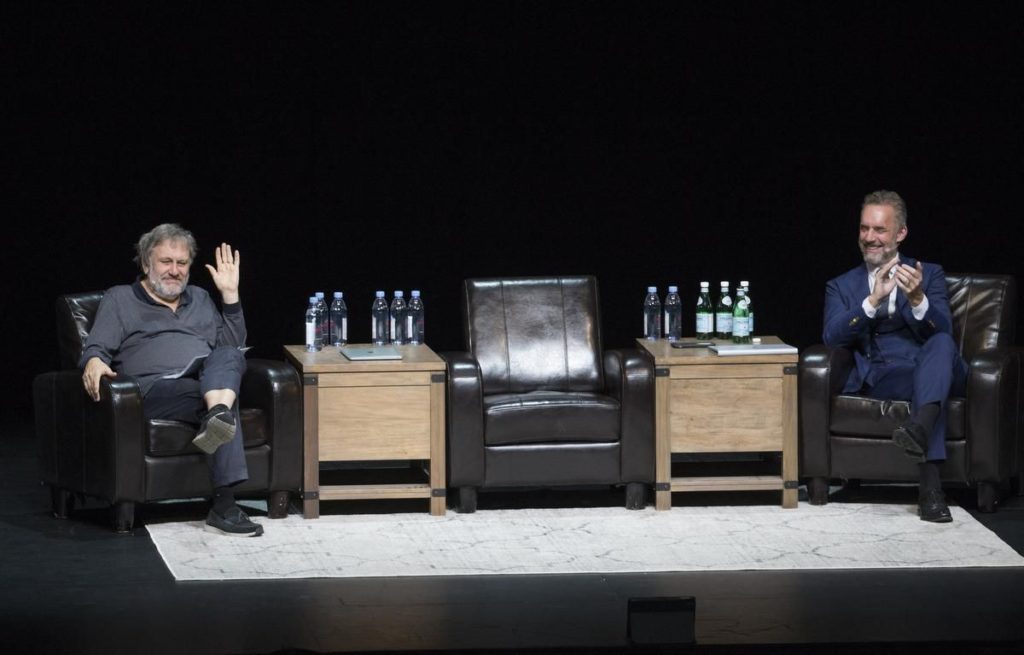
The nadir of intellectual culture in Clown World may have been reached with the Slavoj Zizek vs. Jordan Peterson debate, which took place in Toronto on April 19, 2019. This debate encapsulated intellectual culture in Clown World. It pit two highly unbalanced men against each other, whereupon they promptly embarrassed themselves and taught the audience little.
Peterson represented an excess of order. His voice was strained, neurotic, as if he was afraid to let it out. He critiqued Marxism and The Communist Manifesto on the grounds that it promoted identity politics, which in his view led to authoritarianism. This was to hold closely to the official title of the debate, which was ‘Happiness: Capitalism vs. Marxism’.
Zizek represented an excess of chaos. The man was incoherent, a dribbling mess: the psychosis to Peterson’s neurosis. Anyone who didn’t know that he was a highly esteemed philosopher could be forgiven for thinking he was a crazy person. Anyone who did know that he was a highly esteemed philosopher could be forgiven for thinking he was on hard drugs.
Supposedly Zizek was to mount a defence of Marxism. Instead he ranted and raved, launching a searing attack against phantasms in his own head. After this barrage of nonsense, Peterson’s will to engage collapsed, and the two men seemed to enter an unspoken agreement to wrap things up with as little further mutual humiliation as possible.
The overall impression was abortionate. Neither man could conduct a coherent attack of their opponent’s position, or even describe meaningfully what it was. Neither man could even explain his own position. Apart from Peterson’s initial salvo against The Communist Manifesto, which he attacked as if it were the holy text of an enemy religion, it wasn’t clear what either of them wanted to achieve from the spectacle.
Intellectual culture in Clown World isn’t just shit, it’s also absurd. One element making it so is the televisionisation of popular culture. Thanks to this phenomenon, people now imagine that television entities like “The Science Guy” Bill Nye are legitimate scientific authorities, and that “Bill Nye said X” is a wise argument that leads to truth.
The height of absurdity was reached when Clown World realised that Swedish actor Dolph Lundgren was a higher scientific authority than Nye, on account of that Lundgren has a Master’s degree in Chemical Engineering while Nye only has a Bachelor’s degree. Very few have ever argued “Dolph Lundgren says X” by way of settling an intellectual argument – but it would unironically be a better argument than appealing to what The Science Guy says.
Despite all the mainstream crapness, there are places where intellectual culture flourishes. In fact, the mainstream crapness has encouraged those of a more discerning taste to search far and wide for intellectual forums on the Internet. Many of these places are like Wild West saloons, where anything goes. Others are like cybersanctuaries that are not easy to find.
Because of the role that universities have played in encouraging Internet access, many of the residents of such places are highly educated young people. This has made these far-flung Internet spaces the true hotbeds of today’s intellectual culture. The anonymity makes it possible to discuss ideas that one doesn’t want associated with oneself in meatspace, something very difficult to achieve at a university.
Encouragingly, the shittier mainstream intellectual culture becomes, the more people get driven to these cyberbackwaters. Many of them are now full of the world’s most intelligent and most free-thinking people, liberated from the strictures of political correctness that have destroyed intellectual culture at universities.
*
This article is an excerpt from Clown World Chronicles, a book about the insanity of life in the post-Industrial West. This is being compiled by Vince McLeod for an expected release in January 2021.
Jacinda Ardern’s Labour Party comprehensively won the 2020 General Election, drawing 50.0% of the party votes (1,443,546), up from 36.9% (956,184) in 2017. This allowed the Sixth Labour Government to continue governing alone, and without needing help from either the Greens or New Zealand First. This shift towards Labour is the main story of the 2020 General Election.
The main reason for it was the large number of white New Zealanders who shifted loyalty from National to Labour between 2017 and 2020.
The fact is that New Zealand is a majority white country (around 70% of New Zealanders are white according to 2018 Census data). So there only have to be small changes in average sentiment among white people to have major electoral effects. Winning back a large number of white voters from National was chiefly how Labour won a Parliamentary majority.
Variable
Labour Vote 2020
Labour Vote 2017
European
0.11
-0.65
Maori
-0.33
0.58
Pacific Islander
0.23
0.61
Asian
-0.04
0.01
The numbers show a major change in sentiments towards Labour among white people. In 2017, the correlation between voting Labour that year and being of European descent was -0.65. By 2020, the correlation between voting Labour and being of European descent was 0.11. This is an enormous change, and it’s the primary reason for Labour’s comprehensive win at the 2020 General Election.
What it means is that the average white person, despite their relative wealth, supported the Labour Party in 2020. This wasn’t close to being true in 2017.
In fact, so many white people voted for Labour in 2020 that there was no longer any significant positive correlation between voting Labour that year and being either Maori or a Pacific Islander. Both of these correlations were very strong in 2017, but had faded away by 2020 owing to the fact that the Labour voting demographic was much whiter that year.
Variable
Labour Vote 2020
Labour Vote 2017
No qualifications
0.06
0.38
Level 1 certificate
-0.05
0.07
Level 2 certificate
-0.05
0.11
Level 3 certificate
-0.01
0.20*
Level 4 certificate
-0.02
0.20*
Level 5 diploma
-0.15
-0.75**
Level 6 diploma
0.06
-0.75**
Bachelor’s degree
-0.06
-0.24
Honours degree
0.04
-0.22
Master’s degree
0.01
-0.19
Doctorate
0.17
-0.17
The people who switched allegiance to Labour in 2020 were often the highly-educated ones who strongly supported National in 2017.
The correlations between voting Labour in 2017 and having any university degree were all negative and either significant or bordering on it. The correlation between voting Labour in 2017 and having a doctorate was -0.17, but by the time of the 2020 General Election, this had flipped to a positive correlation of 0.17. Holders of other degrees also became notably more Labour-friendly, although less drastically than those with doctorates.
Meanwhile, the correlation between voting Labour and having no qualifications weakened, from 0.38 in 2017 to an almost neutral 0.06 in 2020. This underlines the extent to which the new Labour supporters in 2020 were primarily from the middle class.
Variable
Labour Vote 2020
20-24 years old
-0.02
25-29 years old
-0.07
30-34 years old
-0.01
35-39 years old
0.03
40-44 years old
0.06
45-49 years old
0.04
50-54 years old
0.10
55-59 years old
0.18
60-64 years old
0.17
65-69 years old
0.17
70-74 years old
0.20
75-79 years old
0.21
80-84 years old
0.27
85+ years old
0.27
Those who shifted to Labour in 2020 weren’t just educated, they were also old.
In 2017, there was a correlation of -0.70 between being aged 50-64 and voting Labour, and a correlation of -0.61 between being aged 65+ and voting Labour. The reason for this was easy to explain at the time: old people overwhelmingly prefer conservative parties, a general rule across the entire democratic world.
They didn’t in 2020. Although the correlations between being old and voting National in 2020 are much stronger than the correlations between being old and voting Labour, the correlations between being aged 80-84 years old or 85+ years old and voting Labour in 2020 were both significantly positive, an enormous swing from 2017.
Expressed in rough terms, very few old people voted Labour in 2017, but in 2020 about half of them did. This may be because old people were particularly impressed by Jacinda Ardern’s handling of the Covid-19 pandemic, which threatened to kill many of them, or because they’re concerned about the kind of New Zealand that the National Party would create for their descendants.
Variable
Labour Vote 2020
Labour Vote 2017
Managers
-0.42
-0.69
Professionals
0.10
-0.14
Technicians and Trades Workers
0.22
-0.01
Community and Personal Service Workers
0.11
0.39
Clerical and Administrative Workers
0.25
0.05
Sales Workers
0.11
0.10
Machinery Operators and Drivers
0.06
0.54
Labourers
-0.06
0.24
Commensurate with increased support for Labour among highly-educated people was increased support among high-skill occupations. Although there was a negative correlation of -0.14 between voting Labour in 2017 and working as a professional, by 2020 this had flipped to 0.10. A thaw in sentiments was also observed among managers. The correlation between working as a manager in 2017 and voting Labour was -0.69, but by 2020 it was only -0.42.
Another notable change from 2017 is that there is no longer a significant positive correlation between voting for Labour and working as a machinery operator or driver. This correlation was 0.54 in 2017, but a mere 0.06 by 2020. A similar, but smaller, pattern is observable with labourers and with community and personal service workers.
This shows that Labour expanded from its base to the centre ground between 2017 and 2020. Over these three years, Labour reduced its reliance on traditional working-class occupations, and increased its appeal to high-skill ones.
Variable
Labour Vote 2020
Personal income < $5,000
-0.14
Personal income $5,000-$10,000
-0.06
Personal income $10,000-$20,000
0.12
Personal income $20,000-$30,000
0.21
Personal income $30,000-$50,000
0.14
Personal income $50,000-$70,000
0.02
Personal income > $70,000
-0.14
Labour also reduced its traditional reliance on poor voters.
In 2017, the correlation between voting Labour and having an income between $5,000 and $10,000 was 0.58. This is strong enough to show that Labour got many of their votes from there. By 2020, the correlation between being in this income bracket and voting Labour had become negative. This was because Labour shifted from the party of the poor to the party of the everyman.
In 2017, the correlation between voting Labour and being in any income bracket above $60,000 was significantly negative. However, in 2020, the correlation between earning over $70,000 and voting Labour was negative, but not significant. Much of this could be explained by wealthy people starting to feel that Labour had no real appetite for raising taxes.
Indeed, the correlation between voting Labour and median personal income became much less strongly negative between 2017, when it was -0.52, and 2020, when it was -0.27. So although wealthy people still avoid Labour, they do so much less eagerly than they did in 2017.
Variable
Labour Vote 2020
Labour Vote 2017
Agriculture, Forestry and Fishing
-0.23
-0.27
Mining
-0.03
-0.04
Manufacturing
-0.05
0.23
Electricity, Gas, Water and Waste Services
0.10
0.08
Construction
-0.03
-0.00
Wholesale Trade
-0.19
-0.15
Retail Trade
0.23
-0.03
Accommodation and Food Services/Hospitality
-0.10
0.08
Transport, Postal and Warehousing
-0.01
0.54
Information Media and Telecommunications
0.07
0.10
Financial and Insurance Services
-0.04
-0.08
Rental, Hiring and Real Estate Services
-0.36
-0.58
Professional, Scientific and Technical Services
-0.05
-0.20
Administrative and Support Services
0.01
0.37
Public Administration and Safety
0.36
0.20
Education and Training
0.12
0.15
Healthcare and Social Assistance
0.44
0.14
Arts and Recreation Services
-0.16
0.02
Labour’s resurgence might have been pronounced along lines of race, age, education, and occupational skill level, but it was not particularly pronounced along any industry lines.
Generally speaking, the demographic of Labour Party voters became a lot closer to the demographic of everyday New Zealanders between 2017 and 2020. This was apparent from the fact that most correlations between voting Labour and working in a particular industry became weaker as Labour expanded from its working-class base.
Most striking was the correlation between voting Labour and working in transport, postal and warehousing, which crashed from 0.54 in 2017 to -0.01 in 2020. Other industries went in the opposite direction. The correlation between voting Labour and working in rental, hiring and real estate services went from -0.58 in 2017 to -0.38 in 2020.
Wholesale trade, retail trade, manufacturing, public administration and safety, professional and technical services, and agriculture, forestry and fishing all moved towards no correlation with voting Labour from 2017 to 2020. This reflects the broad-based increase in appeal achieved by Labour over the past three years.
One notable exception was the correlation between working in healthcare and social assistance and voting Labour. In 2017 this was not significant, at 0.14. By 2020 it had leapt up to 0.44, and was the strongest correlation between working in any industry and voting Labour. It may be that this workers in this industry, more than any other, anticipate a lot of help from the Sixth Labour Government in its second term.
Variable
Labour Vote 2020
No Source of Income
-0.18
Wage or Salary
0.02
Self-employed or Own Own Business
-0.26
Interest, Dividends, Rent, Other Investments
0.03
ACC or Private Work Insurance
-0.09
NZ Super or Veteran’s Pension
0.22
Jobseeker Support
-0.09
Sole Parent Support
-0.16
Supported Living Payment
0.28
Student Allowance
0.08
Labour also drastically reduced their reliance on unemployment and invalid’s beneficiaries. In 2017, the correlation between being on the unemployment benefit and voting Labour was 0.73 – by 2020 it was -0.09. This is partly because a great many non-unemployment beneficiaries switched to Labour, but it’s also because of strong support among unemployment beneficiaries for the New Zealand First, Maori, Aotearoa Legalise Cannabis, ONE, Vision NZ and Advance NZ parties.
The correlation between being on the invalid’s benefit and voting Labour in 2020 was significantly positive, at 0.28. This was much weaker than in 2017, when it was 0.58. As with the unemployment benefit, this reflects how Labour broadened their appeal beyond beneficiaries.
Perhaps the most striking change involved pensioners. There was a correlation of -0.51 between being on a pension and voting Labour in 2017. By 2020, this had flipped to a positive correlation of 0.22. The fact that Labour did much better among old people in 2020 has been discussed above. Along with the coronavirus response, the introduction and then doubling of a winter energy payment to pensioners no doubt helped Labour here.
There was still a significant negative correlation between being self-employed or owning one’s own business and voting Labour, but at -0.26 this was much weaker than most people would have guessed. The correlation between being self-employed and voting Labour in 2017 was -0.77.
Variable
Labour Vote 2020
National Vote 2020
-0.16
Greens Vote 2020
0.29
ACT Vote 2020
-0.12
New Zealand First Vote 2020
0.06
New Conservative Vote 2020
0.13
The Opportunity Party Vote 2020
0.33
Maori Party Vote 2020
-0.37
Advance NZ Vote 2020
-0.19
Sustainable NZ Vote 2020
0.02
ALCP Vote 2020
-0.27
TEA Party Vote 2020
-0.21
Heartland NZ Vote 2020
-0.17
Social Credit Vote 2020
0.25
NZ Outdoors Party Vote 2020
0.01
ONE Party Vote 2020
0.25
Vision NZ Party Vote 2020
-0.23
That the average Labour voter is much whiter and better-educated in 2020 than in 2017 can be seen from the change in correlations between voting for Labour and voting for other parties.
For one thing, there were significant positive correlations between voting Labour in 2020 and either voting Greens in 2020 (0.29) or voting for The Opportunities Party in 2020 (0.33). These are much stronger than the correlations between voting Labour in 2017 and either voting Greens in 2017 (0.14) or voting for TOP in 2017 (0.00). Greens and TOP voters are disproportionately white and well-educated, two groups that heavily switched to Labour in 2020.
For another thing, there are now significant negative correlations between voting Labour in 2020 and voting for most of the Maori-heavy parties. Although Labour won a great number of votes from old white people, they lost a smaller number of Maori voters to fringe parties. Losing such marginal voters to fringe parties is the inevitable blowback from Ardern’s drive to the centre.
A further noticable change is the correlation between voting Labour in 2017 and voting National in 2017 (-0.94) and the correlation between voting Labour in 2020 and voting National in 2020 (-0.16).
This is a profound difference, and tells the story of a major shift in the demographics of the average Labour voter. In 2017, Labour and National were sharply opposed along lines of wealth, ethnicity, age and education. By 2020, most of those distinctions were eroded. National was still the party for rich old people, but Labour had transformed from the party of the disenfranchised, the brown and the working-class to the party of the average Kiwi.
Variable
Labour Vote 2020
Labour Vote 2017
Percentage of males
-0.15
-0.33
Urban electorate
0.17
0.11
Percentage NZ-born
-0.05
0.22
South Island electorate
0.23
-0.05
Turnout Rate 2020
0.28
n/a
Turnout Rate 2017
n/a
-0.72
The Labour Party won a lot of male voters from National over the three years before the 2020 General Election. The correlation between voting Labour in 2017 and being male was -0.33. By 2020, this had fallen to -0.15. This suggests that Labour did well in 2020 not only because they demonstrated compassion since 2017 but also because they demonstrated competency.
Labour voters also became much less New Zealand-born between 2017 and 2020. This is mostly because there was not a disproportionate number of Maori voters this time. Immigrants to New Zealand tend to be wealthier than the New Zealand-born, so if Labour wins more middle-class voters they will also win proportionately more immigrants.
Some conspiracy theorists suggested that the 2020 General Election may have been rigged by Labour, the proof being Labour dominance in the rural South Island electorates. But rural South Island voters overlap heavily with the elderly, middle-class voters who switched overwhelmingly to Labour in 2020. In 2020 Labour won a significantly greater proportion of votes from South Island voters than from North Island ones, unlike in 2017.
One of the most striking changes between the 2017 General Election and the 2020 edition were the correlations between voting Labour and turnout rate. In 2017, the correlation between turnout rate and voting Labour was -0.72, which is extremely strong and evidence that Labour voters that year were mostly heavily disenfranchised people. By 2020, the correlation between turnout rate and voting Labour was 0.28, showing that Labour had won the centre between 2017 and 2020.
In summary, Labour won the 2020 General Election by broadening their appeal to the average New Zealander. Increased support for Labour from 2017 was especially noticeable among rich people, white people, old people and the well-educated, all of who are traditionally antipathetic to social democratic parties.
*
This article is an excerpt from the upcoming 3rd Edition of Understanding New Zealand, by Dan McGlashan and published by VJM Publishing. Understanding New Zealand is the comprehensive guide to the demographics and voting patterns of the New Zealand people.