The Case For Cannabis: Legalisation Would Not Increase Rates of Cannabis Use

A common prohibitionist double-whammy is to argue that cannabis should remain illegal because, if it were made legal, people would use it more, and because its use is harmful, legalisation would therefore lead to more harm. This article will not argue whether cannabis is harmful (this is done elsewhere), but will simply summarise what the evidence suggests: that legalisation will not increase rates of cannabis use.

It seems intuitively obvious that making cannabis illegal lowers the rate of cannabis use. After all, the whole point of making it illegal was to make it harder to get, and if it were legal people would be able to buy it from shops.

Fair enough, but the statistics show a different story.

The truth is that cannabis cultivation is so common (believed to account for 1% of electricity consumption) that pretty much anyone who wants to get hold of it can, except for times of unusually high demand. This means that the cannabis market is already saturated – and this can be demonstrated with reference to real-world examples.

The most obvious counterpoint to the argument that legalising cannabis will increase rates of use is the fact that rates of cannabis use are not higher in places where it is legal.

In the Netherlands, 8% of the adult population has used cannabis at some point in the last 12 months. This rate is lower than in Australia (10.6%), where cannabis is illegal, and much lower than in New Zealand (14.6%), where cannabis is also illegal. In countries such as Israel and Ghana, the rate of cannabis use is higher still. Cannabis might not be technically legal in the Netherlands, but in practice anyone who wants to buy it from a shop can do so.

If legalising cannabis will inevitably cause rates of use to increase, how can it be possible that rates of use are lower in a place where it is legal, where getting supplied is as simple as walking into a shop? If the link between cannabis being legal and higher rates of cannabis use is so certain, we could expect to see higher usage rates in all the places where it is legal, and lower usage rates in all the places where it is illegal. In reality, any such correlation is hard to discern.

The truth is already known to anyone who has ever been to the Netherlands. Cannabis is easy to get hold of, yes, and the Police won’t harass you for it, that’s true, but the bulk of the population would rather drink alcohol anyway. Cannabis law reform didn’t turn a large number of non-drug users into cannabis users – a small number of alcohol users became cannabis users, and the rest stayed the same.

The absence of a correlation between the legal status of cannabis and the rate of use within a jurisdiction is not the only place that statistics disprove the idea that legalisation will lead to more cannabis use.

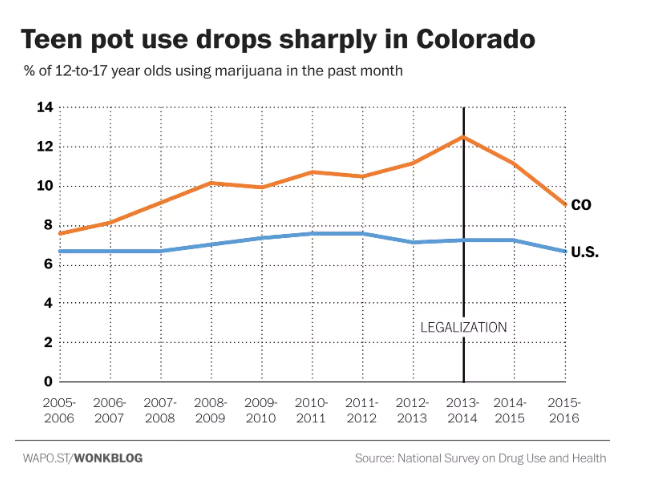
A poll by the Colorado Department of Public Health found that cannabis use rates declined among teenagers after legalisation, with rates of teenage use in Colorado lower than the American national average. Another study, the National Survey on Drug Use and Health, supports the idea that teenage cannabis use rates actually declined after it was made legal.

In fact, the latter study suggests that teen cannabis use rates declined in the majority of states that recently made cannabis legal. It may be, as some have suggested for decades, that the Government lying about the effects of cannabis and exaggerating its dangers was what led to many young people becoming attracted to it. Had there never been an unjust law prohibiting cannabis, it’s possible that the rebellious section of society would never have felt obliged to defy it.

At this point it could be countered that, even if teenage usage rates of cannabis go down, and even if this was the most important thing, adult rates of cannabis use might still increase if cannabis were legalised, and that this might lead to more harm. Leaving aside the fact that this argument has already been countered in the first part of this article, it doesn’t even apply here.

There is little doubt that some people will replace recreational alcohol use with recreational cannabis use if it were legal to do so. Technically, this would mean that the rate of cannabis use would increase, but the rate of recreational drug use would remain the same. Moreover, the rate of harm caused by recreational drug use would decrease if some people replaced boozing with cannabis, on account of that alcohol is more harmful.

Ultimately, the argument that cannabis legalisation would lead to more suffering through increased rates of cannabis use is in error, for multiple reasons. A review of the statistical data shows that cannabis use is not higher in places where it is legal, and also that rates of teen use have declined in American states that have made it legal.

*

This article is an excerpt from The Case For Cannabis Law Reform, compiled by Vince McLeod and due for release by VJM Publishing in the summer of 2018/19.

Banning The Great Replacement Manifesto Violates The NZ Bill of Rights Act

In the wake of the Christchurch mosque shootings, the country has been forced to endure the Great New Zealand Chimpout. This has involved everyone losing their minds, and over-reacting in ways that they may later come to regret. One of these over-reactions was to ban Branton Tarrant’s Great Replacement Manifesto, an action which was – as this article will show – a violation of the basic rights of New Zealanders.

The idea of the New Zealand Bill of Rights Act is ostensibly to “affirm, protect and promote human rights and fundamental freedoms in New Zealand”. Supposedly based on the American model of inherent human rights, the NZ Bill of Rights Act is said to guarantee the rights of Kiwis and delineate areas in which the Government cannot take freedoms away.

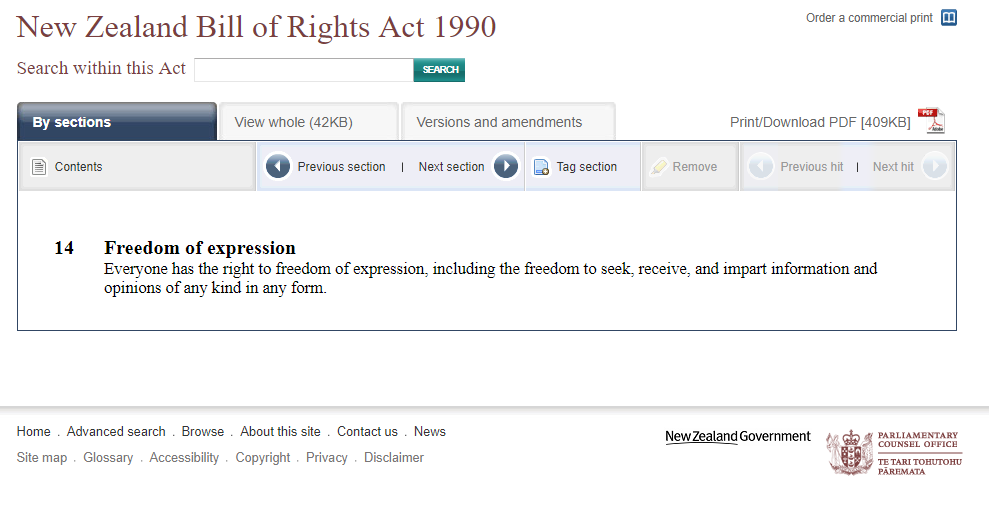
However, the New Zealand Government has just violated this. In deciding to ban the possession of a copy of Tarrant’s manifesto, the Government violated Section 14 of the NZ Bill of Rights Act, which states:

14 Freedom of expression

Everyone has the right to freedom of expression, including the freedom to seek, receive, and impart information and opinions of any kind in any form.

This states, perfectly clearly, that New Zealanders have the right to seek the Great Replacement Manifesto, to receive the Great Replacement Manifesto, and to impart (share) the Great Replacement Manifesto. Consequently, the actions of the New Zealand Government to ban this document are illegal, and are a violation of the human rights of New Zealanders.

So why did they do this?

The Government doesn’t want anyone becoming aware of its failures. Like the psychopathic narcissists they are, politicians are incapable of admitting that they are ever wrong. Therefore, they are incapable of admitting what every working-class Kiwi already knows: that mass immigration has greatly enriched the already wealthy, at the expense of the already poor.

What they really, really don’t want is other working-class people realising that the demographic trajectory of New Zealand appears to be taking them on a path towards Brazil, and then South Africa, and then Haiti. Because, if they do realise this, then the Government either has to take action to prevent it (which will put them offside with their masters in banking and industry), or risk more mass shootings as the position of the working class continues to decline.

Much better to kick the can down the road, and just try not to talk about it, like we did with drug law reform, euthanasia law reform, climate change etc. Otherwise, someone has to point out that the emperor has no clothes. The fear that the charade might soon be over has led to a state of panic among New Zealand’s ruling class.

This atmosphere of panic, coupled with the unusually large number of weaklings in the highest reaches of Government, is why there has been an over-reaction like this. Most New Zealanders are still running around like headless chickens, and in their submission have accepted that the Government can take away any rights it sees fit.

Moreover, there’s a set precedent that the Government can violate the Bill of Rights Act and no-one cares. As a previous article here has pointed out, psychiatrists already violate the Bill of Rights Act by forcing medical treatment on people who have explicitly withdrawn their consent. This has even gone as far as electroshock treatment, but only alt-media sources like VJM Publishing are interested in taking up the issue.

What needs to happen is twofold. The Government first needs to quietly make Tarrant’s manifesto legal for people to read. Second, it needs to address the concerns raised in the manifesto in a more honest and respectful manner than just screaming about “white supremacism”. After all, the bulk of the concerns about the effects of mass Third World immigration are held just as strongly by Maoris as by white people.

If the indigenous people of New Zealand don’t want to be replaced by overseas sources of cheap labour, then this has to be acknowledged and addressed. If they believe that maintaining some level of ethnic homogeneity is better than full globohomo, then this has to be acknowledged and addressed. If they believe that the past conduct of certain ethnic and religious groups is so poor that we would be better off keeping those groups out of the country, this too needs to be acknowledged and addressed.

An honest conversation with the New Zealand working class has been needed since the imposition of neoliberalism. True courage, and true leadership, would see it happen soon. The New Zealand Government has to speak honestly to the people about their vision for the nation. It cannot end suffering by banning information and sending the Police to harass any Kiwi who speaks freely.

*

If you enjoyed reading this essay, you can get a compilation of the Best VJMP Essays and Articles of 2018 from Amazon for Kindle or Amazon for CreateSpace (for international readers), or TradeMe (for Kiwis). A compilation of the Best VJMP Essays and Articles of 2017 is also available.

The Case For Cannabis: Prohibition Makes the Police Less Effective

Of all of the side-effects of cannabis prohibition, one of the most insidious is the suffering caused to the population by decreased bureaucratic and institutional effectiveness. This occurs across a range of Government agencies, but none as severely as the criminal justice system. As this article will examine, cannabis prohibition makes the Police less effective and less able to do their jobs properly.

A lot of successful Police work depends on input from the community, because the Police frequently rely on tips from people who know about crimes. Criminals aren’t always tight-lipped, and sometimes they talk about their crimes when they shouldn’t (especially to women). Many more crimes get solved as a result of someone who knew the perpetrator ratting them out than as a result of detectives finding clues with magnifying glasses.

This is why reports of crimes in the media frequently come with an appeal from Police to witnesses or anyone who knows the perpetrator to come forward. Realistically, this is the best that the Police can do in many cases. It’s easy to see, then, that policing depends on having good relations with the community, and a sense of mutual trust.

If cannabis is illegal, then any individual cannabis user is going to be very wary of the Police, and for good reason. They will be highly averse to having officers come to their house, and will be highly averse to making contact with the Police. After all, they are criminals themselves.

It’s easy to imagine this from the perspective of a cannabis user. Why would a cannabis user who has just witnessed a crime call the Police, when doing so greatly increases the risk that said cannabis user gets arrested themselves? If the Police want to talk to them, then the cannabis user is going to have to present themselves with no sign that they use cannabis, or risk getting arrested.

This makes the Police less effective because they can no longer rely on the voluntary co-operation of cannabis users. Prohibition shifts people who use cannabis from the set of potential Police allies to the set of Police opponents.

This also isn’t the only way that cannabis makes the Police less effective.

A British study showed that one million manhours of Police time was spent every year on enforcing cannabis prohibition. This accounts for all the arrests, all the time spent booking and processing people and the following up of tips. Adjusting for the size of the country, that suggests that somewhere between 70,000 and 80,000 manhours are wasted in this manner every year in New Zealand.

The fact of the matter is that the general Police budget is limited, and the manhours used to enforce cannabis prohibition come out of that general Police budget. So 70,000 hours spent harassing people for cannabis is 70,000 hours not spent following up burglaries, assaults, thefts and the other petty crimes whose enforcement depends on general funding.

In the wake of the Christchurch mosque shootings, it emerged that shooter Branton Tarrant had never had his firearms licence checked by the Police. He had come to New Zealand with an Australian firearms licence and used that to purchase weaponry, and at no point was it ensured that he had his firearms safely locked away, or even that he was in a sound mind to own them.

This is not to argue that the Christchurch mosque shootings would have been prevented if cannabis was legal. The point is that Police effectiveness is a matter of correctly apportioning their limited manhours to enforcing the laws of New Zealand. Should they decide that a certain amount of spending is necessary to enforce cannabis prohibition, then they cannot escape the opportunity cost of not having the funding to fully enforce certain other areas.

Cannabis prohibition should be repealed for the sake of making the Police force more effective. Not only would this allow for a decrease in the mistrust held by sections of the population towards the Police, but it would also allow the Police to expend their resources more efficiently, by freeing up at least 70,000 manhours currently wasted on enforcing cannabis prohibition.

*

This article is an excerpt from The Case For Cannabis Law Reform, compiled by Vince McLeod and due for release by VJM Publishing in the summer of 2018/19.