
How Psychological Scientists Know The “Structural Racism” Theory Is Crap

The “structural racism” conspiracy theory is everywhere nowadays. Most media consumers take it for granted that white people are to blame for black and brown economic and academic underachievement. But people trained in psychological science, who understand the real causes of behavioural phenomena, know this theory is crap. This essay explains how they know.

Any quality scientist will tell you that the value of a scientific theory is a function of its predictive power.

This has always been the case. Back in the day, when learned people discussed astronomical phenomena, the greatest among those scholars were able to accurately predict solar and lunar eclipses. The theories that correctly predicted eclipse seasons were praised and committed to memory or written down; the theories that incorrectly predicted eclipse seasons, or failed to predict them, were denounced and forgotten.

This ongoing process of refining theories, based on which ones best predicted the outcomes of experiments, evolved into the scientific method. Today, the scientific method involves taking multiple different theories and subjecting them to experiments with various conditions. Then the scientist compares the theories to see which best fits the resulting data.

When the Western World opened its borders to mass immigration from Far East Asia in the 1990s, there were two major theories about how successful it would be.

The structural racism theory predicted that these immigrants would do poorly. This theory held that the low economic and academic achievement of blacks and browns was the result of white prejudice, and, since those whites had no reason to be less prejudiced against Asians, those Asians would also have low economic and academic achievement.

The biological realism theory predicted that these immigrants would do well. It had been known since shortly after World War II that Japanese, Korean and Chinese populations scored as highly as European ones on psychometric measures of intelligence. Because economic and academic achievement is primarily a function of intelligence, biological realists predicted that Asian immigrants would have high economic and academic achievement.

In fact, the majority of Far East Asian immigrants did very well upon immigrating to the West. They all faced some degree of prejudice from the native populations, but few of them were impacted heavily enough by this to remain poor; Asian Americans have the highest net wealth and highest average income of any American racial group.

This outcome repudiated the structural racism theory, and supported the biological realism theory. But this is not the only case where the latter showed itself to have more predictive power than the former.

Another test of theories involved the relative developmental prospects of China, India and Africa. After World War II, China, India and most of Africa were at a similar level of poverty, i.e. undeveloped. But the Western plan was to develop all of these territories to the maximum extent possible, as quickly as possible.

The structural racism theory predicted that all of these territories would develop at a similar rate. Absent the white oppression that had held them back during the Colonial Era, and absent the white oppression that held back blacks, browns and natives in colonial countries, there was no reason to assume anything other than uniform progression to Western levels of wealth.

The biological realism theory, by contrast, predicted that China would develop faster than India, which would develop faster than Africa. This prediction was based on the fact that psychologists knew the IQ scores of these groups were different.

The Chinese scored at a similar level to white people, or even higher. India was about one standard deviation below that. Africa was about one standard deviation below India. So the biological realists predicted that China would develop the fastest, Africa the slowest, and India in between.

By 2021, the GDP per capita (PPP) of China was $18,931, that of India $7,333, and most African countries between $5,000 and $1,000. These differences were just as predicted by the biological realists. The structural racism theories are left floundering for an explanation as to why high-IQ China has outstripped medium-IQ India and low-IQ Africa, when none of the three are controlled by whites. They are left spouting nonsense about “white adjacency”.

In summary, the biological realism theory of explaining group differences in economic and academic achievement has proven itself to have far greater predictive power than the structural racism theory. In fact, the structural racism theory has no predictive power, and can be rightly considered a conspiracy theory pushed for political reasons, and not a scientific one.

*

If you enjoyed reading this essay/article, you can get a compilation of the Best VJMP Essays and Articles of 2020 from Amazon for Kindle or Amazon for CreateSpace (for international readers), or TradeMe (for Kiwis). A compilation of the Best VJMP Essays and Articles of 2019, the Best VJMP Essays and Articles of 2018 and the Best VJMP Essays and Articles of 2017 are also available.

*

If you would like to support our work in other ways, please consider subscribing to our SubscribeStar fund. Even better, buy any one of our books!

The Elementalist Conception Of Death

A fear of death can cripple anyone who has become spiritually aware. Foreknowledge of one’s inevitable demise can seem to make all of our actions in this world meaningless. The greatest test of merit of any spiritual tradition is that it assuages a person’s fear of death. The Elementalist conception of death is that it both is, and isn’t, something to be feared.

Death is both terrifying and inevitable, and all the more terrifying because it is inevitable. It casts a shadow over every single action – or inaction – we take on this planet.

The inevitability of death means that nothing we achieve or acquire here can ever be permanent. It means that no matter how many billions we collect, or how many children we produce, or how many awards and honours we rack up, all is rendered to null upon the expiration of our physical bodies. Death will separate us from all.

The Elementalist doesn’t take this fact as cause for despair, but rather as cause for quiet rejoicing. Socrates said that the purpose of philosophy was to prepare oneself for death, and, to this end, Elementalism has specific, defined teachings about death and the nature of death.

Central to Elementalism is the knowledge that consciousness is the prima materia, and the material world merely a set of sensory perceptions within that consciousness, in the same way that a dream is. The physical bodies of each of us are merely sets of perceptions within consciousness, and these perceptions will come and go like any other.

Consciousness is outside of space and time, and therefore is not affected by whatever part of the Great Fractal it happens to be perceiving. To the contrary – the Great Fractal comes alive when it is perceived by consciousness. This means that our physical bodies can never really die, because consciousness will always dream them up again.

The Elementalist conception of death accords with the line in the Bhagavad Gita, which states: “Never have you existed not.” The true self is the consciousness that endures through all the changing perceptions; the false self is the current physical body and the identity that goes with it.

Therefore, the Elementalist’s faith in reincarnation is absolute. As such, the death of this particular physical form is not to be feared. It may even be something to be looked forward to – the death of one’s physical body in this realm might allow one to achieve a higher form in another realm. In any case, the Elementalist knows that they will get what they deserve, in line with the Law of Associative Reincarnation.

Elementalists maintain that all things existing in our world are just shadows of eternal forms that exist elsewhere in the Great Fractal. There are multitudinous dimensions of existence above (and below) the one in which we find ourselves now. One’s physical death here might cause one’s consciousness to ascend to a higher level, in which case it will incarnate into a less flawed form of the same body.

These beliefs mean that Elementalists have a different conception of grief to that of First and Second Hurdlers.

Our friends and family members, when they die, are only gone from us in the most immediate and most physical sense. They – and their frequency – still exist in the Great Fractal. Not only do the consciousnesses that we interacted with during this life still exist, but all the frequencies of consciousness that we interacted with still exist.

All possible aspects of every possible life are being experienced in every moment by God. As such, all of the consciousnesses and frequencies of consciousness that we engaged with in this life will reunite with us after death, as we reunite with God.

God can be thought of, in this context, as the source of all consciousness and of all frequencies of consciousness. In the same way that white light contains all other frequencies of light, God contains all spiritual frequencies. Even if a friend or family member should die young, their frequency still exists within God – and even in forms which did not die young.

A person might lose their attachment to a particular physical form when that form dies, but then, being freed from that form and reunited with God, that person will also become reunited with all the other frequencies that were encountered during that person’s previous life – or lives.

The easiest way to conceptualise the Elementalist understanding of death is as follows. Imagine climbing an arduous mountain trail and, after what seems like almost a century, coming to a mountaintop. Upon reaching the mountaintop, you are reunited with all the friends and family that you ever had, in every previous life.

Death is much like arriving at this rest space at the top of this mountain. From this vantage point, it’s possible to see, stretching off into the distance, all of your previous lives, as other valleys. Every time the trail descends and then rises again represents another life. With the right vision, it’s possible to see previous lives stretching off into infinity.

After an unknown length of time in this higher dimension serving as a rest space, another descent into a valley will be made (i.e. another journey into a lower dimension will be made), and that will be experienced as another life, wherein the true nature of reality will again be forgotten – and then again remembered.

This is all there is to life. To be one with God, and one with all the frequencies that resonate in harmony with your own, and then to separate from this state of congregated bliss and to enter into an illusionary world of suffering, only to awaken and return to God again. Elementalists call this pattern the Cosmic Dance, and we all dance it, even if we’re not very good at it.

Death is not to be feared, but the correct response to this fact is not callous indifference. The correct approach to death is to live with the highest possible frequency of consciousness: one that values life, but at the same time does not forego rectitude on account of the inevitability of physical death. Such an approach will lead to reincarnation among the highest possible frequency of beings.

*

If you enjoyed reading this essay/article, you can get a compilation of the Best VJMP Essays and Articles of 2019 from Amazon for Kindle or Amazon for CreateSpace (for international readers), or TradeMe (for Kiwis). A compilation of the Best VJMP Essays and Articles of 2018 and the Best VJMP Essays and Articles of 2017 are also available.

*

If you would like to support our work in other ways, please consider subscribing to our SubscribeStar fund. Even better, buy any one of our books!
Why I Won’t Be Taking A Coronavirus Vaccine

The whole world seems to be at a standstill, awaiting a coronavirus vaccine. Only when a vaccine is available, we are told, can we risk opening up the borders again and resuming normal life. But there are many good reasons to be skeptical about these impeding vaccines. I won’t be taking one – and in this essay I explain why not.

The mainstream media has presented a misleading picture of how easy it is to produce a coronavirus vaccine. The story we’ve been sold is that we just have to wait a few months longer, then it will be ready and all will be good. Apparently, “COVID-19 vaccine development has been expedited via unprecedented collaboration in the multinational pharmaceutical industry and between governments.”

By September last year, a variety of different potential vaccines were supposedly in advanced stages of development. At some point – soon – doctors everywhere will be telling people that they have an effective and safe coronavirus vaccine, and they’ll be expecting people to believe them and take one, as they expect people to believe everything else they say.

And I won’t be believing them and I won’t be taking a coronavirus vaccine.

Why?

Because they still don’t know that cannabis is medicinal. If they still don’t know that cannabis is medicinal, when there are mountains of evidence suggesting this and has been for decades, then how can I trust them to have an accurate picture about a coronavirus vaccine?

In 1996, doctors in California, being aware already then that cannabis was medicinal, organised to have it made legal. They arranged to have a referendum on the subject and made sure that the voters were correctly educated. Since then, recognising the science, 16 countries and 39 other American jurisdictions have legalised medicinal cannabis.

Despite these advances, doctors here in New Zealand have resolutely stayed ignorant. They know nothing about medicinal cannabis, not even the difference between CBD and THC. All cannabis use causes mental illness, they bleat, as if it were still 1970. The most recent quarter-century of scientific advancement can just fuck off.

So when doctors start telling me about a coronavirus vaccine, and how they’re sure it’s safe and effective, I’m just going to laugh. Their approach to medicinal cannabis has shown me that they’re more interested in political realities than scientific ones. Twelve years of trying to communicate with New Zealand doctors about medicinal cannabis has been utterly fruitless.

If these doctors want people to trust them about a vaccine that has been known for a few months, they have to start telling the truth about a medicine that has been known for thousands of years. If they’re not capable of doing that, I’m going to stay well away from any vaccines they might offer me.

*

If you enjoyed reading this essay/article, you can get a compilation of the Best VJMP Essays and Articles of 2019 from Amazon for Kindle or Amazon for CreateSpace (for international readers), or TradeMe (for Kiwis). A compilation of the Best VJMP Essays and Articles of 2018 and the Best VJMP Essays and Articles of 2017 are also available.

*

If you would like to support our work in other ways, please consider subscribing to our SubscribeStar fund. Even better, buy any one of our books!

Clown World Chronicles: What Is ‘Virtue Signalling’?

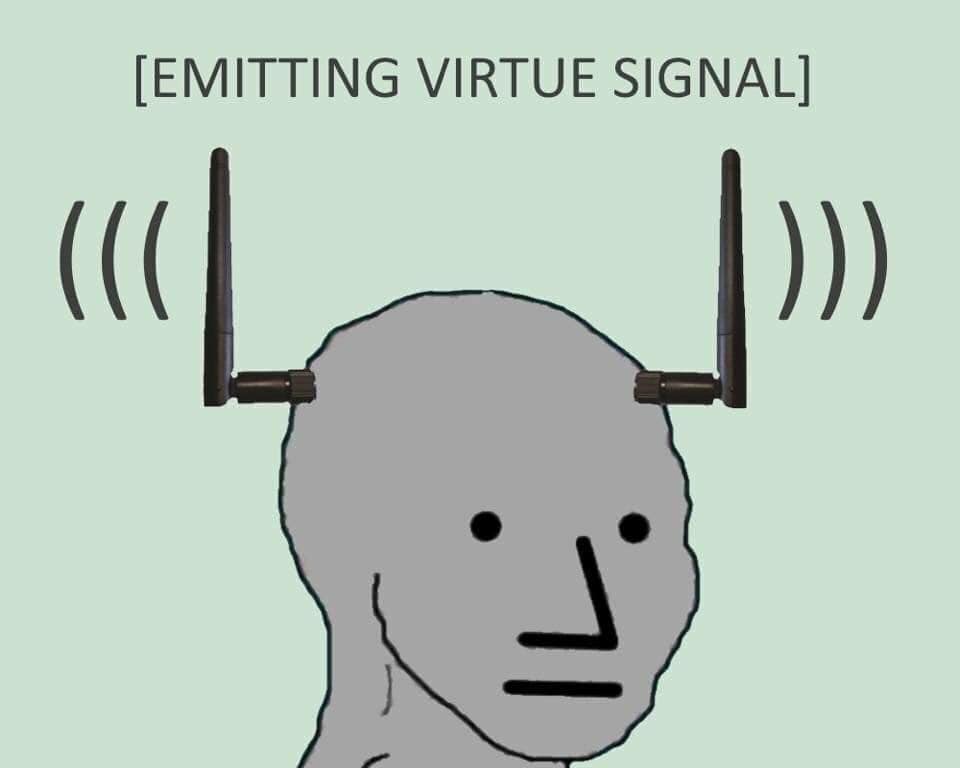
Anyone spending any time in social forums recently will have observed people making passionate defences of mass Muslim immigration, of ten-year old drag queens or of transfaggotry, despite not really believing in the truth of their own assertions. This behaviour might seem strange, or even paradoxical. But it’s a long-observed behavioural pattern known as virtue signalling.

In short, virtue signalling is when you show off how wonderful you are. In Clown World, this usually manifests as an overt attempt to communicate one’s moral rectitude to other people.

It’s originally a biological term referring to the efforts of male suitors to impress potential breeding partners. Being well-groomed and smelling good is a way of demonstrating one’s physical health to females. So is performing vigourous physical activity, or posing in a way that displays one’s muscles. These actions signal one’s physical virtue and suitability as a breeding partner.

In the discourse of Clown World, virtue signalling refers to the ubiquitous moral grandstanding that has infected public discussion. In everyday conversation today it’s normal for people, instead of contributing to an exchange of knowledge, to promote themselves as a moral authority. This phenomenon is especially acute on social media and at universities.

In practice, there are three forms of virtue signalling in Clown World.

The first is the aforementioned biological one, of trying to demonstrate one’s genetic quality through superior health and conditioning. When a man raises a curled arm with clenched fist to show off his biceps, or when a woman grows her hair long to show off her youthful vigour, it’s virtue signalling. Although these behaviours happen in Clown World, they are not what is usually meant when ‘virtue signalling’ is used as a pejorative.

The second form is intellectual. The most common expression is using unnecessarily large or uncommon words when speaking or writing. The purpose of doing so is to ascend the intellectual dominance hierarchy by intimidating lesser minds. Although this also happens in Clown World, it’s also not what is usually meant by ‘virtue signalling’.

The third form is moral. This moral grandstanding is usually associated with political and religious figures. It involves presenting oneself as if one possessed a more sophisticated, more refined, more educated moral sense. In Clown World, this third form of virtue signalling is extremely common. When Clown Worlders refer to virtue signalling, they’re probably referring to this.

Am important corollary to this third form is that the virtue signaller does precisely fuck-all about solving the issue they’re beating their chests over. Even when presented with an easy opportunity to help, they will not take it. Actions risk going wrong and lowering one’s social standing – by comparison, virtue signalling is risk-free.

Understanding this form of virtue signalling is essential if one wants to understand Clown World behaviour. It’s so common today that, in 2019, the brilliant American psychologist Geoffrey Miller was able to write an entire book about it.

Virtue signalling is especially common among gutmenschen, baizuos, simps, soyboys, dhimmis and Social Justice Warriors. The undisputed king of virtue signalling, however, is the Christcuck. The Christcuck’s entire gambit is to present himself as a moral authority of such distinction that everyone else is obliged to submit to his instruction.

The origins of virtue signalling, in a human context, reflect our social origins. In the biological past, when we lived as tribes, human societies were more like criminal gangs. If one got offside with the wrong people, one could get ostracised, which probably meant death. Because of resource scarcity and the ever-present threat of famine, people have always needed to get other people to think of them as valuable.

Human societies, whether they admit it or not, are all obsessed with the question of which individuals are the most valuable. This is true from the village to the imperial level. It seems to be hard-wired into the human brain to both rank other people in terms of value, and to strive to be seen as higher value.

All forms of virtue signalling are intended in increase the social position of the signaller. The purpose of loudly proclaiming virtue is that other people will see you as a moral authority.

Intelligent people correctly understand virtue signalling to be a sign of weakness. In practice, high-value people don’t need to virtue signal, because their value is either clearly apparent to everyone, or other people make it apparent to everyone. This is the reason why most professional workers dress without ostentation.

Anyone who does virtue signal, then, is probably low-value. If they weren’t, they’d let their own actions do the talking.

Dumb people, on the other hand, believe that virtue signalling increases their social standing. They are so anxious about being seen as moral authorities, or at least with not being seen as moral reprobates, that they can’t resist a chance to talk themselves up. The act of talking up one’s moral qualifications is the essence of virtue signalling.

Virtue signalling is not going away, because resources are becoming scarcer, and this will intensify the fear of getting ostracised. Also, globalisation has led to steeper and steeper social dominance hierarchies, which require ever-more effort to ascend. Worst of all is the opportunity afforded by social media to effortlessly virtue signal to more and more people.

*

This article is an excerpt from Clown World Chronicles, a book about the insanity of life in the post-Industrial West. This is being compiled by Vince McLeod for an expected release in January 2021.

*

If you enjoyed reading this essay, you can get a compilation of the Best VJMP Essays and Articles of 2019 from Amazon for Kindle or Amazon for CreateSpace (for international readers), or TradeMe (for Kiwis). A compilation of the Best VJMP Essays and Articles of 2018 and the Best VJMP Essays and Articles of 2017 are also available.

*

If you would like to support our work in other ways, please consider subscribing to our SubscribeStar fund. Even better, buy any one of our books!