
Clown World Chronicles: What Is ‘Race Neurosis’?

People in Clown World exhibit all kinds of neuroses, most of them caused by our highly unnatural way of life. Adapting to modern industrial society has proven to be challenging for even the most resourceful of people. As this essay will examine, the forced diversity that we all live under has created a form of mental illness particular to itself.

A neurosis refers to a class of mental disorders that are characterised by anxiety, obsessional thoughts and avoidance behaviour. Karen Horney considered the defining characteristic of neurosis to be a worldview that is distorted by compulsive needs. Neurotics exhibit their unusual behaviours, according to Horney, to meet their exaggerated needs for power, prestige and affection.

It’s common for people to be neurotic about cleanliness – some are excessively anxious about getting infected by germs and will obsessively wash their hands or clean their teeth. These behaviours feed the neurosis by causing the neurotic to feel themselves superior to others on account of their greater hygiene, and that other people will be more affectionate towards them because they are so clean.

People with race neurosis are similar. Their need for power is met by silencing others for making ‘racist’ comments, and their need for prestige is met by looking down their noses at those moral inferiors and shaming them. As with other ingratiating behaviours motivated by neurosis, those with race neurosis believe that this virtue signalling will cause others to like them more.

‘Race neurosis’ refers to a very specific kind of neurosis that is most accurately considered a type of obsessive-compulsive disorder. The compulsive need in the case of race neurosis is the need to deny human biodiversity. This compels them to believe that all human subgroups are precisely the same and, when different, only different for environmental and not genetic reasons.

The person with race neurosis will instantly disregard any explanatory theory of human behaviour that assumes that human biodiversity exists. They do this out of a deeper compulsive need – the one to assert that all human subgroups have equal value. This assertion may be true in a metaphysical sense, but it isn’t at all true in a biological sense – and the racial neurotic has trouble making a distinction.

No two things in Nature are the same, whether measured as individuals or as groups. Of any two, one will be taller, one will be darker, one will be relatively more endomorphic – and one will be smarter. This means that, by any measure you care to name, one will be superior and the other inferior. A person with race neurosis has extreme difficulty accepting this.

This neurosis is an echo of the earlier Christian neurosis that was triggered by the realisation that humans were just another form of animal. In the same way that this realisation led to people denying the science of evolution and castigating Darwin as a heretic, race neurosis also leads to people denying the science of evolution and castigating its proponents as evil.

Race neurosis goes hand-in-hand with creationist narratives about the origins of the human species. Because no two things in Nature are the same, human biodiversity denial is most plausible when it can appeal to a creator God, who (for various reasons) is presumed to be unwilling to create superior and inferior groups of people. Therefore, certain qualities (like intelligence) can be assumed to be equal across all human groups.

People suffering from race neurosis also practice a variety of avoidance behaviours, on account of that they live in constant fear of empowering “far-right wing extremists”. They are extremely reluctant to acknowledge either white or Asian superiority in any intellectual or behavioural facet, out of the fear that, if either was widely acknowledged, certain races would find themselves in gas chambers again.

Race neurosis can even go so far that a person can think it immoral for someone else to say that it’s okay to be white.

A person can confidently be said to have race neurosis if they become angry or distressed when a belief in human biodiversity is asserted. If a person merely disagrees with hereditarianism, they will be able to discuss the relevant scientific evidence without becoming distressed. But if they suffer from a form of race neurosis, they will sense that one of their sacred beliefs is being challenged, and they will become defensive.

Race neurosis is deliberately aggravated by the mainstream media, who play up stories that have a racial angle and play down stories that don’t. Examples can be found right now in the numerous articles admonishing people to abstain from any anti-Chinese racism that might have been provoked by coronavirus fears. This constant hammering has created the false impression that racial prejudice causes a significant proportion of the world’s avoidable suffering, and that is one of the world’s foremost issues.

Also contributing to the problem is the common eschatological belief that all of the world’s races are destined to fight to the death for supremacy in some future race war, willingly or otherwise. People who hold this belief are often afraid that talking about human biodiversity will set this conflict off. Their logic is that recognition of group differences is a step on the slippery slope to warfare.

The cure for race neurosis is genuine hardship. Anyone genuinely worried about whether they have signalled their anti-racism hard enough is immensely privileged – to worry so much about something so meaningless is evidence of no genuine troubles. In Clown World, the disconnect that many people have from reality manifests in psychiatric conditions such as race neurosis.

*

This article is an excerpt from Clown World Chronicles, a book about the insanity of life in the post-Industrial West. This is being compiled by Vince McLeod for an expected release in the middle of 2020.

*

If you enjoyed reading this essay, you can get a compilation of the Best VJMP Essays and Articles of 2019 from Amazon for Kindle or Amazon for CreateSpace (for international readers), or TradeMe (for Kiwis). A compilation of the Best VJMP Essays and Articles of 2018 and the Best VJMP Essays and Articles of 2017 are also available.

*

If you would like to support our work in other ways, please consider subscribing to our SubscribeStar fund. Even better, buy any one of our books!
New Zealand Should Legalise Cannabis For The Coronavirus Lockdown

It seems inevitable now that the country will soon end up in lockdown on account of the COVID-19 pandemic. This will cause a great deal of stress not only to our society and to our economy, but also to the minds of individual Kiwis. This essay discusses a simple, easy way that the Government could help the nation avoid much of the suffering coming our way: legalise cannabis.

When the lockdown happens, people are going to be trapped inside their houses for a long time. This sudden, forced, close proximity is going to sharply increase the stress levels of a great number of them. Kiwis are an outdoors people – for us community is found on the sports fields, the tramping trails and the beaches, not inside churches or auditoriums. Being stuck inside will be highly unnatural for us.

The Playstation will help for a while – a few days at most – but that will wear thin quickly. The lockdown will lead to sharply elevated levels of boredom and stress – emotions which, if felt for a prolonged period of time, lead to chaos and destruction.

New Zealand already has a serious problem with domestic violence, mostly due to the fact that alcohol is promoted while more peaceful alternatives are suppressed. In our culture, where most lack the self-confidence to speak eloquently, bashing someone is considered an acceptable way to discipline someone misbehaving.

We can predict, sadly, that the enforced proximity created by the lockdowns will result in a sharp rise in domestic violence. Having to live on top of each other for weeks will lead to more nagging and fighting, especially when some turn to alcohol to beat the tedium. As tempers fray, fists will fly. Because children will be at home from school, they will be exposed to it all. In some cases, this will cause long-term trauma.

The Government could pre-empt a great deal of this suffering today, if they had the wit and will to legalise cannabis.

One of the foremost benefits of cannabis is that it makes boredom easier to deal with. As Doug Stanhope said: “Boredom is a disease. Drugs cure it.” Cannabis can make all kinds of dull things exciting, and can make ordinary things seem interesting. Cannabis enthusiasts have found that weed adds to the appreciation of life in much the same way that salt adds to the appreciation of a meal.

If cannabis were to be made legal today, people could make plans to use it during the lockdown. Although it will not be possible to institute retail sales on such short notice, people could take measures to acquire it from those who already have it, who could themselves be temporarily authorised to sell it while a proper recreational system was being set up (although not to people under 18).

Such a move would ease a great deal of the extraordinary stresses to which Kiwis will be subjected in coming months.

The Government is going to have to deal with the prospect of civil unrest over the next few months. There has already been looting in London, if limited, as a result of the increased tensions. Although the nation is pulling in behind the Government now, this is only because the state of alarm is keeping people in line. As the lockdown wears on, people’s dissatisfaction will change their sentiments.

Legalising cannabis would make this much easier. It would provide relief to the great number of New Zealanders who will be suffering heightened stress and anxiety from the lockdown and from its economic consequences. It would provide relaxation to those disturbed by the disruption to normal life. Not least of all, it would allow for different patterns of thinking in these times of panic and despair.

Jacinda Ardern has already proven that the country is willing to accept extraordinary measures in this time of crisis. We have already accepted a shutdown of the national borders, despite the fact that this measure condemns to bankruptcy a proportion of our tourism, transport and hospitality operators. The general mood is akin to a siege mindset. It’s the perfect time to take bold measures.

A majority of New Zealanders have already accepted that legal cannabis is inevitable. The only holdouts are clinging to prohibition out of stubbornness, spite or malice. The COVID-19 lockdown offers the perfect opportunity to bulldoze through these last recalcitrants and to repeal cannabis prohibition.

Over and above all this, repealing cannabis prohibition would free up some $400,000,000 of Government spending and tens of thousands of Police man hours that is currently wasted every year on enforcing cannabis prohibition. Both of those things will be in desperate short supply over the coming months – time to acknowledge that they’re not well spent persecuting weed smokers.

If the Sixth Labour Government thought intelligently about it, they would understand that the COVID-19 epidemic had temporarily slapped the nation out of its usual slumber, and they would use this opportunity to do things that had previously been made impossible by obstinacy and cowardice. The Cannabis Control Bill that is scheduled to be put to a referendum this September could simply be passed into law by majority vote.

*

Vince McLeod is the author of The Case For Cannabis Law Reform, the comprehensive collection of arguments for ending cannabis prohibition.

*

If you enjoyed reading this essay, you can get a compilation of the Best VJMP Essays and Articles of 2019 from Amazon for Kindle or Amazon for CreateSpace (for international readers), or TradeMe (for Kiwis). A compilation of the Best VJMP Essays and Articles of 2018 and the Best VJMP Essays and Articles of 2017 are also available.

*

If you would like to support our work in other ways, please consider subscribing to our SubscribeStar fund. Even better, buy any one of our books!
Diversity Is A Strength In Times Of Plenty, And A Weakness In Times Of Shortage

The Establishment and the mainstream media like to say that diversity is a strength. This opinion is aggressively rejected by most of the working class, who consider it a great weakness. The reality, as this essay will discuss, is that both sides are right – but only in the appropriate context.

Since the end of World War II, the West has enjoyed great prosperity. Our stockmarkets, factories, airports and seaports have all boomed from the ever-increasing demand. Most people felt like they were getting a good deal, or that, if they weren’t, they soon would. During this great age of plenty, diversity has generally caused more pleasure than pain.

In times of plenty, diversity is a strength. When the economy is growing, and no-one has to worry about competing with each other, then diversity means an enrichment of the everyday experience of life. It means new foods, new cultural displays, new ideas. It means an exciting, vibrant increase in novelty.

In times of shortage, however, diversity means something else.

Every community is divided along fracture lines – lines of race, gender, religion, age, education and cultural affinity. In good times, these fracture lines are papered over by wealth – people don’t need to fight if everyone has enough to meet their own needs. In bad times, these fracture lines are exposed and aggravated.

When times are tough, the community needs to pull together. A given community’s ability to pull together depends mostly on its level of solidarity, and that in turn depends mostly on the number and degree of commonalities that members of the community have with each other. After all, ‘commonality’ and ‘community’ have a similar etymology.

The presence of commonality means co-operation. Where commonalities exist, people are happy to help each other, because they know that this help will benefit a person like them. This knowledge assures them that the help will be reciprocated, and not just taken. They can count on getting helped in the future, and so feel like part of a society, a wider kinship group.

A lack of commonality means exploitation. The rule is that people are willing to exploit others to the degree that those others are different from them. The greater the number of fracture lines in a community or society, the greater the degree of exploitation that exists. As mentioned above, this is no big deal when the economy is expanding, because this means new niches open up for people to move into.

In times of shortage, however, diversity means that helping other people is helping people who aren’t your kin. The natural inclination, then, is to keep for yourself, to not share. The problem here is that people get desperate in times of shortage. When people are desperate, a refusal to share with them often leads to violence.

Diversity makes it much harder to settle the tensions that arise from shortages. Two people of the same culture can use their shared moral values to come to a mutual agreement. If they have a common language, they can talk their way to a mutual understanding. Absent these things, misunderstandings lead to flaring tempers.

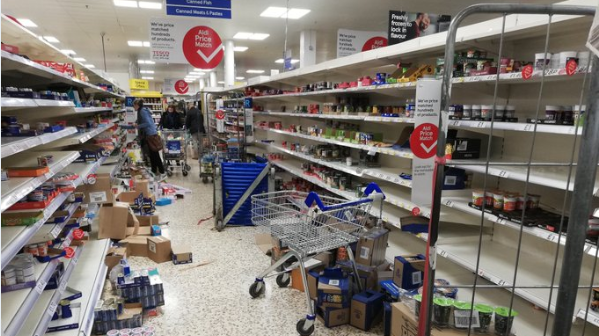
Arriving at a mutual agreement in times of scarcity is much easier between two natives than between a native and an immigrant. Between two immigrants, as we see in the Woolworths toilet paper fight video linked above, there is a minimum of commonality, and this regularly ends in actions that are not made from a place of empathy.

If the COVID-19 pandemic does have a severe enough economic impact to cause widespread shortages, some people are going to be forced into making some terrible decisions – and much more terrible than what brand of toilet paper to buy because their preferred one is sold out.

Faced with two patients who can’t breathe, and only one ventilator, the medical staff dealing with the pandemic are going to be forced to make decisions as to who lives and who dies. There are already reports that Italian doctors have been forced to leave old people to die on account of that there aren’t enough beds in intensive care units. Increasing diversity means that some Italian doctors will have to decide whether an elderly native Italian or a younger immigrant gets the ICU bed.

More relevant to the average person are the hundreds of small decisions that they will have to make about questions that test their loyalties. Some people have been stockpiling hand sanitiser on account of that the sudden shortage of it has spiked the price. These price gouging actions have been heavily criticised, on the grounds that not only are they shamelessly opportunistic but they also prevent needy people from getting supplies.

But in a highly diverse society, the balance of rewards is different to what it would be in a more homogenous one. The more diverse society is, the less likely such actions are to harm a person who has something in common with you. All the profit from such actions, however, you keep for yourself. So why not use a pandemic as an opportunity to price gouge? If no-one from your kin group loses out, you might as well take advantage.

Proof for these suppositions come from the fact that neither supermarket fighting nor price-gouging is happening in nations with low levels of diversity. There are no videos of people fighting over toilet paper in places like South Korea, Taiwan or Japan – and there may never be. The absence of diversity in these places means they have enough in common for people to work together instead of chimping out.

All of these problems are just part of the regular course of empires. Empires burgeon, rise, stagnate, decay and fall. The increase in diversity usually comes after the stagnation phase, as the ruling class tries to squeeze out the maximum possible expansion by opening the borders. The current iteration of the West is somewhere between the decay and the fall stages. The nations to successfully respond to the COVID-19 pandemic, like South Korea and Japan, will be the leading nations of this century.

*

If you enjoyed reading this essay, you can get a compilation of the Best VJMP Essays and Articles of 2019 from Amazon for Kindle or Amazon for CreateSpace (for international readers), or TradeMe (for Kiwis). A compilation of the Best VJMP Essays and Articles of 2018 and the Best VJMP Essays and Articles of 2017 are also available.

*

If you would like to support our work in other ways, please consider subscribing to our SubscribeStar fund. Even better, buy any one of our books!

How A Coronavirus Pandemic Could Win Jacinda Ardern The Election

This September’s election promises to be very close. Opinion polls suggest that either of a National-ACT or Labour-New Zealand First-Greens coalition could easily take power in the aftermath. The actual winner will be determined by a number of factors. One of those factors, as this essay will discuss, is the effect of COVID-19 on the demographic makeup of the nation.

One striking feature of this particular form of coronavirus is its death rate among old people. The death rate for people aged 80 and over who contract it is believed to be over 14%. For people aged between 70 and 79 it appears to be 8.0%, and 3.6% for people aged between 60 and 69. Corona-Chan is the Scourge of the Aged.

The death rate among young people, by contrast, is extremely low. No-one aged under 10 is known to have died of COVID-19 yet, and the death rate for those under 40 appears to be no more than 0.2%, i.e. barely different to regular bouts of influenza. Corona-Chan is merciful upon the young.

This great differential in danger across age brackets may have electoral consequences.

As Dan McGlashan showed in Understanding New Zealand, there are very strong correlations between being old and voting Conservative or National. In 2017, the correlation between being aged 65+ and voting Conservative was 0.39, and between being aged 65+ and voting National it was 0.62. At the other end of the scale, the correlation between being aged 20-29 and voting Labour in 2017 was 0.34, and with voting Greens it was 0.60.

0.62 is a strong enough correlation to suggest that the vast majority of people over 65 will vote National, and much of the remainder will vote Conservative. Meanwhile, the correlation of -0.35 between being aged 20-29 and voting National in 2017 tells us that few young people will vote for them in September.

Put these two things together, and it becomes apparent that COVID-19 is likely to kill off a significant proportion of National and Conservative voters.

There were over 711,000 people in New Zealand aged 65 or over at the end of 2016. It might be closer to 800,000 by now. If COVID-19 kills off 10% of people over 65 before September 19, that will approach 80,000 deaths, and if 75% of those people were National or Conservative voters, that suggests that they could well lose 60,000 voters – 20,000 more than Labour, Greens or New Zealand First would lose.

At the 2017 General Election, National, ACT and Conservatives got 1,171,403 votes between them out of a total of 2,591,896, a proportion of 45.2%. If they would lose 60,000 voters from coronavirus deaths, as per the scenario outlined in the above paragraph, they would end up with 1,111,403 votes out of a total of 2,511,896 – a proportion of 44.2%.

A loss of one percent might not sound like much, but the effect of COVID-19 in suppressing right-wing voters is not limited to deaths.

If there are 60,000 deaths among National and Conservative voters, there will be at least this many incapacitated by the illness. The overseas experience has shows that COVID-19 often means a few weeks confined to an artificial respirator. If the pandemic is at or near its peak in New Zealand at the time of the election, there could be a large number of old people unable to vote because coronavirus has left them physically incapable of doing so.

A further factor is that some old people might decide to stay away from polling booths on Election Day out of the fear of contracting coronavirus. As COVID-19’s greater threat to the elderly is widely known by now, a significant number of those elderly might be persuaded to stay away from the polling booths altogether. A majority of the population will pass through the nation’s polling booths on September 19, so standing in line at one for half an hour is asking for trouble.

Adding together deaths, incapacitations and discouragements, the right wing appears likely to lose several tens of thousands of voters before September 19.

All of this is moot if Jacinda Ardern suspends the election. There is presently no hard indication that she is prepared to do this, but mayoral elections due for May have already been suspended for 12 months in London, and Ardern must have felt the temptation. New Zealand has already been in chimpout mode for the past year and this coronavirus pandemic has made it three times worse.

Assuming the election goes ahead as planned though, there is a small but realistic chance that what would have been a National-ACT victory is transformed into a loss by the effects of COVID-19. The balance is so fine that a nudge the size of a coronavirus pandemic could tip it over.

*

If you enjoyed reading this essay, you can get a compilation of the Best VJMP Essays and Articles of 2019 from Amazon for Kindle or Amazon for CreateSpace (for international readers), or TradeMe (for Kiwis). A compilation of the Best VJMP Essays and Articles of 2018 and the Best VJMP Essays and Articles of 2017 are also available.

*

If you would like to support our work in other ways, please consider subscribing to our SubscribeStar fund. Even better, buy any one of our books!