The 20th Century gave us the right-wing totalitarianism of the Nazis and the left-wing totalitarianism of the Communists. The trauma caused by these ideologies caused people to gravitate towards the centre, in the belief that this was the opposite of totalitarianism. But the 21st Century has given us a new, centrist form of totalitarianism: the neoliberal form.
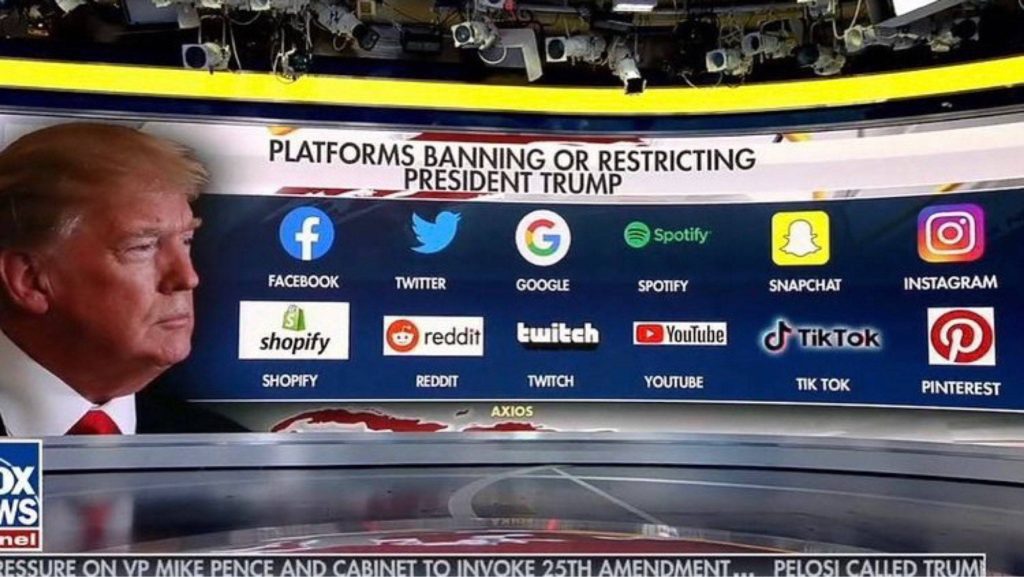
Neoliberal totalitarianism announced itself last week with the unpersoning of American President Donald Trump. Trump was first banned from Twitter, and then FaceBook, and then the rest of the neoliberal establishment piled in. Within days, he was even banned from Spotify.
The tech tyrants justified this by saying that Trump had violated the terms and conditions of the respective websites. But Twitter continues to host representatives of ISIS – who have been described as “winning the social media war” – as well as supporters of the Chinese Communist Party who argue in favour of concentration camps, and people sharing videos celebrating the Charlie Hebdo murders.
Nazi totalitarianism sought to control everyone’s lives down to the minutest detail, and was willing to destroy anyone who resisted. Communist totalitarianism also sought to control everyone’s lives down to the minutest detail, and was also willing to destroy anyone who resisted. The rhetoric that these forces used may have been different, but fundamentally both were authoritarian movements.
Neoliberal totalitarianism is just as bad. Like Nazism and Communism, it seeks total control over the lives of the citizens. Much like other totalitarian systems, it involves Big Business and Big Government working together against the common person. The degree of authoritarianism is the same. As Trump learned, when the neoliberal totalitarians decide that you’re gone, you’re gone.
Neoliberal totalitarianism is much more sophisticated than either Nazism or Communism.
The crude tyrannies of the 20th Century were not at all shy about making enemies, whether external or internal. Theirs was very much a rule of iron. Dissenters were crushed, sometimes literally as in the case of Tienanmen Square. Consent was achieved through submission to fear. Secret police were an everyday menace.
The tyrannies of the 21st Century are more the rule of silver. The logic is to abnormalise violence as much as possible, with the intent of making it unthinkable for any of their victims to use it against them. Neoliberal totalitarianism achieves its power through absolute control of the media matrix.
Josef Goebbels, in his Principles of Propaganda, wrote that “Propaganda must be planned and executed by only one authority. It must issue all the propaganda directives. It must explain propaganda directives to important officials and maintain their morale. It must oversee other agencies’ activities which have propaganda consequences.”
This totalitarian approach was the basis of the Nazi propaganda strategy. Far from recognising the value of free speech, the Nazis banned every propaganda organ that wasn’t under their control. The Nazi Party would be the sole source of truth for the German citizenry. A similar situation arose in Communist countries.
Goebbels understood that, if all other voices were silenced, people would unquestioningly follow the narratives they were given. It was only when other voices started to question the veracity of the Nazi propaganda that it started to become less effective. So all those questioning it were silenced. Anyone pointing out how the Nazis were lying were liquidated, many in concentration camps.
Totalitarian governments attack free speech with more fervour than they attack any other freedom. This is because free speech is the basis of every other freedom. Without free speech, the other freedoms cannot be peacefully defended. The loss of free speech is therefore the breach in the dam that leads inevitably to tyranny.
The neoliberal totalitarianism of today is pushing for the same degree of central control over media content that existed in Nazi or Communist countries. They do this out of similar motivations to the Nazi and Communist totalitarians. Desiring power, and being indifferent to the suffering of the people whose freedoms would be lost, the totalitarian is happy to trade those freedoms away for more control.
The only major difference between the neoliberal totalitarians of 2020 and the Nazi/Communist totalitarians of 1940 is that today’s tyrants are more subtle. They use their total control of the apparatus of propaganda to train the citizens to police each other. They don’t need to put wrongthinkers in gulags if they can train the citizens to shun those wrongthinkers into submission.
Because the citizens themselves act as the overseers of the slave plantation, it feels like they are doing so consensually. As long as no-one questions why it is that people think they way they do, or who decided that they should think that way, the hate machine can roll onwards unimpeded. In this manner, wrongthinkers can be neutralised without provoking resistance.
Any future solution to neoliberal totalitarianism must base itself on anti-totalitarian grounds. This will require common agreement across all of left, right and centre that totalitarian measures are unacceptable. The first step might be to declare common agreement with George Washington that “If freedom of speech is taken away, then dumb and silent we may be led, like sheep to the slaughter.”
The 2020 General Election was a disaster for National. Their vote count collapsed from 1,152,075 (44.4%) to 738,275 (25.6%). This catastrophic result saw National with no chance of negotiating their way into government.
National lost voters in two major directions. Not only did they lose votes to their fellow right-wing party ACT, but they also lost votes across the centre to Labour.
Variable
Voting National 2020
Voting National 2017
Age 20-24
-0.48
-0.35*
Age 25-29
-0.39
-0.35*
Age 30-34
-0.25
0.20**
Age 35-39
-0.04
0.20**
Age 40-44
0.22
0.20**
Age 45-49
0.58
0.20**
Age 50-54
0.69
0.71***
Age 55-59
0.67
0.71***
Age 60-64
0.70
0.71***
Age 65-69
0.67
0.62****
Age 70-74
0.68
0.62****
Age 75-79
0.69
0.62****
Age 80-84
0.66
0.62****
Age 85+
0.63
0.62****
Although National never got many votes from young people (the correlation between voting National in 2017 and being aged 20-29 was significantly negative), they got even fewer in 2020. Young New Zealand voters followed the general trend of drifting away from conservative parties between 2017 and 2020.
One pattern here is very striking: support for National rises as age rises, up until the 50-54 year old age bracket, at which point it levels off. National support increases the most quickly between ages 30-45, because this is the age in which the largest number make the transition from renter to homeowner, and therefore from a victim of the Establishment to a beneficiary of it.
People in the age brackets where homeownership is very high, i.e. those aged 50 or above, are solidly National supporters. The correlation between voting National in 2020 and owning one’s own home in a family trust was 0.81, and with owning or part owning one’s own home outright it was 0.56. The correlation between voting National in 2020 and neither owning one’s home in a family trust nor outright was -0.75.
The reason for this is obvious: National is more interested in taxing labour than capital, so those who own a lot of capital vote National out of self-interest. The New Zealand homeowner can rest assured that the National Party will never impose a capital gains tax nor a land tax. They are very much the representatives of accumulated capital.
The ongoing and worsening housing crisis is probably the foremost reason that National lost many younger voters, but maintained their position among the middle-aged. After all, the more arduous and difficult it is for a young person to get into a house, the more cruisy and luxurious life is for those who own the houses.
Variable
Voting National 2020
Voting National 2017
European
0.53
0.52
Maori
-0.65
-0.74
Pacific Islander
-0.46
-0.39
Asian
0.07
0.16
If National is the party of the Establishment, then they predictably get a lot of votes from white people. In 2020, the correlation between voting National and being of European descent was 0.53. This is strong enough to suggest that the vast majority of National support comes from white people.
Support for National sank noticeably among Pacific Islanders and Asians, however. Asians are almost completely indifferent to National, and Pacific Islanders now dislike National almost as much as Maoris do. It’s possible that National becomes more and more a white person’s party over time.
The Pacific Island voting bloc is an interesting one, because they are torn between voting Labour for economic reasons and voting National for religious reasons. Few appreciate how hotly contested this bloc is. This contention is probably why Labour does not come out in support of cannabis law reform.
Variable
Voting National 2020
Voting National 2017
Loss or Nil Income
-0.45*
-0.51
Personal Income $1-$5,000
-0.45*
-0.58
Personal Income $5,001-$10,000
-0.57
-0.71
Personal Income $10,001-$15,000
-0.29**
-0.48
Personal Income $15,001-$20,000
-0.29**
-0.19
Personal Income $20,001-$25,000
0.07***
-0.16
Personal Income $25,001-$30,000
0.07***
-0.33
Personal Income $30,001-$35,000
-0.15****
-0.36
Personal Income $35,001-$40,000
-0.15****
-0.42
Personal Income $40,001-$50,000
-0.15****
-0.25
Personal Income $50,001-$60,000
0.32*****
-0.01
Personal Income $60,001-$70,000
0.32*****
0.21
Personal Income $70,001-$100,000
0.41******
0.32
Personal Income $100,001-$150,000
0.41******
0.30
Personal Income $150,000+
0.41******
0.30
The National Party isn’t just the party of those holding wealth, it’s also the party of those earning it. There were significant correlations between voting National in 2020 and having a personal income of over $50,000 per year. The correlation between voting National in 2020 and having a personal income of over $70,000 was 0.41.
Beneficiaries and people in that income range are extremely disinclined to vote National. This is because of the perception, earned during the Bolger and Key Governments, that National is cruel towards non-pensioner beneficiaries. The correlation between voting National in 2020 and having a personal income between $10,001 and $20,000 (i.e. in the non-pensioner beneficiary range) was significantly negative, at -0.29.
The correlations between voting National in 2020 and having a personal income in the pensioner range – between $20,001 and $30,000 per year – were positive. This reflects two things: that National are much more generous towards pensioners than towards other beneficiaries, and that pensioners tend to be more conservative than younger voters, who tend to have less to lose from the status quo.
However, the correlations between being wealthy and voting National were not as strong as the correlations between being old and voting National, and the correlation between earning over $70,000 and voting for a party was stronger for the Greens (0.52) than it was for National. This speaks to the degree to which votes for National are often cast for reasons of social conservatism and not just wealth.
Variable
National Vote 2020
National Vote 2017
No religion
0.16
0.02
Buddhism
0.12
0.20
Christianity
0.10
0.33
Hinduism
-0.14
-0.06
Islam
-0.19
-0.10
Judaism
0.17
0.20
Spiritualism and New Age
-0.16
-0.30
On the subject of social conservatism, this has traditionally been where National got a lot of its voters. Christians are generally happy to have homosexuals, prostitutes and cannabis users locked up in prison for moral reasons, and to that end they tend to vote National.
In 2017, the correlation between voting National and being Christian was 0.33. But by 2020 this had fallen to 0.10. Support for National also fell between 2017 and 2020 among Buddhists (0.20 to 0.12), Hindus (-0.06 to -0.14) and Muslims (-0.10 to -0.19). These voters probably didn’t switch because of moral reasons, but because of the poor example National set with their multiple changes of leadership.
Some might be surprised that Jewish support for National is not higher, given that National recently had a Jewish Prime Minister, and that Jews are by far the most economically privileged demographic in New Zealand. The fact is that Jews are so economically privileged that they are more likely to vote ACT than National.
Spiritualists and New Agers tend not to vote National because they see National as the party of materialism and consumerism. The correlation between voting National in 2020 and being a Spiritualist or New Ager was not significant in 2020, while it was significantly negative in 2017.
The positive (if not significant) correlation between voting National in 2020 or 2017 and having no religion might surprise some, given the existing association between National and Christianity.
Variable
Voting National 2020
Voting National 2017
Voting Labour same year
-0.16
-0.94
Voting Greens same year
-0.16
-0.25
Voting ACT same year
0.92
0.61
Voting New Zealand First same year
0.07
0.04
Voting New Conservative same year
0.68
0.45
Voting The Opportunities Party same year
0.11
-0.20
Voting Maori Party same year
-0.71
-0.76
Voting Advance NZ same year
-0.13
n/a
Voting Sustainable NZ same year
0.50
n/a
Voting ALCP same year
-0.60
-0.70
Voting TEA Party same year
0.21
n/a
Voting Heartland NZ same year
0.13
n/a
Voting Social Credit same year
0.19
n/a
Voting NZ Outdoors Party same year
0.20
n/a
Voting ONE Party same year
-0.17
n/a
Voting Vision NZ Party same year
-0.60
n/a
In 2017 National and Labour were heavily polarised, and appealed to very different demographics. The correlation between voting National in 2017 and voting Labour in 2017 was -0.94, suggesting that there was very little overlap between the two voting blocs.
By 2020, the correlation between voting National and voting Labour was -0.16. This was because so many elderly, rich, white, Christian voters switched to Labour that there was no longer any significant difference between the voters of the two parties. National was still older, richer, whiter – but not by anywhere near as much.
So many old, rich, white people abandoned National for ACT in 2020 that the correlation between voting for either party in 2020 was 0.92. In 2017 this correlation was only 0.61.
There were also strong correlations between voting National in 2020 and voting New Conservative in 2020 (0.68) or voting Sustainable NZ in 2020 (0.50).
Significant negative correlations existed between voting National in 2020 and voting Maori Party in 2020 (-0.71), voting Vision NZ in 2020 or voting Aotearoa Legalise Cannabis Party in 2020 (both -0.60). These parties have a young, poor and brown demographic and are therefore different to the National-voting demographic in several major ways.
None of the correlations between voting National in 2020 and voting for the other parties in 2020 were significant, which speaks to the degree that National is a middle-of-the-road party with broad-based appeal. Most demographics can appreciate the basic National Party appeal of an orderly society, and so National will always have some amount of support even among traditionally disadvantaged demographics.
Variable
Voting National 2020
Voting National 2017
Percentage of males
-0.02
0.33
Perhaps most emblematic of National’s failure in 2020 was the collapse in the male vote from 2017.
Conservative parties all around the world can count on a significantly higher level of support among males than females. This is because men, on average, control a significantly higher proportion of both income and wealth. As such, they are inclined against voting for parties that want to tax income and redistribute wealth, i.e. against the social democratic parties.
That there was a negative correlation between being male and voting National in 2020 reflects how incompetent National appeared between 2017 and 2020. In 2017, the correlation between being male and voting National was significantly positive, at 0.33. By 2020 this advantage had been completely lost.
Variable
Voting National 2020
Voting National 2017
No qualifications
-0.22
-0.41
Level 1 certificate
0.04
-0.16
Level 2 certificate
-0.13
-0.22
Level 3 certificate
-0.68
-0.24*
Level 4 certificate
-0.05
-0.24*
Level 5 diploma
0.01
0.75**
Level 6 diploma
0.80
0.75**
Bachelor’s degree
0.16
0.22
Honours degree
0.20
0.16
Master’s degree
0.11
0.16
Doctorate
0.07
0.13
National likes to present itself as the party of the elite, which they are in a limited sense. However, their eliteness is mostly limited to wealth, and not education.
There were no significant positive correlations between voting National in 2020 and having any of the university degrees. The closest was between voting National in 2020 and having an Honours degree, at 0.20.
This finding might surprise those who are used to thinking of National voters as the natural intellectual elites. National voters are the natural ruling class, because they’re the ones that inherit money and connections, and the ruling class are those who inherit money and connections, not the most intelligent.
The best-educated people, in fact, tend to vote ACT (if male) and Greens (if female).
The correlations between having a Bachelor’s, Master’s or doctorate degree and voting National in 2020 all weakened from 2017. To lose these demographics is to lose the true elite, those who are distinguished by their intellectual contribution to the culture. It’s also to lose the most reasonable people in the centre.
Variable
Voting National 2020
Own house in family trust
0.81
Own or part-own house
0.56
Neither ownership nor family trust
-0.75
As some could guess from their opposition to restrictions on landlords, National is very much the landlords’ party. It’s not surprising, then, that there was an extremely strong correlation between owning a house in a family trust and voting National in 2020. 0.81 is one of the strongest of all correlations between any demographic variable and voting National in 2020.
If people owning a house in a family trust can be considered the upper-middle class, those who own or part-own a house outright might be considered the middle-middle class. There was a correlation of 0.56 between being in this category and voting National in 2020. Landowners, then, are the core National Party demographic.
If society can be crudely divided into the owners and the owned, those who have to labour to pay rent are the owned. The difference between being a feudal-era serf and having to work 15-20 hours a week to pay rent is not obvious to the person doing the work. Few people in this category want to maintain the status quo.
As such, those who don’t own property are extremely unlikely to vote National. There was a correlation of -0.75 between neither owning property outright nor in a family trust and voting National in 2020.
Variable
Voting National 2020
Income from wage or salary
-0.47
Income from self-employment or own business
0.74
Income from interest, dividends, rents or other investments
0.71
If National are the party of ownership, it would follow that their supporters tend to make money from owning things. Indeed, the correlation between receiving an income from interest, dividends, rents or other investments and voting National in 2002 was 0.71.
Receiving an income from a wage or salary had a correlation of -0.47 with voting National in 2020. Unfortunately this category was not separated into income from a wage and income from a salary, because this would have given us some very useful information. In any case, it’s clear that those who have to work don’t like to vote National and those who don’t have to work do like to vote National.
Receiving an income from self-employment or one’s own business and voting National in 2020 had a correlation of 0.74. Unfortunately, also, this category was not separated into income from self-employment and income from passively owning a business. Many self-employed are tradesmen and would vote Labour because of working-class sentiments, so those who own their own business must be among the strongest National supporters of all.
Variable
Voting National 2020
Managers
0.78
Professionals
0.09
Technicians and Trades Workers
0.05
Community and Personal Service Workers
-0.61
Clerical and Administrative Workers
-0.01
Sales Workers
-0.18
Machinery Operators and Drivers
-0.43
Labourers
-0.29
That National is the party of those with power, and not so much the party of those with brains, is further underlined by looking at which professions voted for them in 2020.
The occupation with the strongest support for National, by far, were managers. Being a manager had a correlation of 0.78 with voting for National in 2020. If you have people underneath you who you need to manage, National is your party. This is because of previous pro-employer National measures, such as the Employment Contracts Act.
The correlation between being a professional and voting National in 2020 (0.09) was barely strongly than the correlation between being a technician or trades worker and voting National in 2020 (0.05). This demonstrates the degree to which National doesn’t appeal to those running the country, just to those owning it.
Community and personal service workers were the occupation with the strongest negative correlation with voting National in 2020 (-0.61). This is mostly because this is an occupation that requires high levels of empathy, and National has been known for cruelty ever since the welfare reforms of the Third National Government (a.k.a. Ruthanasia).
Traditional working-class occupations were significantly negatively correlated with voting National in 2020. This was true of both labourers (-0.29) and machinery operators and drivers (-0.43). As with other demographics, this can be readily explained by the fact that National prefers to tax income than wealth, which disadvantages those in working-class occupations.
*
This article is an excerpt from the upcoming 3rd Edition of Understanding New Zealand, by Dan McGlashan and published by VJM Publishing. Understanding New Zealand is the comprehensive guide to the demographics and voting patterns of the New Zealand people.
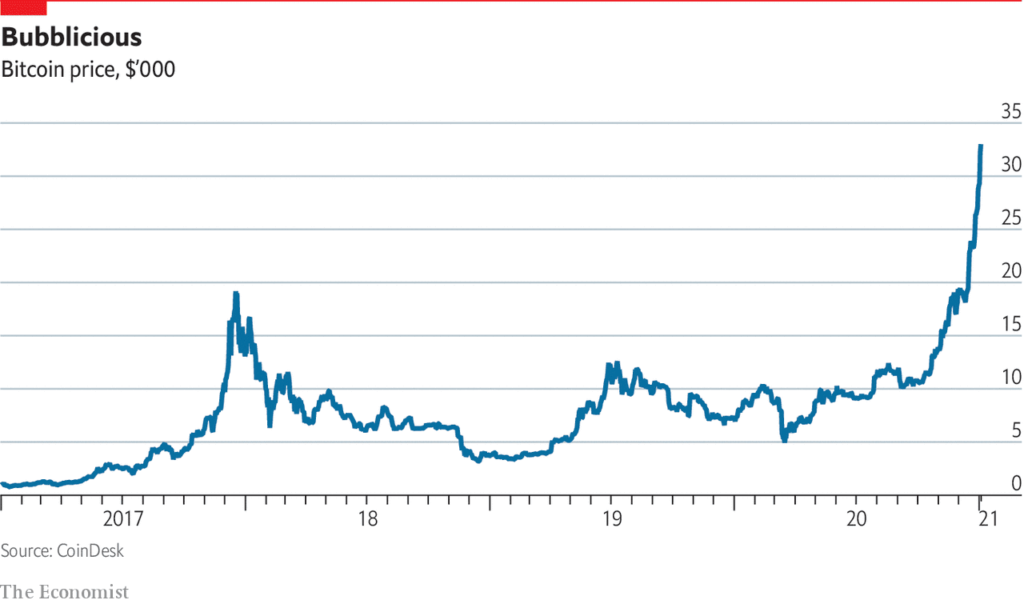
BitCoin enthusiasts have been overjoyed in recent months to observe the rise of their favourite cryptocurrency against the US Dollar. The price of BitCoin recently touched USD40,000 earlier today, making predictions of an eventual six-figure value seem believable. But the good news for BitCoin holders might herald bad news for everyone else. This could be the collapse of the fiat currency system.
The rise in the price of BitCoin has to be understood in the wider economic context.
Ever since the Global Financial Crisis of 2007, Western governments have taken to what is known as quantitative easing. This involves the widespread printing of fiat currency, a practice that has seen the price of everything go up. New Zealand recently increased the Quantitative Easing limits to $100 billion, up from $60 billion, meaning that the Reserve Bank of New Zealand will help to fund the Government through buying bonds.
Almost 24% of all US Dollars in existence have been created over the past 12 months. This money printing has led to a much greater supply of money in circulation, which means one thing: inflation. The fiat currencies of the world are rapidly becoming worthless. This is evident when comparing their value to housing, bullion and BitCoin.
In New Zealand, the average house price has doubled since 2009, but wages have only gone up 40% since then. The average house cost ($330,000/$25) 13,200 hours of labour at the average wage in 2009. By 2020, it cost ($700,000/$34) 20,600 hours. So measured in house-buying terms, the average wage has lost 50% of its power since the Global Financial Crisis.
This is despite that fact that the value of housing stock has served as a kind of heat sink that has taken the steam out of the economy. That sink has now absorbed all the energy that it can. The extra is manifesting as inflation.
The rise in the price of silver bullion is even more striking. Silver bullion has doubled in value since April 2020. The reason for this is mostly uncertainty around fiat currency (the last time silver bullion spiked was in the immediate aftermath of the Global Financial Crisis). Silver has traditionally been seen as an alternative to fiat currency owing to its millennia of trade use.
Most striking of all is the price of BitCoin. At the time of writing this article, the price of BitCoin had gone up 30% over the previous week. It had gone up 500% over the previous nine months. BitCoin has gained fame as a digital alternative to fiat currency, owing to the fact that it is not under centralised control.
Many people have predicted that BitCoin will take over once the fiat currency system collapses completely. It will be evident when this is happening, apparently, from a sustained spike in the BitCoin price. Well, there’s a spike in the BitCoin price right now, as well as a spike in the silver price, the gold price and the house price.
All of these trends point unmistakably to one conclusion: the fiat currency system is collapsing. This isn’t surprising to those who were already aware of the life cycle of fiat currencies. Soon, fiat currencies might be worth so little that some people refuse to take them in trade. Then the shit will hit the fan.
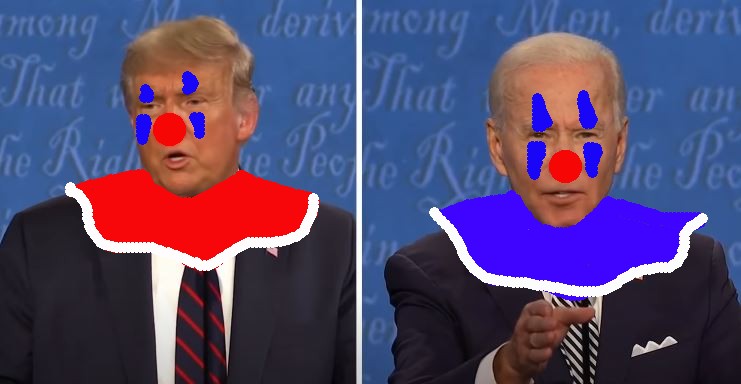
That Clown World is at the point where democracy tips over into tyranny is evident from the state of elections today. If there’s anything in today’s world that could be compared to a grotesque circus, it’s our general elections. The political world has always been like a circus, but in Clown World the circus is 24/7.
Problems with starting a democracy in places like Africa, it is said, don’t generally arise during the first election. It’s in one of the subsequent elections, when the winner of the initial election loses, that the problems start happening. It’s all well and good for one party to assume control after winning the first democratic election. What matters more, though, is what happens when they lose control and are asked to hand over power.
Characteristic of democratic elections in African scumholes is that they are contested. Almost inevitably, the loser accuses the winner of cheating, either by stuffing ballot boxes or by intimidating opposition voters into staying home. This is especially likely to be true if the loser won the previous election. It’s common for these disputes to end up in massacres or even civil wars.
Characteristic of democratic elections in the West is that the loser accepts the result. This is why it was so shocking for the 2000 American Presidential Election to drag on for as long as it did. But in Clown World, elections in the West have started to go down the African route.
The first real sign of it was the Russian interference conspiracy theory that was pushed by Democrat Party operatives in the wake of Hillary Clinton’s 2016 loss. This conspiracy theory suggested that the election result might not have been legitimate because it was influenced by the actions of the Russian Government, who supposedly purchased enough FaceBook ads to switch the result from Clinton to Donald Trump.
At time of writing this chapter, the result of the 2020 American Presidential Election still isn’t clear. Seven weeks after the election, neither Joe Biden nor Donald Trump has conceded (although the mainstream media has anointed Biden the winner). Trump has mounted a number of legal challenges relating to the vote, and rumours persist that he might try to enlist the military in a coup.
The tendency of Clown World politicians to dispute election results is made worse by the fact that the elections themselves have become detached from reality. The election process presents an image of a politician that 99.9% of voters will never meet. So it’s almost impossible to know if the results of a general election reflect the will of the country. This makes disputes much more plausible.
In Clown World, elections come down to a battle between competing narratives. Whichever narrative can assert itself the strongest wins, regardless of what any vote tally might say. Elections aren’t so much won as consent for one side’s victory is manufactured. This has made elections into permanent public relations exercises more than temporary leadership contests.
Buying media space is how positive public relations are maintained, and thereby how most elections are won. 90% of the time, the better-resourced candidate wins. This is because most voters in a democracy simply vote for the candidate with the most name recognition. If they saw Candidate A on the television and not Candidate B, that must mean that Candidate A is superior.
It’s even possible to calculate how much money you need to buy enough positive attention to win. A seat in the United States House of Representatives, for example, will cost around $1.6 million. However, it’s not always as simple as money – Michael Bloomberg spent $500 million to win the Democratic nomination for the 2020 Presidential election, and failed. Generally speaking, the lower the office the easier it can be bought.
No matter how hard it is to buy an office, though, people will always try. Because of all the mainstream media propaganda and disinformation this leads to, we still don’t know who has won the 2020 Presidential election. Faith in institutions is so low that there’s no-one we trust to tell us the definitive truth about who the President will be. FaceBook will censor anyone questioning Biden’s supposed victory, but as of right now it’s not clear that Trump intends to concede.
The great risk when elections become disputed is that it can lead to tyranny. The logic is that if the other side isn’t going to play fair, then why should we? Mistrust can escalate to the point where both sides reason that they had better get their retaliation in first. At that point, the country is essentially in a state of civil war.
Unfortunately, if the last two decades of American presidential elections are anything to go by, civil war is almost inevitable. It seems like the election results are becoming more and more heavily disputed by the loser. Trump is digging in his heels right now, and ill will is so widespread that if he called for a million Republican supporters to hit the streets with firearms he might get it.
For democratic elections to work, there has to be widespread confidence that the electoral process is legitimate. This means widespread confidence that there is no voter suppression, no foreign interference, no collusion with outside third parties and no influential disinformation campaigns. If one or more of these factors are present, the results are liable to get disputed.
It might well be that democratic elections themselves are inherently signs of Clown World. But the decay doesn’t stop at democratic elections. The predictable future is increased Weimarisation, up to the point where the system collapses or is overthrown. One possible pre-emptive solution is withdrawing the franchise from certain anti-social groups.
*
This article is an excerpt from Clown World Chronicles, a book about the insanity of life in the post-Industrial West. This is being compiled by Vince McLeod for an expected release in January 2021.