In 1984, the purpose of Newspeak was to make anti-government thoughts impossible. The logic was that if people were prevented by language from talking about opposing the government, they’d also be prevented from thinking about it. Being unable to think about opposing the government, they’d make perfect slaves.
In the West of 2023, our rulers have forced a form of Newspeak on us. As in 1984, the purpose of it is to make dissent impossible. The major difference is that, in our world, Newspeak works by confusing and corrupting existing definitions of words. This has the effect of making communication impossible, and thereby making resistance impossible.
The word ‘racist’ is the classic example of twisted definitions. The word used to refer to people with racial prejudice, who expressed contempt for others for no other reason than their race. But over time, as people displayed a willingness to submit to those shrieking racist, the definition expanded. Today some will argue that the term can only refer to white people.
Ther term ‘racist’ is now so overused that you can be called racist for resisting racism, such as if you say ‘It’s Okay To Be White’. ‘It’s Okay To Be White’ is an explicitly anti-racist statement, used primarily by working-class whites in response to comments such as that of Marama Davidson. That it can be considered racist shows that words (and phrases) can be twisted to their exact opposites in the Newspeak of 2023.
‘Nazi’ is a related example. Originally used to refer to members of the German NSDAP of 1920-1945, it’s now so overused that any nationalist or anti-globalist sentiments are written off as Nazi ones. Today, almost any unfashionable opinion attracts cries of Nazism.
As with racist, a person can explicitly decry Nazism, to the extent of listing multiple grievances with the doctrine, and still get accused of being a Nazi. Trying to distinguish between the nationalist aspects of Nazism and the totalitarian aspects is not permitted. To do so is to become a “Nazi apologist”.
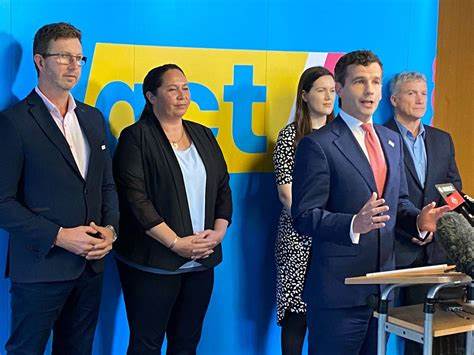
‘Far right’ relates to the above examples. Logically, if the right-wing is capitalist then the far-right ought to refer to hypercapitalist neoliberals like the ACT Party. Bizzarely, however, those described as far-right today are primarily working-class nationalists, whose main complaint is often the corporate importation of cheap labour. Somehow the right-wing are corporates while the far-right is anti-corporate.
‘Nation’ no longer means a population united by ties of blood and soil, as it has always meant. In the Newspeak of 2023, national ties are just like masks that a person puts on and takes off as needed. Anyone can claim to be of any nationality. The dumbing-down of language has obscured the difference between roots citizens and paper citizens. All are considered part of one big club, defined not by Nature but by the Government.
‘Disinformation’ now means ‘anything said by someone the Government doesn’t like’. This has been made evident by the New Zealand Government’s Disinformation Project, which serves as a Ministry of Truth, smearing anyone who speaks out against the ruling class. Enemies of the Government, in Newspeak, are incapable of speaking the truth. Everything they say is either disinformation, misinformation or malinformation.
‘The economy’ now means ‘the interests of international banking and finance’. It doesn’t have anything to do with the material needs of the nation being met. Today’s Newspeak will claim that the economy is doing well because unemployment is low, and will ignore the fact that most of those jobs don’t pay enough for the workers to own homes and raise families.
It doesn’t matter if people can raise families, because, as per the Newspeak definition of nation, the nation doesn’t need families. It can just import them from overseas, and as long as the GDP goes up it’s all good. Herein it can be seen that the Newspeak of 2023 is a form of neoliberal totalitarianism, unlike the national socialist and communist forms of totalitarianism in surface ways, but like them in fundamental ways.
‘Conspiracy theorist’, heard often in the mainstream media of 2023, is classic Newspeak. It’s another term for wrongthinker, denoting someone who is outside of society, a memetic outlaw. Even though human history is a parade of conspiracies, one after the other, anyone who notices a conspiracy in 2023 is equated with the severely mentally ill. ‘Conspiracy theorist’, in 2023 speak, is a synonymn for ‘schizophrenic’, i.e. a person whose paranoia leads them to see things that aren’t there.
There’s a reason why Confucius said that, if he were to be offered power, the first thing he would do would be the “rectification of names” i.e. he would make sure that words had accurate, commonly-understood meanings again. Newspeak was a thing in ancient China just as it was in 1984, and just as it is in 2023. Wherever you have totalitarianism, you have centralised attempts to control expression.
“In the end we shall make thought-crime literally impossible, because there will be no words in which to express it,” Orwell wrote. In 2023 thoughtcrime has been made impossible by the fact that each of us has been trapped in a silo of language, where communication is crippled by an absence of common understanding of the words we are using.
The Newspeak of 2023 has twisted all language, not to the service of Big Brother, but to globohomo – the alliance of globalist capitalism and globalist communism that has forced neoliberalism on the populations of the West. It’s no longer a sure thing that, when a person uses a particular word, that their audience will understand the intended meaning of that word. And so, we’re too confused to resist our ruling classes.
The final chapter of this book answers the question of which demographics turned out to vote in the 2020 General Election. In total, 2,919,073 people cast a party vote, out of 3,549,580 eligible voters, for a turnout rate of 82.24%. This was higher than in 2017, breaking the usual trend of declining turnout rates in Western democracies.
Turnout rate is very closely related to general disenfranchisement, hence the General Disenfranchisement Rule. As we can see in the analysis below, it’s possible to tell who is running society from the extent of their engagement in the political system. The higher the turnout rate, the higher the engagement, the more power and influence.
Variable
Turnout rate 2020
Voting Labour 2020
0.28
Voting National 2020
0.69
Voting Greens 2020
0.39
Voting ACT 2020
0.81
Voting New Zealand First 2020
0.10
Voting New Conservative 2020
0.52
Voting The Opportunities Party 2020
0.63
Voting The Maori Party 2020
-0.69
Voting Advance NZ 2020
-0.16
Voting Sustainable NZ 2020
0.53
Voting ALCP 2020
-0.52
Voting TEA Party 2020
-0.24
Voting Heartland NZ 2020
0.06
Voting Social Credit 2020
0.34
Voting NZ Outdoors Party 2020
0.28
Voting ONE Party 2020
-0.03
Voting Vision NZ 2020
-0.68
Perhaps more than any other measure, the correlations between party affiliation and turnout rate reveal who the true ruling class of New Zealand is. Those who turn out to vote are those psychologically engaged with the political system. They are those with a reasonable expectation that a politician might listen to them.
The top tier by this measure are ACT, National and The Opportunities Party. The correlation between turnout rate in 2020 and voting ACT in 2020 was 0.81; with voting National in 2020 it was 0.69; with voting The Opportunities Party in 2020 it was 0.63. These voters comprise society’s insiders – the wealthy and influential. They are the people who are in charge almost no matter what the political system is.
Immediately underneath them are New Conservative, Greens and Labour voters. The correlation between turnout rate in 2020 and voting New Conservative in 2020 was 0.52; with voting Greens in 2020 it was 0.39; with voting Labour in 2020 it was 0.28.
New Conservative voters are old and old people have very high turnout rates (see below). Greens voters are young but are usually from wealthy families and are usually well-educated. The significant positive correlation between turnout rate in 2020 and voting Labour in 2020 is harder to explain. In truth, Labour voters are part of the political Establishment.
The three parties whose supporters were least likely to turn out to vote were the Maori Party, Vision NZ and the ALCP. The correlation between turnout rate in 2020 and voting Maori Party in 2020 was -0.69; with voting Vision NZ it was -0.68 and with voting ALCP it was -0.52. It’s not news that Maori people tend to be disenfranchised, and all three of these parties have a high proportion of Maori voters.
Variable
Turnout rate in 2020
No NZQA qualifications
-0.30
Level 1 certificate
0.01
Level 2 certificate
-0.10
Level 3 certificate
-0.49
Level 4 certificate
-0.10
Level 5 diploma
-0.25
Level 6 diploma
0.73
Bachelor’s degree
0.20
Honours degree
0.42
Master’s degree
0.27
Doctorate
0.42
It’s well understood that the more educated someone is, the more enfranchised they tend to be. Educated people can express themselves in agreeable and persuasive ways, and tend to be more influential thereby. People with university degrees are heavily over-represented in Parliament, even among Labour Party MPs.
Therefore, it’s not surprising to see significant positive correlations between having any of the postgraduate university degrees and turnout rate in 2020.
It might be surprising to see that the correlation between having a Bachelor’s degree and turnout rate in 2020, while positive, was not significant. After all, a large proportion of the managerial class have that qualification. But the explanation is simple: most people with degrees are young, and young people tend not to vote (see below).
There was a significant negative correlation between turnout rate in 2020 and having no NZQA qualifications (-0.30). Many would have expected this to be stronger, but people in the older age groups are much more likely to have no NZQA qualifications than people in the younger age groups, balancing out the fact that older age groups are more likely to vote.
Variable
Turnout rate in 2020
Aged 20-24
-0.26
Aged 25-29
-0.23
Aged 30-34
-0.15
Aged 35-39
-0.07
Aged 40-44
0.27
Aged 45-49
0.54
Aged 50-54
0.63
Aged 55-59
0.67
Aged 60-64
0.65
Aged 65-69
0.64
Aged 70-74
0.65
Aged 75-79
0.65
Aged 80-84
0.64
Aged 85+
0.65
The origin of the widespread dislike of Boomers can be noted in the table above. Old people are far more likely to turn out than younger ones. Even taking into account the fact that people under 18 can’t vote, old people are much more likely to vote in New Zealand than younger ones.
There was a negative correlation between turnout rate in 2020 and being in any age group under 40 years old. This shows that New Zealand is little different to other modern democracies when measured by the turnout rate of young people.
There was a strong positive correlation (0.63 or stronger) between turnout rate in 2020 and being in any age group above 50 years old. The over-50s hit the polling booths in massive proportions. If the General Disenfranchisement Rule shows us anything, it’s that Boomers are enfranchised.
The age group between 40 and 50 appears to be when, in New Zealand, the transition from liberal to conservative is made. This is also when the transition from renter/mortgage holder to homeowner is usually made. These two apparent facts are intimately related. Not until most people become homeowners themselves do they feel an interest in conserving the status quo.
Variable
Turnout rate in 2020
Percentage of males
-0.04
Contrary to the expectations of some – but which could be surmised by many – there is no statistical evidence that men are more enfranchised than women. Although the historical example has been one of male dominance, there is little evidence that this state of affairs exists in the present day. Indeed, the correlation between turnout rate in 2020 and being male was negative (if too weak to be significant).
This could be guessed by anyone who knew that the correlations between being male and holding any of the university degrees were all negative. However true the historical example of male dominance might be, the experience of today is closer to the opposite.
Variable
Turnout rate in 2020
Being European
0.83
Being Maori
-0.67
Being Pacific Islander
-0.63
Being Asian
-0.20
Anyone who thinks that white Kiwis and Maori Kiwis are roughly equally enfranchised would get a shock from looking at the statistics.
The correlation between turnout rate in 2020 and being of European descent was extremely strongly positive, at 0.83. This is one of the strongest correlations in this entire study, of either direction. The correlation between turnout rate in 2020 and being of Maori descent, by contrast, was strongly negative, at -0.67.
It might be true that Maoris are technically over-represented in Parliament, in that there are more Maori MPs than the Maori proportion of the population would warrant, but that isn’t the same thing as enfranchisement. Enfranchisement is when you can reasonably expect your MP to listen to you and to take your concerns seriously, whatever their race.
Pacific Islanders are about as disenfranchised as Maoris. The correlation between turnout rate in 2020 and being a Pacific Islander was -0.63. This cannot be explained by Pacific Islanders being outside the bicultural system, because the correlation between turnout rate in 2020 was much less negative, at -0.20. Thus, poor education and low levels of wealth better explain the low Pacific Islander turnout.
Some might argue that Asians vote in high numbers out of a sense of duty, and are not truly enfranchised. That may be true to some extent. Nonetheless, the fact is that if Asians do vote in high proportions, they will have a significant influence on the vote (see the cannabis referendum for an example).
Variable
Turnout rate 2020
Income < $5,000
-0.70
Income $5,000-$10,000
-0.43
Income $10,000-$20,000
-0.23
Income $20,000-$30,000
0.16
Income $30,000-$50,000
-0.19
Income $50,000-$70,000
0.28
Income > $70,000
0.45
The correlations between income groups and turnout rate in 2020 will surprise few. With a few exceptions, these correlations follow the General Disenfranchisement Rule closely, in that the rich tend to vote and the poor tend to not vote.
Voters in every income group below $20,000 had a significant negative correlation with turnout rate in 2020. This is not surprising, as most beneficiaries will be in this category, and beneficiaries comprise a large proportion of society’s most disenfranchised people.
Voters in both income groups above $50,000 had a significant positive correlation with turnout rate in 2020. The strongest was between having an income above $70,000 p.a. and turnout rate in 2020, which was 0.45. It is people in this group who politicians listen to the most.
The general rule is obvious: the wealthier a person is, the more enfranchised they tend to be. This rule is already widely understood, but it’s useful to put some numbers to it.
It might seem paradoxical that the correlation between turnout rate in 2020 and having an income between $20,000 and $30,000 is positive, while the correlation between turnout rate in 2020 and having an income between $30,000 and $50,000 was negative. This is because those receiving between $20,000 and $30,000 tend to be students and pensioners, and therefore not really disenfranchised, whereas those between $30,000 and $50,000 tend to be minimum wage workers or in other working-class occupations, and therefore closer to the bottom of society than either students or pensioners.
Variable
Turnout rate in 2020
Working as a manager
0.56
Working as a professional
0.30
Working as a technician or trades worker
0.01
Working as a community or personal services worker
-0.33
Working as a clerical or administrative worker
-0.14
Working as a sales worker
-0.35
Working as a machinery operator or driver
-0.61
Working as a labourer
-0.30
The two most privileged occupations are the two most enfranchised ones. Both of the correlations between turnout rate in 2020 and working as either a manager (0.56) or as a professional (0.30) were significantly positive. Ultimately it’s managers and professionals who run society, and so it’s them that politicians listen to the most.
People in middle-class jobs had moderate levels of enfranchisement. Neither of the correlations between turnout rate in 2020 and occupation were significant in the case of working as a clerical or administrative worker (-0.14) or working as a technican or trades worker (0.01). The latter correlation might even be more positive than expected, a result of the fact that technicians and trades workers tend to be in the relatively elderly age groups, and those age groups have high turnout rates.
Working-class Kiwis were the most disenfranchised. There was a significant negative correlation between turnout rate in 2020 and working as any of a machinery operator or driver (-0.61), sales worker (-0.35), community or personal services worker (-0.33) or labourer (-0.30). Politicians don’t generally care what people in these occupations think, hence the disenfranchisement.
Variable
Turnout rate in 2020
No source of income
-0.69
Income from wage or salary
-0.19
Income from self-employment or own business
0.68
Income from interest, dividends, rents or other investments
0.83
Income from ACC or private work insurance
-0.13
Income from NZ Super or Veteran’s pension
0.64
Income from Jobseeker Support
-0.74
Income from Sole Parent Support
-0.77
Income from Supported Living Payment
-0.39
Income from Student Allowance
-0.22
The cynical will feel proven correct when they hear that the correlation between turnout rate in 2020 and receiving an income from interest, dividends, rents or other investments was 0.83, one of the strongest correlations in this study. It is people who receive an income in this manner who are the most enfranchised of all.
Also highly enfranchised are people who receive an income from self-employment or one’s own business, and people who receive an income from NZ Super or Veteran’s pension. The correlation between turnout rate in 2020 and the former was 0.68, and with the latter it was 0.64.
These three groups of income recipients are the people that politicians listen to the most. A high proportion of them work as managers, whether hired or inheritors.
Perhaps dishearteningly, there was a negative (if not significant) correlation between turnout rate in 2020 and receiving an income from a wage or salary: -0.19. This suggests that the people who do most of the work in our society, whose efforts keep it running, are disenfranchised, nearly significantly so.
The most disenfranchised Kiwis are those on unemployment, sickness or invalid’s benefits. These are society’s forgotten, who have the lowest status and who politicians listen to the least. The correlation between turnout rate in 2020 and receiving income from Jobseeker Support was -0.74, and between turnout rate in 2020 and receiving income from Sole Parent Support was -0.77.
The correlation between turnout rate in 2020 and receiving income from a Student Allowance was negative, but not significantly so (-0.22). Again, this is because students occupy an usual place in the class hierarchy: disenfranchised by age, enfranchised by class. As such, their turnout rate was higher than the other non-pensioner beneficiaries.
Variable
Turnout rate in 2020
Has no religion
0.48
Is a Buddhist
-0.10
Is a Christian
-0.20
Is a follower of the Maori religions
-0.62
Is a Hindu
-0.29
Is a Jew
0.22
Is a Muslim
-0.32
Is a Spiritualist or New Ager
0.33
That New Zealand is a materialist society is shown by many things, and the correlations between turnout rate in 2020 and following a religion is another of those things. The religious affiliation that had the strongest positive correlation with turnout rate in 2020 was having no religion (0.48). This will surprise many who think of atheists as degenerate outsiders. In fact, the people running this society tend to have no religion.
There was a strong negative correlation between following one of the Maori religions and turnout rate in 2020 (-0.62). This is no doubt a function of the significant negative correlation between being Maori and turnout rate in 2020.
Weaker, although still negative, correlations were found between turnout rate in 2020 and being a Muslim (-0.32), a Hindu (-0.29), a Christian (-0.20) or a Buddhist (-0.10). The correlation with Christianity will surprise many, as it is generally assumed that Christians comprise a large part of the power structure in New Zealand. Although this is true, a high proportion of practicising Christians in New Zealand are relatively disenfranchised Pacific Islanders.
Variable
Turnout rate in 2020
No children
-0.03
One child
-0.38
Two children
0.56
Three children
0.34
Four children
-0.21
Five children
-0.58
Six or more children
-0.74
Another nonlinear set of correlations are those between turnout rate in 2020 and number of children.
Some might expect that, since people with no religion have a high turnout rate, and since people with no religion often have no children, that people with no children must have a high turnout rate. This is not the case. The correlation between turnout rate in 2020 and having no children was -0.03.
The strongest positive correlation between turnout rate in 2020 and having any number of children was with two children (0.54), followed by three children (0.34). These correlations represent modal families, in the sense that most upper-middle-class families will have two or three children.
There was a negative correlation between turnout rate in 2020 and any of having four children (-0.21), five children (-0.58) or six or more children (-0.74). This reveals that two is the normal number of children to have, and that a person becomes more disenfranchised the more children they have beyond two.
Variable
Turnout rate in 2020
Own or part own house
0.68
Own house in family trust
0.62
Neither outright ownership of house nor house in family trust
-0.79
One of the main reasons why housing is a major issue in most Western countries right now is that it relates to the feeling of being part of society. For many people, if they don’t own a house they don’t feel like they have a stake in society, and those who don’t feel like they have a stake in society tend to not bother voting.
Reflecting this is the extremely strong negative correlation between turnout rate in 2020 and neither owning a house nor owning a house in a family trust. This was -0.79, showing that non-houseowners are one of New Zealand society’s most disenfranchised groups, despite also being a very large one.
The correlation between turnout rate in 2020 and owning or part-owning a house, by contrast, was 0.68. This is very strong, and shows that homeowners definitely consider themselves listened-to by the political establishment.
In summary, the turnout rates among the various demographics in the 2020 General Election reflect the extent to which those various demographics are enfranchised by the political establishment. ACT/National-voting, old, educated, atheist, white, homeowning managers and professionals of either gender are those primarily enfranchised by the current order, and Maori Party/ALCP-voting, young, poorly-educated, Maori and Pacific Islander, renter labourers and beneficiaries are those primarily disenfranchised.
*
This article is an excerpt from the upcoming 3rd Edition of Understanding New Zealand, by Dan McGlashan and published by VJM Publishing. Understanding New Zealand is the comprehensive guide to the demographics and voting patterns of the New Zealand people.
It’s common to hear demands nowadays for something called “decolonisation”. Apparently colonisation was the worst thing that ever happened to the peoples of the New World, and justice cannot be served until it is reversed. The media, educational and political machinery of the West is fully behind pushing the term and its logic. But what is it?
Some definitions of decolonisation refer to the colonised nation becoming independent of the colonising power. But this cannot be the sense in which most people use the term, because New Zealand has been independent from Britain for decades already and there are still calls for decolonisation. So the term must mean something else.
In most discourse, ‘decolonisation’ is a synonym for white erasure. This means the systematic removal of all white people and all white culture. It means the destruction of all white institutions – whites must not be allowed to organise in any sense. It means the criminalisation of all pro-white speech, even if spoken in self-defence (see the ‘It’s Okay To Be White‘ saga for proof). It means the demonisation of whites in speech and media (as per Marama Davidson).
Understanding this, it’s possible to look back on historical examples of decolonisation to get some clues about how it works in practice.
The first major example is Haiti. The island contained the first European settlement in the Americas, founded by Christopher Columbus in 1492. The French built it into a sugarcane colony, creating immense wealth from the product of slave labour. At one point, there were some 30,000 French living there and 700,000 African slaves.
Decolonisation came in the form of the Haitian Revolution, beginning in 1791 and ending in 1804. This sentence, from Wikipedia, says it all: “On 1 January 1804, Dessalines, the new leader under the dictatorial 1805 constitution, declared Haiti a free republic in the name of the Haitian people, which was followed by the massacre of the remaining whites.”
A second major example comes from Algeria. A French colony since 1830, Algeria was considered an integral part of France for over a century. Algerian French culture was established enough that it managed to produce a mind as great as that of Albert Camus. After Algeria became independent in 1962, some 800,000 French colonials were driven to France.
The next major example is Rhodesia. The white population of Rhodesia peaked at around 300,000 in the mid-1970s. After the Rhodesian Bush War and the reformation of Rhodesia as Zimbabwe in 1980, wholesale ethnic cleansing began. Between 1980 and 1990, some two-thirds of the white population were driven overseas.
Rhodesia is, along with Haiti and Algeria, an archetypal decolonisation story, in the sense that it ended with the extermination of white settlers. Anyone who thinks that decolonisation is about equity is either dishonest or stupid. The spectre of decolonisation should, if we are thinking clearly, invoke images of mass slaughter and rape.
South Africa is the best major example of ongoing decolonisation today. Since 1993, the year of the referendum that introduced black rule, the white proportion of the population has halved, from 16% to 7.5%. Almost one million white South Africans have been driven overseas, an ethnic cleansing that surpasses Algeria in absolute numbers, if not proportion.
Decolonisation in New Zealand would likely involve a path similar to the places above. There is a sizable number of radicals, aided by the usual communists and fellow travellers, who dream of doing to white New Zealanders what was done to white people in Haiti, Kenya, Algeria, Rhodesia, South Africa and other places. Some of them are influential.
It might be argued that Maoris simply don’t have the numbers to repeat the wholesale ethnic cleansing of Haiti, Algeria or Rhodesia. That may be true, but the main principle of decolonisation is the progressive exclusion of all white people from all positions of power or influence, however long it takes. This can be enacted without needing to win any military victory.
For example, some co-governance arrangements involve a 50:50 powershare between Maori interests and non-Maori interests. This is naturally a form of white erasure because it reduces the proportion of power held by whites, from the 70% befitting their population, to less than 50%.
From there, it’s possible to disenfranchise white people further by awarding scholarships preferentially to non-whites, by reserving spaces in prestigious educational courses specifically for non-whites, requiring some proportion of Government procurement to be made with non-white businesses, funding and promoting non-white arts and media, and dozens of other tactics.
It’s easy to imagine that, after a few decades of this, the situation for New Zealand’s whites would start to look like the situation of South African whites today.
The reason why co-governance is so controversial is that New Zealand’s white majority, consciously or not, can sense that the push for it is motivated by the same sentiments that led to the extermination of white populations elsewhere. As such, resisting co-governance might prove to be a matter of survival.
Decolonisation, in practice, amounts to white erasure. It’s not a sure thing that we will ever read the phrase “massacre of the remaining whites” in the context of New Zealand. However, it’s apparent that there are radical elements in New Zealand who would like to massacre whites, and that there are powerful foreign interests who would like to encourage such a thing in order to destabilise an enemy.
Xu Xiaodong is a Chinese MMA fighter and wind-up merchant who has gained fame for making fools out of bullshit artists. This has made him a target for the ire of the CCP, who have punished him through use of the Chinese social credit system. Xu’s example provides a cautionary tale about what might be coming the way of New Zealand dissidents.
In particular, Xu has made a fool out out of several supposed martial artists, who claimed to be teaching useful martial skills but who were really just fraudsters. He has challenged several of them to bouts, which he invariably wins within 30 seconds.
This has upset the CCP because they consider the promotion of kung fu and tai chi to be in China’s cultural interests, and therefore that Xu’s actions are harming those interests by making people take kung fu and tai chi less seriously. Xu echoes the master morality of preferring the painful truth to the comfortable lie, in contrast to the slave morality of the CCP.
The most egregious thing about the CCP’s actions here is that Xu is revealing and destroying falsehood. He isn’t telling lies or making outrageous moral pronouncements. He isn’t going around saying that the CCP are evil and should be overthrown. He’s just telling the truth about the ineffective nature of certain traditional martial arts.
Xu Xiaodong is of the same spirit as the men who said that the Earth rotates around the Sun, and who were persecuted for it.
Simply for exposing the truth, Xu is suffering social credit penalties that have a significant impact on his life. One story holds that Xu had to travel for 36 hours without rest to get to the location of one of his fights, because he had been banned from planes and trains. He has also been forbidden from renting rooms in certain hotels.
If New Zealand ever introduces a central bank digital currency (a.k.a. a CBDC), they will have a similar power to suppress dissenters.
The Chinese system already allows the CCP to, for example, switch off a person’s ability to buy alcohol. A New Zealand social credit system based on a CBDC could easily achieve the same ends. Criticise the Government? No alcohol, tobacco or flights for you. No renting a room outside of your delegated containment zone.
A CBDC-based social credit system in New Zealand would also mean that, in the case of a repeat of last year’s Parliament Lawn protests, the New Zealand Government could simply shut off the bank accounts of anyone observed protesting. They could also pre-empt protests from starting by blocking known protesters from accessing the transport necessary to take them to Wellington.
It could mean that the people running alternative media channels like CounterSpin and VJM Publishing could be prevented from owning property, as is currently the case in China for people with the lowest ratings. We could even be prevented from legally accessing the Internet.
New Zealand is already getting close to a situation where a Kiwi cannot hold a government office unless they parrot known lies about the Treaty of Waitangi being a partnership agreement. A social credit system in New Zealand would mean that you have to agree with the Government, even when it’s wrong, or face a penalty.
Imagine not being allowed to take domestic flights because you disagreed with co-governance, or the mass importation of cheap labour, or cannabis prohibition, or any one of the numerous evils that the New Zealand Government inflicts upon its long-suffering people.
The control freaks that forced the Covid mandates on us would love nothing more than to have another go. We already know that they’re planning a CBDC that central governments could use as a social credit system to silence dissenters. Some likely proposals are based on carbon credits, such that each person is allocated a set number of credits per set time period and can lose credits for displeasing the Government.
There are two major ways that freedom-lovers can fight against this.
The first is to raise awareness that it is happening. It’s not schizophrenia to say that powerful ruling-class interests are conspiring to strip rights and freedoms away form the masses. Ruling classes have always done that, all throughout history. The CBDC is just another step towards a Chinese-style social credit system. Make people aware of this.
The second is to explore alternative economies. Sometimes (but not always) this includes criminal ones. The black market has always existed to meet the needs of those who have been ostracised by tyrants. As entheogen users could tell you today, it still does. In any case, people can practice barter or trade for silver bullion without needing to become criminal.
What the case of Xu Xiaodong teaches us is that the tyrannical impulse on the part of the world’s ruling classes never goes away – it simply takes new forms depending on the technology available to it. The Covid mandates showed that the will to totalitarianism still exists among our ruling class. Letting them control us through a social credit system is the last thing the New Zealand nation needs.