

How to Cope With Climate Hysteria

A recent article on NewsHub offered some advice for coping with climate anxiety and despair. What is needed, however, is advice for coping with something far more dangerous than climate change: the mass hysteria around climate change. This essay gives some advice to those trying to find a way to cope with the Climate Chimpout.

The Climate Chimpout is best personified by Swedish activist Greta Thunberg, who is jetting around the world to warn us of the consequences of excess consumption. In a voice quavering with rage, Thunberg admonishes us adults for our part in destroying the planet. Like Blade Runner‘s Roy Batty, Thunberg sees us as stealing her life potential.

Thunberg is far from unique. The human mind, having evolved over several hundred thousand years to solve short-term survival issues of finding food, water and shelter, is not at all suited to solving long-term global issues like climate change. The very thought of world-ending catastrophe just makes us chimp out. The more the media pushes the issue of climate change, the more hysteria our monkey brains will generate.

The first thing to keep in mind is that climate hysteria cannot be prevented.

Climate change itself may or may not be preventable, but the hysteria now has its own momentum. The people who own the mainstream media have an interest in keeping the consumer class in a state of anxiety, because anxiety keeps people consuming. The owners and manipulators of the apparatus of propaganda are skillful enough that they can produce virtually any result they desire – and they desire fear.

There are a limited number of things one can do about the hysteria, and they fall into two categories: things that are unhelpful and things that are helpful.

The most unhelpful thing that one can do is go along with the crowd and panic. Yes, it may well seem that scientific data is pointing towards major lifestyle changes being enforced upon us by resource scarcity. This is not a reason to panic and to add to the hysteria. Panicking will just lead to more shitty, short-term decisions being made.

These changes forced on us, no matter how major, will take place over many years and decades. Better to focus our energies on things like mindfulness and centering practices. A person could help things by calming their own frequency down to the point where they can think more clearly. This can inspire others around them to do the same.

Another unhelpful thing one can do is to fall into anarcho-nihilism. Global problems have the tendency to make individuals feel powerless. A paralysing condition known as learned helplessness can set in, making it impossible to motivate oneself to take any action. The result has been satirised with the Doomer meme, and described with the Black Pill meme, but is really just depression.

Much like panicking, falling into despair can also become contagious. The sight of another person in despair is sometimes enough to engender it in oneself, which is why the Greta Thunberg Show could be said to be a black magic ritual performed for the sake of seizing control. A moral imperative exists, therefore, to not despair, so that one might keep morale high.

Hedonism is a third option. This isn’t necessarily a failure, because there may be nothing more to life than the imperative to entertain the gods. Living to enjoy life as much as possible, while ultimately pointless, is at least meaningful in the immediate present. Acting to pursue pleasure, or at a minimum novel experiences, is at least a gameplan.

However, hedonism fails where the other two strategies fail: it does not significantly alleviate the suffering associated with human existence. The best it can do is distraction. As mentioned above, there may be no more to life than the patterns of behaviours we perform to distract ourselves from the suffering inherent to existence. But it is for those who feel there is more this essay is written.

At its most basic, the challenge brought about by climate change is an existential one.

One a deeper level, there is one brutal truth that can neither be escaped or denied. That is the fact that we were all going to die anyway, climate or otherwise, and therefore climate change doesn’t change the basic existential equation. In fact, most people today can expect to die before climate change causes them major survival challenges.

Most of us alive today will be dead within 60 years, as the natural metabolic processes of our bodies lead to them becoming worn out. Almost certainly, everyone currently alive will be dead within 120 years, and, even if we discovered some kind of process that allowed for extreme life extension, eventually the Sun will transform into a red giant and consume the Earth in cosmic hellfire.

Climate change, no matter how bad it gets, does not alter the essential truth that our great war is a spiritual war.

No matter how bad things appear to become in the material world, the fact remains that we are spiritual beings having a limited human experience. The solution, therefore, remains the same as it ever was. Make peace with God, then make peace with your neighbour. Enjoy the company of all the people you can, good and bad ones alike, for they are all cursed to die, just as you are.

It’s apparent that we cannot take any physical wealth with us into the next world, and it’s not clear that the social connections we have on this side will mean much either. It’s far from a sure thing that if we are intelligent, wise or strong-willed in this world we will be so in the next one. All of these qualities are merely contents of consciousness, and therefore as transitory and ephemeral as the others.

What is believable is that our frequency of consciousness continues beyond the death of the physical body. It is this that determines our fate when we stand, stripped of all illusion, before God. A high-frequency consciousness of kindness and understanding will reincarnate among like-minded. A low-frequency consciousness of narcissism and brutality will also reincarnate among like-minded.

Climate hysteria cannot affect a truly spiritual person, because they will understand that climate change doesn’t really change anything. The basic facts of life are still the same, and the most important thing is still coming to terms with them.

*

If you enjoyed reading this essay, you can get a compilation of the Best VJMP Essays and Articles of 2018 from Amazon for Kindle or Amazon for CreateSpace (for international readers), or TradeMe (for Kiwis). A compilation of the Best VJMP Essays and Articles of 2017 is also available.

If you would like to support our work in other ways, please consider subscribing to our SubscribeStar fund.

Understanding The Coomer Meme

A new meme has swept across cyberspace in recent weeks. Called the Coomer, it depicts a balding social reject with bloodshot eyes and a massively outsized right arm. This essay explains how the Coomer meme came to prominence, and what it means.

Ever more frequently, we are hearing reports of people being alarmed about Internet pornography. Politicians all around the world are suggesting measures to combat this supposed new scourge, one that is apparently especially dangerous for young people. The image portrayed is one of miserable degenerates, as hopelessly addicted to jerking off as other men are to heroin.

Enter the Coomer.

The Coomer is a figure of mockery. He has completely lost control of himself. His eyes are baggy, reflecting the fact he was up all night jerking it. The Coomer no longer has any interest in social relations or the political environment in which he moves. All he lives for is to bust another nut. Consequently, he represents a wretched figure, almost vampire-like in his detachment from the outside world.

The Coomer meme is actually based on solid scientific grounds. Not only is it entirely possible to get addicted to masturbation, but it’s also possible to overstimulate yourself to the point where everything else has less impact. This creates a kind of amotivational syndrome where nothing is stimulating enough to motivate action – except for more porn (and more extreme porn). It’s very similar to the amotivational syndromes that can arise from excessive stimulation from anything.

Those promoting the Coomer meme are the usual trolls and windup merchants, but there’s a strong sense of what Rick Giles would call Dignity Culture among them. It might sound astonishing to some, but the ease and openness of modern sexual relations have led many to become bored (or even disgusted) with the idea of casual sex, and many of these people have then become celibate.

A common experience among men who become celibate, especially if they had previously had intense engagement with women, is that it feels much like giving up any other drug addiction. Withdrawal eventually gives way to an exhilarating sense of freedom. After all, much of the pleasure of making love comes simply from oxytocin and dopamine release, and experiences as intense as orgasm can easily lead to psychological dependence.

On the surface level, then, the Coomer meme serves as a light-hearted warning about the pitfalls of excessive porn consumption. On a deeper level, the Coomer meme is a satirical jibe at the materialism and hedonism of our age. In a world where God is still dead, finding a higher meaning is impossible. Therefore, there is no motivation to strive. Following one’s basest instincts towards the crudest pleasures is the order of the day.

Many young people have become aware that the problems of previous generations have been caused, to a major extent, by a lack of spirituality. The capitalist system that has wrecked communities and environments all over the world has been powered by an acquisitiveness that itself is fuelled by spiritual ignorance. Poking fun at the Coomer is a way that this awareness manifests.

The Coomer is an archetypal figure that warns against the consequences of sex addiction and genital worship. Much like Tolkien’s Gollum, whose obsession with the One Ring reduced him to a wraith-like figure, the Coomer is a pitiful creature. Invoking him serves to ward off addictions to pornography and the slack-jawed sedation that comes from oxytocin overload, a phenomenon known as “cumbrain”.

*

If you enjoyed reading this essay, you can get a compilation of the Best VJMP Essays and Articles of 2018 from Amazon for Kindle or Amazon for CreateSpace (for international readers), or TradeMe (for Kiwis). A compilation of the Best VJMP Essays and Articles of 2017 is also available.

If you would like to support our work in other ways, please consider subscribing to our SubscribeStar fund.
Racism Is The Original Sin Of White People

Christian guilt-trippers like to emotionally abuse anyone they can with a concept called Original Sin. According to Christian dogma, all human beings are inherently guilty of sin as soon as they are born, and are obliged to take action to make up for this. As this essay will explain, this concept has mutated, in recent decades, into the concept of racism.

Otherwise known as “ancestral sin”, Christian dogma has it that humans have been afflicted ever since Adam and Eve ate the fruit from the Tree of Forbidden Knowledge and were kicked out of the Garden of Eden. This is why it is said that “All have sinned and all have fallen short of the glory of God.”

The idea is that all humans are automatically guilty of this Original Sin, by virtue of being descended from Adam and Eve. This state of guilt exists until they bow the knee to Jesus Christ. The concept of Original Sin means that any person, how matter how righteous, can have a guilt trip laid on them about how they haven’t done enough.

Guilt-tripping people about being sinners has long been proven an excellent way to manipulate and swindle them, as cashed-up priests have known for millennia. If you can convince a person that your approval is necessary to avoid punishment in the afterlife, you have effectively enslaved them. They will do whatever you tell them, and give you whatever you want from them, out of a fear of being condemned to Hell.

In today’s world of near-total atheistic degeneracy, this idea of Original Sin is no longer convincing enough to manipulate people. However, the basic human brain circuitry that makes us vulnerable to guilt trips still exists, and our rulers still exploit that vulnerability. The difference is that, now, our rulers have replaced Original Sin with racism, and the fear of punishment in Hell with the fear of ostracisation.

According to those doing the manipulating and swindling today, all white people are guilty of racism from the moment they are born. It doesn’t matter if one has no racist attitudes and never disrespect non-white people. All white people are guilty, and all non-whites are innocent.

If you are white, all of your wealth, all your joy, everything good in your life comes from racism and the racist abuse of non-whites.

If you have a roof over your head, it was because your ancestors stole it. If you have a good job, it’s because a non-white was unfairly looked over for the position. If a white nation is wealthy, it’s because of exploitation of either natives, refugees or non-white trading partners. Everything good in a white person’s life is the fruit of racist evil.

Being educated is no justification for wealth, either.

If you have an education, it’s because your Government racistly educated you while leaving non-whites to stagnate. If your parents educated you, that was only possible because their exploitation of non-whites gave them the time in which to do so. If you educated yourself, it’s because your teachers racistly favoured you at school and gave you more attention.

Fundamentally, if you are white, you are the beneficiary of racism and have to make amends. It doesn’t matter if you are working class, and it doesn’t matter if the average non-white is wealthier than you. Even if you’re a homeless schizophrenic you’re the beneficiary of “white privilege”.

To be white is to be guilty of racism, as surely as being a Nazi is to be guilty of the crimes of the Third Reich.

Racism is not only the fundamental explanation for every white person who is doing well, but it is also the fundamental explanatory principle of all sociology. The simplest and most accurate explanation for any difference in outcomes between whites and another group is racism.

If Maoris are poorer than white New Zealanders, or blacks are poorer than white Americans, or Aborigines poorer than white Australians, it’s all because of racism. Had white people not been as racist as they are, and oppressed and exploited these people, they would all be precisely as wealthy as whites. Disagreeing with this contention is racism, and you’re not allowed to ask why Japanese and Koreans are rich.

Wealth doesn’t come from hard work or education – it only comes from exploiting the oppressed. Therefore, the only way to solve the problem of racism and the economic inequality it has created is to give non-whites the opportunity to exploit whites. All non-white exploitation of white people is therefore justified, as reparations for past oppression. A white person would only complain about it if they were racist.

In the same way that one can only be absolved of Original Sin by converting to Christianity, white people can only be absolved of racism by becoming Communists. Only the complete repudiation of one’s family, nation and race is enough.

By way of laying this massive guilt trip on white people, modern leftists have been able to assume vast control over Western society. Westerners have been so beaten down with shame for their Original Sin of racism that the mere accusation of it is often enough to make someone persona non grata. Speech, writing and thought is now heavily policed to make sure it doesn’t fall foul of those who have appointed themselves our moral guardians.

Defeating these manipulations requires the same strategy that defeated the manipulations of Christianity, i.e. a combination of cold reason and genuine spirituality. This will lead to the healthy self-esteem that is necessary to defend oneself against guilt-tripping and emotional abuse.

*

If you enjoyed reading this essay, you can get a compilation of the Best VJMP Essays and Articles of 2018 from Amazon for Kindle or Amazon for CreateSpace (for international readers), or TradeMe (for Kiwis). A compilation of the Best VJMP Essays and Articles of 2017 is also available.

The Case For Cannabis: Prohibition Doesn’t Work

Although this book is full of arguments for cannabis law reform, all of them are technically forms of one great metaargument. All of the arguments for cannabis law reform, as the reader will discover, explore different facets of the failure of cannabis prohibition. This essay examines the fundamental argument at the core of the case for cannabis law reform – that prohibition doesn’t work.

Although there are a plethora of different kinds of cannabis law reform, all of them are based on the recognition that cannabis prohibition has a number of costs that could be saved. Although it’s denied by many, prohibition does have costs – the cost of law enforcement, the cost of prisons, the cost of faith in the Government, the Police and the medical establishment, among others.

Therefore, in order for this cost to be justified, cannabis prohibition has to do something good. There have to be profits somewhere to make up for all the costs. If there aren’t, then cannabis prohibition is a failed experiment and must be ended.

So let us ask: what is the objective of cannabis prohibition?

If the objective was to prevent people from using cannabis, that has failed. In 2008, 14.6 percent of the New Zealand population had used cannabis within the past 12 months, which is comparable to the prevalence rate of tobacco use. A decade later, cannabis is even more popular than before, and tobacco even less.

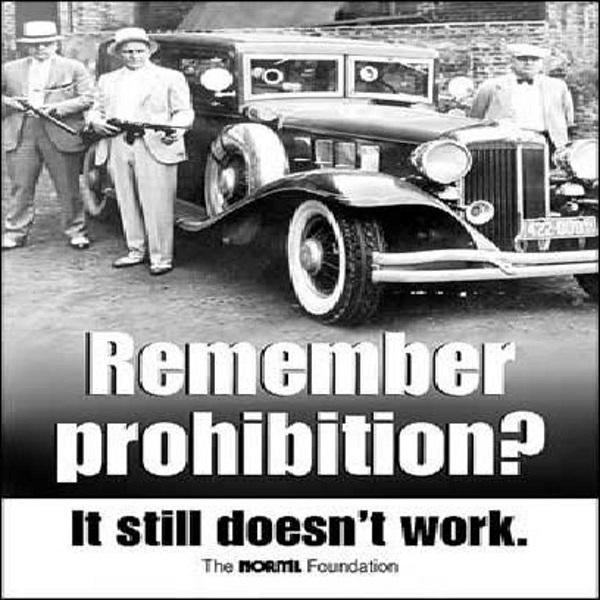
No intelligent person seriously believes that the law can override the people’s will to use cannabis. Exactly like alcohol prohibition, which failed to stop people from using alcohol, cannabis prohibition won’t stop people from using cannabis. Not only do people have a will to use it, but they feel that they have the right to do so. They’re going to keep using it forever.

If the objective was to protect people’s mental health, that too has failed. Not only is there no correlation between rates of cannabis use and prevalence of mental illness on the national level, but there is ample scientific evidence that cannabis does not cause psychosis or schizophrenia. The cannabis-psychosis link is best explained by the fact that cannabis is medicinal for many mentally ill people, and so they seek it out.

Instead of protecting people’s mental health, cannabis prohibition leads to the further social isolation of cannabis users by making them unwilling to speak candidly to mental health professionals, or to their friends or workmates. If cannabis is illegal, then confessing to using it is tantamount to confessing to criminal activity, so many mentally ill people who need help would rather just sit in silence.

If the objective was to protect children from psychoactive drugs while their brains are still developing, that too has failed. Because cannabis is on the black market, and therefore sold by criminals, there is nothing in the way of age checks between young people and the cannabis supply. Gang members will happily sell bags of cannabis to 12-year olds if they have the cash.

People often make the “think of the children!” argument when it comes to cannabis law reform, but the simple fact is that prohibition makes it easier for minors to get hold of cannabis. Proof for this is as simple as asking a minor if it’s easier to get hold of alcohol or cannabis. They’ll tell you that it’s harder to get hold of booze because those selling it are serious about keeping their liquor license.

If the objective was to instill respect for authority, that’s completely backfired. Cannabis prohibition is so stupid an idea that the people at large have lost respect for those pushing at and those enforcing it. Although the idea that one’s politicians are stupid and evil is far from new, these sentiments become problematic when they’re applied to other segments of society. Prohibition, however, makes this all but inevitable.

Many New Zealanders have now come to feel that the Police are their enemy, because Police officers have shown themselves willing to confiscate people’s medicine and to imprison them for using it. Far from being the trusted community servants that they are seen as in places like Holland, they’re seen as enemy soldiers waging an immoral war against an innocent people. To a great extent, this is the fault of cannabis prohibition.

All of these arguments (among others) are discussed at length in the various chapters of this book, but they all support the central thesis – that cannabis prohibition doesn’t work. It doesn’t achieve its stated aim of reducing the sum total of human suffering, and if it doesn’t achieve its stated aims, then it isn’t justified to continue with it any longer.

The men who pushed cannabis prohibition on a naive and unsuspecting public almost a century ago are now dead. Whether they knew they were speaking falsehoods or whether they were genuinely misled is no longer material. The right thing for us to do is to assess reality accurately, so that we can move forward in the correct direction.

If we look around the world honestly, it’s obvious that prohibition has failed. Not only is cannabis culture thriving, even in the most unlikely places, but support for cannabis law reform is rising almost universally, across all nations and demographics. The most striking sign is the ever-increasing number of states, territories or countries that have recently liberalised their cannabis laws.

The cynic might say that this is an example of the bandwagon fallacy, but that is not an accurate criticism. The reason why so many countries are changing their cannabis laws is because the evidence against cannabis prohibition has now mounted so high that it can no longer be ignored. There are now many countries liberalising their cannabis laws for the simple reason that the evidence suggests that it’s a better approach.

Cannabis prohibition simply doesn’t work. There is nowhere in the world that has prohibited cannabis and observed any result other than more poverty, distrust, misery and hatred. It’s fundamentally for this reason that the cannabis laws ought to be reformed.

*

This article is an excerpt from The Case For Cannabis Law Reform, compiled by Vince McLeod and due for release by VJM Publishing in the summer of 2018/19.