
Why The New Conservatives Could Get 5% In September

Following overseas trends, it’s apparent that an intense degree of discontentment exists among Western voters. There are protests all over the West – some violent, most confined to the ballot boxes for now. This article explores the possibility that discontentment in New Zealand could see the New Conservative Party get 5% of the vote in this year’s election.

It’s all but official that the neo-Nazi Sweden Democrats are the most popular party in Sweden now. Five opinion polls in a row, all from different polling companies, have established that the Sweden Democrats have more current support than any other party. A moving average of recent polls suggests that their support is at least 25%.

The Sweden Democrats might be the most aggressive of the European alt-right parties, having been founded by former Waffen-SS members. Although it’s not an official position, prominent elements within their membership speak of repatriating everyone of a non-Swedish background. They are taking full advantage of the fact that support for the Social Democrats is at its lowest ever level.

In France, opinion polls suggest that the National Rally’s Marine Le Pen, long decried as an extremist, is threatening to win the French Presidential election in 2022. She is polling equal to Emmanuel Macron on the first round, and is polling at 45% to his 55% on the second. This is well up from Le Pen’s 33% result in the second round of the previous Presidential election.

In Germany, the Alternative fuer Deutschland is polling at around 15%. In the Netherlands, Thierry Baudet’s Forum for Democracy is the second-strongest party right now, having briefly been the strongest earlier this year. In Italy, the nationalist Lega Nord is now dominant. In Spain, the right-wing populist bloc is now polling at 17%, up from 10% in the general election less than a year ago.

The mainstream New Zealand media will never report on any of this.

The reason for all this discontent is the increasingly apparent failure of the Establishment to manage the Western World in a way that reduces the suffering of the Western people. The ruling class of the West transparently stopped giving a fuck about their people’s suffering many years ago, and the ensuing resentment has become bitter.

The mass immigration to Europe of Muslims and Africans over recent decades has heavily lowered the standard of living of the average European citizen. On the flipside, however, it has generated immense profits for those who benefit from this suffering. Those with an interest in hiring cheap labour, selling accommodation to the highest bidder or profiting from ethnic strife and division have seen their stocks rise handsomely.

This oversupply of cheap labour has made it all but impossible for young, working-class people to get into a position where they own a home suitable to raise a family in. Young people in New Zealand have less than 40% of the house-buying power that their parents had, and it’s getting worse. Most aggravating of all, the Western Establishment has shown no interest in changing this state of affairs.

This refusal to change course, when the current course only benefits 5-10% of the population, is the ultimate reason for most of the current discontent in the Western World. We can conclude from the examples in Europe that any party taking a meaningful stand against the New Zealand Establishment has the potential to win up to 25% of the vote.

The New Conservatives are the most prominent of the parties on the right that oppose the Establishment. Therefore, they are the only party appealing to the Kiwi equivalents of the Sweden Democrats, National Rally, Liga Nord etc. voters. Their constituency is angry, white, rural and male – the same demographic that won the World Wars.

It’s obvious to most by now that there is no meaningful difference between National and Labour, both being business-as-usual neoliberals whose overriding concern is keeping the economy going at full tilt.

The big problem is that there’s no meaningful difference between these two parties and any of the Greens, ACT or New Zealand First. The Greens are even more globalist than Labour, and ACT are even more globalist than National. For anyone who opposes globalism the traditional choice has been New Zealand First, but their close co-operation with Labour and the Greens has now made clear to all that they are as globalist as the rest.

In the minds of most dissenters, this leaves few options. Leftist discontents have been fond of throwing a vote towards the Aotearoa Legalise Cannabis Party, and no doubt many who turn out for the cannabis referendum will do so again this year. Most of the discontent at the moment, however, is inspired by right-wing sentiments, and people motivated by this tend to despise cannabis users and consider them subhuman.

For the right-wing discontents, the realistic options are ACT and New Conservative.

As this column has previously argued, ACT could get 5% if they were willing to step into the alt-right niche, instead of merely following puppy-like behind the National Party. However, they are clearly not willing. ACT is perfectly comfortable being the party of big-money corporate neoliberals, because that ensures that they get plenty of funding. David Seymour flirts with anti-Establishment positions, but his heart isn’t in it.

For this reason, the New Conservatives are the only party that are primed to take advantage of the wave of discontent that is sweeping the West.

At the time of the most recent poll, the New Conservatives apparently had less than 1% support. However, that poll was almost two months ago. Since then, several things have happened, and all of them follow the general trend of stoking discontentment towards the Establishment. If they keep happening – if that great wave of populist discontent reaches New Zealand – the New Conservatives might rise all the way to 5% before September 19.

As Dan McGlashan showed in Understanding New Zealand, there is a very strong correlation between voting Conservative and voting National (0.77), and therefore a strong New Conservative vote is likely to significantly weaken the National vote. If it does, it will not shift the balance of power in 2020. In fact, it could even strengthen Labour’s position if the New Conservatives get less than 5%, thereby causing the votes of many people who would otherwise have voted National to be wasted.

The far-right populists have shown in Europe that, in times of high discontentment, it’s possible for them to attract voters from otherwise left-wing demographics. New Conservative will attract anti-Establishment voters from National, but they could also attract a significant number of voters from those who would otherwise have cast their lot in with Labour, New Zealand First or ACT. If they succeed at this, New Zealand could be in for an electoral surprise in September.

*

If you enjoyed reading this essay, you can get a compilation of the Best VJMP Essays and Articles of 2019 from Amazon for Kindle or Amazon for CreateSpace (for international readers), or TradeMe (for Kiwis). A compilation of the Best VJMP Essays and Articles of 2018 and the Best VJMP Essays and Articles of 2017 are also available.

*

If you would like to support our work in other ways, please consider subscribing to our SubscribeStar fund.


VJMP Reads: Religion, Property, Violence I

The next edition in the VJMP Reads column is Religion, Property, Violence: A Revolutionary Idea For Society by Horst Niclaus. This book was purchased cheaply from TradeMe. The back cover asks the question “Is the creation of God the reason why equality between human beings has not been achieved yet?”

After a short introduction, in which Niclaus recounts his early upbringing in wartime Germany, the first chapter begins. It is called ‘Does God exist?’

Niclaus mentions here that God was silent during the Holocaust and that “he” has no problems with things like the mass child rapes of the Catholic Church. It’s apparent that Niclaus is arguing against a conception of the Abrahamic God, in particular the Christian one. He lists a number of Biblical contradictions here.

In this chapter Niclaus cites Albert Einstein as saying that the Jewish religion is “an incarnation of the most childish superstition.” He then cites a list of arguments against the Abrahamic God and against religion in general, such as the fact that ignorance and fear underpins much religious belief. These arguments all proceed from a materialist perspective, and should be convincing to someone who has fallen at the second hurdle.

This list of arguments is duplicated from elsewhere, and any materialist ought to find them agreeable. One of the arguments copied here is Epicurus’s one, that makes that claim that if God has the power to end all suffering, but not the Will, then God must be malevolent.

The problem here is that Epicurus makes the assumption that the end of suffering is the highest value. The reality is that God encourages an unpredictable degree of suffering for the purposes of entertainment, on account of that infinite bliss is infinite boredom, and therefore more suffering than a the madcap mix of pleasure and pain that is life on Earth.

Many of the arguments listed here suffer from similar problems. They are attacking a Christian conception of God and therefore attack the characteristics that Christians claim that God has. These arguments do not address (e.g.) Luciferian or Hindu conceptions of divinity. As is true of many Western commentators, Niclaus appears to believe that disproving the Abrahamic conception of God is sufficient to prove the non-existence of God.

Most of the arguments in this chapter proceed on this basis, i.e. they are worthwhile criticisms towards Christianity or Abrahamism, but no more. The quoted section makes one cutting observation of missionaries in particular: while their work is risky, the rewards are to be worshipped by those who accept his guidance.

This chapter ends with the mention of some scientists who advanced the materialist world view, and then some letters to the Christchurch newspaper The Press arguing against Christianity.

*

If you enjoyed reading this essay, you can get a compilation of the Best VJMP Essays and Articles of 2019 from Amazon for Kindle or Amazon for CreateSpace (for international readers), or TradeMe (for Kiwis). A compilation of the Best VJMP Essays and Articles of 2018 and the Best VJMP Essays and Articles of 2017 are also available.

*

If you would like to support our work in other ways, please consider subscribing to our SubscribeStar fund.

The Gentlemen Shows That The Normalisation Of Cannabis Is All But Complete


Guy Ritchie’s latest crime caper film, The Gentlemen, is the rollicking, romping gorefest that one has come to expect from the director of Snatch. Behind the larger-than-life characters and the brilliant dialogue, however, are a few hints about where society is going, and a few things made to look normal that aren’t usually normalised. This article explains.

Cannabis users who stopped to think about it may have noticed a few things in The Gentlemen that are different to the usual messages contained within big-budget films. Normally alcohol, tobacco, adrenaline and oxytocin are all portrayed as acceptable forms of enjoyment, but cannabis is not. Cannabis tends to get lumped with opium and heroin as a drug of despair.

The hero of the story, Mickey Pearson, is a British cannabis tycoon. The character, played by Matthew McConaughey, is in charge of an empire that produces 50 tons of skunk every year. Yes, he has done some bad things on the way up through the underworld, but he’s very much a moral player, someone with far more class than the average criminal.

This weed-dealing protagonist is presented as the good guy, who the audience is invited to sympathise with. Not a good guy – because he’s certainly capable of violent crime still – but the good guy. This makes a change from the usual popular culture treatment of cannabis users. Aside from this central fact, several scenes in the film serve to normalise the idea of cannabis in the eyes of the audience.

In one scene, Mickey speaks to a Chinese gangster and heroin dealer named Lord George. Mickey makes the point that the drug he himself deals doesn’t kill anyone, unlike the heroin that George deals. It’s uncommon for a popular culture film to draw a distinction between cannabis dealers and “other” drug dealers. Usually the two are lumped in together, but here Lord George is presented as distinctly less moral than Mickey.

In another scene, Mickey’s henchman Ray (played by Charlie Hunnam) smokes a joint while expressing his disgust for heroin users. While rolling it up he expounds upon his weed preferences, including his belief that the right mixture of cannabis and tobacco is 50:50. In this scene, we are invited to sympathise with the cannabis-smoking Ray, whose classy demeanour presents him in sharp contrast to the heroin users around him.

In yet another scene, the major antagonist is trying to bargain Mickey down on the selling price of Mickey’s business. The antagonist makes the point that cannabis will become legal soon and therefore his enterprise would have to compete with the legal market, which inspires Mickey to demonstrate that his business has been future-proofed already.

The point that cannabis will become legal soon, and therefore that the relative values of positions in the cannabis market will change soon, is made with certainty. Guy Ritchie has his finger on the pulse well enough to know which way things are going, and it’s obvious from the international trends that moves towards cannabis liberalisation will soon occur everywhere. People have thought through most possibilities already.

This means that the plot of The Gentlemen is realistic enough to suspend disbelief and enjoy the story. It’s a great film – and for cannabis users eager to see an end to the prejudice against them, it’s great to see cannabis use normalised in popular culture.

*

If you enjoyed reading this essay, you can get a compilation of the Best VJMP Essays and Articles of 2019 from Amazon for Kindle or Amazon for CreateSpace (for international readers), or TradeMe (for Kiwis). A compilation of the Best VJMP Essays and Articles of 2018 and the Best VJMP Essays and Articles of 2017 are also available.

*

If you would like to support our work in other ways, please consider subscribing to our SubscribeStar fund.
Clown World Chronicles: What Is An ‘Incel’?

The history of Clown World has two major phases. The first is the decline into ever-increasing levels of depravity, something that we can call the Weimar Stage. The second is the self-immolation, involving ever-increasing levels of violence and brutality, something that we can call the Nazi stage. This essay discusses a phenomenon that can be found inbetween those two phases: the incel.

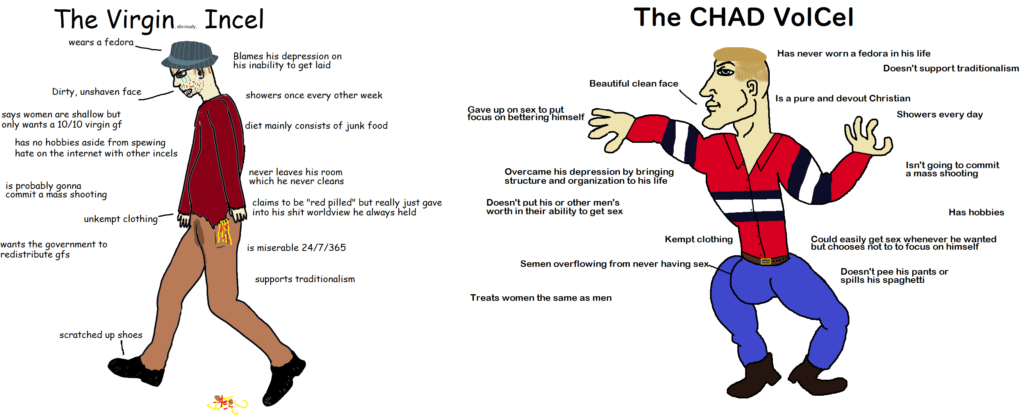
‘Incel’ stands for ‘involuntary celibate’. Here ‘celibate’ is used to mean someone who doesn’t have sex, and ‘involuntary’ means that they’d rather be having sex if they could. Of those who abstain from sex involuntarily, some are disfigured or infirm, but others are forced to abstain on account of that they aren’t physically or socially attractive enough to find sexual partners.

‘Incel’ stands in contrast both to a sexually active person and to those who have chosen to abstain from sexual activity. The latter are known as ‘volcels’, which stands for ‘voluntary celibate’. Volcels and incels occupy entirely separate worlds. Whereas the volcel is like a monk or shaman who has transcended the sexual impulse, the incel is like a horny dog who is dominated by it.

In practice, only men are referred to as incels. The reality is that almost every female can get laid if they want to, even if they’re unusually ugly. Some women may be celibate on account of that they’re unable to form an emotional connection with men, but even such women can still get laid if they can get their heads into it.

Internet dating apps have led to something called the “Incel Epidemic.” Because the human mating process is gynocentric – i.e. women hold the vast bulk of the decision-making power – the bottom 50% or so of men now have little chance of finding a satisfying sexual relationship. Women can simply choose that their Internet dating profile doesn’t get seen by (for example) men shorter than six feet tall – and they do.

This epidemic has been accelerated by the further breakdown of society. Ever more young men are autistic, and these men often have too much trouble interacting with women to ever get laid. Many of these young men have been rejected enough times that they have become bitter. Having become bitter they have turned away from women, and from the social occasions that offer chances to meet them.

The icing on the cake is the easy availability of competing pleasures. PornHub can deliver the most intense, hardcore and depraved pornography ever recorded in human history direct to the visual synapses of every 13-year old with an Internet connection. So if women seem like too much hassle, there are plenty of alternatives. Some will say that porn isn’t real, but the incel would retort that most of the dating scene isn’t real either.

All of these things have combined to make the proportion of young men not having sex higher than ever before. There have never been more incels in Western society. The danger with this is clear: not getting laid can lead to incel rage. Perhaps the most infamous example was that of Elliot Rodgers.

On May 23, 2014, Rogers went on a killing spree motivated by incel rage, claiming six lives and wounding 14 others. He left a manifesto detailing his motivation for the killings. In it the explained that he was angry at women for rejecting him, and jealous of sexually active men for sleeping with those same women. This deep-seated resentment exploded in violence, as it so often does.

Many people are concerned that, as the proportion of incels continues to increase, the risk of other young men doing an Elliot Rodgers increases. Many incels have yet to do so because they still believe that they can get laid. But as society disintegrates further, more and more of them will turn away from society in resentment. The incel epidemic promises to get worse and worse.

The nightmare scenario is that another Hitler rises up to channel the incel rage against their enemies. The original Nazi movement was partially motivated by the everyday man’s horror at how slutty and degenerate the everyday Fraulein had become under the Weimar Republic, and a future totalitarian movement could use incel rage to gain power. A new Hitler could blame Jewish media influence for why young men can’t get laid any more.

As this magazine has written about previously, the incel problem is older than the human species. As civilisation has developed, we have also developed a number of solutions to this problem, some more effective than others.

The Abrahamic solution to the incel problem, favoured by many men still today, is to make women into second-class citizens. In practice, the physical dominance of men will always make this option possible. This solution arranges things so that every man gets one woman, and if she doesn’t like it she gets beaten or raped into submission. It appeals naturally to those of a Semitic mindset, but does not appeal to those of an Indo-European one.

Another solution that people joke about, some more jokingly than others, is state-mandated girlfriends. This solution appeals to those men who work, but whose income is not sufficient to really impress women – in other words, whose income enough to raise a family on. It also appeals to the autistic segment of the male population that cannot into charming women.

Yet another solution is to allow rich men to marry multiple women. This solution has been used by many different cultures at different times, usually after a great war has caused a shortage of suitable men. It could be argued that the West is in the process of losing a great spiritual war, and therefore many men are already spiritually dead. It might be better, then, to allow spiritually extant men to marry multiple women.

The ultimate outcome of the incel epidemic is not clear. What is known, however, is that sexual frustration regularly manifests as violence in countless numbers of vertebrate species. There’s every chance that, as the incel epidemic increases in magnitude, the incidence of incel rage-based chimpouts increase in frequency. The energies involves may even contribute to a great collective chimpout.

*

This article is an excerpt from Clown World Chronicles, a book about the insanity of life in the post-Industrial West. This is being compiled by Vince McLeod for an expected release in the middle of 2020.