
Intergenerational Rape

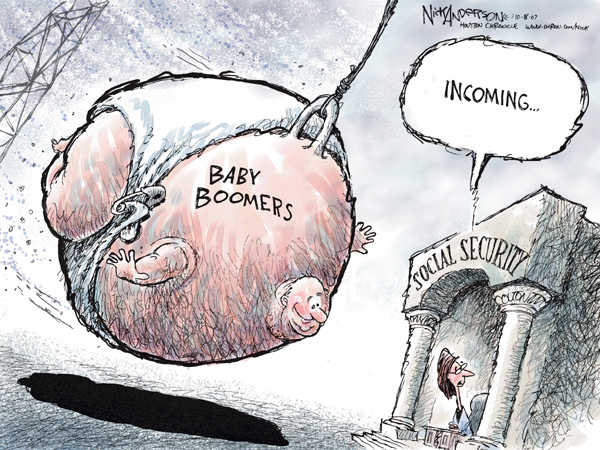
Young people today are starting to realise that the economic system isn’t what it’s claimed to be. Although Boomers keep saying that anyone who works hard will be compensated enough to own a home and raise a family in it, few young people still believe them. The truth, now widely understood, is that the entire system has been rigged to benefit the old at the expense of the young.

What the Boomers have done can rightly be termed intergenerational rape.

The “postwar generation” has taken advantage of their political power over the younger generations to subject those young people to a degrading level of servitude and hopelessness. Young people nowadays have found themselves effectively enslaved, working long hours and then having to fork out so much in profits, taxes and rents that they have little left for themselves.

The Boomers have tilted the scales so that every operation of the economic system favours them to the exclusion of everyone else. They are sucking the life energy out of the younger generations, and for no other reason than their own greed. Nowhere is this more evident than in the fact that the Millennial generation controls less than a quarter of the wealth that the Boomers controlled at the same age.

The intergenerational social contract, according to which the elderly sacrificed their wealth so that their offspring could be strong, has been annihilated by the Boomers. Instead of nurturing the following generations, the Boomers have plundered them. Boomers credit themselves for working hard and investing prudently, but the reality is that they have built their wealth on the impoverishment of those to follow.

They have done this by using their voting power to elect politicians who were willing to pass laws dispossessing the young. Everywhere that a balance needs to be struck – employer or employee, landlord or tenant, pension recipient or taxpayer, borrowing and spending now or saving for the future – the law favours the Boomers.

This intergenerational favouritism is stark if one considers house prices.

Boomers in 1992 were able to purchase the average New Zealand house for $105,000. As the average wage was above $14 per hour back then, it means that the average house cost about 7,000 hours of labour. It means that, if a person was able to save about a third of their income, they could buy a house after ten years of full-time work. Good times.

By today, when the Boomers own all the houses, the average house price has increased by seven times from 1992 levels, but the average wage only slightly more than twice. The average New Zealand house now costs more than $740,000, whereas the average wage is around $34 per hour. It means that the average house now costs 22,000 hours of labour. Hard times.

Intergenerational rape is when the Boomers charge 22,000 hours of labour for entry to a circle of wealth (homeownership) that they themselves were admitted to after only 7,000 hours of labour. Whereas the average Boomer was able to buy the average house after ten years of labour, young people are looking at thirty years of labour to get to that position.

All of this economic exploitation serves no other purpose than to keep Boomers in a luxurious state of retirement, with regular holidays, plentiful rich food and first-class medical care.

The Boomer generation has inherited an enviable level of wealth from their predecessors and then pulled up the ladder so that none of their descendants can share in it. The Boomers have behaved in this manner because they are the single most selfish and godless generation to have existed in human history. Never before has there been a generation of people willing to put their own whims and fancies above the physical needs of their own offspring.

Their actions could be compared to those of a meth addict who passes out on the couch while their children run around in the streets looking for food. It’s a degree of reckless neglectfulness that ought to be criminal.

The Boomers, however, will get what they deserve. They are mortal after all, and the eldest of them are already 75 years old. Within three decades, almost all of them will be gone. As this column has written previously, God will return to Earth when the Boomers finally die off. They represent peak godlessness, and their passing will result in a new spiritual age.

It is unlikely that intergenerational rape will end owing to any action taken by younger people. The generations following the Boomers are too divided, too demoralised and too apathetic to do anything about their situation. They will have to wait for the Boomers to die off – which means that the rape will continue for another 30 years yet.

*

If you enjoyed reading this article, you can get a compilation of the Best VJMP Essays and Articles of 2019 from Amazon for Kindle or Amazon for CreateSpace (for international readers), or TradeMe (for Kiwis). A compilation of the Best VJMP Essays and Articles of 2018 and the Best VJMP Essays and Articles of 2017 are also available.

*

If you would like to support our work in other ways, please consider subscribing to our SubscribeStar fund. Even better, buy any one of our books!

Understanding New Zealand 3: Voting Sustainable NZ in 2020

Vernon Tava’s Sustainable NZ party made a transparent attempt to target the center of the political spectrum. The logic was that they would be an environmentalist movement that wasn’t tarnished by the social justice obsession of the Greens. In the end, they received 1,880 votes, which amounted to less than 0.1% of the total.

VariableVoting Sustainable NZ in 2020
Voting ACT in 20200.54
Voting National in 20200.50
Voting Greens in 20200.26
Voting New Conservative in 20200.37
Voting The Opportunities Party in 20200.32
Voting Labour in 20200.02
Voting Aotearoa Legalise Cannabis Party in 2020-0.41
Voting Maori Party in 2020-0.46

Sustainable NZ may not have won many votes, but they succeeded in positioning themselves somewhere between the National Party and the Green Party. The correlation between voting Sustainable NZ in 2020 and voting National in 2020 was 0.50, and with voting Greens in 2020 it was 0.26. Both are significantly positive.

The correlation between voting Sustainable NZ in 2020 and voting Labour in 2020 was not significant, at 0.02. This suggests that Sustainable NZ was successful in avoiding the label of ‘left-wing’. In fact, there was even a correlation of 0.37 between voting Sustainable NZ in 2020 and voting New Conservative in 2020.

The strongest negative correlations with voting Sustainable NZ in 2020 were with voting for the parties representing disadvantaged demographics, such as the ALCP (-0.41) and the Maori Party (-0.46).

VariableVoting Sustainable NZ in 2020
< $5,000-0.17
$5,000-$10,000-0.11
$10,000-$20,000-0.37
$20,000-$30,000-0.18
$30,000-$50,000-0.32
$50,000-$70,0000.23
$70,000+0.44

The general rule is: the wealthier the voter, the more likely they were to vote Sustainable NZ in 2020. The reason for this, as it is for the Greens and The Opportunities Party, is that environmental issues are high up Maslow’s Hierarchy of Needs, and people suffering from housing or income insecurity will vote on the basis of that instead.

The strongest support of any income bracket for Sustainable NZ came from the $70,000+ bracket. The correlation between voting for Sustainable NZ in 2020 and having a personal income of over $70,000 was 0.44. This is a curious result, given that votes for alternative parties are normally cast by disenfranchised people, and disenfranchised people normally vote for left-wing parties. This paradox may explain why Sustainable NZ got so few votes.

The financially disenfranchised avoided voting for Sustainable NZ. The correlation between having an income between $10,000 and $20,000 and voting Sustainable NZ in 2020 was -0.37.

VariableVoting Sustainable NZ in 2020
No qualifications-0.46
Level 1 certificate-0.22
Level 2 certificate-0.31
Level 3 certificate-0.24
Level 4 certifiate-0.30
Level 5 diploma-0.20
Level 6 diploma0.55
Bachelor’s degree0.36
Honours degree0.40
Master’s degree0.34
Doctorate0.34

As with the Greens, ACT and The Opportunities Party, highly educated voters were more likely to vote Sustainable NZ than poorly educated ones. There was a significant positive correlation between voting Sustainable NZ in 2020 and having any of the university degrees. On the other hand, there was a correlation of -0.46 between voting Sustainable NZ in 2020 and having no academic qualifications.

Unlike the Greens, the correlation between voting Sustainable NZ in 2020 and having a highest educational qualification of a level 3 certificate was significantly negative. This reflects the fact that the Greens have broad appeal among university students, a niche that Sustainable NZ were unable to gain entry to.

From these three sets of correlations, we can see that Sustainable NZ voters were considerably more privileged than the average voter.

VariableVoting Sustainable NZ in 2020
No children0.19
One child-0.02
Two children0.39
Three children-0.05
Four children-0.46
Five children-0.62
Six children-0.64

Sustainable NZ voters walked the talk when it comes to the sustainability of their breeding. The strongest correlation between voting for Sustainable NZ in 2020 and having any number of children was two (0.39). There was also a positive correlation of 0.19 between voting for Sustainable NZ in 2020 and having no children.

On the other hand, there were significant negative correlations between voting Sustainable NZ in 2020 and having four, five or six children. All three of these correlations were at least as negative as -0.46. Sustainable NZ voters are clearly aware that having more than two children is unsustainable.

VariableVoting Sustainable NZ in 2020
Working as a manager0.45
Working as a professional0.31
Working as a machinery operator or driver-0.52
Working as a labourer-0.45

A curious outcome of the election is that there was a significant positive correlation between voting Sustainable NZ in 2020 and both working as a manager and working as a professional. Working as a manager and working as a professional are the archetypal occupations of National and the Greens, respectively.

The working-class occupations, by contrast, were relatively less likely to vote Sustainable NZ in 2020. As mentioned above, people who are worried about housing affordability generally consider environmentalism to be a luxury concern.

In summary, Vernon Tava and his Sustainable NZ movement were successful in positioning themselves in the “blue-green” space that appeals to educated, long-sighted people, whether managers or professionals. The problem is that they failed in the much more important objective of obtaining enough votes to threaten the 5% threshold.

*

This article is an excerpt from the upcoming 3rd Edition of Understanding New Zealand, by Dan McGlashan and published by VJM Publishing. Understanding New Zealand is the comprehensive guide to the demographics and voting patterns of the New Zealand people.

*

If you enjoyed reading this essay/article, you can get a compilation of the Best VJMP Essays and Articles of 2019 from Amazon for Kindle or Amazon for CreateSpace (for international readers), or TradeMe (for Kiwis). A compilation of the Best VJMP Essays and Articles of 2018 and the Best VJMP Essays and Articles of 2017 are also available.

*

If you would like to support our work in other ways, please consider subscribing to our SubscribeStar fund. Even better, buy any one of our books!
Starving The Three Lions

People today work as hard as their parents did, but they have much less wealth. The reason for their relative poverty is that three mighty lions take a share of every worker’s production before it gets to their bank account. These three lions have always existed, but today they are much more ravenous than ever before.

The first lion is profits.

Ultimately, it doesn’t matter how productive the average worker is, because their employer takes all their production off them and gives only a fraction back, in the form of wages. This is inescapable given that the employer owns the workplace and everything that gets produced in it, and given that the Police will always take their side (at least initially) in any property or rights dispute.

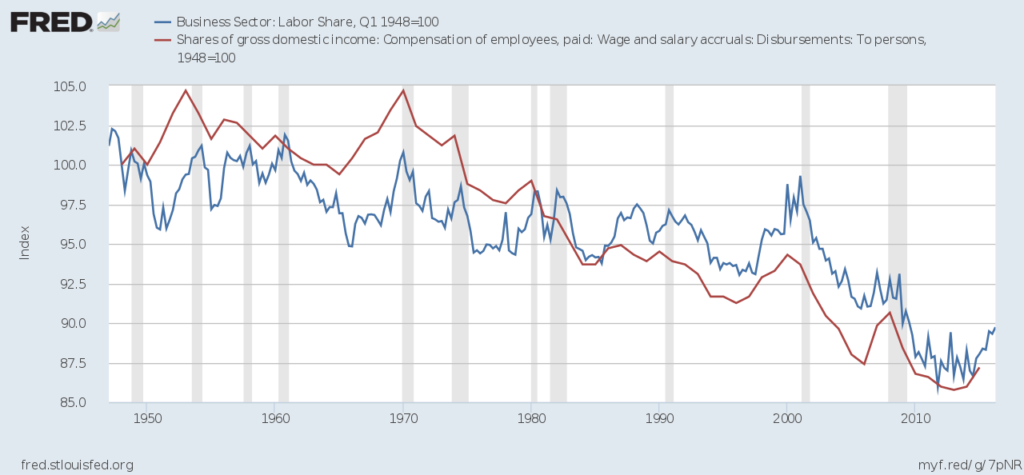
In America, the labour share (or wage share) has been declining for several decades. Compared to the early 1970s, the labour share has declined some 10%. An OECD report suggests that a similar decline, of about 10%, has been seen in the labour share across a basket of Western countries. Employers take more, and give back less, than ever before.

To put this into perspective, the average American worker produces some USD72 of goods and services per hour of labour. A fall in labour share, from 65% to 55%, represents a $7.20 difference by the time it gets to the worker – and that’s before the other two lions take their share!

The second lion is taxes.

The average tax burden in Anglo countries is about 30%. This is lower than the average of other Western nations, and reflects that Anglo countries are run in accordance with a small-government ideology. However, it’s still a significant amount of the average worker’s productivity. After losing 45% of their productivity to profits, to lose a further 30% to taxes is brutal.

It means that our average worker, having produced $72 of goods and services before the lions took their share, is now down to about $27 after profits and taxes have been accounted for. The tax burdens of Taiwan, Hong Kong and Singapore, by contrast, are all less than 15%, despite that their wages and standards of living are similar to those of Anglo countries.

And there’s still the third lion to contend with – perhaps the hungriest of all. This third lion is rents.

The median monthly gross residential rent in the United States is now around $1,100 per month. Median rents in New Zealand are around the same level. Assuming that our average worker works 150 hours a month, dividing their rent by the number of hours worked gives us around $7 an hour. In other words, seven dollars of the income earned for every hour of labour the average worker performs goes to pay the rent.

Subtracting this from the $27 after profits and taxes means that the average American worker ends up with $20 out of every $72 they produce, once profits, taxes and rents have been taken out. If the labour share was still 65%, if the tax rate was 15% like in Far East Asia and if the average rents were at pre-Clown World levels (let’s say $600 per month), the average worker would be left with around $36 for every hour worked – almost twice as much as in reality.

Moreover, out of the $20 per hour the average worker gets in reality, they have to pay for a number of work-related expenses out of that. Transport to and from their job, work clothing, health insurance (if American) and the cost of any psychiatric medicine they might need would account for another $10 at least. They also need to save some of their wage for a house deposit if they aspire to ever be more than a rentcuck.

All of these facts tell us that, if the average Anglo worker in 2021 had the benefit of a pre-1970s labour share, Far East Asian tax levels and pre-Global Financial Crisis rent levels, they would have about three times as much disposable income as they actually do have in reality. Once the three lions have taken their share, there isn’t much left over for the average worker.

In summary, the three lions that take a share out of every worker’s wage, before the worker sees it, are profits, taxes and rents. If we could reduce these expenses to levels that exist elsewhere in space and time, we could triple the prosperity of the average worker.

*

If you enjoyed reading this essay/article, you can get a compilation of the Best VJMP Essays and Articles of 2019 from Amazon for Kindle or Amazon for CreateSpace (for international readers), or TradeMe (for Kiwis). A compilation of the Best VJMP Essays and Articles of 2018 and the Best VJMP Essays and Articles of 2017 are also available.

*

If you would like to support our work in other ways, please consider subscribing to our SubscribeStar fund. Even better, buy any one of our books!
Why They Will Never Solve The Homelessness Crisis

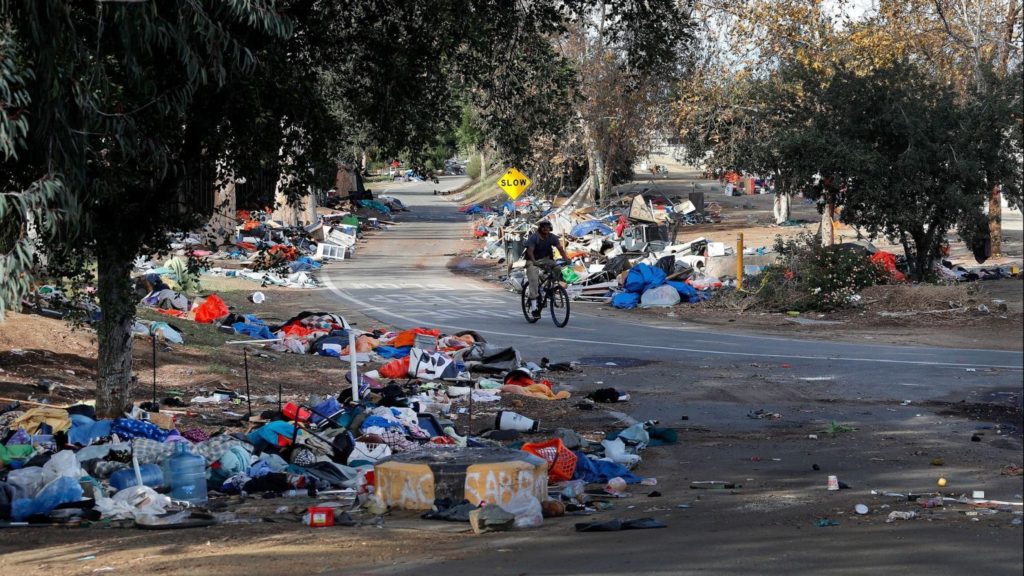
Increasing levels of homelessness have been observed all over the Western World. The waiting list of families in severe need of housing in New Zealand has increased sevenfold since 2016, and has nearly quadrupled since the Sixth Labour Government came to power in late 2017. A similar situation exists in America, where “tent cities” of homeless people now surround major metropolitan areas.

A great deal of thought has gone into solving this crisis – or so we’re told. Apparently it’s an issue of great concern to the leaders of the West, who are doing everything they can to get their young people into houses. The reality is that they don’t care about homelessness at all – in fact, they want more of it. Homelessness serves a very important social role.

Like much of human behaviour, whether or not the lower classes rebel is a function of two factors: reward and risk.

The greater the reward for rebelling, the greater the likelihood it will happen. The more oppressed a people are, the greater the reward for rebelling. Anyone who has to endure daily humiliations, especially those of a physical kind, will soon come to feel that it’s worth rolling the dice.

The greater the risk for rebelling, the less the likelihood it will happen. This is why ancient kings used to put every male in rebellious villages to the sword. Others had to learn that the consequences of rebellion were either self-determination or death.

The ruling classes have always had to keep this reward-to-risk balance titled towards not rebelling. A failure to do so could mean that those ruling classes were violently deposed.

Ever since the advent of agriculture, the ruling classes have been preoccupied with one question: how to get people to work. Tilling fields is much less interesting than hunting. Left to their own devices, people would rather hunt and fish, and then lie around the rest of the time, than till fields and accumulate a surplus of grain.

Using violence to force people to work led to rebellion. So the ruling classes had to be subtle about tinkering with the reward-to-risk ratio.

One approach was to increase the reward for working. This was originally how early societies came to have a schedule of festivals, such as harvest festivals in Autumn, fertility festivals in Spring, and festivals for Midsummer and Midwinter. The idea was that people would more readily work a week of tilling fields if they had a festival to look forward to.

The other approach was to increase the risk of not working. As mentioned above, the ruling class couldn’t simply whip people, because they would rebel. The punishment for not working had to be more subtle. The usual solution was ostracisation. Anyone considered to not be working hard enough was deemed a ‘bludger’ or ‘malingerer’ and abused psychologically, instead of physically.

In contrast to physical abuse, psychological abuse can be dished out with very little chance of retaliation. So the ruling classes of today seek to maximise the amount of psychological abuse they inflict upon the lower classes, and that means spreading fear. The ruling class, in the final analysis, are little different to terrorists, and to that end they deliberately cultivate visible homelessness.

Most homelessness has been purposefully created by the ruling class, because they need to have people visibly suffering in public in order to scare the rest of the population into submission. In the terms used above, homelessness has been purposefully cultivated by the ruling class in order to increase the risk of not working.

The presence of homelessness means that the working classes put their heads down and obey orders without complaint, for fear of being made homeless themselves.

Many people have wondered about the logic of doubling the refugee quota, as Labour did in 2017. It seemed especially mysterious, as we were already in the grip of a housing crisis at the time, and each refugee family we housed meant one Kiwi family had to go without.

But that was the precise outcome intended.

The reason why they let the refugees in, and give them housing, while leaving Kiwis to suffer homeless, is because they want Kiwis to suffer. They want the average New Zealander to see his fellows suffering and homeless every day, because this will keep the average New Zealander compliant.

This strategy, which could be summarised as “A boot stamping on a human face, forever,” has reached its apogee in today’s America, where major Californian cities are now surrounded by miles and miles of tents. Los Angeles is believed to contain 60,000 homeless, many of who live in tents in the downtown commercial area.

This need to threaten people into submission is why they will never solve the homelessness crisis.

Much like cannabis prohibition, homelessness serves the purpose of signalling the government’s cruelty, and thereby works to bring the lower classes into a state of compliance. The homeless have to be there, so that the average citizen can be reminded of the consequences of resisting the government’s will. The more tyrannical the government becomes, the more homeless there will be.

The presence of homeless people, then, could be considered a sign of tyranny. Therefore, the homelessness problem won’t be solved until the tyranny one is.

*

If you enjoyed reading this essay/article, you can get a compilation of the Best VJMP Essays and Articles of 2019 from Amazon for Kindle or Amazon for CreateSpace (for international readers), or TradeMe (for Kiwis). A compilation of the Best VJMP Essays and Articles of 2018 and the Best VJMP Essays and Articles of 2017 are also available.

*

If you would like to support our work in other ways, please consider subscribing to our SubscribeStar fund. Even better, buy any one of our books!