
Understanding New Zealand 3: Demographics and Voting Patterns of Euthanasia Referendum Voters

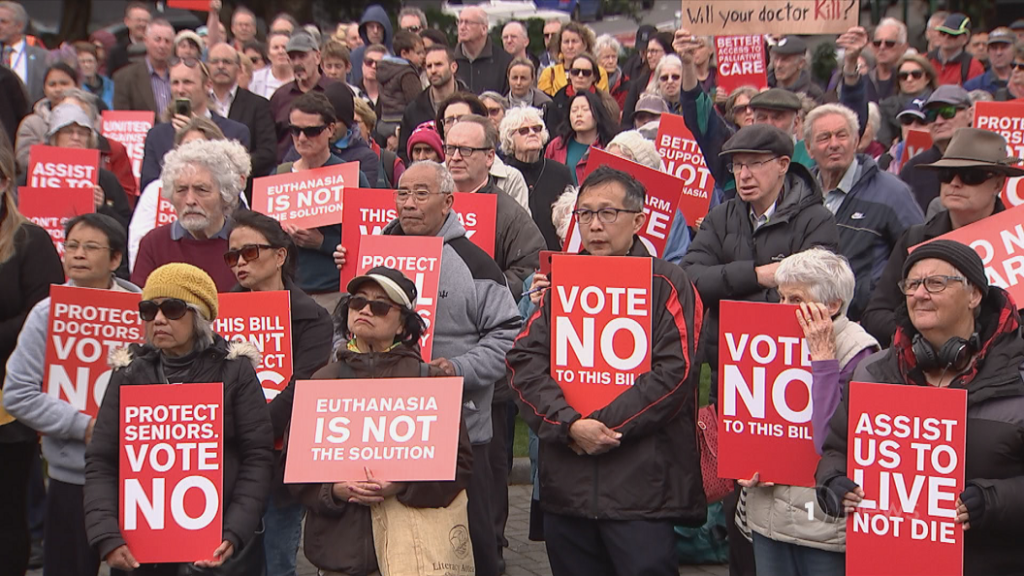
The euthanasia referendum took place at the same time as the cannabis referendum. It attracted much less attention than the cannabis one, probably because a vote in favour of reform appeared to be inevitable from the beginning. In the end, 1,893,290 people voted in favour of euthanasia, with only 979,079 against, meaning that 65.1% were in favour of reform.

Although the euthanasia issue is usually presented as one of religious morality, it’s much more complicated than that.

As with the cannabis referendum, the normal ballots for both General Electorates and Maori Electorates were placed in the same box, making it impossible to draw meaningful statistical inferences about voting patterns. This chapter, therefore, focuses on special votes only.

VariableSpecial voting Yes for euthanasia
No religion0.27
Buddhism0.36
Christianity-0.39
Hinduism0.16
Islam0.09
Judaism0.62
Maori religions-0.31
Spiritualism and New Age0.14

It’s true that, as with cannabis law reform, the main opponents to euthanasia were Christians. Perhaps surprising to most, however, sentiments were not particularly strong about the topic in either direction. Although the correlation between being Christian and special voting Yes in the euthanasia referendum was significantly negative, at -0.39, this was weaker than the correlation between being Christian and special voting Yes in the cannabis referendum (-0.48).

Spiritualists and New Agers, Buddhists, Hindus, Jews and the non-religious were the most likely to special vote Yes in the euthanasia referendum. These groups don’t tend to have superstitious beliefs about keeping people alive even when terminally suffering, which is primarily a Christian belief, itself a consequence of the Christian non-belief in reincarnation.

Also surprising is that the correlation between special voting Yes in the euthanasia referendum and having no religion was only 0.27. This was significant, but only barely so.

The fact that it was significant reveals the extent to which materialists in general support legal access to euthanasia. The fact that it was only barely so reveals the extent to which superstitions around death are universal in nature and not restricted to the followers of any particular religious tradition.

VariableSpecial voting Yes for euthanasia
No qualifications-0.73
Level 1 certificate-0.59
Level 2 certificate-0.57
Level 3 certificate0.07
Level 4 certificate-0.60
Level 5 diploma-0.54
Level 6 diploma0.23
Bachelor’s degree0.69
Honours degree0.75
Master’s degree0.75
Doctorate0.61

Underlining the degree to which fear of euthanasia is mostly an irrational one, but not necessarily religious in origin, are the correlations between educational attainment and special voting Yes in the euthanasia referendum.

The correlation of -0.73 between having no NZQA qualifications and special voting Yes in the euthanasia referendum was much stronger than any correlation between religious belief and special voting Yes, whether negative or positive. This correlation cannot entirely be explained by appealing to the fact that older people, who tend to be more conservative on such issues, tend to also be less well educated (see below).

Likewise, the correlations between having a Master’s degree or an honours degree and special voting Yes in the euthanasia referendum were both 0.75. This is probably because educated people have thought about the issue more, and are more likely to conclude that death is nothing to fear, and that forcing the terminally ill to stay alive is immoral.

Historically, the strongest pro-euthanasia support has come from those educated into a scientific materialist framework. This is probably because such people have the least superstitious worry about going to Hell if they end their own lives.

VariableSpecial voting Yes for euthanasia
Working in agriculture, forestry or fishing-0.37
Working in mining-0.17
Working in manufacturing-0.66
Working in electricity, gas, water or wastewater-0.24
Working in construction-0.21
Working in wholesale trade0.00
Working in retail trade-0.25
Working in accommodation or food services0.31
Working in transport, postal or warehousing-0.42
Working in information media or telecommunications0.62
Working in financial or insurance services0.56
Working in rental, hiring or real estate services0.49
Working in professional, scientific or technical services0.74
Working in administrative or support services-0.01
Working in public administration or safety0.20
Working in education or training0.09
Working in healthcare or social assistance-0.18
Working in arts and recreation services0.54

There are strong correlations between the average education level of an occupation and that occupation’s willingness to special vote Yes in the euthanasia referendum.

The strongest positive correlations between working in a particular occupation and special voting Yes in the euthanasia referendum were for the typically highly-educated professions such as professional, scientific or technical services (0.74), information media and telecommunications (0.62) or financial and insurance services (0.56).

The typically poorly-educated professions were much less likely to support euthanasia. The correlation between voting Yes in the euthanasia referendum and working in manufacturing was -0.66; with working in transport, postal or warehousing it was -0.42; with working in agriculture, forestry or fishing it was -0.37.

It might seem strange that education level was a much stronger predictor of opposition to euthanasia than religion. After all, the ban on euthanasia was initially motivated by religious sentiments. It appears that superstition is highly prevalent among the poorly-educated in New Zealand, even more so than among the religious.

VariableSpecial voting Yes for euthanasia
Working as manager0.28
Working as professional0.70
Working as a technician or trades worker-0.44
Working as community or personal services worker-0.24
Working as clerical or administrative worker0.11
Working as sales worker-0.00
Working as machinery operator or driver-0.62
Working as labourer-0.64

As with industries, professions were much more likely to support euthanasia if they were educated.

The best-educated profession is working as a professional, and the correlation between special voting Yes for euthanasia and working as a professional was a very strong 0.70. Working as a manager was also significantly correlated with special voting Yes for euthanasia, although the correlation was much weaker, at 0.28.

The least-educated professions had the strongest negative correlations with special voting Yes for euthanasia. These were working as a machinery operator or driver (-0.62) and being a labourer (-0.64). To some extent these correlations can also be explained by the fact that many machinery operators, drivers and labourers are Maori or Pacific Islander, who tended to oppose euthanasia.

VariableSpecial voting Yes for euthanasia
Age 20-240.43
Age 25-290.50
Age 30-340.44
Age 35-390.31
Age 40-440.23
Age 45-490.21
Age 50-540.07
Age 55-59-0.10
Age 60-64-0.15
Age 65-69-0.13
Age 70-74-0.12
Age 75-79-0.15
Age 80-84-0.18
Age 85+-0.08

Young people are, of course, more removed from death than older people. This could perhaps lead to them being more blase about the subject, explaining their support for euthanasia. Old people are significantly more Christian than young people, but did not vote against euthanasia in significant numbers. The truth is that euthanasia has reasonably broad support across all age groups.

All of the age groups from 45-49 years old and above had no significant correlation with special voting Yes in the euthanasia referendum. This result will surprise the many who would have expected significant negative correlations. Old Christians seem to be much less against euthanasia than they were against cannabis – perhaps because euthanasia prohibition threatens to cause suffering to them, whereas cannabis prohibition mostly causes suffering to others.

VariableSpecial voting Yes for euthanasia
No children0.66
One child0.00
Two children-0.12
Three children-0.49
Four children-0.67
Five children-0.65
Six or more children-0.55

One of the strongest correlations was between special voting Yes in the euthanasia referendum and having no children – this was 0.66. This can mostly be explained by the existence of a strong correlation between special voting Yes in the euthanasia referendum and having no NZQA qualifications.

There was a correlation of -0.67 between having four children and special voting Yes in the euthanasia referendum. This might best be explained by reference to the fact that those with four children tend to be less well educated than the average, and the less well educated tend to oppose euthanasia.

An alternative explanation is that those with the strongest pro-life sentiments will both have many children and oppose euthanasia. These sentiments, contrary to popular belief, are far from necessarily Christian. Some will be, but most not.

VariableSpecial voting Yes for euthanasia
Yearly income < $5,0000.03
Yearly income $5,000-$10,0000.14
Yearly income $10,000-$20,000-0.54
Yearly income $20,000-$30,000-0.53
Yearly income $30,000-$50,000-0.60
Yearly income $50,000-$70,0000.12
Yearly income $70,000+0.69

This set of correlations is unusual. They start relatively neutral, then become significantly negative as people become wealthier, and then become significantly positive as people become still wealthier. This is different to the usual linear pattern seen in correlations between e.g. education and income.

Probably this pattern can best be explained by appeal to the fact that the wealthiest segment of the population is also the most highly-educated, whereas the middle-wealthiest segment is the poorest educated, and the poorest segment of the population, because it is mostly comprised of students, pensioners and young workers, is a blend of both.

Therefore, the wealthiest and most highly-educated Kiwis special voted Yes for euthanasia, the middle-wealthy and most poorly-educated Kiwis voted against it, and the poorest and middle-educated Kiwis were inbetween the two.

VariableSpecial voting Yes for euthanasia
Born in New Zealand-0.40

A very curious result is that those born in NZ were significantly less likely to vote for euthanasia. Being NZ-born made a person even more likely to vote against euthanasia than being a Christian did.

This is primarily a function of the fact that NZ-born voters are significantly less educated than foreign-born ones, and poorly-educated people voted heavily against euthanasia. The sort of person who immigrates to a foreign country tends to be the sort of person who is not superstitious.

VariableSpecial voting Yes for euthanasia
NZ European0.13
Maori-0.32
Pacific Islander-0.22
Asian0.28

There were no strong correlations between belonging to a particular race and voting a particular way in the euthanasia referendum. There was a significant negative correlation between being Maori and special voting Yes in the euthanasia referendum, and there was a significant positive correlation between being Asian and special voting Yes. However, neither was particularly strong.

Perhaps the most curious outcome here is the fact that Asians were the race most likely to vote in favour of euthanasia law reform, at the same time as being the race least likely to vote in favour of cannabis law reform. This is especially noteworthy given the strength of the correlation between special voting Yes for euthanasia and special voting Yes for cannabis (see below).

Also noteworthy is the fact that Maoris and Pacific Islanders voted similarly on euthanasia, when their votes were very different on cannabis. Just because pan-Pacific opposition to some reforms (like euthanasia) might exist, doesn’t mean that it exists with regard to other reforms (like cannabis).

VariableSpecial voting Yes for euthanasia
Special vote Yes for cannabis0.74

One of the strongest correlations of all was between special voting Yes in the euthanasia referendum and special voting Yes in the cannabis referendum. This is because Yes voters in both instances tended to be young and well-educated. Most people in this category felt that both euthanasia prohibition and cannabis prohibition were antiquated laws that reflected the morality of a bygone age.

The major difference between the two is that those special voting Yes in the euthanasia referendum tended to be foreign-born, whereas those special voting Yes in the cannabis referendum were more likely to be New Zealand-born.

VariableSpecial vote Yes for euthanasia
Voting Labour 2020-0.09
Voting National 20200.17
Voting Greens 20200.70
Voting ACT 20200.17
Voting New Zealand First 2020-0.28
Voting Maori Party 2020-0.21
Voting New Conservative 2020-0.21
Voting The Opportunities Party 20200.60
Voting Advance NZ 2020-0.31
Voting Sustainable NZ 20200.47
Voting ALCP 2020-0.31
Voting TEA Party 20200.13
Voting Heartland NZ 2020-0.02
Voting Social Credit 2020-0.21
Voting NZ Outdoors Party 2020-0.16
Voting ONE Party 2020-0.30
Voting Vision NZ Party 2020-0.23

The party correlations provide more evidence for the trends already outlined.

The parties with well-educated voters tended to support euthanasia. The correlation between special voting Yes in the euthanasia referendum and voting Greens was 0.70; with voting The Opportunities Party it was 0.60; with voting Sustainable NZ it was 0.47. All of these parties make a point of basing their opinions on evidence, and therefore they reject the “if you kill yourself you go to Hell” narrative.

Advance NZ and ALCP had two of the most poorly-educated voting blocs, and those blocs were also the least likely to support euthanasia. The correlation between special voting Yes for euthanasia and voting for either party in 2020 was significantly negative, at -0.31. There was also negative correlations between special voting Yes for euthanasia and voting ONE Party, Vision NZ, Maori Party or New Conservatives.

Considering that ACT voters tend to be highly educated, and that many of them are Chinese (who tend to support euthanasia), it might seem surprising that the correlation between voting ACT in 2020 and special voting Yes for euthanasia was only 0.17. This can be explained by the fact that ACT voters in 2020 were much older than they usually are, and old people tended to oppose euthanasia.

VariableSpecial vote Yes for euthanasia
Median income0.55
Mean income0.65

There were strong correlations between personal wealth and support for euthanasia. The correlation between special voting Yes for euthanasia and median income was 0.55, and with mean income it was 0.65. These two correlations lay bare the extent to which the people near the top of society supported euthanasia reform.

It’s not likely that wealth, by itself, makes a person more likely to support euthanasia. More likely it’s education that does so, and since wealth is highly correlated with education it’s also correlated with support for euthanasia.

In summary, those who cast a special vote for Yes in the euthanasia referendum were primarily well-educated. They varied greatly in race, income, religion and age, but the strongest correlations with special voting Yes for euthanasia were with educational levels.

Euthanasia, unlike cannabis, was an issue on which the ruling class were mostly agreed. This is, at least partly, because the ruling class is almost entirely materialist. This materialism apparently makes it easier to see the benefit in “death with dignity” measures such as euthanasia, but does not make it easier to see the benefit in legalising spiritual sacraments such as cannabis.

*

This article is an excerpt from the upcoming 3rd Edition of Understanding New Zealand, by Dan McGlashan and published by VJM Publishing. Understanding New Zealand is the comprehensive guide to the demographics and voting patterns of the New Zealand people.

*

If you enjoyed reading this essay/article, you can get a compilation of the Best VJMP Essays and Articles from 2021 from Amazon for Kindle or Amazon for CreateSpace (for international readers), or TradeMe (for Kiwis). A compilation of the Best VJMP Essays and Articles of 2019, the Best VJMP Essays and Articles of 2018 and the Best VJMP Essays and Articles of 2017 are also available.

*

If you would like to support our work in other ways, subscribe to our SubscribeStar fund, or make a donation to our Paypal! Even better, buy any one of our books!

The Problem Of Sub-Global Identities

The grand political battlefield of the 21st Century so far is identity. Who am I? Who are we? Such questions used to have obvious answers, but 60-70 years after the first waves of cheap labour imports swept into Western countries, it’s no longer clear. The greatest difficulty comes from the fact that confusion around these issues is deliberately generated by nefarious actors.

Answering the question of Who am I? or Who are we? is hard enough when it’s being asked without interference. The world is a marvellously complex kaleidoscope of human expressions at the simplest of times. But when globalists deliberately muddy the waters in order to promote their own interests, it starts to get tricky.

Globalists have always known one thing: in order to maximise globalist consciousness, all identities relating to groups smaller than the globe have to be destroyed. This is true for every level of organisation from the race down through the nation to the community and the family. These sub-global identities, as competitors to globalist identity, have to be smashed.

When you’re trying to create a One World Government, you need people loyal to the concept of globalism above all else. These people need to be conditioned to think of themselves as humanity first and foremost. They must not be allowed to think of themselves as anything sub-global. All sub-global identities weaken loyalty to the One World Government.

The simplest way to ensure this loyalty is to condition them, through indoctrination at school and propaganda through the television, that all sub-global identities are for low-status people. This is done eagerly by the Marxists in the teachers’ corps, who tell their pupils that nationalism caused the world wars and that racism is the single biggest issue facing the West.

Hollywood assists with a parade of caricatures: moronic rednecks, vampiric Nazis, small-town lowlives, bickering married couples. Each one helps create the impression that only through hate could a person have a sub-global identity, and that those with globalist consciousness always win in the end.

It isn’t just communists on the authoritarian left who wish to destroy all sub-global identities.

Capitalists also seek such destruction, and also encourage globalist consciousness. This they do not for ideological reasons (as the communists), but out of a drive to maximise profit potential – it’s well known that anyone who derives joy and meaning from their family or nation will consume less than an atomised individual.

The common refrain from the corporate media is that families just make your life worse. Extended families, like races and nations, are for rednecks only. The compleat 21st Century person lives as an individual, only to consume. Identity comes not from family, nation or race, but from consumption choice. Thus, it’s not anything important, just a mask that one can put on and take off as needed.

Nations make your life worse as well – they just drag you into wars. Corporate media denies that nations offer individuals a sense of belonging, meaning, culture, history and structure. The impression we’re given is that nations are merely a vehicle by which the ruling class can call you up to die in some overseas adventure. In other words, national ties are burdensome and should be discarded.

Aside from destroying sub-global consciousness, the world’s ruling class also promotes global consciousness.

Brand consciousness is one of the most obvious ways they do this. The forced “Holden vs. Ford” meme is a favourite corporate trick to raise brand awareness and, by necessity therefore, to lower racial, national or familial awareness. Coke vs. Pepsi, Sega vs. Nintendo, McDonald’s vs. KFC are all presented to us as globalist alternatives to sub-global identities.

Franchise sport is one of the subtler ways they do this. Instead of supporting representative teams, which represent real-world phenomena such as provinces and nations, people are induced to support franchise clubs which have no connection to the locale in which they play. Arsenal fans will still support Arsenal even when none of their players are English. They might as well support McDonald’s.

On top of these moves comes the ever-present kumbaya mentality of blank slatism, which claims that all human populations are exactly the same and interchangable. Because all humans are exactly the same, according to this mindset, there’s no point in thinking about sub-global identities. Racial or national identities have no meaning.

The solution to these globalist aggressions is whole-hearted embrace of sub-global identities, without the out-group antipathy stereotypical of such actions.

Embrace identifying with your nation, your race, your province, your city or town. Laugh in the faces of those who call you a bigot for this. Refuse to go along with the mindless supremacism of trashy people who happen to share an identity with you.

Go even further than this. Act as the solar energy that returns your race, your nation, your province to the embrace of the divine. Shine above those who would call you immoral for rejecting globalist narratives. Never forget that you are free to decide your own identity.

*

If you enjoyed reading this essay/article, you can get a compilation of the Best VJMP Essays and Articles from 2021 from Amazon as a Kindle ebook or paperback. Compilations of the Best VJMP Essays and Articles of 2020, the Best VJMP Essays and Articles of 2019, the Best VJMP Essays and Articles of 2018 and the Best VJMP Essays and Articles of 2017 are also available.

*

If you would like to support our work in other ways, subscribe to our SubscribeStar fund, or make a donation to our Paypal! Even better, buy any one of our books!

Xu Xiaodong’s Cautionary Tale, Or What A Social Credit System Could Mean For New Zealand

Xu Xiaodong is a Chinese MMA fighter and wind-up merchant who has gained fame for making fools out of bullshit artists. This has made him a target for the ire of the CCP, who have punished him through use of the Chinese social credit system. Xu’s example provides a cautionary tale about what might be coming the way of New Zealand dissidents.

In particular, Xu has made a fool out out of several supposed martial artists, who claimed to be teaching useful martial skills but who were really just fraudsters. He has challenged several of them to bouts, which he invariably wins within 30 seconds.

This has upset the CCP because they consider the promotion of kung fu and tai chi to be in China’s cultural interests, and therefore that Xu’s actions are harming those interests by making people take kung fu and tai chi less seriously. Xu echoes the master morality of preferring the painful truth to the comfortable lie, in contrast to the slave morality of the CCP.

The most egregious thing about the CCP’s actions here is that Xu is revealing and destroying falsehood. He isn’t telling lies or making outrageous moral pronouncements. He isn’t going around saying that the CCP are evil and should be overthrown. He’s just telling the truth about the ineffective nature of certain traditional martial arts.

Xu Xiaodong is of the same spirit as the men who said that the Earth rotates around the Sun, and who were persecuted for it.

Simply for exposing the truth, Xu is suffering social credit penalties that have a significant impact on his life. One story holds that Xu had to travel for 36 hours without rest to get to the location of one of his fights, because he had been banned from planes and trains. He has also been forbidden from renting rooms in certain hotels.

If New Zealand ever introduces a central bank digital currency (a.k.a. a CBDC), they will have a similar power to suppress dissenters.

The Chinese system already allows the CCP to, for example, switch off a person’s ability to buy alcohol. A New Zealand social credit system based on a CBDC could easily achieve the same ends. Criticise the Government? No alcohol, tobacco or flights for you. No renting a room outside of your delegated containment zone.

A CBDC-based social credit system in New Zealand would also mean that, in the case of a repeat of last year’s Parliament Lawn protests, the New Zealand Government could simply shut off the bank accounts of anyone observed protesting. They could also pre-empt protests from starting by blocking known protesters from accessing the transport necessary to take them to Wellington.

It could mean that the people running alternative media channels like CounterSpin and VJM Publishing could be prevented from owning property, as is currently the case in China for people with the lowest ratings. We could even be prevented from legally accessing the Internet.

New Zealand is already getting close to a situation where a Kiwi cannot hold a government office unless they parrot known lies about the Treaty of Waitangi being a partnership agreement. A social credit system in New Zealand would mean that you have to agree with the Government, even when it’s wrong, or face a penalty.

Imagine not being allowed to take domestic flights because you disagreed with co-governance, or the mass importation of cheap labour, or cannabis prohibition, or any one of the numerous evils that the New Zealand Government inflicts upon its long-suffering people.

The control freaks that forced the Covid mandates on us would love nothing more than to have another go. We already know that they’re planning a CBDC that central governments could use as a social credit system to silence dissenters. Some likely proposals are based on carbon credits, such that each person is allocated a set number of credits per set time period and can lose credits for displeasing the Government.

There are two major ways that freedom-lovers can fight against this.

The first is to raise awareness that it is happening. It’s not schizophrenia to say that powerful ruling-class interests are conspiring to strip rights and freedoms away form the masses. Ruling classes have always done that, all throughout history. The CBDC is just another step towards a Chinese-style social credit system. Make people aware of this.

The second is to explore alternative economies. Sometimes (but not always) this includes criminal ones. The black market has always existed to meet the needs of those who have been ostracised by tyrants. As entheogen users could tell you today, it still does. In any case, people can practice barter or trade for silver bullion without needing to become criminal.

What the case of Xu Xiaodong teaches us is that the tyrannical impulse on the part of the world’s ruling classes never goes away – it simply takes new forms depending on the technology available to it. The Covid mandates showed that the will to totalitarianism still exists among our ruling class. Letting them control us through a social credit system is the last thing the New Zealand nation needs.

*

If you enjoyed reading this essay/article, you can get a compilation of the Best VJMP Essays and Articles from 2021 from Amazon as a Kindle ebook or paperback. Compilations of the Best VJMP Essays and Articles of 2020, the Best VJMP Essays and Articles of 2019, the Best VJMP Essays and Articles of 2018 and the Best VJMP Essays and Articles of 2017 are also available.

*

If you would like to support our work in other ways, subscribe to our SubscribeStar fund, or make a donation to our Paypal! Even better, buy any one of our books!

Understanding New Zealand 3: Who Voted Advance NZ in 2020?

The Advance NZ Party was one of the most interesting phenomena of the 2020 General Election. We at VJM Publishing were among the first to document the rise of Billy TK and Jami-Lee Ross’s populist vehicle. Ultimately, they won 28,429 party votes, giving them 1.0% of the total, and did not win an electorate seat, and therefore failed to get into Parliament.

In short, most Advance NZ voters were poorly-educated Boomers.

VariableAdvance NZ vote 2020
No qualifications0.65
Level 1 certificate0.74
Level 2 certificate0.71
Level 3 certificate-0.04
Level 4 certificate0.78
Level 5 diploma0.56
Level 6 diploma-0.12
Bachelor’s degree-0.71
Honours degree-0.63
Master’s degree-0.66
Doctorate-0.54

There were very strong positive correlations between voting Advance NZ in 2020 and belonging to any of the three lowest educational groups. The correlation between having no academic qualifications and voting Advance NZ in 2020 was 0.65, and with having only NZQA Level 1 or 2 the correlations were even more strongly positive.

The correlations between voting Advance NZ in 2020 and having a university degree, by contrast, were all -0.54 or greater. The correlation between having a Bachelor’s degree in particular and voting Advance NZ in 2020 was -0.71, revealing that very, very few people from this demographic found any appeal in AdvanceNZ.

Advance NZ actually had the most poorly educated voters of any party. Even ALCP, New Zealand First, ONE Party and Vision NZ voters were more likely to have advanced past the lowest NZQA levels, as well as being more likely to have a university degree.

The obvious explanation for this is that the Advance NZ campaign appealed specifically to the gullible and easily manipulated. Those capable of telling truth from lies were generally aware that Billy TK and Jami-Lee Ross were charlatans.

VariableAdvance NZ vote 2020
20-24 years old-0.43
25-29 years old-0.47
30-34 years old-0.55
35-39 years old-0.65
40-44 years old-0.49
45-49 years old-0.24
50-54 years old-0.00
55-59 years old0.28
60-64 years old0.30
65-69 years old0.33
70-74 years old0.29
75-79 years old0.22
80-84 years old0.11
85+ years old-0.04

Boomers supported Advance NZ more than any other demographic did. All of the age brackets in the Boomer generation (i.e. those aged between 55 and 74 years old) had a significant positive correlation with voting Advance NZ in 2020. By contrast, all of the age brackets under 50 years of age had a significant negative correlation with voting Advance NZ in 2020.

It may seem strange that support for Advance NZ was so strong among Boomers but much weaker among those in older generations. The reason for this is because Advance NZ mostly recruited online, and therefore recruited many of the “terminally online” Boomers that have voted for anti-Establishment parties in other countries.

The reason for this is probably education. There are a lot of Boomers in New Zealand who are poorly educated but who lack the humility to understand that. As such, they are especially vulnerable to hysteria, especially of the religious kind that Billy TK was pushing.

VariableAdvance NZ vote 2020
No religion0.33
Buddhism-0.69
Christianity-0.29
Hinduism-0.54
Islam-0.55
Judaism-0.49
Maori religions0.63
Spiritualism and New Age0.44

Perhaps surprisingly, then, given the correlations between voting Advance NZ in 2020 and being poorly-educated and old, and given Billy TK’s preacher’s persona, there were relatively few Christians among Advance NZ voters. The correlation between voting Advance NZ in 2020 and being Christian was, in fact, significantly negative, at -0.29.

There was a significant negative correlation between voting Advance NZ in 2020 and being any of Christian, Buddhist, Hindu, Muslim or Jewish. By contrast, there were significant positive correlations between voting Advance NZ in 2020 and having no religion (0.33), being a Spiritualist or New Ager (0.44) or following one of the Maori religions (0.63).

What explains these correlations is that most Christians, Buddhists, Hindus, Muslims and Jews are foreign-born, and most Spiritualists, New Agers or followers of Maori religions are New Zealand-born, and Advance NZ voters were very likely to be New Zealand-born.

VariableAdvance NZ vote 2020
New Zealand-born0.72

Advance NZ had the highest proportion of New Zealand-born voters of any party in 2020, even more than the ALCP. The main reason for this is probably that Advance NZ had two Maori leaders. As New Zealand First has shown for a few decades, foreign-born voters don’t like to vote for Maori leaders.

Given that the immigration system favours young and well-educated people, it follows naturally that a party with a poorly-educated and old demographic will have disproportionately many New Zealand-born voters.

VariableAdvance NZ vote 2020
ACC or private work insurance0.78
NZ Super or Veteran’s pension0.33
Jobseeker Support0.55
Sole Parent Support0.49
Supported Living Payment0.32
Student Allowance-0.33

There are significant positive correlations between voting Advance NZ in 2020 and being on any main benefit apart from the Student Allowance. The most extreme was between voting Advance NZ in 2020 and being on ACC or private work insurance, which was 0.78. There was a significant negative correlation between voting Advance NZ in 2020 and being on the Student Allowance, however.

These correlations can be easily explained by degree of disenfranchisement.

As previous analyses in this volume have shown, people who receive the Student Allowance recipients are unlike other beneficiaries.

People on the Jobseeker Support, the Sole Parent Support or the Supported Living Payment are some of the most disenfranchised in all of society. People on the Student Allowance, by contrast, tend to be from middle-class families, as it’s mostly middle-class families who produce the sort of children who aspire to tertiary education.

As a result, Student Allowance recipients often vote like highly educated and highly productive people, despite being beneficiaries, who are usually neither. This explains why there is a significant negative correlation between receiving a Student Allowance and voting Advance NZ in 2020, at the same time as a significant positive correlation between receiving any other benefit and voting Advance NZ in 2020.

VariableVoting Advance NZ 2020
Voting Labour 2020-0.19
Voting National 2020-0.13
Voting Greens 2020-0.36
Voting ACT 20200.02
Voting New Zealand First 20200.71
Voting New Conservative 20200.12
Voting TOP 2020-0.36
Voting Maori Party 20200.47
Voting Sustainable NZ 2020-0.17
Voting ALCP 20200.68
Voting TEA Party 2020-0.47
Voting Heartland NZ 2020-0.01
Voting Social Credit 20200.30
Voting NZ Outdoors Party 20200.51
Voting ONE Party 20200.39
Voting Vision NZ Party 20200.34

The outsider nature of the Advance NZ movement can be easily seen from the fact that voting Advance NZ in 2020 was not significantly positively correlated with voting for any of the four major parties in 2020. Voting Advance NZ in 2020 and voting Greens in 2020 was significantly negatively correlated, at -0.36. The only positive correlation of these four was between voting Advance NZ in 2020 and voting ACT in 2020, which was not significant at 0.02.

These four correlations underline the extent to which Advance NZ was a protest movement that looked for votes from otherwise disenfranchised people.

Supporting this conclusion are the strong correlations between voting Advance NZ in 2020 and voting for any of the other traditionally protest parties. With voting NZ First in 2020 the correlation was 0.71, with voting ALCP in 2020 it was 0.68, with voting NZ Outdoors Party in 2020 it was 0.51 and with voting Maori Party in 2020 it was 0.47.

The parties whose voters were least like Advance NZ voters were the highly urbanised ones. The correlation between voting Advance NZ in 2020 and voting for another party in 2020 was -0.47 in the case of the TEA Party, and -0.36 in the case of either TOP or the Greens.

VariableVoting Advance NZ 2020
European0.19
Maori0.63
Pacific Islander-0.21
Asian-0.69

The four correlations in the table above demonstrate that support for Advance NZ in 2020 was more complicated than just education.

The fact that Advance NZ voters tended to be poorly educated might explain why there is a strong positive correlation between voting Advance NZ in 2020 and being Maori (who tend to be poorly educated) and a strong negative correlation between voting Advance NZ in 2020 and being Asian (who tend to be well educated).

However, if education level was the only predictive factor, it would be impossible to explain why the correlation between voting Advance NZ in 2020 and being European (0.19) was positive whereas the correlation between voting Advance NZ in 2020 and being a Pacific Islander (-0.21) was negative.

The truth is that Advance NZ voters tended to come from the disenfranchised nationalist underclass that also produces a lot of New Zealand First voters. Hence, the presence of Advance NZ in the 2020 General Election may have been one of the reasons for the relatively poor New Zealand First result that year.

VariableVoting Advance NZ 2020
Living in an urban electorate-0.56

This chapter so far has already established the outsider nature of Advance NZ voters. Given that, it’s little surprise to see a strong negative correlation between voting Advance NZ in 2020 and living in an urban electorate. Advance NZ voters are as physically outside of society as they are emotionally outside it.

Indeed, the strongest negative correlation between living in an urban electorate and voting for any party in 2020 was with voting Advance NZ, at -0.56. This was even stronger than the correlations between living in an urban electorate and voting for other outsider parties such as New Zealand First or Outdoors NZ in 2020 (both parties -0.43).

This, perhaps more than any other statistic, underlines the extent to which Advance NZ voters live far away from the levers of power. Their sudden rise could be taken as a sign that there is significant dissatisfaction with the way New Zealand is being run, and their fall is good news for the other protest parties and for New Zealand First in particular, who stand to pick up the voters.

VariableVoting Advance NZ 2020
Working as a manager0.04
Working as a professional-0.61
Working as a technician or trades worker0.31
Working as a community or personal services worker0.38
Working as a clerical or administrative worker-0.48
Working as a sales worker-0.36
Working as a machinery operator or driver0.31
Working as a labourer0.63

Fitting with the picture of Advance NZ voters as poorly educated, there was a strong negative correlation of -0.61 between voting Advance NZ 2020 and working as a professional. However, there was also a significant negative correlation between voting Advance NZ in 2020 and working as a clerical or administrative worker (-0.48) or a sales worker (-0.36), which are not typically highly-educated professions.

The explanation for this apparent paradox is that Advance NZ did poorly among typically urban professions in general, because urbanites tend to be “in” (the system) whereas rural dwellers tend to be “out” of it.

Consequently, there was a significant positive correlation between voting Advance NZ in 2020 and working in a number of typically disenfranchised professions, such as labourer (0.63), community or personal services worker (0.38), machinery operator or driver (0.31) ot technician or trades worker (0.31).

The most difficult correlation to explain is that of voting Advance NZ in 2020 and working as a manager (0.04). On the one hand, managers are not disenfranchised, and are therefore unlike the typical Advance NZ voter. But on the other hand, managers don’t usually need to be well-educated, rather determined and stress-tolerant. So in comparison to those who work as professional, managers are more likely to fall for huckstering.

VariableVoting Advance NZ 2020
Working in agriculture, forestry or fishing0.54
Working in mining0.38
Working in manufacturing0.25
Working in electricity, gas, water or wastewater0.20
Working in construction0.45
Working in wholesale trade-0.45
Working in retail trade0.06
Working in accommodation or food services-0.04
Working in transport, postal or warehousing0.14
Working in information media or telecommunications-0.58
Working in financial or insurance services-0.64
Working in rental, hiring or real estate services-0.21
Working in professional, scientific or technical services-0.63
Working in administrative or support services-0.03
Working in public administration or safety-0.20
Working in education or training-0.11
Working in healthcare or social assistance0.15
Working in arts or recreation services-0.10

When it comes to industry, the most powerful predictive factor is once again relatively poor education of the average Advance NZ voter.

There are strong negative correlations between voting Advance NZ in 2020 and working in a typically high-skilled industry such as financial or insurance services (-0.64), professional, scientific or technical services (-0.63) or information media or telecommunications (-0.58).

By contrast, there are significant positive correlations between voting Advance NZ in 2020 and working in a typically low-skilled industry such as agriculture, forestry or fishing (0.54), construction (0.45), mining (0.38) or manufacturing (0.25).

There’s more to this than being rural, New Zealand-born and poorly educated. There’s a certain type of person who is disenfranchised enough that they turn to wild conspiracy theories (as opposed to accurate conspiracy theories) in order to explain their lot. These unfortunates are prone to paranoid distrust, which can make them see saviour figures in men like Billy TK and Jami-Lee Ross.

VariableVoting Advance NZ 2020
Married (not separated)-0.17
Divorced/separated/widowed0.56
Never married-0.04

There was a strong positive correlation of 0.56 between voting Advance NZ in 2020 and being divorced/separated/widowed. Voting for a particular party in 2020 was also strongly positively correlated with being divorced/separated/widowed in the case of New Zealand First (0.64), NZ Outdoors Party (0.52) and New Conservative (0.47).

This points to a moderate to high level of disagreeability among Advance NZ voters. This disagreeability could contribute to the sense of outsidership that motivates a person to vote for an outsider party like Advance NZ.

All these correlations fill in our picture of the average Advance NZ voter. The sort of person who votes Advance NZ is the sort of person who spends a lot of time on the Internet, and who doesn’t have much in the way of competing interests such as a job or an education. A correlation of 0.56 between voting Advance NZ in 2020 and being divorced, separated or widowed paints a picture of a reasonably unhappy, reasonably socially isolated Boomer.

*

This article is an excerpt from the upcoming 3rd Edition of Understanding New Zealand, by Dan McGlashan and published by VJM Publishing. Understanding New Zealand is the comprehensive guide to the demographics and voting patterns of the New Zealand people.

*

If you enjoyed reading this essay/article, you can get a compilation of the Best VJMP Essays and Articles of 2019 from Amazon for Kindle or Amazon for CreateSpace (for international readers), or TradeMe (for Kiwis). A compilation of the Best VJMP Essays and Articles of 2018 and the Best VJMP Essays and Articles of 2017 are also available.

*

If you would like to support our work in other ways, please consider subscribing to our SubscribeStar fund. Even better, buy any one of our books!