
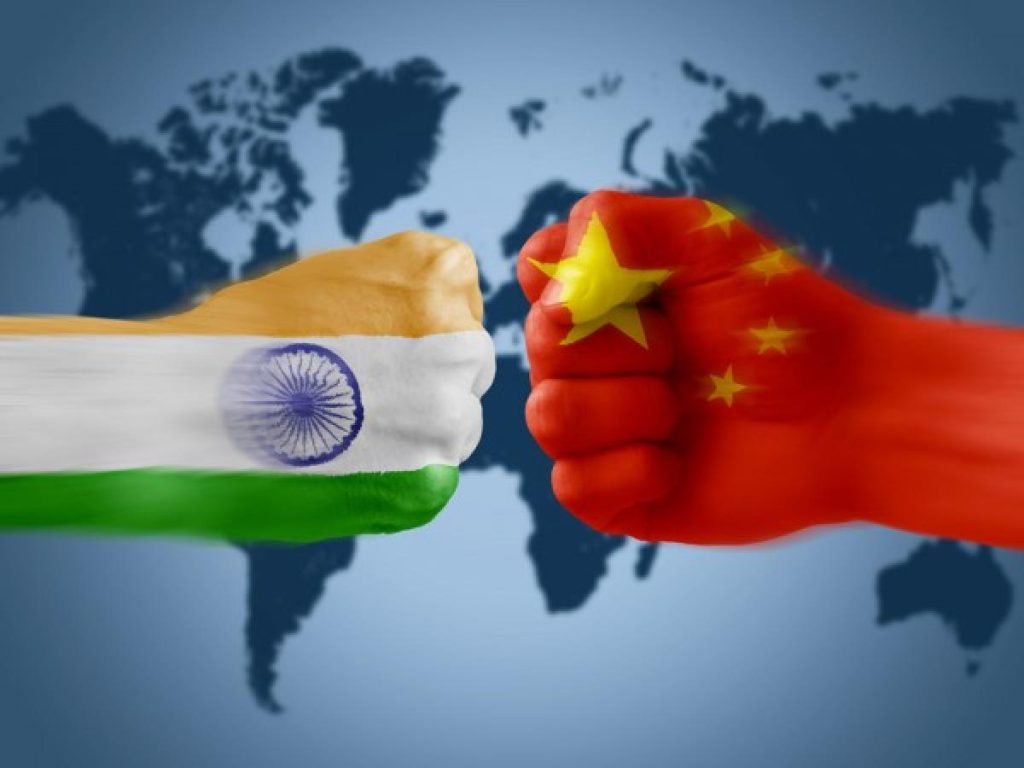
Why The West Should Replace China With India

It’s apparent to all that the world is currently undergoing a strategic realignment. When the COVID-19 dramas have settled down, we will be left with a new set of alliances and global political arrangements. This essay will argue that the Western World should use this opportunity to replace the economic ties it currently has with China.

To a major extent, those who are powerful in the non-Western world are only so because of the favour of Western elites. China’s economic miracle is chiefly the result of the transfer of manufacturing capacity from the West since the early 1980s. After forty years of this, China has grown into a major world power.

In 1990, China had a smaller economy than Canada. Their GDP per capita was a pitiful $349 per year, putting them in the same class as Uganda, Mali and Rwanda. Today, China is second only to America by total economy size. Their GDP per capita is now in the same class as fringe Western nations such as Russia, Argentina and Bulgaria.

This development has brought with it great wealth, not only to China but also to their major trading partners. But with this wealth has come power, and with that power has come ambition.

China’s strategic goals in the South China Sea are evident: to take control of the entire region. As their economy continues to develop, their ability to actualise these goals increases. They are now wealthy enough to devote a vast sum of surplus capital to military outfitting and development. Some of this has been devoted to building artificial islands – rightly considered forward military bases – in the South China Sea.

Given that Chinese strategic goals often don’t align with ours, and that Indian strategic goals often do, it might be time for the West to make an immense pivot away from China and towards India. There are several reasons why this might be a good idea.

The most obvious strategic reason to replace China with India is the aforementioned military one. A close alliance with India would all but guarantee Western control over the Straits of Malacca, which is the jugular vein of Chinese shipping and trade. This would minimise the potential for China to get tempted into further expansionism.

Existing tensions on the shared border between India and China have flared in recent weeks. China has already moved a brigade’s strength of men into territory India claims as its own. This is an extreme provocation by any measure, if not an outright act of war. India’s response could lead to a wider conflagration.

If it does, it would be the perfect time for the West to throw our lot in behind India. Not only would it enable us to impose a collective will upon China in a weak moment for them, but giving assistance to India in their time of need would engender the greatest amount of long-term goodwill from their side.

More subtle are the economic reasons. China’s economy has advanced to the point where it is a competitor to the West in many ways, whereas India’s has not. Many Chinese firms have been able to drive Western ones out of certain markets by way of having a superior product. The general level of scientific knowledge in the Chinese population is now high enough that Chinese firms are likely to pose a consistent threat into the future.

It would be much better to co-operate with Indian firms, and to raise them to the level where they can compete with the Chinese ones, than to continue to raise Chinese firms so that they can compete with ours in the future. We can help India to adopt technology that both the West and China already have, at no strategic loss to ourselves.

As mentioned above, Chinese GDP per capita has increased sharply in recent decades. Today, it is over twice as high as the GDP per capita in India. This has brought with it increasing expectations of living standards, such that India now offers better opportunities to employ cheap labour. Factories could be set up in India at competitive prices.

The greatest reasons to pursue an alliance with India at the expense of China are cultural.

India is culturally superior to the West in several ways. Here we are not merely talking about lamb saagwalas. Their compassion for animals is such that India has more vegetarians than the rest of the world put together. This compassion is a feature of Dharmic religions such as Buddhism and Hinduism.

The sadistic Abrahamic religions have no such restrictions, and neither does Chinese culture with its hellish wet markets. As such, there is an opportunity for us in the West to learn from Indian culture and from the Indian approach to life, and to use its inspiration to better ourselves.

The Indian spiritual culture fills a need in the Western soul for answers about how to morally conduct ourselves in this life. This is not to claim that all Indians conduct themselves perfectly, or even better than Westerners do on average. It is merely to suggest that there is great value to Westerners in the spiritual traditions of the Indian people, in particular Buddhism and Hinduism.

Because India has cultural advancements that we in the West ought to learn from, there is the possibility of genuinely reciprocal trade. We have scientific, technological and commercial knowledge that they would benefit from learning, and they have spiritual knowledge that we would benefit from learning. It would be a two-way exchange.

A further point relating to culture is the shared love of cricket. That cricket is popular in India as well as in Britain, Australia, South Africa and New Zealand means that men from all of these places have a shared bond, and this naturally allows for some degree of solidarity. After all, it’s through sport that men learn to conduct themselves in wartime, and men bonded in such a fashion are bonded deeply.

No such bond is shared with China.

In summary, an entire spectrum of reasons suggests that the West ought to take the economic bonds that tie us to China, and to replace them with bonds that tie us to India. This would not only make a great deal of natural sense, but it would also strengthen the strategic position of the West deep into this century.

*

If you enjoyed reading this essay, you can get a compilation of the Best VJMP Essays and Articles of 2019 from Amazon for Kindle or Amazon for CreateSpace (for international readers), or TradeMe (for Kiwis). A compilation of the Best VJMP Essays and Articles of 2018 and the Best VJMP Essays and Articles of 2017 are also available.

*

If you would like to support our work in other ways, please consider subscribing to our SubscribeStar fund. Even better, buy any one of our books!

Conservative Parties In Every Western Nation Will Eventually Become White Parties

The National Party has revealed its party list for this year’s General Election, stoking outrage. In an age when it’s not okay to be white, the racial composition of their top ten list candidates is unrepentantly vanilla. This essay will argue that this outcome was not only inevitable, but is likely to intensify in the future.

In the age of social justice, racism is the Original Sin of the white race. The fight against racism, many believe, is one of the most pressing of all social issues. Anyone who doesn’t think so stands alongside Adolf Hitler as a public enemy motivated by sadism. Practically any action can be justified, no matter how ludicrous, if the intent is “anti-racist”.

The social justice warriors seems to think that the best way to fight racism is to minimise the number of white people in positions of power. The best way to achieve this is to oppose white people at every turn. Consequently, Labour and the Greens have become openly anti-white parties.

18 out of Labour’s 46 current MPs are non-white – 39% of the total. This is a much higher percentage than the percentage of non-whites in New Zealand, which is 29%. 11 of those 46 are Maori – 24% of the total. This is also a much higher percentage than the percentage of Maoris in New Zealand (16%). These figures are even more remarkable if one accounts for the size of the Maori presence in the New Zealand First, Maori and Mana parties.

There is nothing wrong with having Maori MPs (or white ones). But if the Labour Party wants to have a disproportionately high number of non-white or Maori MPs, then no-one can be surprised if their opponents in the National Party have a disproportionately low number of non-white or Maori MPs.

This essay predicts that things aren’t going to end there. The problem is that it’s now all but inevitable that National eventually becomes the white person’s party.

As diversity increases in any white country, the in-group solidarity of the white people in that country also increases. This can be extrapolated from known laws of social psychology. As the position of white people gets weaker, and closer to minority status, the more this in-group solidarity will intensify out of a concern to protect their position. Hence, the strongest white in-group solidarity is seen in places like Brazil and South Africa.

As all other Western counties become more like Brazil and South Africa, the white people in those countries will come to face a certain calculus: the more their local social democrat party becomes non-white, the more it makes sense for them to rally behind the local conservative party. This calculus explains why the National top ten is now all white.

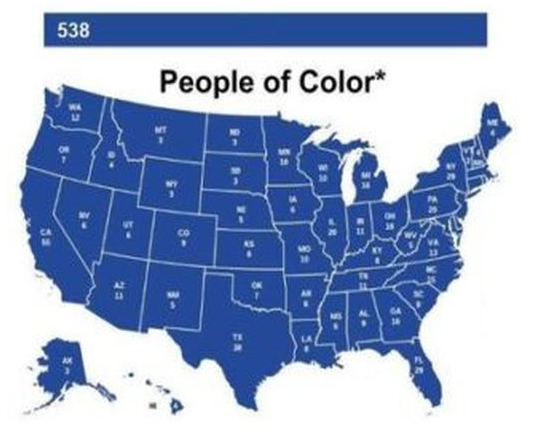
This phenomenon is perhaps most advanced in America, where the Republican Party is now the White Party in all but name, while the Democrats are the Party of The People of Colour. The image at the top of this page shows the reality clearly.

If only non-white Americans voted in Presidential Elections, the Democrats would win every single Electoral College delegate. Something similar is true in all other Western countries – namely, that if only non-whites voted, the social democrats would always win. It is certainly true in New Zealand, as Dan McGlashan showed in Understanding New Zealand.

Conservatism has always been about maintaining the status quo. The logic is that things came to be the way they are by way of the collective applied wisdom of our ancestors. But if progress is equated with a smaller and weaker white presence, then conservatism will necessarily come to be equated with maintaining and protecting that presence.

The National Party top ten might be all white, but this is hard to avoid when Labour positions itself as the brown party. What’s also hard to avoid is that increasing anti-white aggression on the part of Labour and the Greens will intensify these sentiments, making National come to seem like the white man’s last stand.

What would really be a coup, from the perspective of Todd Muller, would be for National to take advantage of these pressures to win working-class whites to their side. If National accepted the inevitability of the grim calculus outlined above, they might realise the need to act upon it immediately, rather than be acted upon.

The Labour Party was founded by working-class whites for working-class whites, but its grip on that constituency has never been weaker. The Labour movement has turned its back on working-class whites all throughout the West, preferring to champion middle-class browns and blacks. This has made it highly vulnerable to being split in two, as it has been in places like Sweden.

The National Party could swoop in here – not from introducing racist measures themselves, but from winding back previously-introduced measures that were motivated by anti-white racism. A broad commitment to get rid of all policies based on skin colour and not need would be a good start.

If the National Party promised to scrap the Ministries of Maori and Pacific Island Affairs, as well as to scrap race-based education and health funding, as well as to scrap all race-based differential treatment in the Justice System, they would steal a march on a Labour Party that expects working-class white people to go to the back of the queue behind recent immigrants.

It would provoke fury from the globalist mainstream media, who are committed to propagandising for cheap labour and its importation. However, it might benefit National’s electoral chances, as did Don Brash’s Orewa speech in 2005. More importantly still, such a move is bound to entertain the gods, upon whose favour we all rely.

*

If you enjoyed reading this essay, you can get a compilation of the Best VJMP Essays and Articles of 2019 from Amazon for Kindle or Amazon for CreateSpace (for international readers), or TradeMe (for Kiwis). A compilation of the Best VJMP Essays and Articles of 2018 and the Best VJMP Essays and Articles of 2017 are also available.

*

If you would like to support our work in other ways, please consider subscribing to our SubscribeStar fund. Even better, buy any one of our books!

Is It Time For New Zealand To Embrace Apartheid?

Most people consider apartheid to be one of the recent century’s many evils. Elderly Kiwis speak with pride of opposing the 1981 Springbok tour and helping to bring the regime in South Africa to its knees. Today, though, it’s apparent that race-based policies are making a comeback. This essay asks the inevitable question.

To Kiwis in Generation X, apartheid was placed along the Holocaust as an example of the worst of all possible crimes – racism. We were made to write essays in school denouncing it. The television and radio told us every day that ending it was one of the world’s most pressing issues. So when apartheid ended with the democratic elections in 1994, we all cheered.

In recent years, however, apartheid has surged back into fashion. The powers that be, for reasons nefarious, have encouraged a renaissance in racial consciousness. In 2020, most people’s identities are once again based primarily around their racial heritage. It’s once again common for people to think of themselves as their race first and as a Kiwi second.

In New Zealand, successive strategic Government decisions have rejected the idea that New Zealanders are one people under one law. They have enshrined separatist sentiments, promulgating the belief that the essential nature of relations between whites and Maoris is one of oppression, deceit and exploitation.

Part of the New New Zealand history is that white people have stolen some innumerable wealth from the Maoris, and that justice demands therefore that the Maoris get their own back on white people whenever they can. This blatantly racist narrative has inspired an anti-racist counter-reaction, as the nation has been set against itself.

Anti-racists were appalled by recent news that the Sixth Labour Government was allocating coronavirus support funding on the basis of race. GPs of Maoris and Pacific Islanders were given $4.50 per patient, but GPs of white people were only given $1.50 unless those patients had been previously marked out as belonging to the poorest quintile. This is a blatantly racist policy, and some were surprised it was even legal.

Given that the most recent Budget allocated $1,000,000,000 to Maori causes alone, some could be forgiven for thinking that the Sixth Labour Government had given up on the white working class completely, and had settled for being a brown party. If this is the case, then we’re arguably on our way to an apartheid system where political factions argue for racial interests first and foremost.

This news came in the context of the realisation that the Police had no intention of stopping certain Maori tribes from blockading public roads, particularly roads in Northland. Despite the fact that blockading a public road is a crime, the Police have not made any arrests, and have even said that they weren’t going to do anything about it.

So many people have supported these actions that it seems as if New Zealand is taking tentative steps towards a fully apartheid system, where different laws apply depending on one’s skin colour.

The question raised by this essay is: should New Zealand embrace this shift, and institute full apartheid? Should we organise our society to reflect a fundamental and unbreachable difference between Maoris and non-Maoris, such that the two different groups cross each others’ paths as little as possible?

The first step would be to entrench the Maori Roll. This would mean that all Maoris were forced to vote in the Maori electorates whether they wanted to or not. Their race being their defining quality, they would no longer be eligible for the General Roll. Correspondingly, Maori voters would not be permitted any influence over non-Maori affairs.

The second step would be to declare certain areas as tribal reservations. In principle, these already exist. The areas being blocked by roadblocks are, by virtue of that residents are allowed to block them, effectively the same as North American-style reservations. Eventually, Maoris would be transported from the cities into these tribal enclaves.

Future steps would entail the institution of separate drinking fountains, toilets and beaches. Sports leagues would also be segregated, with a special Maori league for rugby. Maori players would no longer be eligible for the All Blacks or Black Caps.

The reality, of course, is that apartheid between Maoris and whites in New Zealand is impossible on account of that they’re already too mixed together.

At least 25% of New Zealanders – including the author of this piece – are some kind of mixed-race Northern European/Polynesian. Those of us who are cannot reasonably be expected to pick a side in the great race war that so many seem to be agitating for.

If you’re a mixed race white-Maori, you are probably the result of a relationship in which a white person and a Maori loved each other. Your entire existence is an expression of co-operation and goodwill between these two peoples. Therefore, it’s impossible for a Kiwi of mixed blood to choose one side over the other, any more than they could choose their left hand over their right one.

The majority of New Zealand already has white ancestry. Sooner or later, the majority of the country will also have Maori ancestry – this is inevitable given that Maori ancestry is already carried by many Kiwis who are indistinguishable from fully white people, and that interbreeding rates between Maoris and whites are extremely high (the average Maori woman is more likely to breed with a non-Maori than with another Maori).

Seeing as there is no reproductive barrier between the two groups, it seems inevitable that mixed-race white-Kiwis will eventually comprise a majority of Kiwis. From that point, there’s no looking back.

If apartheid really is impossible, then it’s a mistake to take steps towards it. That means that all separatist measures have to be opposed, both intellectually and legally. No Treaty favouritism, no race-based funding, no Maori roadblocks, no official narrative of hatred, division and revenge. It’s time to replace our national narrative with Esoteric Aotearoanism.

*

If you enjoyed reading this essay, you can get a compilation of the Best VJMP Essays and Articles of 2019 from Amazon for Kindle or Amazon for CreateSpace (for international readers), or TradeMe (for Kiwis). A compilation of the Best VJMP Essays and Articles of 2018 and the Best VJMP Essays and Articles of 2017 are also available.

*

If you would like to support our work in other ways, please consider subscribing to our SubscribeStar fund. Even better, buy any one of our books!

VJMP Anzac Day Address 2020: The Federalisation Imperative

The original proposed articles of Australian federation stated that voting rights were to be restricted to white people and Maoris only. The founders had assumed from the beginning that New Zealand would join the Federation, but they also knew that white New Zealanders were unwilling to see Maoris as lessers. Therefore, they were unable to restrict the franchise to white people only.

Given that the Australian representatives were willing to go to such lengths to accommodate the colony of New Zealand, they were surprised by the decision of the New Zealand representatives to not join the Federation. It seemed obvious that, as all the other British colonies in the Southeastern corner of the world were joining together, New Zealand would follow suit. But they did not.

Although the century that has passed since then has seen the thousands of kilometres between us reduced to a few hours in a plane, the Mistake of 1901 has never been repealed. Australia and New Zealand have continued to insist on their own differences, despite that no differences are apparent to outsiders. Although the whole world sees us as one, we do not – at least not officially.

To be fair, there was little pressure to unite while the West was so far ahead of any competitors. Even as recently as 1980, the combined Anzac economy was greater than that of China (according to World Bank figures). India and Indonesia were even further behind. The possibility that these countries could ever get it together enough to pose a military threat to us seemed remote.

Because China was so poor in 1980, they had a much greater potential for further development than Australia and New Zealand had. As such, their economic growth over the last 40 years has been much greater than ours. Over the last 40 years, China has transformed itself from an Africa-tier level of poverty to having a higher GDP per capita than either Argentina or Iran. The total Chinese economy is now over seven times the size of the Anzac one.

Currently, the Indonesian economy is smaller than that of the Anzac Empire, reflecting the fact that their GDP per capita is less than a twelfth of ours (some $4,000 per year). However, if they also underwent a 40-year stretch of relentless turbocharged economic development, as China did, then their economy would become five times bigger. And that would be a power right on our doorstep.

These growing Asian powers present us with a dilemma. The easy dominance that Australia and New Zealand has taken for granted for two centuries no longer applies. It’s no longer certain that the other Anglo powers have enough spare resources to keep the South Asian sealanes open. If not, then the burden falls necessarily on us.

Some have suggested a “Big Australia” in response to these challenges. This strategy involves opening the borders to all kinds of immigration, social consequences be damned. But there’s an easier way to add five million people to the population of Australia: welcome New Zealand into the Anzac Federation.

Australian Prime Minister Scott Morrison recently mooted the idea of open borders between New Zealand and Australia, arguing that such a measure would help restart the economy after the COVID-19 pandemic was over. He is entirely correct, as is evidenced by the fact that previous measures to integrate the two economies have resulted in increased wealth. However, open borders don’t go far enough.

The Anzac Empire needs to unite to meet the challenges of this century, one in which the continued Anglo dominance of the seas might not endure. New Zealand needs to formally become part of the natural ruling power of the Southeast corner of the world stage.

We must accept the federalisation imperative.

Becoming one, united Anzac Empire would necessitate a change of thinking for New Zealanders. We are used to thinking of ourselves as a small, isolated and meaningless part of the world occupying a tiny corner of the world. A united Anzac Empire would belong to the second tier of world powers – with a future as a first tier power beckoning.

This realisation is perhaps best conveyed in raw numbers. As of 2019, Australian GDP sits at $1,376 billion (USD), while New Zealand GDP sits at $204 billion. The Australian population is 25,500,000, while the New Zealand population is 4,800,000. The Australian land area is 7,682,300 and the New Zealand land area is 263,310.

Therefore, the Anzac Empire would have a GDP of $1,580 billion, making it the 13th largest economy in the world, just behind Russia. It would have a population of over 30,000,000 and a land area of 7,945,600 square kilometres. Having won 17 Nobel Prizes, it would belong to the same cultural and intellectual tier as nations like Italy and the Netherlands.

Perhaps most importantly, the Anzac Empire would have the world’s single largest Exclusive Economic Zone. The EEZ of Australia is over 10 million square kilometres, and that of New Zealand over 4 million. The combined EEZ of 14 million square kilometres would be larger than that of America. This fact underlines the degree to which the Anzac Empire will be a maritime power.

Commensurately, the first priority of the updated federation must be to assure our territorial independence through developing a number of Trident-style nuclear submarines. An arsenal of a few hundred submarine-launched nuclear ballistic missiles would ensure the Anzac Empire’s place among the top rung of global powers, and safeguard our future prosperity.

The second priority must be to ensure that each province of the empire have its own culture. The spirit of the Anzac people is one of independence – therefore, the federal government must govern with a light touch. The vastness of the Empire must be recognised, and this means that the constituent states must be allowed to develop unique cultures that impress the others.

The Anzac Empire is today where Rome was in 300 B.C. We have enough might and culture to impress barbarians and minor nations, but our time in the Sun is yet to arrive. If, as seems true, the Spear of Destiny has leapt from the Atlantic to the Pacific, it means that the Anzac Empire is as entitled as anyone else to contest for the leadership of the world. Let us lay the foundations for it then.

An Anzac Empire based around the Tasman Sea, and with the expanses of the Australian continent as imperial possessions, would inevitably become one of the world’s foremost powers. Just an inevitably, it seems like it’s fate for Australia and New Zealand to combine in this manner. The Mistake of 1901 shall be repealed, and this will loose the Anzac Empire upon the world stage.

*

If you enjoyed reading this essay, you can get a compilation of the Best VJMP Essays and Articles of 2019 from Amazon for Kindle or Amazon for CreateSpace (for international readers), or TradeMe (for Kiwis). A compilation of the Best VJMP Essays and Articles of 2018 and the Best VJMP Essays and Articles of 2017 are also available.

*

If you would like to support our work in other ways, please consider subscribing to our SubscribeStar fund. Even better, buy any one of our books!