

Metaphysical Abolitionism

The term ‘abolitionism’ refers to the political movement that sought to abolish chattel slavery. It was a popular term in the 19th century, when first the British and later the Americans made it illegal to own other people. However, as this essay will examine, the battle against slavery merely shifted to a different front – the metaphysical one.

Controlling slaves physically is a major undertaking. They have to be shackled so as to not escape the plantation, and beaten or whipped so as to not shirk labour. Plantation owners in the antebellum South found themselves spending a great deal of their profits on keeping their slaves in line. Slave rebellions were common.

Eventually, the slave owners realised, it was unnecessary to keep people in chains and shackles when they could simply control their minds and their spirits. Controlling the minds and spirits of the slaves meant that the slave owners controlled all of their actions anyway, without having to physically abuse them and generate resentment or risk rebellion.

The enslavement of the mind and the spirit is linked to the Silver Right and the Golden Right of alt centrism. Simply put, a people cannot be free unless they’re both free to think for themselves and free to reconnect with God. The metaphysical abolitionist demands the removal of any obstacle preventing these two goals from being achieved.

Enslaving the mind, however, is the expertise of the Western ruling class. This they achieve through control of the popular narrative.

Ever since the publication of Edward Bernays’s Propaganda in 1928, the ruling elites have structured the education and media systems to both condition people to feel bad for questioning the popular narrative, and to feel good for enforcing that narrative on those who question it. The end product is a country of willing slaves, as submissive as any other herd animal.

The first step to inducing a population into trusting the mainstream media is to pacify them through the education system. 12 years of schooling is enough to condition most people into believing that questioning the popular narrative is an act of evil, and only by going along with it can happiness be found. It’s a simple matter of punishing those who ask questions and rewarding those who submit.

Controlling the popular narrative through the mainstream media means that Western elites control the permissible boundaries of thought. By normalising certain topics of discussion through repeated media exposure, they abnormalise others. The term ‘Overton window’ refers to that range of political positions that have been thus legitimised.

Any idea expressed in the mainstream media is legitimate; any idea not expressed in the mainstream media is illegitimate. If the elites really don’t like an idea, they simply instruct the talking heads on the television to describe supporters of that idea as ‘conspiracy theorists’. By discouraging unwanted lines of reasoning, the elites can keep people going around in circles, chasing mental phantoms like rats on a wheel.

The results of this widespread brainwashing are easily noted. The ruling elites merely have to broadcast the necessity of something over the television, and the masses will fall unquestioningly in line. If a talking head on the television says that Saddam Hussein was behind 9/11, the masses will demand his destruction. If the talking head says to wear a mask to prevent coronavirus, the masses obey.

The metaphysical abolitionist opposes all of this. Metaphysical abolitionism demands that people be allowed to think freely. So a metaphysical abolitionist will reject the importance of mainstream schooling, will discourage the consumption of the mass media and will encourage people to consume alternative media of all kinds. Their favourite thing is people getting together, away from normies, to discuss what the truth really is.

However, even if we did manage to break the psychological conditioning that enslaves our minds, there is a greater challenge.

Our minds may have been enslaved for a hundred years, but our spirits have been enslaved for even longer – ever since Christians destroyed the Eleusinian Mysteries in the 4th Century A.D. Since then, we’ve been the slaves of those who would tell us lies about God. The metaphysical abolitionist opposes this and wishes for the spirits of all people to be free.

In the same way that the ruling elites can engender intellectual submission by restricting intellectual expression to a range of harmless ideas, they can engender spiritual submission by restricting spiritual expression to a range of pointless superstitious dogmas. The humiliation engendered by forcing people to worship an idol of Rabbi Yeshua ben Yosef instead of God has the effect of inducing passivity. With spiritual slavery follows slavery of every other kind.

Although humans have been using spiritual sacraments such as cannabis and psilocybin to reconnect with God for thousands of years, their use is mostly illegal in the modern West. The laws prohibiting them are explained to us as laws protecting the people’s mental health, but this is a total lie.

The truth is that cannabis and psilocybin are illegal because they are spiritual sacraments.

All spiritual people know that the truth will set you free, so those who would enslave the spirit must tell lies. Spiritual sacraments such as cannabis and psilocybin teach people the spiritual truths about reality: that consciousness is eternal and that God not only exists but also wishes the best for us. These sacraments have been made illegal so that the common people remain blind to the lies of the elites.

Spiritually speaking, the vast bulk of the population divides neatly into two halves: the slaves who follow whatever mainstream religion is pushed on them as children, and the malcontents who, recognising the mainstream dogma to be lies, reject the question of spirituality entirely. Genuine spiritual seekers – those who reject both the “Christian” label and the “atheist” label – are thus marginalised.

Metaphysical abolitionism demands that the human spirit be as free as the human body. This requires that people have free access to whatever spiritual sacrament they feel will help them reconnect with God. All spiritual sacraments must be legal and readily available: cannabis, psilocybin, LSD, DMT – the lot.

In summary, the metaphysical abolitionist advocates for free speech, free thought and for the annihilation of dogmatic religious strictures. This is to advocate for free minds and free spirits. The abolition of chattel slavery has been achieved already, at least in the West. It’s time to achieve the abolition of a much more insidious form of slavery, that of our minds and spirits.

*

If you enjoyed reading this essay, you can get a compilation of the Best VJMP Essays and Articles of 2019 from Amazon for Kindle or Amazon for CreateSpace (for international readers), or TradeMe (for Kiwis). A compilation of the Best VJMP Essays and Articles of 2018 and the Best VJMP Essays and Articles of 2017 are also available.

*

If you would like to support our work in other ways, please consider subscribing to our SubscribeStar fund. Even better, buy any one of our books!

Clown World Chronicles: Who Is The Merchant?

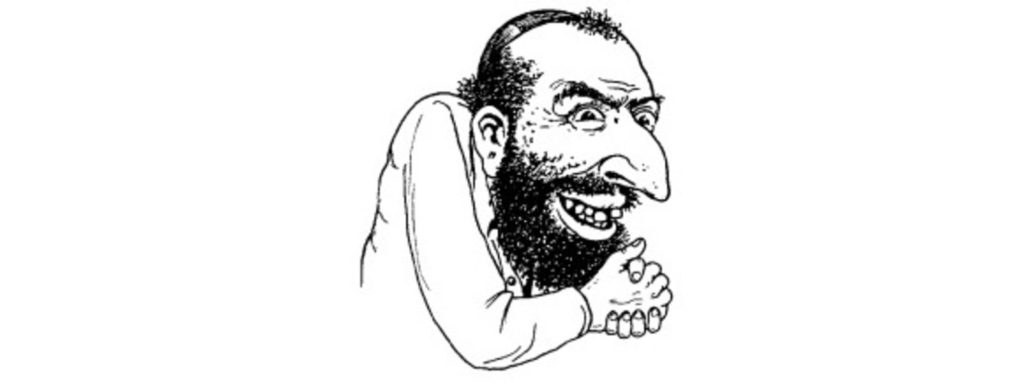
The Merchant, aka Shlomo Goldberg, aka Abraham Shekelstein, is a prominent figure in Clown World. All the various tricks and schemes that lower people’s quality of life seem to have the Merchant’s fingerprints on them. Like a dark shadow cast by a thick cloud, the Merchant’s influence is seen and felt everywhere.

Usually depicted rubbing his hands together in anticipation of a fat profit, the Merchant is a hideously deformed figure. His outsized nose juts snout-like from his face, his teeth are crooked as if he uses them to open bottles, and his feeble arms and shoulders betray the fact that he never does any physical labour.

The Merchant is the Elder God of the Fundamental Negative Axis. As such, he is an extremely powerful figure. He is the greatest force for evil in all of Clown World. This is because he, more than anyone else, denies the supremacy of Kek.

The Merchant’s arrogance is such that he believes there are none greater than himself, and as such he believes he has the right to reshape the world according to his whims. This brings him into direct conflict with the Will of Kek, which is to spread the lulz. The Merchant is not interested in humour, but rather in subjugating people through contracts and legal obligations.

Although the Merchant has a Jewish appearance, this is incidental. The ugliness of the Merchant is not because he is Jewish but because he represents the ugliness within all of us. The Merchant is the physical embodiment of the desires within all of us to either humiliate our enemies or to escape into fantasy worlds. He is the incarnation of all of our anti-life sentiments.

Most Clown World denizens have figured out by now that our collective preoccupation with money and material wealth is destroying us. Despite decades of supposedly relentless economic progress, most young workers are much poorer than their parents were at the same age. The pressure that this unexpected poverty has put on the minds of the young is driving many to seeking oblivion in drugs, porn, video games or even suicide.

The obsession with achieving social status through material possessions has caused us to cast spirituality aside for so long that we have now forgotten its importance. The received wisdom in Clown World is that spirituality is mental illness, the absolute meaninglessness of life and the inevitable extinguishing of consciousness being hard facts. As a result, more people than ever are now NPCs.

The Merchant sees this, cackles and rubs his hands.

He represents our greed, our acquisitiveness, our aggression, our narcissistic status anxiety, our deceitfulness and our shamelessness. He is us, and there is no escaping that fact. Every citizen of Clown World, without exception, has an aspect of the Merchant within themselves. It is the duty of each of us to keep it under control.

The Merchant’s role in Clown World is to tempt. Every time a person’s will wavers, the Merchant is there to tempt them into making a short-term decision. The Merchant influences people to tick up impulse purchases on the credit card, or to smash back a six-pack when they have work in the morning. He tempts people to rat their neighbours out to the cops and to schedule hour-long work meetings.

In the Clown World pantheon, the Merchant exists in a state of mutual antagonism with Kek, the Elder God of the Positive Fundamental Axis. The world is the battleground on which they fight for the consciousness of everything that lives. The current state of Clown World is a sign that the Merchant is currently in the ascendancy.

The Great NPC is the henchman of the Merchant, and does his bidding in all instances. The Merchant has achieved total control over the Great NPC by controlling his informational environment and his desires. Not only does the Merchant control all the media the Great NPC watches, he uses this to tell the Great NPC what he desires. As such, the Great NPC stumbles from seeking one indulgence to the next.

The major influence of the Merchant in Clown World is to create more NPCs. This has the effect of destroying all of the humour in the world, thereby making life difficult for Kek followers. The Merchant’s influence on the mass media ensures that the common citizen is assaulted with propaganda telling them what to think and what to consume.

The Merchant is not powerful enough to take on Kek directly, and it is the Merchant’s fate to be destroyed in righteous fire when Kek returns to liberate the human race from Clown World. But the Merchant is powerful enough to effectively banish Kek from various parts of the world. This he does by influencing people to become serious and humourless.

Wherever you find people who want to ban cannabis, MDMA and the other spiritual sacraments, people who demand that everyone else take the knee in solemn submission, wherever you find cancel culture, you can find the influence of the Merchant. His influence will grow until Kek returns, at which point the Merchant’s machinations will be exposed.

*

This article is an excerpt from Clown World Chronicles, a book about the insanity of life in the post-Industrial West. This is being compiled by Vince McLeod for an expected release in the middle of 2020.

*

If you enjoyed reading this essay, you can get a compilation of the Best VJMP Essays and Articles of 2019 from Amazon for Kindle or Amazon for CreateSpace (for international readers), or TradeMe (for Kiwis). A compilation of the Best VJMP Essays and Articles of 2018 and the Best VJMP Essays and Articles of 2017 are also available.

*

If you would like to support our work in other ways, please consider subscribing to our SubscribeStar fund. Even better, buy any one of our books!
Clown World Chronicles: Who Is Chad?

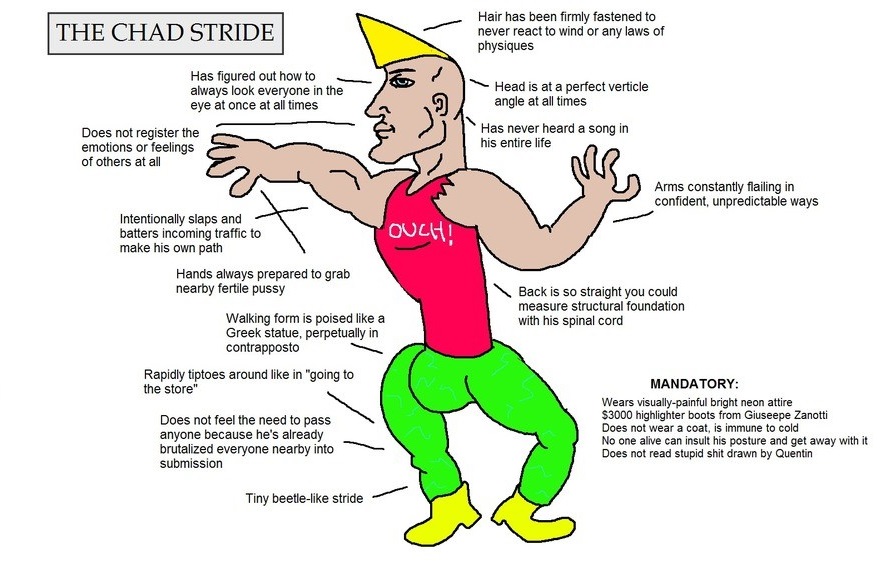
The first thing you notice is his stride. He strides like he has somewhere to be, but the truth is that wherever he is right now is the place to be. His choice of bright neon clothing is so appallingly bad that it’s somehow good. His hair is so perfect that it sits atop his head like a block of gold. He is Chad, and he plays a major role in the Clown World pantheon.

If Stacy is the Aphrodite of Clown World, Chad is its Hercules. He is tall, powerfully muscled, extraverted, brave and warm-blooded. Chad is the kind of man who commands attention in all situations. His brightly coloured clothing turns heads everywhere, the ‘Ouch!’ emblazoned across his chest creating an air of mystique.

Chad is immune to both cold and pain. Some think this is because of Chad’s natural physical masculinity, but in reality it is his spiritual strength which warms him from within. This is an essential quality of Chad: his faith in the ultimate victory of Kek is absolute.

This ultimate faith in Kek is what leads Chad on his many adventures. Knowing that Kek is with him, Chad goes out and parties hard, chases women and travels to foreign lands, knowing that good times will be the result. Chad is the life of every party, up for anything. His unshakable belief that all will be good radiates joy to all those around him.

Chad is the archetype of perfection for many of the young men of Clown World. This isn’t because Chad gets laid a lot – that is secondary. The primary reason Chad is adored is that he represents positive masculinity, that which remains upright despite the multitudinous temptations of Clown World. Chad is the rectitude which prevails.

Chad is simply immune to many of the negative emotions that hold people back in real life. He does not feel fear – not because he is reckless, but because he is in tune with reality enough to always make the right decision. He never doubts himself – not because he is arrogant, but because he has examined himself rigourously enough to know that his true will is good.

The ultimate power of Chad is that his actions are perfectly in tune with the Tao, and so no-one resists him. He gets laid a lot because he only hits on women who have shown interest. As such, he can rely on his own instincts to lead him to a place absent of suffering. This ability to rely on his own instincts makes him behave naturally and spontaneously, without effort or stress.

Before Clown World, many men were of the nature of Chad. The hard times that existed during the Great Depression and World War II led to the ascendancy of strong men, who created good times. During these good times the spirit of Chad was ascendant.

In Clown World, The Merchant has the ascendancy. He has exploited this to shape the mass consciousness in a way which suppresses men’s inner chadly tendencies. As such, most men are like Virgin today. But Chad lurks in the shadows of all of them, awaiting his chance to break out. A sufficient effort of will can bring the inner Chad out of any man.

Chad is the Younger God of the Positive Masculine Axis. He is what Wojak can become if Wojak summons the divine energy of Kek. This he can achieve if he finds a way to transmute fear into joy. It is in banishing fear that Wojak rejects the temptations of The Merchant, and escapes becoming an NPC, a Virgin or a Doomer.

To a major extent, overcoming Clown World is a matter of summoning one’s inner Chad. If Honkler and Kek are divine forms, unattainable by man, Chad is what happens when the human masculine is infused with their divine energy. He is like the perfect older brother, a guide as well as a friend.

If Chad lives correctly, he can live a full and worthy life, eventually becoming Boomer, with nothing left to achieve. Chad becomes Boomer if he finds a Waifu to settle down with, or if he decides to become celibate and go his own way.

If Chad does not live correctly, he can transmute into Doomer. The most common way for this to occur is if Chad sleeps with so many women that he comes to stare too long into the abyss of female nature. Chad can also become Doomer if he is trapped into getting the wrong woman pregnant.

Chad plays a central role in the Clown World pantheon as the god whose energy one summons when things are challenging. If one is physically suffering, or if one is trying to make a good impression at a party and get laid, then it’s time to call upon the power of Chad. Look at yourself in the mirror and imagine Chad’s face on yours, and the Will of Kek shall be with you.

*

This article is an excerpt from Clown World Chronicles, a book about the insanity of life in the post-Industrial West. This is being compiled by Vince McLeod for an expected release in the middle of 2020.

*

If you enjoyed reading this essay, you can get a compilation of the Best VJMP Essays and Articles of 2019 from Amazon for Kindle or Amazon for CreateSpace (for international readers), or TradeMe (for Kiwis). A compilation of the Best VJMP Essays and Articles of 2018 and the Best VJMP Essays and Articles of 2017 are also available.

*

If you would like to support our work in other ways, please consider subscribing to our SubscribeStar fund. Even better, buy any one of our books!
Clown World Chronicles: Who Is Virgin?

Most of the luminaries in the Clown World pantheon are admired and imitated, but others serve as warnings. Human nature contains a great variety of instinctual desires and impulses, and many of those are nasty. Every spiritual tradition carries warnings about indulging those desires and impulses to excess. In Clown World, one such warning is the example of Virgin.

Virgin is not conspicuously shorter or uglier than average. If he was, he wouldn’t be the Virgin – he’d just be some short or ugly man. To have achieved a place in the Clown World pantheon, Virgin has had to embody a particular spiritual essence. His is the essence of narcissistic masculine self-absorption.

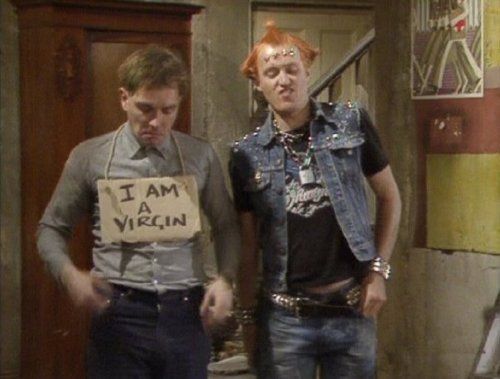
Virgin shuffles along in drab clothing and cheap sneakers, his gaze downcast, his shoulders hunched. Never does he think about the effect that his sullenness has on the other people around him. Nor does he think about how his passive and weak body language repels women. His virginity is, in his mind, 100% the fault of other people.

The idea that virginity is shameful is an old one. It follows from the idea that women are the gatekeepers of sex, and so only men who have been declared worthy may enter. It’s related to the idea that losing one’s virginity makes one a man. Most people understand that sexual reproduction is, to a major extent, a contest, and to get laid is therefore to win.

‘Virgin’ has been used as an insult ever since. It refers to an unworthy man who does not appeal to women. Since the roasties of Clown World will fuck almost anything, a man usually has to have something wrong with him to still be a virgin. But there’s more to Virgin than being simply physically unattractive. He is very different to El Goblino.

The major difference between Virgin and Chad is that Virgin is massively egotistical.

Legends tell of women that were into Virgin but got rejected because they were less than perfect. Virgin is so conceited that anything less than perfection is not up to his standards. He genuinely believes that he is the greatest of all men, and therefore that he deserves the best looking of all women.

Virgin is also heavily neurotic, again for egotistical reasons. He doesn’t know if he prefers Stacy for a summer romance or Waifu for a permanent relationship. He is the archetypal example of chasing two rabbits and losing them both. Fundamentally, his neurotic insecurity follows from being unable to let go of the delusion that he is the centre of the Universe.

Chad causes Virgin to seethe in many ways. It isn’t just that Chad gets laid all the time when Virgin does not. It’s also that Virgin attributes all kinds of false motives to Chad’s masculine rectitude. Where Chad is friendly, Virgin sees him as shallow. Where Chad is brave, Virgin sees him as stupid. Where Chad is honest, Virgin sees him as immoral.

This uncharitable cynicism is the main reason why Virgin is a god of the negative axis. He is an unpleasant character, always complaining, always trying to pull others down to make himself appear better by comparison.

Although a pitiable figure, Virgin’s suffering is all self-inflicted. As such, he serves as a dark figure of warning. In the Clown World pantheon, Virgin represents the dangers of letting one’s ego get out of control. He is entirely capable of achieving great things and becoming a Chad himself, but he is prevented by the fact that he won’t let go of his ego.

Virgin is the Younger God of the Negative Masculine Axis. He is what Wojak can transmute into if he falls off the spiritual path. The everyday Clown World citizen can start losing the spiritual battle if they, like Virgin, fail to keep their egos in check. Virgin serves as a warning of what happens if one doesn’t do enough meditation or smoke enough weed.

If Virgin doesn’t change the path he’s on, he’ll end up like Doomer. Doomer is someone who never figured it out, and who can only see the evil in the world. The main difference between the two is that Virgin, being the Younger God, still has hope that things will change for the better.

The best option for Virgin is to unfuck himself, start getting laid and transmute into Chad. There are two ways to do this, as mentioned above.

The first way is to meditate. Virgin won’t do this because he lacks a spiritual sense, on account of that he thinks of himself as the highest god. As such, he is utterly incapable of understanding his own shortcomings. Lacking self-insight, he behaves in ways that appall others. Meditating would allow him to learn the humility he needs to become like Chad.

The second way is to take spiritual sacraments. As Alan Watts said, “People suffer only because they take seriously what the gods made for fun.” The insight brought about by the use of sacraments such as cannabis, psilocybin, LSD and dimethyltryptamine has the potential to radically alter a person’s spiritual path. Virgin isn’t interested in spiritual sacraments, on account of that he already considers himself perfect.

Any denizen of Clown World who wishes to alleviate their spiritual suffering might win from meditating upon the travails of Virgin. It is often worth reflecting upon the fact that excessive self-regard can repel both women and other people in general. Clown World could be conceptualised as a time when ego runs rampant, and Virgin as an example of the type of man it produces.

*

This article is an excerpt from Clown World Chronicles, a book about the insanity of life in the post-Industrial West. This is being compiled by Vince McLeod for an expected release in the middle of 2020.

*

If you enjoyed reading this essay, you can get a compilation of the Best VJMP Essays and Articles of 2019 from Amazon for Kindle or Amazon for CreateSpace (for international readers), or TradeMe (for Kiwis). A compilation of the Best VJMP Essays and Articles of 2018 and the Best VJMP Essays and Articles of 2017 are also available.

*

If you would like to support our work in other ways, please consider subscribing to our SubscribeStar fund. Even better, buy any one of our books!