
Class Consciousness Is Dead – And It Was Murdered

Class consciousness was once widely understood to be the vehicle that the workers would use to liberate themselves from the divide-and-conquer tactics of the rulers. For that reason, the rulers sought to oppose the flourishing of class consciousness wherever they could. Today, class consciousness is dead – and we can tell you how it was killed.

From the point of view of the ruling class, watching class consciousness take root is like being a feudal lord and watching the peasantry assemble outside your manor with pitchforks and burning torches. You know that you’re going to have to do something about it sooner or later, or risk losing your position.

For the rulers of our society, it’s an imperative to destroy class consciousness wherever they can.

For a long time, the go-to tactic for destroying class consciousness was virulent nationalism. The ruling class had learned that they could take the hate and anger ordinary people had as a result of their suffering, and channel it towards rival neighbours. All they had to do was subject their working classes to several years of propaganda about how the neighbouring nation was evil, and then those working classes could safely be marched off to kill each other, at no threat to the rulers.

The ruling class eventually overplayed their hand. After the Hemoclysm of World Wars I and II, class consciousness made a resurgence. Although fraternisation between opposing troops was rare, it was common enough that the average soldier was able to figure out who their real enemy was – their real enemy was behind them all along.

Returning to the West, these soldiers brought with them an immensely strong class solidarity and a dogged refusal to allow the ruling class to divide and conquer them. This powerful class consciousness set the stage for the economic boom times of the 1950s and 60s. Because class consciousness was so strong, wages were high and working conditions were favourable. One worker could easily buy a house and raise a family on one wage.

The extreme unfashionability of nationalism meant that workers were no longer willing to kill another man simply because he wore a different uniform. The ruling class needed a new way to divide and conquer the workers. The ongoing Civil Rights Movement would provide the inspiration for their next strategic advance.

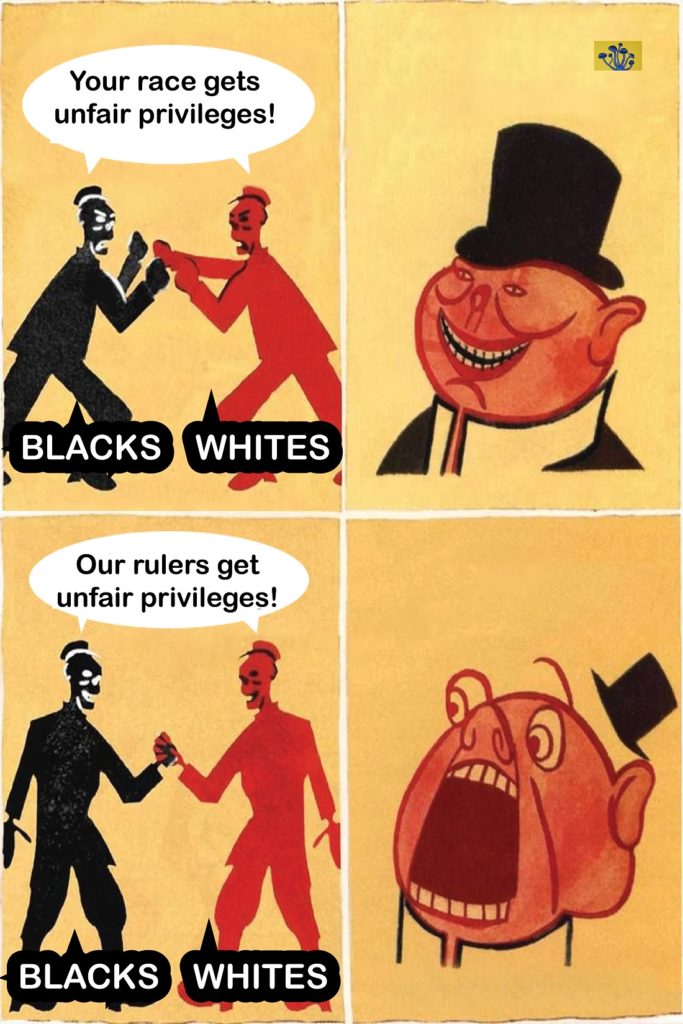
The masterstroke was to divide and conquer the workers in the exact opposite way to how they were divided and conquered before 1945. Thus, the workers never saw it coming. Whereas they were once united along ethnic lines, now they would be divided along them. Since the advent of neoliberalism, which was when the ruling class started to win back the territory they had lost over the previous 40 years, the working class has been divided among racial lines.

The secret to this has been manipulating a rise in the level of racial consciousness. The logic was that, if racial consciousness could be increased beyond a certain point, both working-class and middle-class people of the same race would come to see each other as being on the same team, and start to see people of the same class but a different race as being on a different team. With this achieved, working-class people of any race would stop fighting for their class interests.

To that end, the ruling class directed their lackeys in the mainstream media to overemphasise racial issues and underemphasise class issues. Any incident of racial conflict was magnified out of proportion and made to appear a terrible evil, while measures that damaged the working class were trivialised or made to appear inevitable (and therefore not objectionable).

Thanks to all of this, the number of people who identify with their race first and foremost has increased sharply, while the number of people who identify with their class first and foremost has decreased. People now say “If Maoris do well, then New Zealand does well,” but no-one ever says “If the working class does well, then New Zealand does well.” They used to – back in the days when class consciousness existed.

Wages were much higher back in the days when class consciousness was stronger than race consciousness, as was housing affordability, which ought to provide a couple of clues as to why it’s important. Sadly, not enough people get it.

Today, the ruling class knows that it can divide the working class neatly in two, simply by appearing to exclusively help the non-white half. They don’t have to actually help them – the Government gives with one hand and takes away with the other – they just have to give the impression that they do, and that they’re ignoring the white proportion of the working class.

As they do this, they tell the non-whites that this advantageous treatment is the result of past white racism. When the whites complain about being demonised, they’re told to suck it up because of the crimes of their ancestors. The outrage and resentment that naturally arises from this inevitably causes the working class to disintegrate from bickering. Then the ruling class laugh and go back to their gated communities.

The reality is that class consciousness is by far the greater threat to the ruling class’s stranglehold on our society than race consciousness ever could be. It allows the working class to present a united front to their rulers, which makes their negotiating position much stronger, and consequently their wages much higher.

A smart person will ask themselves, the next time they see a racial issue being blown out of all reasonable proportion in the mainstream media: what important issues is this hysteria intended to distract me from? In most cases, a small amount of investigation will reveal a class issue that our rulers would rather sweep under the rug. Racial issues were always a distraction from class issues, and the focus on them has made the working class much poorer.

*

If you enjoyed reading this essay, you can get a compilation of the Best VJMP Essays and Articles of 2019 from Amazon for Kindle or Amazon for CreateSpace (for international readers), or TradeMe (for Kiwis). A compilation of the Best VJMP Essays and Articles of 2018 and the Best VJMP Essays and Articles of 2017 are also available.

*

If you would like to support our work in other ways, please consider subscribing to our SubscribeStar fund. Even better, buy any one of our books!

How To Get Rid Of The 5% Threshold Without Empowering Extremists

New Zealand runs elections under a Mixed Member Proportional system, meaning that parties contesting the election win a number of seats in Parliament proportional to how many votes they receive. This system has advantages and disadvantages, one of the latter being that it facilitates extremists coming to Parliament. Various methods have been adopted to counter this, such as a 5% threshold – this essay suggests a more elegant solution.

As John F Kennedy warned us, “Those who make peaceful revolution impossible make violent revolution inevitable.” Although it’s never admitted, the purpose of the democratic system is to pre-empt the violence that inevitably follows when people are not given a say in their own destiny. The problem with totalitarianism is that people resent it, and if they resent it enough they end up killing their rulers.

Democracy is a charade in which the ruling class pretends to take the opinion of the working classes seriously, in exchange for a dampening of revolutionary sentiments among those working classes. If the ruling class can successfully placate the workers, then they can continue to do as they please. If they cannot, then resentment will arise, and this will eventually lead to radical extremism.

Kennedy might have warned us that a 5% threshold to get into the New Zealand Parliament creates a number of problems.

It is set so high that no new party has ever crossed it. In 24 years of MMP elections, the only parties to achieve representation apart from National and Labour were parties that broke away from them (New Zealand First and United Future from National, ACT from Labour, the Greens from the Alliance that itself broke from Labour).

The ruling class considers this a win, but the people consider it a great loss. It has meant that no opinion, other than the mainstream ones, can find expression in Parliament. Only those opinions that have been so thoroughly vetted and curated by the Establishment that they pose no threat are allowed into the House of Representatives. This does little to soothe the people’s feelings of frustration.

It could be argued that having a 5% threshold leads directly to outcomes like the Christchurch mosque shootings. The mass immigration of the last half a century has caused immense resentment among the many who have lost out from it, but their voices are silenced by a system that profits heavily from the cheap labour. Sentiments like these are liable to boil over into xenophobic violence on occasion – a pattern that has been seen all around the world.

There is a possible solution to these tensions – one that has never previously been tried. This is to firstly scrap the 5% threshold, and secondly for each voter to have three votes instead of one. Two of the votes can be cast for any candidate or party, much like the current system, but one vote can only be cast against a candidate or party. This anti-vote cancels out one of someone else’s votes for that candidate or party.

Having two positive votes, one negative vote and no threshold means that (in theory) small parties who do not engender hatred can still achieve representation in Parliament, while the extremists who do engender hatred get eliminated by the negative votes.

Parties like the Aotearoa Legalise Cannabis Party, Social Credit, or The Opportunities Party, who have unfashionable ideas but who are not malevolent or extremist, ought to be able to take some seats in Parliament. The ideas that these parties represent are long overdue for serious consideration, but the 5% threshold has prevented them from ever being represented.

Other parties like the New Conservatives, who combine popular ideas like ending mass immigration with horrendous human rights abuses like increasing penalties for cannabis use, are the reason for the 5% threshold in the first place. It was precisely to keep aggressive, narcissistic, Bible-thumping morons like them away from power that it was invented.

In practice, we could expect that parties like the New Conservatives would attract a high number of negative votes. If the total number of negative votes for a given party was greater than the total number of positive votes, they would receive no seats in Parliament. Therefore, the ability to cast a negative vote would mean that human rights abusers could be kept out of Parliament, but not at the expense of other small parties who have ideas the country needs to hear.

Then again, Germany has a 5% threshold (our version of MMP was modelled on theirs) and they have six parties currently polling well over that. So it could be argued that the New Zealand political class severely lacks imagination, which is the reason why no party other than Labour, National, Greens or New Zealand First has ever presented a compelling enough case to get over the threshold.

The positive/negative vote model would allow our electoral system to not only measure and weigh the sympathy of the public for the various political platforms, but also to measure and weigh their antipathy for those platforms. The biggest advantage with this suggestion is that platforms that inspired disgust, hatred and contempt would now find themselves judged for that, instead of getting away with it.

*

If you enjoyed reading this essay, you can get a compilation of the Best VJMP Essays and Articles of 2019 from Amazon for Kindle or Amazon for CreateSpace (for international readers), or TradeMe (for Kiwis). A compilation of the Best VJMP Essays and Articles of 2018 and the Best VJMP Essays and Articles of 2017 are also available.

*

If you would like to support our work in other ways, please consider subscribing to our SubscribeStar fund. Even better, buy any one of our books!
The Four Main Opponents Of Cannabis Law Reform

With the date for the cannabis law reform referendum now set, the battlelines have been drawn. The opposing forces have taken up their positions: the pro-cannabis forces on the side of God, and the anti-cannabis forces on the side of suffering, misery, ignorance and hate. This essay describes the four major groupings of opponents to cannabis law reform.

The first major group of opponents to cannabis law reform are simple cowards.

There’s a certain kind of person who is terrified of anything new, of any change at all – they can be called neophobic. In much the same way that a certain kind of person shit their pants at the sight of their town’s first Indian restaurant, there is a certain kind of person who shits their pants at any thought of a new psychoactive substance.

This teeming mass of sheep-like idiots comprise about half of the opponents to cannabis law reform. They also comprised a large proportion of the people who opposed homosexual and prostitution law reform, and they will comprise a large proportion of those who oppose the next change, no matter how obviously needed or overdue that change is.

The second major group of opponents are the sadists who oppose cannabis because of its healing and medicinal properties.

Hard as it may be to believe, there are many people out there who just want to create as much suffering and misery as possible, usually because it brings them a sense of gratification and power. In much the same way that sadism exists in many of Nature’s creatures, so too does it exist within the human animal. The human sadist recognises the medicinal properties of cannabis – which is why they seek to withhold it from those who would benefit.

Also in this group are the retards who will guzzle alcohol like there’s no tomorrow and belch smoke like a 19th-century factory from their cigarettes, but won’t touch cannabis on account of that it’s a “drug”. There are plenty of alcoholics out there who have boozed themselves into a state of permanent retardation, and some of these people, owing to this brain damage, support harsher sentences for cannabis users.

The third major group of opponents are the turboautists who can’t into anything as mysterious as cannabis use.

Cannabis use, like other spiritual enterprises, can be an extremely humbling experience. It can teach you that you really knew nothing about the world, and about life. The intellectually conceited sort of person, the one who has an egoic need to establish themselves as a recognised intellectual authority, has extreme difficulty with such revelations. They prefer ideological security and safety.

The intellectually arrogant are the same group of people who see all cannabis use as stupefying. They can’t get their heads around the truth of it because there are no recognised peer-reviewed journals on the subject. For these people, all talk of spirituality is mental illness, and so if smoking cannabis leads to a person talking about God, then smoking cannabis drives people crazy. They don’t want legal cannabis because it shows them up as the spoofers they are.

The final major group of opponents are the spiritual liars.

Cannabis is a spiritual sacrament, and has been used continuously for thousands of years for this purpose. Unfortunately, a great number of people in the West today are spiritually dead. Not only do they not believe in God, but they believe that death is the end on account of that the brain generates consciousness. This is not a natural state of affairs – it is because they have been lied to.

There are spiritual criminals out there who earn a living from withholding from people the truth about God and about consciousness, and then selling some watered-down, padded-out, corrupted version of it for a fee. These criminals have always tried to establish themselves as intermediaries between the people and God, and in order to make this profitable they have needed to destroy all true spiritual movements and methodologies.

These criminals recognise that cannabis makes their position untenable, on account of that it’s a spiritual sacrament that leads people to God directly. Consequently, they act to keep cannabis illegal, for the sake of holding people in a state of profitable ignorance.

These four groups cover the basic emotions that motivate people to oppose cannabis law reform: fear, cruelty and ignorance.

Some people fall into more than one of these groups. Many pretentious intellectuals are also cowards who don’t dare to step outside of well-travelled paths; many religious fundamentalists are also sadists. Someone like Bob McCoskrie might fall into all four: the pants-pissing, shit-talking, hippie-bashing religious bigot is almost the archetypal prohibitionist.

Changing the attitudes of anyone in one of these four groups is easier said than done.

There isn’t much that can be done to persuade the cruel and the evil, because the more information you give them, the more power they have to cause suffering. Those who are ignorant can be persuaded of the merits of cannabis law reform by appealing to the successful examples of reform overseas. Those who are cowards can be persuaded by showing them the rest of the herd changing their direction.

Ultimately, cannabis will continue to be used more by Maoris, by young people, by non-Christians and by freethinkers, and so anyone who hates one or more of those groups will tend towards opposing cannabis law reform out of spite. Anyone not motivated by hate, but rather by honest ignorance or naivety, can easily be persuaded to see how cannabis prohibition isn’t in their best interests.

*

Vince McLeod is the author of The Case For Cannabis Law Reform, the comprehensive collection of arguments for liberalising New Zealand’s cannabis laws.

*

If you would like to support our work in other ways, please consider subscribing to our SubscribeStar fund. Even better, buy any one of our books!

Clown World Chronicles: What Is A ‘NEET’?

As mentioned in the chapter about behavioural sinks, one of the common phenomena of Clown World is withdrawal. When society just seems absolutely fucked, and no effort to fix it seems like it could pay off, the logical thing to do is to withdraw. This article discusses the modern phenomenon of the NEET, and where it might lead.

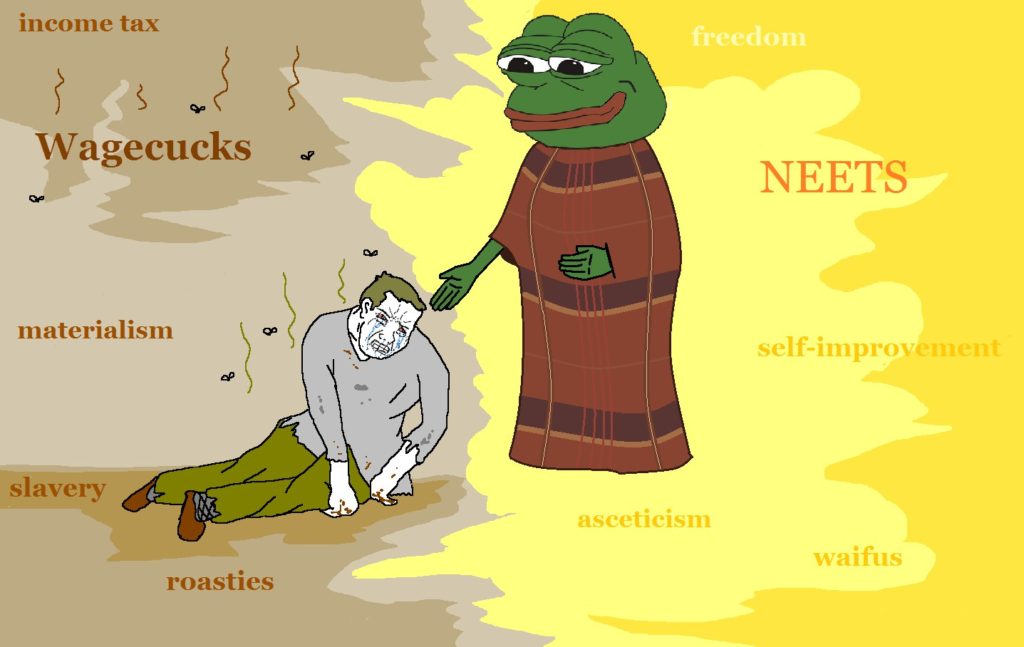
‘NEET’ stands for ‘Not in Employment, Education or Training.’ It refers to people who don’t have an occupation. There are essentially two ways to be a NEET: live off your parents or live off welfare.

Living off your parents is the middle-class way to be a NEET. Usually, if your parents are stable and successful, they have a spare room at their house that you can live in rent-free. If they have enough income of their own they might even pay for your board. In such situations, a person can live almost indefinitely.

Living off welfare is the lower-class option, on account of the extra grief that comes with it. This is known as “receiving NEETbux”. One way to achieve this involves going on the dole, or unemployment benefit. This is not an easy option, because it doesn’t offer anywhere near enough money to be happy. It’s also not easy to make it permanent, and a permanent passive income is the holy grail of NEET life.

The increasingly popular option is to claim a disability allowance on the grounds of having a mental illness. The bizarre paradox here is that any genuinely sane person, when exposed to Clown World, will become insane. The only people that can cope with Clown World are the ones that were defective from the beginning. Consequently, an element of Catch-22 exists when it comes to who’s sane.

Some kind of “mental illness” accounts for most NEETs. Although these people are labelled mentally ill, their thoughts and behaviours are often rational and logical reactions to living in Clown World. The demands of the modern workplace are such that not everyone’s mental health can cope, and many people don’t even make it that far, having been driven insane by the school system.

A NEET is very similar to what used to be called a recluse. In Japan, where the phenomenon is very common, such people are known as hikikomoris. It’s someone who has withdrawn so much from society that they’re hardly even part of it anymore. Not in employment, education or training is another way of saying “dropped out”. It’s for people who no longer give a fuck.

In practice, most NEETs are men, for a variety of reasons. For one thing, society values young men less than young women, which incentivises young men to withdraw. For another, young men are much more likely to suffer from the autism that is commonly the ultimate reason for NEETdom.

Although the NEET is stereotyped as having a great life, sitting comfortable while wagies slog their gutses out, in reality NEETlife is mostly wretched.

On a metaphysical level, it’s extremely difficult to live without a sense of purpose. The NEET spends much of his time watching porn and playing vidya, and neither of these activities are fulfilling in any sense. NEETlife is kind of like an extended childhood, particularly when it’s adopted by a young person who never gave adult life a serious crack.

On a psychological level, NEETlife doesn’t provide that which is known to make people happy. Sigmund Freud once said that the formula for happiness was to love and to work. The NEET has extreme difficulty on both counts.

Not working makes it really hard to attract women. Consequently, very few NEETs have quality lovelives. It’s possible to tinderwhore as a NEET but, because the vast majority of sexual encounters happen between people in at least semi-committed relationships, and because women don’t like to form relationships with unemployed men, quality sexual encounters are rare.

Not working also makes it hard to have a social life. Because human existence in Clown World has been reduced to little more than an economic production engine, people are defined by their jobs, and social circles are commonly restricted to workmates only. These two difficulties strongly interplay with each other – a great many relationships form through friends of workmates.

The ultimate question for the NEET is: have I dropped out of society because I am too weak to cope with it, or because society is too shit to be worth engaging in? Either answer could be correct, depending on the individual in question. Some people just don’t give a fuck, others make a genuine and prolonged effort to fit in but just find society too fucked.

The NEET epidemic, like the incel epidemic, shows no sign of abating. As Clown World becomes ever more ridiculous, and as society drifts ever further from reason, an increasingly large number of people will end up dropping out. As shown by the behavioural sink studies mentioned in the opening paragraph, Clown World will probably get worse and worse until one final, glorious climax. The NEET epidemic may play a contributory role here.

*

This article is an excerpt from Clown World Chronicles, a book about the insanity of life in the post-Industrial West. This is being compiled by Vince McLeod for an expected release in the middle of 2020.

*

If you would like to support our work in other ways, please consider subscribing to our SubscribeStar fund.