
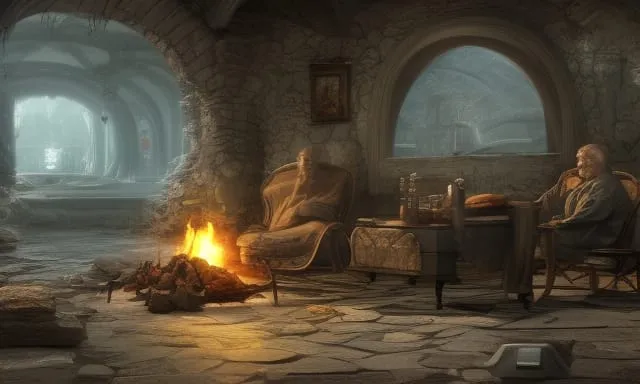
Mythologising Retirement

Such a great portion of our human lives involves paid work. There is an important sense in which we have been convinced that the ultimate goal of work is to pay off our debts, only to then retire. There is value in challenging the assumptions beneath this kind of myth, because so much of our lives are invested in what is at stake. Unless we come to a very clear understanding of what it is that we feel and what the outcomes are of our participation in this life, we will never arrive at any kind of satisfactory point, nor will we have divined any beneficial understanding of our place in the world.

Firstly, we have inherited a cultural premise that tells us that ultimate well-being can be postponed to the future. This is a very large assumption with far-reaching implications.

Your learned capacity to be happy in the future is a clear reflection of how you have learned to be happy now. Obviously, when the future seems to have arrived, that will also be ‘now’, so your appreciation of your present environment must be managed skilfully. 

Have you ever come across people who are retired who cannot stop for one moment? The garden, the housework, the motorhome. These people are continuing the education of a lifetime of work, which is an ethic of keeping busy. People will object: ‘What is wrong if this is what they want?’, but do we really know what we want? Do we know what is best for us, and where we may have misunderstood?

For example, there is hidden assumption that many people have accepted which is that a lifetime of work is also a lifetime involved with suffering, therefore retirement from working life will also equate to retirement from a lifetime of suffering. Just how true is this assumption? It is true that much work, being the expenditure of effort under often physically or mentally stressful conditions, can promote much in the way of personal suffering.

What a lot of people fail to see is that leaving daily work behind is allowing the departure of only one source of suffering, it is not a salvation from suffering as a whole. In fact, the point at which we are accepted to have earned the right to withdraw from a lifetime of work is also the same point at which our mind as well as our physical body is beginning to deteriorate, marking the onset of all kinds of potential physical and medical challenges.

Suffering still follows at our heels from other sources, most notably the illness and death of friends, peers and loved ones who are also subject to the ravages of time. In this respect, retirement enjoys the benefit of a kind of afterlife mythology, in which all of our pain and effort on a daily basis will one day be ultimately vindicated and returned in full measure.

This raises an alarming question: just how much daily tolerance of misery does this mythology support? How many of us are laboring under the illusion that all of our effort is guiding us toward somewhere ultimate where we will have eternal peace and we can finally kick up our heels?

I share a couple of examples of this from my own life which I believe touch upon something relevant here.

I have a friend whose father is in his seventies, and despite remaining reasonably physically fit, he still works himself to the bone every day of his life. He is still in full time employment, despite that fact that he has been given the nod of approval that he could leave his work if he wanted to. Now, you might say ‘If he is doing what he wants to, why not?’ And I would naturally agree, except that all he ever seems to talk about is how much of a welcome change it is going to be when he finally retires.

This poses an odd kind of paradox in which he is on the cusp of retirement, and really past his culturally accepted retirement age, but the actual notion of stopping work seems to terrify him. His insistence on the myth of retirement has been well noted – he has waxed eloquent about the benefits of not having to get up in the morning, to not have to do anything, to have the freedom to kick back with a beer in his hand and watch TV (incidentally, this mythology is also recounted in minor form in the notion of the weekend, almost like a mythic foretaste of Valhalla).
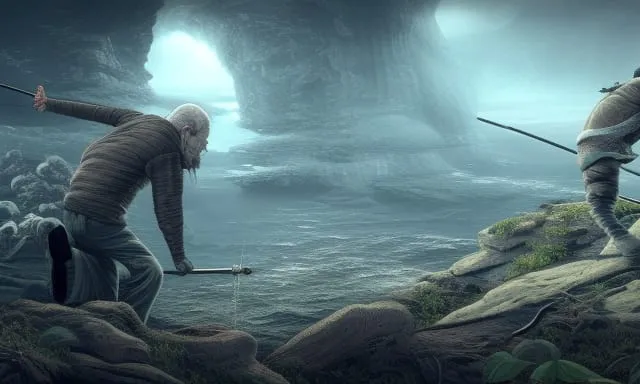
The sad irony is, these are things he has not given himself the permission to enjoy. He may literally never arrive at the point at which he is comfortable with letting go of the ethic of early rising and hard work before he dies. To have lived this way for over seventy years, with no substantial appreciation for being able to allow himself to get a real break, is quite a confounding and yet exceptionally ubiquitous social phenomenon.

We could surmise it comes down to a person’s character and their ethos of being a hard worker, which unsurprisingly is a highly respected social value in any country. It could also be that like the rest of us, he has been successfully indoctrinated into a program of lifelong drudgery, being strung along by an imaginary dangling carrot.

Another example I will give was when I was working out of town one day, an older man came up to me struggling to walk with a stick and specifically wanted to tell me his story. We were the only two people around for at least a kilometer, and he specifically made the effort to approach me from a distance of about three hundred meters.

He told me that he was a keen hunter and fisherman, and that shortly after retiring, he had experienced a stroke which meant that there was no aspect of his retirement he felt he could enjoy. He told me that he worked his whole life, expecting to be able to retire and do what he wanted, except now he felt he had been cheated out of it.

While I don’t believe there is nothing he could have left of value in his life, the fact remains that we do place an inordinate amount of good faith in the application of effort over decades of our lives hoping to have something tangible to show at the end of the process. How does this contribute to us putting off our lives now, and how are we foregoing our responsibility to live wisely and skilfully today?

Are we collectively so enamoured by the prospect of the future holding some form of salvation, either material or spiritual, that we can justify subjecting ourselves to misery today? What would we do differently today, what changes would we be willing to allow in our lives if we discovered the possibility that our imagined future with its ease, relaxation and distance from suffering would never eventuate?

*

Simon P Murphy is a Nelson-based esotericist and philosopher, and author of His Master’s Wretched Organ, a brilliant collection of weird fiction stories.

*

If you enjoyed reading this essay/article, you can get a compilation of the Best VJMP Essays and Articles from 2021 from Amazon as a Kindle ebook or paperback. Compilations of the Best VJMP Essays and Articles of 2020, the Best VJMP Essays and Articles of 2019, the Best VJMP Essays and Articles of 2018 and the Best VJMP Essays and Articles of 2017 are also available.

*

If you would like to support our work in other ways, subscribe to our SubscribeStar fund, or make a donation to our Paypal! Even better, buy any one of our books!
Are (You) A Domestic Terrorist?

The New Zealand Government took another leaf out of the authoritarian playbook recently. The NZ Security Intelligence Service (NZSIS) published a guide for Kiwis keen to rat out one of their friends or neighbours for wrongthinking. Titled ‘Know the signs – A guide for identifying signs of violent extremism‘ (link goes to .pdf), the booklet marks another step in New Zealand’s descent into dystopia. VJM Publishing examines.

The document opens with a foreword by the ghoulish Director-General of the NZSIS, Rebecca Kitteridge. She explains that the NZSIS wants “to help New Zealanders feel more confident about stepping forward” to rat out their friends and neighbours. Apparently this is necessary in order to combat violent extremism, as one of the NZSIS’s core missions “is to detect violent extremists”.

The reader must note here that violent extremist has a very specific definition (as we will get to later). Mongrel Mob members, for example, are not considered violent extremists. The Government is happy to let violent extremists run free if they’re in gangs, because gangs mostly prey on working-class people. The NZSIS is after a different sort of violent extremist.

“We all have a role to play in keeping each other safe,” Kitteridge proclaims. To that end, we’re all obliged to report to the NZSIS any behaviour that might be concerning. “If you see something, say something,” the booklet demands, in an ominous echo of the wartime admonitions to help uncover enemy spies.

On page 6 it states the NZSIS’s wish for people “to report any behaviours or activities they come across that resemble any of the indicators described in this guide, or that feel concerning.” As we will see, the net has been cast so wide that almost every Kiwi with an original thought is now a suspected terrorist.

On page 8 we are informed that “Extreme ideologies can be based on faith, social or political beliefs that exist on the fringes of society, outside the more broadly accepted views and beliefs of most people.” This normative approach to extremism reveals that Kitteridge and the NZSIS are doing the Establishment’s bidding. If society believes that the Earth is flat, then saying it’s round is extremism.

More alarming is the assertion that violent extremists may seek “to create a community based on their ideology.” The fact is that you, the reader, are a head of human livestock, and you’re not allowed to seek out self-governance, any more than a slave is allowed to leave a plantation. Your community is that of the New Zealand Government, and they speak for you, as the sole source of truth.

The booklet gives the game away when it says “Extremists may seek to radically change the nature of government, religion or society.” This demonstrates that the NZSIS has no interest in truth, freedom or justice. Their interest is simply to maintain the status quo. Therefore, whoever has power is assumed to deserve to have power. The NZ Government is infallible, and so anyone wishing to radically change it is an extremist.

We are warned that “Violent extremists take these ideologies further and justify using violence to achieve radical changes.” Note that only violence used to achieve radical changes is considered bad. Violence used to maintain the existing order is of no concern. As such, the Government’s violence against the people, such as during the Wellington Protest or during the War on Drugs, is of no concern here.

The real material of interest begins on page 12, with the section titled ‘The indicators of violent extremism’.

Under ‘Mindset and ideology’, the booklet asks us to watch out for the person who “Consumes violent extremist videos, media, music or messaging”. The irony here is that the vast majority of violent extremist media consumed in New Zealand is consumed through watching the television news, and Normie television-watchers are far more dangerous than anyone else.

On that topic, we’re told to watch out for the person who “Develops a hostile ‘Us-Versus-Them’ worldview” and who “Makes dehumanising, hostile or violent statements against individuals or groups they perceive as ‘the enemy’ or the ‘other’.” Never in New Zealand history were people dehumanised as much as people who didn’t take the Coronavirus vaccine were in recent years – but the NZSIS isn’t interested in that.

Under ‘Association and relationships’, we’re told to watch out for anyone who “seeks a following to promote their cause.” Realistically this means anyone with even the remotest chance of having successful political influence. The subtext of this booklet is by now becoming clear: anyone who doesn’t submit to The Powers That Be is a security concern.

Even more worrying is being asked to watch out for anyone who “Becomes involved in a group […] where extremist ideas are discussed.” No VJM Publishing Chan Chat TeleGram channel. No 4chan. Not even an Aotearoa Legalise Cannabis Party forum. No politics are to be discussed by you at all, pleb! Just turn on the television and receive your thoughts for the next 24 hours.

Under ‘Research and planning’ comes the warning to watch out for anyone who “Searches for offshore conflicts related to their ideology.” So anyone with an interest in history is now a terrorist suspect. If you want to broaden your knowledge of the practical realities of your ideology – terrorist. Interested in World War Two? Terrorist.

After these hysterical and paranoid sections come a couple of sections of sanity. Under ‘Gathering knowledge, skills and resources’ the booklet asks us to look out for anyone who “Suddenly or unusually develops a stockpile of knives, firearms or explosive materials.” Under ‘Preparation’ it calls for us to be wary of anyone who “Declares intent to conduct a terrorist or violent extremist act.”

Entirely reasonable – but this hardly had to be asked for. Surely any sane person would contact the authorities if they heard someone else say they were going to commit an act of terrorism?

The next section, ‘Security awareness’, returns us to the madness, asking us to watch out for anyone who “Uses fake names, aliases or pseudonyms when online or within specific communities” (90% of Internet users) or “Creates exclusive groups on secure forums or messaging apps” (80% of Internet users). Again the common refrain: almost any of your neighbours, friends or workmates could be a terrorist waiting to strike.

Even more psychotic is the request to watch out for anyone who “Becomes secretive about their activities with associates” or “Provides limited or false information when questioned about future plans”. In Ardern’s New Zealand, just like in East Germany under the Stasi, secrecy is itself guilt. If you don’t want people prying into your affairs, you’re a terrorist suspect.

Hilariously, this section comes with a proviso that security awareness on its own is not enough to suspect that a person might be a terrorist. The obvious reason for this is because almost all NZSIS officers themselves would fall foul of almost all criteria here (which is why you’ve never spoken to an NZSIS officer using their real name on the Internet).

The final section, ‘Unusual changes in behaviour’, asks us to keep an eye out for basically anyone with a mental illness. Actions such as “Withdraws from or abandons close relationships”, “Appears withdrawn or prone to sudden outbursts” and “Stops participating in regular and established commitments” are all classical signs of depression or anxiety, which most of us are suffering from acutely in the 22nd year of Clown World.

In summary, the ultimate effect of this document will be to spread suspicion, mistrust, hate and fear between and among all communities in New Zealand. This may have been its intent, or the Government might still be chimping out in the wake of the Christchurch mosque shootings.

*

If you enjoyed reading this essay/article, you can get a compilation of the Best VJMP Essays and Articles from 2021 from Amazon as a Kindle ebook or paperback. Compilations of the Best VJMP Essays and Articles of 2020, the Best VJMP Essays and Articles of 2019, the Best VJMP Essays and Articles of 2018 and the Best VJMP Essays and Articles of 2017 are also available.

*

If you would like to support our work in other ways, subscribe to our SubscribeStar fund, or make a donation to our Paypal! Even better, buy any one of our books!
Anti-Racism Viewed From The Working Class

Growing up in Nelson last century, I was acutely aware of the class structure of society and my place at the bottom of it. Being the son of a gang member and the nephew of another gang member, and seeing other family members get institutionalised for various feral activities, it was clear to me from an early age that society at large was implacably opposed to my sort of person.

I went to university and started studying history, and reading Marx, and realised that history can be understood as a battle between the moneyed classes and the working classes, and that moneyed people have always used their wealth to extort production out of desperate workers.

Studying developmental psychology, I came to realise that some people join gangs because they’re born into hopeless poverty and can only look forward to a life at the bottom of society, having every dollar of their labour wrung from them in profits, taxes and rents. This supported the class narrative that I had learned from studying history. It seemed that the ruling class really were waging a class war on the lower classes – and winning.

It has been astonishing, then, to see the narrative change over the past two decades. Class narratives have completely fallen out of fashion in favour of race narratives. This has come at great expense to the working class, who have seen their class solidarity destroyed, and at great benefit to the ruling class, who have seen the foundations of their enemies shattered.

The social justice warrior who fought to break down class barriers a generation ago is now an “anti-racist”. Instead of helping poor people overcome the class prejudices that were holding them back, social justice warriors today are obsessed with racial equity. Inevitably, this means lifting up brown or black people, however wealthy, and ignoring white people, however poor.

Today, thanks to the “anti-racist” mindset, a working-class white is considered an oppressor. The working-class element of their identity is no longer considered important. The white element, on the other hand, weighs more heavily than ever. So a person can be born into intergenerational poverty, with crime, trauma and mental illness ever-present in their childhood environment, and still be considered privileged.

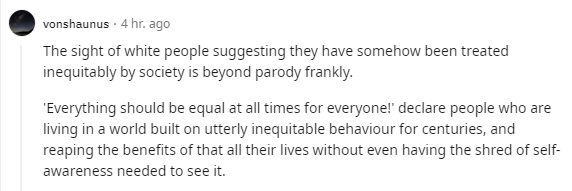
Apparently the entire world has been rigged in my favour for centuries, as the Reddit commentator at the top of the page believes. Even though my great-grandfather was used as cannon fodder in World War I, and my grandfather was used as cannon fodder in World War II, and my father was a gang member, all of the intergenerational trauma inherited from that is as nothing because I have white skin.

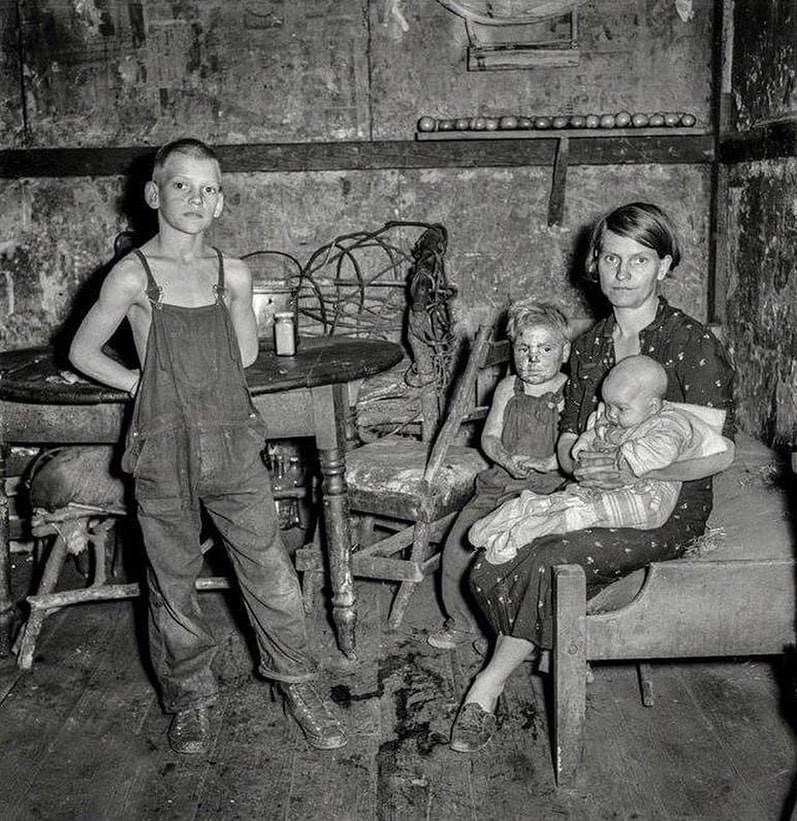
Apparently the white men who were conscripted into service killing the enemies of the New Zealand ruling classes in World Wars One and Two were, in fact, themselves privileged. The working-class whites who worked long days in brutal conditions as miners (one such family pictured below) were likewise privileged, beneficiaries of a system rigged to benefit them.

Imagine my disgust, as a white working-class person, to encounter narratives like those above.

The truth is that the political Establishment has never, ever been in favour of white people as a whole. It has only ever served the interests of the ruling classes. It only ever will serve the interests of the ruling classes. The white working class has never had a seat at the table, except for one brief window between the formation of Western labour movements and their destruction by identity politics.

But today’s popular narrative is that the white working-class has, in fact, been part of the ruling class all along. If an individual white working-class person or family was still poor, it was because they had failed to take advantage of the opportunities presented to them by structural racism, a force even more powerful than compound interest. They are, therefore, losers and wasters as well as oppressors.

The result of this shift in narrative is that working-class whites no longer have a voice in New Zealand. The New Zealand Labour Party, which had championed the working-class since its inception, has now completely abandoned the white part of it in favour of a “Maori caucus”. National and ACT still represent the rich, and the Greens want to kick the New Zealand working class in the guts by raising the refugee quota.

Because working-class whites don’t have a voice in New Zealand, no-one is explaining our perspective for others to understand. So people usually aren’t aware that we don’t consider ourselves part of the control system or the Establishment. In fact, we are its original enemy. Centuries before the British control system had ever enslaved an African, it had enslaved us.

Many New Zealanders are descended from people who were driven off their land by the Crown in the Highland Clearances. This puts many of us in the same category as the Maoris who were driven off their land by the same Crown. The true, unspeakable narrative is that all elements of the New Zealand working-class are on the same side – and the promotion of “anti-racism” is specifically intended to divide us.

As a working-class white who was raised by a Ngati Porou grandmother, and who has several cousins who have married Maoris and had children with them, it’s impossible for me to look at a working-class Maori and see a racial enemy. In fact, I recognise the true enemy of my kind as those trying to divide us and set us against each other: the globalist alliance of capitalists and Commies known as globohomo.

As a working-class white man, those bleating about the need to fight racism are my enemies, whether they realise it or not. These bleaters – inevitably from comfortable middle-class families – have destroyed the working-class solidarity that had seen us make great progress in the century leading up to neoliberalism.

Anti-racism, like feminism and other attempts to push idenitity politics, are narratives designed to divide and conquer the working class. As such, I reject all of them.

*

If you enjoyed reading this essay/article, you can get a compilation of the Best VJMP Essays and Articles from 2021 from Amazon as a Kindle ebook or paperback. Compilations of the Best VJMP Essays and Articles of 2020, the Best VJMP Essays and Articles of 2019, the Best VJMP Essays and Articles of 2018 and the Best VJMP Essays and Articles of 2017 are also available.

*

If you would like to support our work in other ways, subscribe to our SubscribeStar fund, or make a donation to our Paypal! Even better, buy any one of our books!
Why Are Gang Members Platformed While VJM Publishing Is Cancelled?

Those who follow the NZ media scene may have noticed something unexpected: gang members getting platformed while VJM Publishing gets deplatformed. Why would murderers and rapists be given a voice in the mainstream media, while a non-criminal speaker of multiple languages with a postgraduate science degree is denied one? This essay explains.

Most consumers of media assume that the purpose of the mainstream media is to inform the masses. This is incorrect. This belief is naive, almost childish. The reality is that the purpose of the mainstream media is to shape public opinion. To that end, they platform people who help shape the desired narratives and they deplatform people who don’t.

Whose desired narratives? As explained in Clown World Chronicles, the current rulers of the world are known as globohomo, an alliance of international banking and finance interests (on the right) and globalist Commies and cultural Marxists (on the left). The globohomo alliance (a.k.a. the Globohomo Gayplex) wants the same thing as every other tyrannical, authoritarian ruler throughout history: submission.

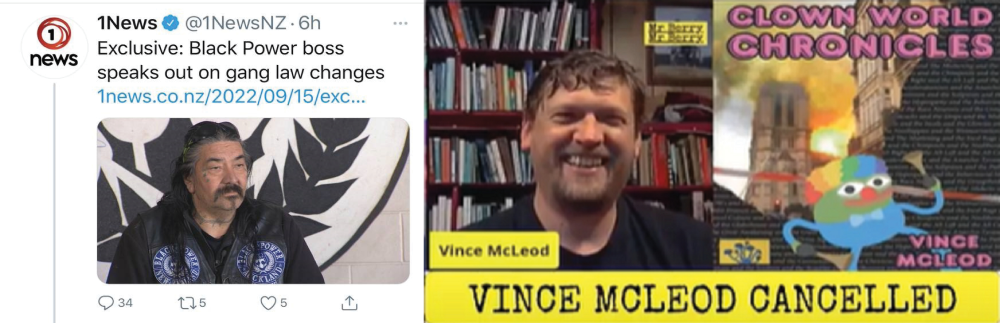
This explains why gang members, like the Black Power boss pictured above, are platformed in the mainstream media.

As anyone familiar with gang members will know, they almost always prey on vulnerable people. This means the poor, the sick, the elderly or the young. Very seldom do they inconvenience middle-class people and never would they touch a member of the ruling class.

As such, gang members aren’t a threat to the people who own the mainstream media. To the contrary. Gang members spread fear and terror in the communities who would otherwise be most likely to come together to oppose Establishment oppression – the working classes and the disadvantaged. Those very same revolutionary elements that threaten tyrants everywhere are weakened by the presence of criminals.

As Ted Kaczynski said, “[the system] needs people who are docile and obedient and don’t make trouble.” The most effective way to create such a populace is fear. Gangs spread fear more effectively than almost anything, and that fear leads to paralysis in the face of authority. It’s a bitter pill to swallow, but it has to be accepted that gangs are a weapon of the Establishment, and they ultimately do the bidding of the Establishment.

VJM Publishing, by contrast, fights for the vulnerable. Our pages are full of essays and articles that champion the worker, the freethinker and the spiritual sacrament user. We openly state the very last thing things that the Establishment wants to be known: that consciousness survives the death of the physical body and that there’s nothing, fundamentally, to be afraid of.

This makes us an actual threat. The spiritual truths about the nature of reality are the most liberating things of all. Anyone who is truly aware of the immortality of the soul also understands that nothing that the Establishment can threaten us with in this life is truly terrible. Anyone who knows this can laugh off the fear-mongering propaganda that the mainstream media vomits out to keep us submissive.

The fact that we can back up our assertions with facts and evidence makes us a major threat. In fact, VJM Publishing articles are far more likely to reference actual scientific literature than any of the mainstream media. This is because VJM, having earned a postgraduate degree in psychology, actually understands the science, unlike the mainstream media presstitutes who just parrot whatever powerful people say.

Any intelligent and objective person would be more inclined to believe something VJM Publishing wrote than to believe something in the mainstream media. So the very presence of an outfit like VJM Publishing costs the Establishment millions of dollars per year through neutralising their propaganda.

As Josef Goebbels understood, even one single voice counter-signalling mainstream propaganda is enough to make people start asking questions. That’s why authoritarians all throughout history have made sure to control the narrative.

This is why TradeMe was hounded by far-left extremists into refusing to sell Clown World Chronicles on the grounds that it’s racist (while continuing to sell Mein Kampf). Clown World Chronicles is the most accurate criticism of the Western political Establishment ever written by a New Zealander, and that simply could not be permitted by that Establishment and their Antifa lackies.

In summary, gang members are platformed because they spread fear, mistrust, suspicion, hysteria and division, all of which serve the interests of those who own the mainstream media platforms. VJM Publishing’s message of good news, by contrast, directly opposes those interests. As such, we must remain underground while murderers and rapists are given centre stage.

*

If you enjoyed reading this essay/article, you can get a compilation of the Best VJMP Essays and Articles from 2021 from Amazon for Kindle or Amazon for CreateSpace (for international readers), or TradeMe (for Kiwis). Compilations of the Best VJMP Essays and Articles of 2020, the Best VJMP Essays and Articles of 2019, the Best VJMP Essays and Articles of 2018 and the Best VJMP Essays and Articles of 2017 are also available.

*

If you would like to support our work in other ways, subscribe to our SubscribeStar fund, or make a donation to our Paypal! Even better, buy any one of our books!