
Where In The World Does New Zealand Rank On Cannabis Law Reform?

New Zealand was once looked to for moral leadership. We were the first country to give women the vote and the first to institute a universal old-age pension, but these were 19th Century issues. On 21st Century issues, such as cannabis law reform, we are no longer close to the frontrunners. This article attempts to determine how far we have fallen.

Perhaps the first major crack in the cannabis prohibition dam came with the legalisation of medicinal cannabis in California in 1996. In the near quarter-century since then, a tidal wave of cannabis law reform has rolled around the world. New Zealand has made a determined attempt to resist this wave, and has stayed loyal to the idea that cannabis users are scum who should be persecuted.

Cannabis is now recreationally legal in California, as it is in Alaska, Colorado, Illinois, Maine, Massachusetts, Michigan, Nevada, Oregon, Vermont, Washington and the District of Colombia. That makes for 12 places in just one country that are more enlightened than New Zealand on the cannabis issue – over 100 million people.

Even if a person would say, uncharitably, that all these places are just one country, there are now several other countries that have legalised recreational cannabis. Uruguay did so in 2013 and never looked back. Canada did so in 2018. Georgia and South Africa have also legalised recreational cannabis for possession and consumption (although not yet for sale).

So that makes five countries that have legalised recreational cannabis to some extent – but they’re not the only ones ahead of New Zealand on cannabis law reform.

Many other countries have legal arrangements where cannabis is tolerated without being fully legal. The most famous example is the Netherlands, where cannabis is openly sold from licensed cafes, on the proviso that the cafe is willing to operate under a strict set of conditions. This is not de jure legal, but there is an understanding on the part of the Police that such activity is to be tolerated (provided it stays within certain limits).

Spain has a similar arrangement, where cannabis is legal if kept to private areas such as the personal home or in cannabis social clubs. In this sense, many countries have decriminalised cannabis to a greater extent than what New Zealand has done.

Antigua and Barbuda, Argentina, Austria, Barbados, Belgium, Belize, Bermuda, Bolivia, Chile, Colombia, Costa Rica, Croatia, the Czech Republic, Ecuador, Estonia, India, Israel, Italy, Jamaica, Luxembourg, Malta, Mexico, Moldova, Nepal, Paraguay, Peru, Portugal, Saint Kitts and Nevis, Saint Vincent and the Grenadines, Slovenia, Switzerland and Trinidad and Tobago have all decriminalised cannabis to some degree.

It might come as a blow to the Kiwi ego that several Third World countries are now more advanced than us when it comes to a major moral issue such as cannabis law reform. But it gets worse – even Australia is ahead of New Zealand in this regard now. Cannabis will be legal in the ACT as of next week, and it has already been decriminalised in the Northern Territory and in South Australia.

So that makes 40 countries that have either legalised or decriminalised cannabis to some degree – but the true picture is even worse than this, because New Zealand doesn’t even have medicinal cannabis yet.

Since becoming legal in California 24 years ago, medicinal cannabis has now become legal in a further 32 American states and four territories. Even if we apply the rule from above (according to which all these states and territories only count as one country) there are still many other countries with more tolerant medicinal cannabis laws than New Zealand.

Even Zimbabwe has more enlightened medicinal cannabis laws than New Zealand does – they legalised it in 2018. It might sound incredible to some Kiwi ears that a place with the reputation for corruption and backwardsness of Zimbabwe could be ahead of New Zealand in a major area of medical knowledge. Alas, it’s the truth.

In reality, every single country already mentioned is ahead of New Zealand when it comes to cannabis law reform. We have neither legalisation nor decriminalisation of recreational cannabis, and medicinal cannabis is de facto illegal on account of that virtually no-one can afford what’s on offer.

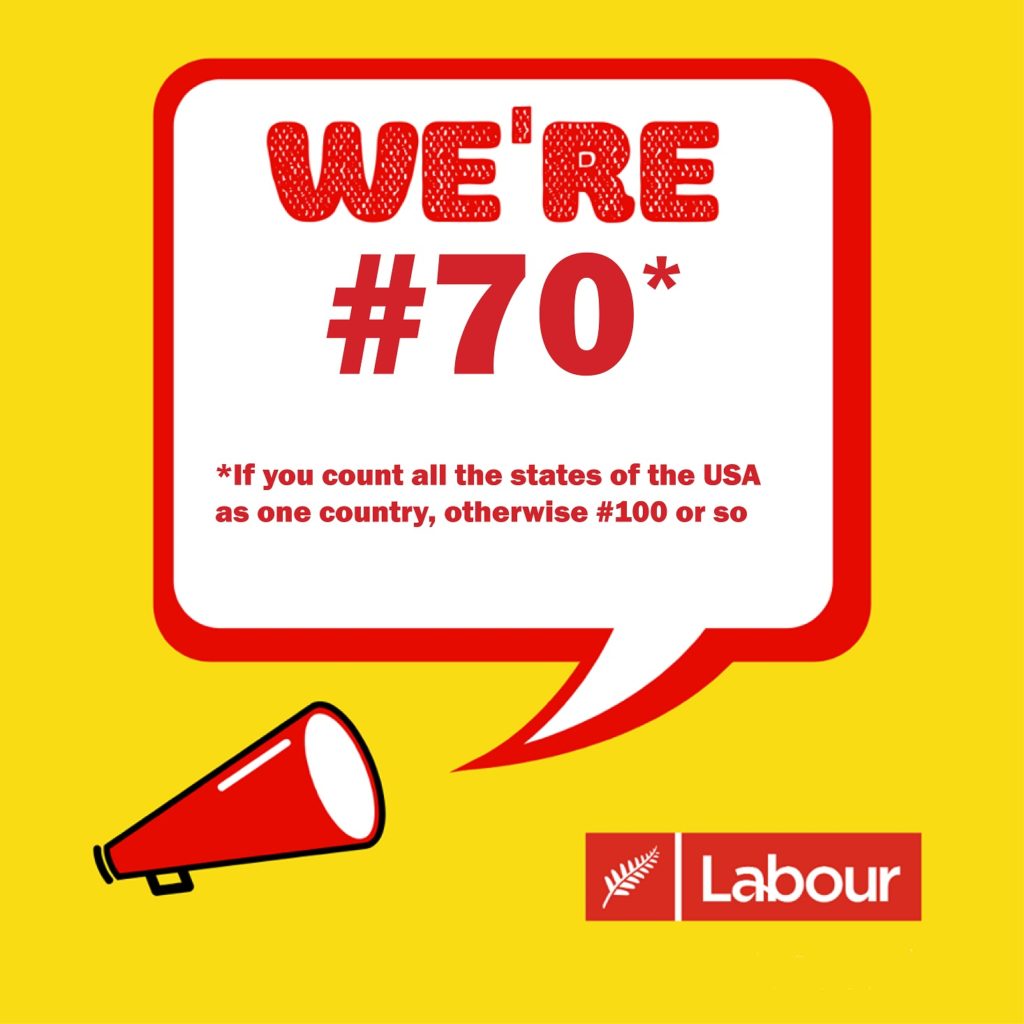
We were first in the world to repeal the prohibition on women voting. When we eventually get around to repealing elements of cannabis prohibition, we will be no earlier than 70th in the world to have begun to do so. If you count the American states separately, New Zealand will be no earlier than 100th or so.

It might not be easy for the Kiwi ego to accept, but not only are we years behind backwards American states like Louisiana and Alabama, but we are also years behind Third World nations such as Uruguay, South Africa and Zimbabwe. If we ever had any special ability to read the winds of change, or to provide moral leadership to a world desperately in need of it, that is now gone.

By 2020 New Zealand is, morally speaking, right back in the pack. Far from being leaders, we now respond with sheep-like herd instinct to patterns that we’re not intelligent enough to understand. The only way to lift this state of disgrace is to legalise cannabis immediately and across the board.

*

If you enjoyed reading this essay, you can get a compilation of the Best VJMP Essays and Articles of 2019 from Amazon for Kindle or Amazon for CreateSpace (for international readers), or TradeMe (for Kiwis). A compilation of the Best VJMP Essays and Articles of 2018 and the Best VJMP Essays and Articles of 2017 are also available.

*

If you would like to support our work in other ways, please consider subscribing to our SubscribeStar fund.


The Gentlemen Shows That The Normalisation Of Cannabis Is All But Complete


Guy Ritchie’s latest crime caper film, The Gentlemen, is the rollicking, romping gorefest that one has come to expect from the director of Snatch. Behind the larger-than-life characters and the brilliant dialogue, however, are a few hints about where society is going, and a few things made to look normal that aren’t usually normalised. This article explains.

Cannabis users who stopped to think about it may have noticed a few things in The Gentlemen that are different to the usual messages contained within big-budget films. Normally alcohol, tobacco, adrenaline and oxytocin are all portrayed as acceptable forms of enjoyment, but cannabis is not. Cannabis tends to get lumped with opium and heroin as a drug of despair.

The hero of the story, Mickey Pearson, is a British cannabis tycoon. The character, played by Matthew McConaughey, is in charge of an empire that produces 50 tons of skunk every year. Yes, he has done some bad things on the way up through the underworld, but he’s very much a moral player, someone with far more class than the average criminal.

This weed-dealing protagonist is presented as the good guy, who the audience is invited to sympathise with. Not a good guy – because he’s certainly capable of violent crime still – but the good guy. This makes a change from the usual popular culture treatment of cannabis users. Aside from this central fact, several scenes in the film serve to normalise the idea of cannabis in the eyes of the audience.

In one scene, Mickey speaks to a Chinese gangster and heroin dealer named Lord George. Mickey makes the point that the drug he himself deals doesn’t kill anyone, unlike the heroin that George deals. It’s uncommon for a popular culture film to draw a distinction between cannabis dealers and “other” drug dealers. Usually the two are lumped in together, but here Lord George is presented as distinctly less moral than Mickey.

In another scene, Mickey’s henchman Ray (played by Charlie Hunnam) smokes a joint while expressing his disgust for heroin users. While rolling it up he expounds upon his weed preferences, including his belief that the right mixture of cannabis and tobacco is 50:50. In this scene, we are invited to sympathise with the cannabis-smoking Ray, whose classy demeanour presents him in sharp contrast to the heroin users around him.

In yet another scene, the major antagonist is trying to bargain Mickey down on the selling price of Mickey’s business. The antagonist makes the point that cannabis will become legal soon and therefore his enterprise would have to compete with the legal market, which inspires Mickey to demonstrate that his business has been future-proofed already.

The point that cannabis will become legal soon, and therefore that the relative values of positions in the cannabis market will change soon, is made with certainty. Guy Ritchie has his finger on the pulse well enough to know which way things are going, and it’s obvious from the international trends that moves towards cannabis liberalisation will soon occur everywhere. People have thought through most possibilities already.

This means that the plot of The Gentlemen is realistic enough to suspend disbelief and enjoy the story. It’s a great film – and for cannabis users eager to see an end to the prejudice against them, it’s great to see cannabis use normalised in popular culture.

*

If you enjoyed reading this essay, you can get a compilation of the Best VJMP Essays and Articles of 2019 from Amazon for Kindle or Amazon for CreateSpace (for international readers), or TradeMe (for Kiwis). A compilation of the Best VJMP Essays and Articles of 2018 and the Best VJMP Essays and Articles of 2017 are also available.

*

If you would like to support our work in other ways, please consider subscribing to our SubscribeStar fund.
Who Are The Forces Of Evil In The Cannabis Referendum Debate?

Now that the cannabis referendum question has been announced, the real battlelines have finally been drawn. Every decent person understands that the forces of evil are lined up against the Cannabis Legalisation And Control Bill, but the question remains: who are they? Dan McGlashan, author of Understanding New Zealand, describes the opponents to cannabis law reform in New Zealand.

The easy way to tell who is for and who is against cannabis is by looking at the correlations between various demographics and their support for the Aotearoa Legalise Cannabis Party in the 2017 General Election.

This can be done by importing the demographic data from the Electoral Profiles on the Parliamentary website into a statistics program such as Statistica, and then calculating a correlation matrix. Such an approach was the basis of my analysis in Understanding New Zealand, in which I calculated the correlations between all demographics and voting preferences and every other.

The strongest correlation between voting ALCP in 2017 and being in any demographic is the one between voting ALCP in 2017 and being Maori. This was a gigantic 0.91, which suggests that the vast bulk of Maori people are in favour of cannabis law reform. The strength of this relationship can be seen from looking at the ALCP vote in the Maori electorates, which is around twice as high as the ALCP vote in general electorates.

Maoris are strong supporters of cannabis law reform for several reasons. The primary reason is because cannabis suits them better than alcohol, to which they have little genetic resistance. The fact that white people have thousands of years of genetic resistance to alcohol, and Maoris don’t, mean that the normalisation of alcohol culture is grossly unfair.

The other super-powerful correlation with voting ALCP in 2017 was with regular tobacco smokers. This was 0.89, suggesting that if a person is a regular tobacco smoker they are all but certain to be a supporter of cannabis law reform.

The reason for this correlation is that it’s mostly only people with mental problems who smoke tobacco, and these same people smoke cannabis for its medicinal effects. If a person has PTSD or anxiety, it’s often the case that tobacco and cannabis both have a similar medicinal effect.

One less strong, but still powerful, correlation was between supporting the Aotearoa Legalise Cannabis Party and being New Zealand born – this was 0.73. It will come as a surprise to many, but cannabis use is an implicit part of the New Zealand identity. It’s as much a part of who we are as rugby, beaches, barbeques and ethnic confusion. Therefore, people who are born and raised in New Zealand are much more likely to support cannabis law reform than those born elsewhere.

These correlations suggest that the average cannabis user is the salt-of-the-earth working-class Kiwi. This is proven by the correlation between voting ALCP in 2017 and being employed in working-class professions, such as community or personal service worker (0.77), labourer (0.71), machinery operators and drivers (0.70) or technicians and trades workers (0.43).

The pro-cannabis forces, then, are basically the people who are at the coal face of the tough jobs in New Zealand. People who work repetitive jobs or jobs with heavy social contact are the ones who tend to have the strongest need to destress at the end of the day, and it’s for them that cannabis law reform would be the most beneficial.

This gives us a good idea of who the forces of evil are.

Many of the opponents to cannabis law reform are old people. The correlation between voting ALCP in 2017 and median age was -0.57. It’s necessary to note, however, that the correlation between voting ALCP and being on the pension was only -0.18, i.e. not statistically significant. This means that the relation to age and support for cannabis law reform is not linear – it rebounds among pensioners.

This replicates a pattern seen overseas. People tend to be anti-cannabis the older they are, up until the point where they are so old that their life starts to revolve around medicines and doctors. At this point it’s common for people to get exposed to cannabis and to come to appreciate its medicinal effects. So the brainwashing only lasts until there’s an element of personal interest in it, at which point it’s discarded.

Christians make up another strong anti-cannabis bloc. The correlation between voting ALCP in 2017 and being Christian was -0.37. Christians have always hated cannabis users, in particular because cannabis is the natural spiritual sacrament of the Eurasian people. This is why Bob McCoskrie, funded by Church money, is taking the leading role in the anti-cannabis campaign.

Jews, Muslims, Hindus and Buddhists are all significantly opposed to cannabis law reform as well. The correlation between voting ALCP in 2017 and belonging to any of these religious groups was at least -0.30. As mentioned above, this is because cannabis is a spiritual sacrament, and therefore its use is directly against the interests of organised religion.

Predictably, then, there is a strong negative correlation between voting National and voting ALCP. Interestingly, the correlation between voting ALCP in 2017 and voting National in 2017 (-0.70) is more strongly negative than the correlation between voting ALCP in 2017 and voting Conservative in 2017 (-0.40). This underlines the degree to which National voters are not motivated by conservatism so much as actual malice.

The forces of evil, then, in the cannabis law reform debate are the same old, religious bigots who have opposed every other attempt at making society better. They’re essentially the same people who opposed homosexual, smacking and prostitution law reform, and they’ll oppose everything in the future too, because any change makes them piss their pants.

*

If you enjoyed reading this essay, you can get a compilation of the Best VJMP Essays and Articles of 2018 from Amazon for Kindle or Amazon for CreateSpace (for international readers), or TradeMe (for Kiwis). A compilation of the Best VJMP Essays and Articles of 2017 is also available.

*

If you would like to support our work in other ways, please consider subscribing to our SubscribeStar fund.

The Cannabis Legalisation And Control Bill: A Weak But Realistic Compromise

The Government released news this week about the exact form of the cannabis referendum question at next year’s General Election. The Cannabis Legalisation and Control Bill, currently in draft form, will serve as the basis for next year’s referendum question. Long-time cannabis law reform campaigner Vince McLeod, author of The Case For Cannabis Law Reform, gives his thoughts on the proposal.

The proposed law is weak, but it’s a realistic compromise with the forces of evil.

Most importantly, it makes the possession of up to 14 grams of cannabis, a small homegrow and licensed retail cannabis sales all legal. As far as the cannabis-using community is concerned, this achieves most of the long-stated goals of cannabis legalisation. It’s broadly in line with what other states and territories in North America have introduced.

Section 18 of the Cannabis Control Bill will allow up to 14 grams of cannabis to be possessed in a public place, and for cannabis to be smoked at home. People are allowed to possess more than this if they are transporting it from one person’s home to another. There appears to be no limit on how much cannabis one is allowed to possess at home.

This will mean that it will no longer matter if a Police officer smells cannabis on you in public or while during a visit to your house. Evidence of cannabis will no longer, by itself, be a sufficient cause for the Police to attack you. Even if the case of smoking cannabis in public, which will still be illegal, the punishment is only a $200 infringement fee.

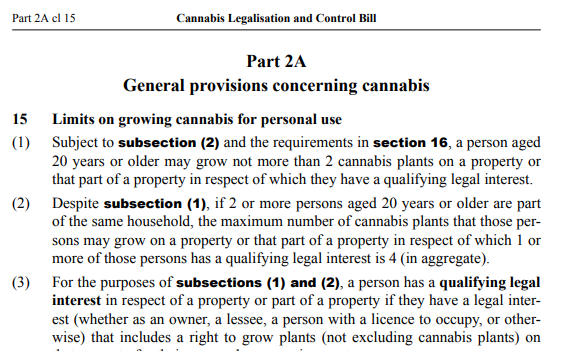
Section 15 of the Bill will allow for two plants to be grown at home per person, and up to four plants to be grown per household.

Two plants is not a lot. However, if you grew four plants in a small grow tent under a 600W light you could get ten or twelve ounces per grow. Assuming that you’re able to get hold of clones, this would mean ten or twelve ounces every eight to ten weeks. In other words, a household could meet its demands for recreational cannabis easily enough by growing it themselves.

Moreover, there is no proposed restriction on the size of the two plants, as has been the case in some North American jurisdictions. This suggests that people will be allowed to put down a couple of honking sativas in an outdoors greenhouse and get them both up to ten feet tall. Such an arrangement would make it legal to grow a year’s worth of cannabis in one season, sparing the need for the environmentally-unfriendly grow tents.

Section 19 of the Bill allows for recreational cannabis sales. Purchases will be limited to 14 grams per day, but this is at least two weeks’ worth by any reasonable measure. Aside from this, it appears the proposed model will be fairly similar to the cannabis cafe model that has existed in the Netherlands since the 1970s.

In other words, it appears that the proposed model is intended to allow for recreational cannabis sales in cafes in a similar fashion to how alcohol is already sold in pubs. Section 49 of the Bill makes reference to “consumption licences” which will allow certain premises to allow people to consume cannabis in public. Such premises will not be allowed to also sell alcohol, and will therefore follow closely to the Daktory model that Dakta Green has already established in New Zealand.

Despite these major wins, the Bill has a number of flaws from the perspective of the average member of the cannabis-using community.

Nowhere in the Bill has provision been made for running a mother plant that clones can be taken from. If one household can only have four plants, it makes having a mother plant that one can take clones off difficult. Against this criticism, however, is that it appears the Bill will allow for retail sale of feminised seeds.

It’s also a mistake to set the legal limit at 20. For one thing, it implies that cannabis is more dangerous than alcohol, which is entirely false. For another, it means two years where young Kiwis will be legally allowed to drink booze but not smoke weed, which will mean two years of exposure to the more destructive of the two drugs. Legal cannabis has been shown to lower rates of alcohol use overseas, and the sooner an alternative to alcohol was available the better.

Perhaps unsurprisingly, the Bill doesn’t address our right to use cannabis for spiritual purposes. Absolutely zero acknowledgement is made of the fact that cannabis is a spiritual sacrament, but this is not unexpected if one considers that New Zealand has been ruled by completely godless people since the turn of the century, and that for their sort spirituality is mental illness.

Also predictably, there is no provision for an official Government apology for conducting a war against them without their consent. The War on Drugs has been the worst human rights violation to occur in the West since World War II. The Government’s role in this war has involved decades of lying to the public about the effects of cannabis and putting people who defy them in cages. Their conduct has been obscene, and an apology should be part of legalisation – but it won’t be.

Perhaps worst of all, the Government is still committed to minimising cannabis use from the standpoint of cannabis use being inherently harmful. It’s possible that they have calculated that legalising cannabis would make it possible to strangle cannabis culture through ever-increasing taxes and red tape, as they have almost successfully done for tobacco. More likely, however, is that they have shifted thinking so that cannabis is now (rightly) grouped with alcohol and tobacco and not heroin and methamphetamine.

There are many possible criticisms of the Bill, but ultimately it is definitely worth supporting. All of the legitimate criticisms relate to aspects of cannabis law that could best be fine-tuned after the referendum has been passed.

Realistically, what the proposed Cannabis Leglisation And Control Bill means is an end to the fear. It would be taking away that dark, nauseating feeling that comes with being marked as a criminal. People smoking or growing cannabis at home will no longer have to fear saying the wrong thing or inviting the wrong person to their house, and the net result will be a reduction in the suffering of the New Zealand people.

*

If you enjoyed reading this essay, you can get a compilation of the Best VJMP Essays and Articles of 2018 from Amazon for Kindle or Amazon for CreateSpace (for international readers), or TradeMe (for Kiwis). A compilation of the Best VJMP Essays and Articles of 2017 is also available.

*

If you would like to support our work in other ways, please consider subscribing to our SubscribeStar fund.