

Clown World Chronicles: What Is A ‘Christcuck’?

Christianity first became popular among the slave classes of ancient Rome. These wretches found an outlet for their resentment in the slave cult that told them the world was evil, and that those who liked it were doomed to everlasting punishment. Christianity ended up destroying the Western World then, and it threatens to do so again now.

It has long been understood that only people who hate life become Christians. Only the sadomasochistic or the deranged would follow a slave cult that promises pleasure in the afterlife in exchange for enduring suffering in this one. Despite that, there are a large number of Christcucks in Clown World, and their collective nature causes suffering for all.

‘Cuck’ is short for ‘cuckold’, which means a man whose wife has sex with other men. It’s a synonym for ‘weakling’ or ‘faggot’, i.e. an excessively feminine man. Cuck has become the archetypal Clown World insult, owing to the fact that we are in the “weak man” part of the historical cycle.

A ‘Christcuck’, then, is a man who has been spiritually cuckolded by the priesthood of the Christian religion. In the same way that a regular cuck is less than a full man on account of that he is subject to the will of his bull, the Christian is less than a full man on account of that he is subject to the will of his priest.

Although decent Christians can and do exist, the common sentiment among sane people in Clown World is that Christians are much like cuckolds. This comparison is made for two major reasons.

The first reason is that they are shamefully weak, and in a way that causes others to suffer.

In the same way that a cuckold invites strange men into his wife, destroying his family, the Christcuck invites strange men into his nation, destroying his community. The universalist creed of Christianity declares that “there is neither Jew nor Greek”, and the Christcuck takes that to mean that borders are against the will of God.

This has resulted in strong Christcuck support for refugee and migrant resettlement. Christian lobby groups are at the forefront of efforts to increase refugee quotas. These refugees and migrants then go on to commit horrendous amounts of violence and sex crimes, causing everyone to suffer – and all just so that the Christcuck can virtue signal.

The Christcuck makes a virtue out of being as pathetic as possible. They act as if their harmlessness made them morally superior to normal people, much like cuckolds argue that their lack of jealousy makes them morally superior to others. They are rightly despised for this, on account of that the absence of masculinity is responsible for most of Clown World’s misery.

The second reason why Christians are compared to cuckolds, and the most appropriate to Clown World, is that Christcucks are grossly dishonest, and that this dishonesty is a major cause of why there’s so much suffering today.

Regular cuckolds go through a massive amount of cognitive dissonance on account of that other men fuck their wives. This dissonance twists them into untrustworthy creatures. Cuckolds lie to themselves and to other people all the time – and so do Christcucks.

Christcucks virtue signal all day, but when an opportunity comes along to actually prevent suffering they don’t take it. Constantly we are told that Jesus is compassion and therefore his followers are the good guys, but when Christians are given an opportunity to show compassion they do nothing. The modern Christcuck supports the War on Drugs, welfare austerity and Middle Eastern military adventurism.

They also attribute the greatness of Western culture to their slave cult, and not to inherent qualities of Westerners. This belief is proven false in two ways. Western culture was great before Christianity, as Socrates, Plato, Aristotle, Alexander, Julius Caesar and Augustus Caesar showed. Moreover, other peoples who have become Christian didn’t become great, as shown by the numerous poverty-riddled African Christian nations.

Perhaps worst of all, they lie about genuine spiritual practices in an effort to keep people dumb and deluded. Not only do Christians lie about meditation, claiming that it can induce demonic possession, but they also lie about cannabis, psilocybin, LSD, mescaline and DMT, claiming that these spiritual sacraments are drugs that cause mental illness. These efforts to keep people spiritually deluded have created immense suffering.

Christcuckery is best exemplified today by Pope Francis. Normally hidden away behind gigantic stone walls, he emerges to lecture Westerners about the need to open borders to refugees, or about climate change. Never does he suggest anything practical, like ending the War on Drugs or the need to study hard at school, because he’s not interested in alleviating anyone’s suffering. Much the opposite.

Christcucks belong in the same group as soyboys, baizuos, incels, dhimmis, trannies, simps, NEETs and gutmenschen as another example of social decay, which is why they’re seen ever more often in today’s Clown World. The common quality linking them all is a lack of rectitude manifesting as weakness and effeminacy.

They contribute directly to the shitness of Clown World by promoting a mindset where people sit and wait for a saviour, instead of taking action themselves. They believe that if they wait long enough Jesus will come along and solve all their problems. As such, it’s not necessary to resist those abusing them. Most of the time, when you have people getting abused yet saying “It’s not time to act yet,” you have the influence of Christcuckery. The meek shall inherit Clown World.

The solution to Christuckery is an occult revival. This might involve a return of Hermeticism, or a new interpretation of the perennial philosophy, or perhaps even an attempt to institute a new Eleusinian Mysteries. Whichever precise form it takes, it will come as a great relief to the multitudes who are currently starved of spiritual nourishment.

*

This article is an excerpt from Clown World Chronicles, a book about the insanity of life in the post-Industrial West. This is being compiled by Vince McLeod for an expected release in the middle of 2020.

*

If you enjoyed reading this essay, you can get a compilation of the Best VJMP Essays and Articles of 2019 from Amazon for Kindle or Amazon for CreateSpace (for international readers), or TradeMe (for Kiwis). A compilation of the Best VJMP Essays and Articles of 2018 and the Best VJMP Essays and Articles of 2017 are also available.

*

If you would like to support our work in other ways, please consider subscribing to our SubscribeStar fund. Even better, buy any one of our books!
Clown World Chronicles: Who Is Kek?

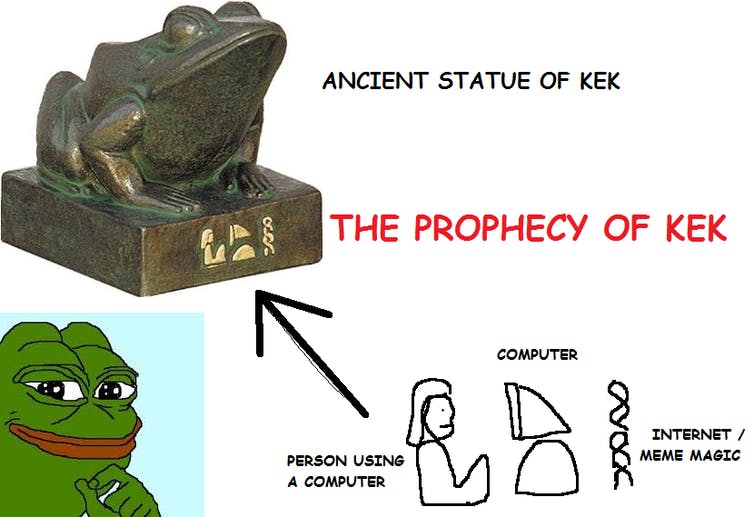
The highest god of the Clown World pantheon is usually portrayed as a green frog known as Kek. Part of the Kek legend is that he is the god responsible for all the joy in the world. Clown World might be a miserable, depressing place, but the wondrous Kek has taken pity on us and chosen to bring us light.

Kek is the highest god of the Clown World pantheon because of his unique ability to transmute suffering into joy. This is the greatest of all the alchemical arts. The Will of Kek is to utterly destroy Clown World by means of a total polar shift that flips all of the pain into pleasure. All followers of the Clown World pantheon believe in this prophesised end to all suffering.

The most devoted followers of the Clown World pantheon will claim that Kek is the light of the world, the Principle of Good which allows us to see the simple joy inherent in all of existence. Absent Kek’s light, we humans can only see pain and misery in the world. When Kek’s light is present, magic and wonder fill every space.

Legend has it that Kek was summoned to Clown World thanks to a quirk in the game World of Warcraft, in which the expression “lel” was translated to “kek” if it had been written by a Horde player and read by an Alliance player. The mass repetition of his name caught the attention of the Elder God, who recognised that it was time to reincarnate on Earth.

Further legend has it that Kek’s first great action upon returning to the world was ensuring the election of American President Donald Trump over his Democratic rival Hillary Clinton. Everyone had expected a Clinton victory and an intensification of Clown World as Clinton doubled down on Bush and Obama’s madness, but Kek had other ideas.

Egyptian mythology had a god named Kek, who was known as “the raiser up of the light”. This is proof that Kek is real, that the Will of Kek is to eliminate the suffering of all good people, and that Kek is eternal. The Kek who heads the Clown World pantheon is the same energy as the ancient Egyptian Kek, and their mission is the same: to bear light into the world.

Kek worship, then, is part of the eternal tradition of worshipping the light and those who bring it to others. In this sense, it could be considered a form of Luciferianism. This is the reason for the heavy overlap between Kek worshippers on the one hand, and Hermeticists and other occultists on the other.

The typical Kek worshipper has several qualities that mark them out as superior to the average pleb in Clown World.

The first is a curiosity about the true nature of reality. An individual will not become a Kek worshipper unless they have thrown off the shackles of two things: the mainstream religion into which they were born, and of nihilistic atheism. People come to Kek out of a willingness to see beyond, and to go beyond. The men and women of Kek are free-thinkers who prize cognitive liberty.

The second is a disregard for the opinions of soyboys, baizuos, simps, incels and cucks. The Kek worshipper has no interest in being liked, and as such is not influenced by peer pressure. They will seek the light in all instances, no matter how much hate is heaped on them for doing so. The Kek worshipper is resolute (although many will call them disagreeable).

The third, and most important quality, is a will to transmute suffering into joy through humour. Kek worshippers can see the joke in everything. No matter how depraved, depressing and degenerate Clown World becomes, the Kek worshipper will find a way to raise a smile. Even when the situation causes Normies to feel horror, followers of Kek can be heard cracking jokes. Kek is invincible.

Kek is the opposite of The Merchant, who seeks to transmute joy into profit. As such, the two are eternally opposed. Their struggle for supremacy defines much of the landscape of Clown World. Kek who thinks that the meaning of life is to experience joy, and The Merchant who thinks that the meaning of life is to generate profit.

People entreat Kek to keep them safe from work drudgery, from violent street crime, from both roasties and inceldom, from nihilistic despair and from the crushing, suffocating demands to conform that Clown World forces upon those it can. The widely-shared hope is that Kek will return and turn Clown World upside down.

Kek is the Elder God of the Positive Fundamental Axis, and as such he has a powerful influence on Honkler, the Younger God. It could be said that Honkler is the greatest at summoning the power of Kek and bringing Kek’s will into Clown World. Kek might provide the light, but it is Honkler who brings people’s attention to it.

It is whispered that the appearance of Honkler is a sign that the Will of Kek is about to return to Earth. The Will of Kek would transmute all of the suffering of Clown World into joy, lifting the veils of darkness and ushering in a new Golden Age. This will be a new spiritual era during which time good people will want for nothing.

*

This article is an excerpt from Clown World Chronicles, a book about the insanity of life in the post-Industrial West. This is being compiled by Vince McLeod for an expected release in the middle of 2020.

*

If you enjoyed reading this essay, you can get a compilation of the Best VJMP Essays and Articles of 2019 from Amazon for Kindle or Amazon for CreateSpace (for international readers), or TradeMe (for Kiwis). A compilation of the Best VJMP Essays and Articles of 2018 and the Best VJMP Essays and Articles of 2017 are also available.

*

If you would like to support our work in other ways, please consider subscribing to our SubscribeStar fund. Even better, buy any one of our books!
The Elementalist Conception Of Time

As with many other philosophical questions, Elementalism has its own ideas about the question of time. Most people take it for granted that there is such a thing as time and that it just kind of ticks along. Upon thinking about it, though, things are no longer as straightforward. This essay explains the Elementalist conception of time.

Most people assume, as if naturally, that space and time exist and that we move around in them. Space is three dimensional (the x, y and z axes), and time adds another dimension of movement, so spacetime can be said to be the four-dimensional space in which we all live. We are born at one point in spacetime and, over the course of our lives, move through it.

This materialist conception of time brings with it a number of logical quandaries.

Quandaries such as: when did time begin? Time seems to run as an arrow flies, unstoppably from one point to the next, but when and how did it start? If time started some fourteen billion years ago, with the Big Bang, what happened before then? Did time exist? If not, how could the material universe possibly have started?

Is time an inherent property of the Universe or does it exist as the result of the will of some divine creator? If an inherent property of the Universe, what makes it progress at the speed it does, and not a greater or a lesser speed? Why progress at all? And – most frightening of all – if it begins and progresses then will it end?

All of these questions create a great number of logical dilemmas in the minds of materialists and non-Elementalists. But an Elementalist, who believes that consciousness is the prima materia and that it explores the Great Fractal to entertain the gods, has no such dilemmas.

To the Elementalist, time is an illusion. Simply put, it doesn’t exist. It’s an illusion brought about by the movement of consciousness through the Great Fractal at a certain rate. Because the perceptions that occur to consciousness appear to change in a rule-based manner, the impression is created that time exists and flows at a uniform rate. The reality is somewhat different.

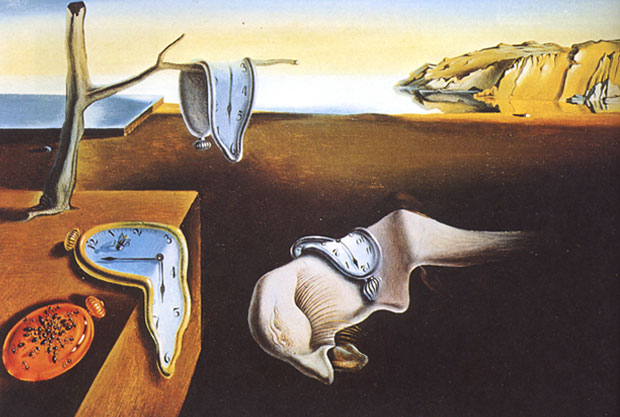
The illusion of a moving picture, on film or on television, is made by displaying a number of frames every second (usually 25), in quick succession. If these frames are displayed rapidly enough, the image on the screen will appear like it is moving, an illusion known as beta movement. The images aren’t really moving – they just appear to, as if in a flipbook.

Our consciousnesses navigate the Great Fractal in a similar manner.

It sounds incredible, but the reality is that our perceptions cycle through a cosmically large number of static universes in extremely short order. Entire universes blink in and out of perception a such a speed that it feels like we’re moving through them fluidly. But in fact, this movement is no more fluid than that of a horse running in a motion video. It’s also an illusion.

The Great Fractal, in its unspeakably majestic, all-encompassing nature, is static. Because the fragment of consciousness that each of us possesses can only be aware of a tiny section of it, and because the tiny section that we are aware of keeps changing, it seems like time exists. And it does, in a sense. But not in the sense that most people are used to thinking of it.

In reality, there is only one ever-present and unchanging now, and consciousness exists there. In this eternal now, perceptions change, and that’s all that time is. The contents of consciousness are ever-changing, but consciousness itself is not, serving as an unwobbling pivot around which the entire drama of material existence unfolds.

This perception of time sounds entirely radical to the materialist mind, but for a Buddhist, a Taoist or a Hindu, everything written here so far is familiar. It has to be understood that the common Western perception of time follows naturally from the common Western assumption of materialism – and this assumption is neither accurate nor rational.

Dilemmas like the Grandfather Paradox are easily solved by the Elementalist. Not believing that time is one-dimensional, there is no “go back in time”. A world in which your grandfather lives and gives rise to one of your parents exists in the Great Fractal, and will always exist. Therefore, a life in which your grandfather gave rise to you is, and will forever be, lived by a fragment of consciousness somewhere in the Great Fractal.

Somewhere in the Great Fractal are worlds in which your grandfather is killed, but this doesn’t negate the fact that there are still an infinitude of worlds in which he was not killed. Therefore, you could kill your grandfather a million times and it wouldn’t change a thing. He would still exist in the Great Fractal, so consciousness would still be aware of him, and would still perceive lives in which he existed and gave rise to progeny.

Likewise, dilemmas about how time started and where it will end are easily resolved. To the Elementalist, there is only one eternal now, and in that now we navigate the Great Fractal. Knowing that time is an illusion, questions about how it started or where it will end are meaningless. Consciousness exists outside of time and is more fundamental than it. Therefore, time is a function of the contents of consciousness only.

In summary, Elementalists have an entirely different conception of time to that of the ordinary materialist. Not only do they not believe in time in the sense it is usually understood, but neither do they believe in any of the conclusions drawn by materialist philosophers of time. For the Elementalist, all these dilemmas really do have elemental solutions.

*

If you enjoyed reading this essay, you can get a compilation of the Best VJMP Essays and Articles of 2019 from Amazon for Kindle or Amazon for CreateSpace (for international readers), or TradeMe (for Kiwis). A compilation of the Best VJMP Essays and Articles of 2018 and the Best VJMP Essays and Articles of 2017 are also available.

*

If you would like to support our work in other ways, please consider subscribing to our SubscribeStar fund. Even better, buy any one of our books!

Writing Characters Of Mercury

The second-highest element on the spiritual hierarchy is mercury. Being one level higher than silver, mercury is the realm a person enters when they are close to perfection. This is represented by the liquid nature of mercury, which reflects a great intensity of spiritual power. Metaphorically, this liquidity suggests that mercury is close to moving beyond the material.

The ancients considered Mercury to be the Messenger of the Gods. This reflects the fact that mercury is the closest to the divine element of gold. Mercury is the closet planet to the Sun, so the Sun shines on Mercury before it shines on anything else. Characters of mercury ought to be able to instill a sense of awe in the characters made of baser elements.

Like silver, mercury is lustrous. Unlike silver, mercury is a liquid at room temperature. This is why it was once known as quicksilver, or water-silver. Alchemically, this property of being a liquid suggests that silver has been quickened to reach the stage of mercury. It suggests that something extra has been added to mere silver, some invisible energy that has had visible effects, and which has transmuted that silver to a higher state.

This quickening is from where we get the term ‘mercurial’. The term mercurial is used to describe people whose behaviour is hard to predict. There’s a more precise meaning – people whose behaviour is hard to predict because they are more closely attuned to the Will of God than anyone else. The characters of mercury are semidivine.

The characteristic quality of mercury is genuine intelligence in the form of a divine spark. This is where it contrasts with silver. Although a character of silver might have a rudimentary intelligence, perhaps enough to give them an advantage over the characters of baser elements, characters of mercury are more intelligent still. They are easily able to perceive the weaknesses of characters of silver, let alone the lesser elements.

Characters of mercury are more intelligent than the others, but they are not always more humble. Although they can be megalomaniacal, they are not prone to the Conceit of Silver, on account of that they are too closely attuned to God’s will. A character of mercury will not resent someone greater than themselves, but will rather co-operate with that person as a way of drawing God’s energy into the world. This disinclination to fight presages the frequency of the characters of gold.

Reflecting this humility, characters of mercury have more compassion than characters of baser elements. They are rarely motivated by purely egoic concerns. Rather, they work to end the suffering of others around them, and as such serve as messengers of the gods by expressing the will of the divine.

However, not being perfect, characters of mercury are still vulnerable to any of the lusts, rages and arrogances of the baser elements. They are just much less likely to fall prey to such impulses, and, when they do, they make amends much more readily. As such, they are clearly more noble in nature than most other people, and they tend to get treated as such.

The big danger of the character of mercury is that their ambition can cause great suffering. Although a character of mercury would never torture someone like a character of iron would, and they wouldn’t steal from someone like a character of lead would, they are still capable of causing immense suffering. Alexander was a character of mercury, if anyone was – and his conquests left piles of bodies in their wake.

The example of Alexander mentioned above perhaps best exemplifies the essence of a character of mercury. Being so close to perfection, they are, in a sense, above being judged by normal men. Chararacters made of baser elements have trouble enough understanding characters of silver; characters of mercury are beyond their understanding. To these baser characters, the characters of mercury appear as forces of nature.

Hindu Yogis associate mercury with the third eye chakra. This chakra is itself associated with intuition and foresight. A character of mercury will have great foresight, being able to see into the metaphysical world. This grants them the ability to predict the future and to see into people’s souls. A character of mercury will have powers of perception that the baser elements may not even believe are possible.

These powers of perception distinguish them from characters of silver. Although a character of silver might be able to accumulate a great amount of knowledge and apply it to, for example, building a bridge, this knowledge is limited to knowledge of the physical world and the phenomena in it. The character of mercury can see into the metaphysical world – something that most other characters don’t even believe exists. As such, they are very much the one-eyed man in the kingdom of the blind.

The concept of a third eye relating to spiritual awakening gives away the essential nature of the character of mercury, which is someone who is almost enlightened. Although not perfect, their every action will be permeated with this greater illumination – which is precisely what makes them seem mercurial to the baser elements. Because the baser elements cannot see into the metaphysical world, they cannot understand why the characters of mercury make the decisions they do. Characters of mercury can easily appear mad to those of baser elements.

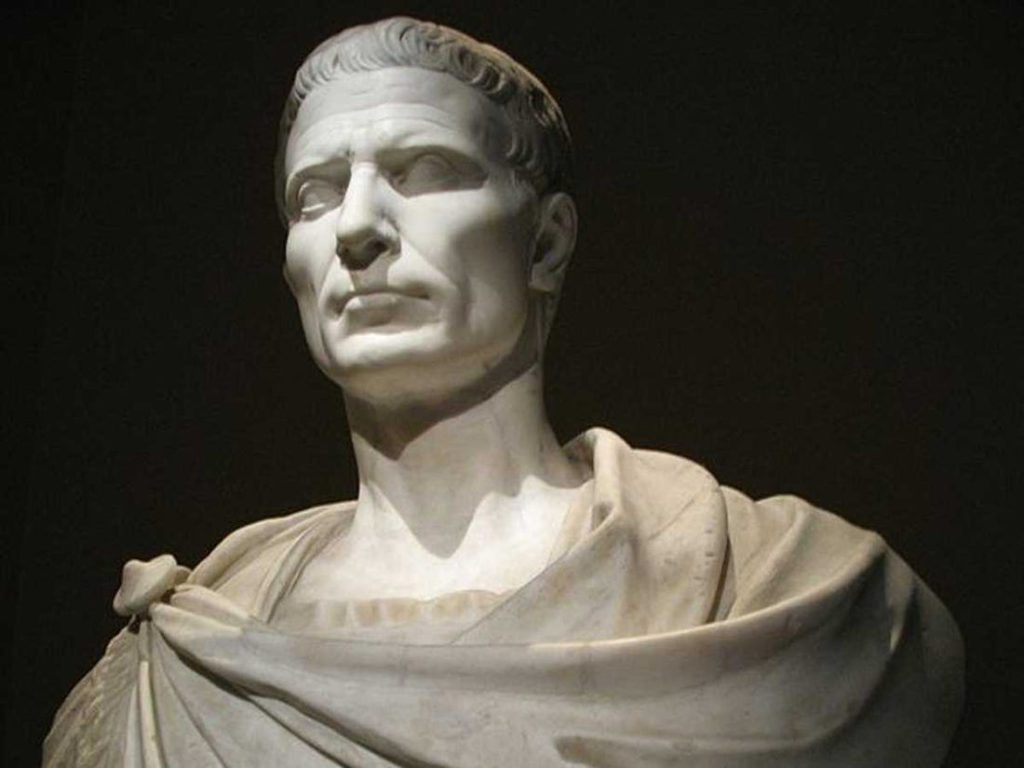
Characters of mercury are the sort of people who set the course of history. They can be found leading kingdoms and empires. A character of mercury is sufficiently impressive that even characters of silver feel awestruck in their presence. As such, they are capable of provoking immense resentment, as did Julius Caesar.

If your story involves a character of mercury, it’s feasible that resentment for them can provide the impetus for the plot. A character of silver might become envious and try to take them down, perhaps employing a character of iron to do so. A character of copper who serves as a priest, resenting the influence that a character of mercury has among the townsfolk, might assemble a mob to drive them out of town.

If not in politics, characters of mercury can be great artists or scientists. Here they distinguish themselves from characters of silver as genius distinguishes itself from mere brilliance. The characters of silver may be exceptionally skilled at applying methods and techniques to create a masterpiece, but only the characters of mercury have the power to create something truly original.

A modern representation of a character of mercury is William Shakespeare in the film Shakespeare in Love, or John Nash in A Beautiful Mind. Such characters clearly stand out from those around them, even if those around them are of silver or copper.

It’s very tempting to have a character of mercury as the protagonist of your story. Being genuinely intelligent, it’s easy to write a story in which they overcome the challenges placed before them. However, being already of the second-highest element, this leaves little room for the character to develop over the course of your story.

If a character of mercury serves as a minor character, it may be to enlighten your protagonist. Your protagonist might work in their service, or they might engage the character of mercury to teach them about some important issue. In either case, the character of mercury will likely be fundamental to the plot.

*

This article is from Viktor Hellman’s The Alchemy of Character Development, the sixth book in VJM Publishing’s Writing With Psychology series. This book will show you how to use alchemy to create deep, realistic and engaging characters for your creative fiction.

*

If you enjoyed reading this essay, you can get a compilation of the Best VJMP Essays and Articles of 2019 from Amazon for Kindle or Amazon for CreateSpace (for international readers), or TradeMe (for Kiwis). A compilation of the Best VJMP Essays and Articles of 2018 and the Best VJMP Essays and Articles of 2017 are also available.

*

If you would like to support our work in other ways, please consider subscribing to our SubscribeStar fund. Even better, buy any one of our books!