
Signs That A New Spiritual Order Is Arising

With every era that passes, old orders fall and new orders rise. Some of these old orders are military, some are technological and some are spiritual. With every Great Month that passes, a pre-existing spiritual order falls and a new spiritual order rises. This essay explains how we find ourselves now in such a time of change.

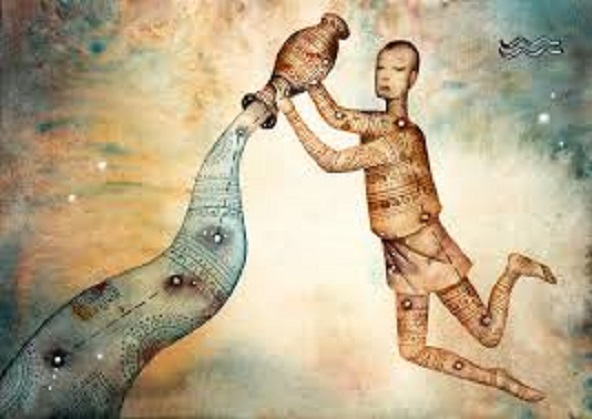
Some have described the changes upon us as the transition between the Age of Pisces, the old order, and the Age of Aquarius, the order to come. With the human entry into the Age of Pisces some 2,000 years ago, we moved out of the Age of Aries, which had been characterised by brutal militaristic sentiments. The Age of Pisces was, then, a reaction to the excesses of the age before it.

Pisces is the mutable water sign, which means that it has a double feminine energy. Arguably, the dominant spiritual ideology of the Age of Pisces has been Christianity, which also has feminine energies – it can be best understood as an attempt to reform Abrahamism from its brutal and hyper-masculine Arian frequency. Christianity has taken a watery form to counter the fiery nature of its predecessor, and the multiplicity of such forms reflects the mutable quality of Pisces.

In this Age of Pisces, people with this double feminine quality have done fairly well. This is not an age in which the strong conquer and dominate, but rather an age where the kind rule through the consent of the masses. The zeitgeist of the age has been to raise up those low down, and to pull down those up high.

Like everything else, however, it has become corrupted over time, and the form of it we now have is a degraded one. In its pure form, those unfairly cast down were lifted up, and those unfairly raised were pulled down. Now, a person is lifted up even if they were low down for natural reasons, or because of their own moral failings, while people who are high for just reasons are dragged down out of resentment.

It has been too long since the original spiritual revelations that began the Age of Pisces for them still to have power, and now a great counter-reaction against their present degraded forms is under way.

This means that the Age of Aquarius will involve a reaction against Christianity and against the ethos of passivity and agreeableness. Unlike the mutable water, the avatars of the Age of Aquarius will move ever-forwards. However, they will also be sure not to fall back into the patterns of the fiery ram-headed Arian aggression. Therefore, the Age of Aquarius will strike an airy balance between the watery Pisces and the fiery Aries.

Aquarius is the fixed air sign, which suggests a dogmatic and inflexible form of intellectualism. Combining this with the gentle masculinism of the age suggests that a kind of nerdiness might be the characteristic of coming centuries, perhaps an uncompromising kind of autism. This may be an outgrowth of today’s scientific materialism, the current dominant paradigm among the world’s ruling classes.

It might be that some kind of scientific materialism remains the dominant intellectual paradigm for the next 2,000 years, with all talk of the spiritual discouraged. It could also be that scientific materialism becomes the dominant paradigm for the ignorant masses only, while the enlightened and the initiated will be aware of the perennial truths that underpin the true philosophies of all times and places.

Certain phenomena predictably arise every time we near the end of a great age, as we now are. The foremost is a gross and paralysing apathy that drives all talk of the spiritual from public life. This can be seen with our current crop of atheistic rulers. However, this enormous apathy is necessary to wash away the vestiges of the old ways, and at its heart is the seed of a new spiritual order. The Age of Aquarius proper will begin when this new spiritual order begins to impose its will upon the world.

The first harbingers of this new spiritual order are those men and women who are rediscovering the spiritual sacraments that revealed the great wisdom that the ancients possessed. The vanguard of the new age of light returning to our benighted world is in those who have learned that psychedelics such as cannabis and psilocybin are capable of reconnecting a person to God and to the perennial wisdom.

There have always been small, clandestine groups of spiritual seekers who have kept the flame of genuine spiritual knowledge alive, despite the oppression from hate ideologies like Abrahamism, Nazism and Communism. These people have retained knowledge of the use of spiritual sacraments and techniques, even though the governments of recent decades have fought to suppress use of them. Most people now accept that the Governments are fighting a losing battle, so these groups have grown rapidly in number and influence.

However, it’s only now that a mass of people are starting to realise that these sacraments have revealed genuine spiritual knowledge to those brave enough to experiment with them. Bearers of light such as VJM Publishing are now able to publish information about spiritual alchemy without persecution – and we are far from the first or only ones. The spread of this knowledge will not stop until a new spiritual age exists upon the Earth.

It’s already possible to see magic mushrooms becoming legalised in places such as Denver. When magic mushrooms become legal more widely, it will become common for intelligent men and women to get together and use them sacramentally, to reconnect with God. When they do this, genuine spiritual knowledge will come to return to the Earth.

Although public sacramental use along the lines of the Eleusinian Mysteries are still some way off, in this general atmosphere of intellectual and spiritual exploration, it won’t be too long before there are some quasi-public rituals involving mass consumption of psychedelics. When this occurs, an entirely new consciousness will arise upon the Earth, involving new ways of relating to and identifying with each other.

If the Age of Aquarius means that scientific materialism completely destroys Abrahamism and the other superstitious cultures, this should clear the way for a return of those schools of thought that had been superstitiously attacked. This could very well lead to genuine spiritual revelation, and this could lead to a new spiritual era of human history and a new Golden Age.

*

If you enjoyed reading this essay, you can get a compilation of the Best VJMP Essays and Articles of 2018 from Amazon for Kindle or Amazon for CreateSpace (for international readers), or TradeMe (for Kiwis). A compilation of the Best VJMP Essays and Articles of 2017 is also available.
The Occult Background of The Magic: The Gathering Five-Colour System

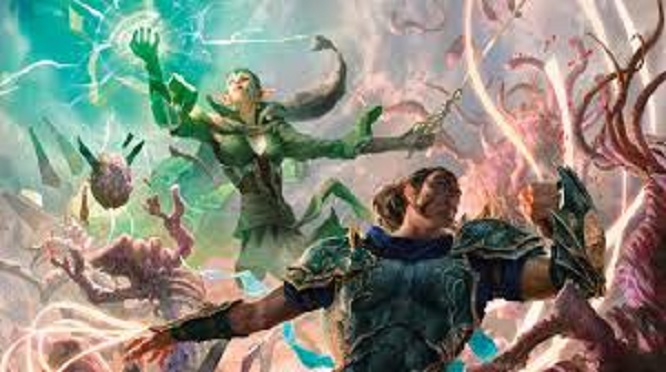
The magical and mystical references and themes of Magic: the Gathering are a rich part of the background of the story world, and many play it for that reason. The reality is that Magic is not just occult in flavour and appearance but also in fundamental structure and gameplay. As this essay will describe, the layout of the five fundamental Magic colours maps out a space in occult philosophy.

Many people are familiar with the conception of four classical elements of earth, water, air and fire. These are said to represent various elemental forces, viz. being cold and dry in the case of earth, cold and wet in the case of water, warm and wet in the case of air and warm and dry in the case of fire. More precisely, these are what are known as the four feminine elements, because they all have equal value.

Being four elements of equal value, they can be distinguished on the basis of yin and yang. The yin elements are Earth and Water, because they are cold and passive. The yang elements are Air and Fire, because they are warm and active. Earth relates to inertia, Water relates to cohesion, Air to expansion and Fire to heat.

There are also such things as the four masculine elements, which all have differing value. These four elements collapse into a basic dichotomy between precious things that need to be guarded or defended and base things that do not. These precious things are usually characterised as white on account of the light nature of silver and gold, whereas base things are usually characterised as black on account of the dark nature of clay and iron.

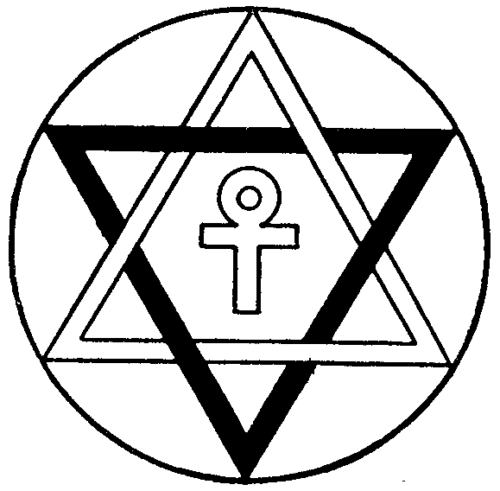
This masculine dichotomy and feminine quadrichotomy combine to give us a system based around six separate points – a system that the reader may have previously seen diagrammed (as below) in various occult symbols and drawings. 

In this model, Air and Fire are the bottom corners of the white triangle, because they are warm and therefore rise upwards. Earth and Water are the top corners of the black triangle, because they are cold and therefore sink downwards. The uppermost point of the white triangle represents spirituality, which seeks to rise above matter, and the bottommost point of the black triangle represents materialism, which indulges in it.

The masculine axis is represented by the vertical line of the central ankh, and the feminine axis by the horizontal line. So in this diagram all of creation is represented: all of the physical, the metaphysical, the feminine, the masculine, the spiritual and the material worlds can be found therein.

Where it gets interesting is how this esoteric diagram maps to the five different colour types in M:tG.

Blue represents both Air Magic and Water Magic. In this it combines the intellectualism of Air with the flexibility of Water to create a magic that tricks, deceives, binds and maddens. It’s also a magic that can open up new intellectual possibilities and mental realms. Air and Water are the two wet elements, and so it’s fitting that blue is a slippery and ephemeral colour. 

Red represents Fire Magic. This is encapsulated not only in the obvious fire, lightning and volcano-related imagery but also in red magic’s use of chaos. Fire is the most chaotic form of matter, because solids, liquids and even gasses all behave in reasonably predictable ways. This is why red uses cards like ‘Wheel of Fortune’.

Green represents Earth Magic. This refers to the natural world and to the procreative qualities of the natural world. The classic Green Magic strategy is to overrun one’s opponent, to crush them by sheer mindless mass or weight of numbers. Trample is the quintessential ability of Green Magic, as are magics that represent damage done by natural phenomena such as hurricanes and poisons.

White represents spirituality, or White Magic. To this end, most of the healing magic is white in nature (in this sense, M:tG lifts many of their concepts from existing esoteric philosophy). The point of White Magic is to banish the darkness or suffering, hence their use of wards and salves. White also plays on the idea of God acting upon the world through cards such as ‘Wrath of God’ and ‘Armageddon’.

Black represents materialism, or Black Magic. Perhaps the characteristic card of this colour is ‘Greed’. Elegant practitioners of Black Magic will use other people’s materialistic desires to exploit them, or to manipulate them into furthering the magician’s wishes. Life imitates art in the sense that Black Magic is essentially the same in M:tG as in real life.

So the five colours of a Magic game represent five alchemical positions on two fundamental axes: masculine on the masculine axis (white), feminine on the masculine axis (black), masculine on the feminine axis (red), feminine on the feminine axis (green) and neutral on the feminine axis (blue).

A game of Magic can be thought of as an alchemical battle, with the player who is greatest able to project power through their mastery of the elements the winner. Curiously, there is no guarantee that the forces of “good” will win any given battle, which is what gives the game its dramatic potential. The side with the angels and God on it can still be defeated by competent Black Magic or by any other alliance.

*

If you enjoyed reading this essay, you can get a compilation of the Best VJMP Essays and Articles of 2018 from Amazon for Kindle or Amazon for CreateSpace (for international readers), or TradeMe (for Kiwis). A compilation of the Best VJMP Essays and Articles of 2017 is also available.

20 Years Since Columbine: Are We Still Nihilists?

This week saw the 20th anniversary of the Columbine High School massacre. The massacre shocked a Western World used to adult serial killers, because we didn’t believe that high schoolers could also be capable of such evil. In the aftermath of the massacre, the consensus was that the motivation for the deed came from nihilism. This essay asks: are we still nihilists?

History can be thought of as a series of attempts to solve the basic existential question of what we’re supposed to be doing here on this planet.

For many centuries, we had religion, and the struggle between good and evil, chaos and order. But then we killed God, and (as Nietzsche predicted) this threw us back into Nature, and the world of eternal struggle. This played itself out in the titanic clash of empires that was World War One, and the following clash of nations that was World War Two. After three decades of trauma, we decided that we’d had enough bloodshed, and so we tried a new narrative.

The postwar consensus was based around pure hedonism. After three decades of deprivation, something as simple as being able to buy a milkshake or a cheeseburger on demand was seen as a great pleasure that demanded appreciation. Later, the number of television channels to which one was subscribed was the sign of material fortune. The problem was, of course, that hedonism is not an answer to spiritual problems.

The Columbine High School massacre was perhaps the first major sign that the postwar consensus had failed. The prosperity the Boomers enjoyed was based on the idea that material consumption was the reason for human existence. This was great fun, but it was only ever a distraction. It never solved the basic existential dilemma.

Klebold and Harris’s actions were an example of something that this column has previously called anarcho-nihilism. This is where one proposes to destroy the pre-existing system without offering any alternative system that might replace it. One simply destroys for the sake of destroying.

Anders Breivik and Brenton Tarrant were later examples of this phenomenon. Both men wrote entire manifestos that detailed at length their grievances with the world and the way it was being run. Enemy crimes were listed exhaustively, but neither man suggested much in the way of an alternative. Both will go down in history, but neither as a builder of nations.

Anarcho-nihilism could be said to be the challenge of our time. This isn’t the same as simple nihilism, which was the problem of previous times, because nihilism didn’t always lead to a violent assault on the old order. It usually led to simple suicide, which meant that the ruling class were not particularly bothered by it. Since March 14th this year, there have been more deaths to suicide in New Zealand than to terrorism, but the latter has taken up a hundred thousand times more emotional energy.

If we are to avoid going down the path of Breiviks and Tarrants destroying the whole world in a hail of bullets, we need to assert some kind of anti-nihilism that meets the emotional needs of the masses, while not repeating the mistakes of previous attempts at this.

An idea of what form this anti-nihilism might take can be seen in the various corners of cyberspace. In 1999, The Shroomery was only just getting started. Now it is one of the most popular counter-culture websites in the world, with an Alexa ranking in the top 30,000. Here it’s possible to find all kinds of discussions about aspects of spirituality that ordinary people would have trouble being able to comprehend – at least for now.

Any anti-nihilistic movement powerful enough to truly appeal to a great number of people will have to achieve a number of things. At a minimum, it must convince people that their actions in this world, and specifically whether or not those actions increase or decrease the suffering of their fellow sentient beings, are meaningful.

Achieving this may require the promulgation of the kind of sentiment that arises as a result of the psychedelic experience, the kind that is often derided as “hippie” or “new age” but which, if examined closely, answers with awesome clarity the questions of how we got here and what we’re supposed to be doing. This might require the reinstatement of something like the Eleusinian Mysteries, so that we can collectively revel in something beyond the material.

At time of writing, in 2019, it seems like not only are we nihilists, but we are destructive ones, and not only that, but the destructive and nihilistic sentiments are getting worse. That is certainly cause for alarm, but it’s also cause to take action, and to help promote an alternative. With enthusiastic promotion of psychedelic medicines for curing spiritual illness, it may be possible for us to finally overcome the threat of nihilism, and to allow a new spirituality to rise.

*

If you enjoyed reading this essay, you can get a compilation of the Best VJMP Essays and Articles of 2018 from Amazon for Kindle or Amazon for CreateSpace (for international readers), or TradeMe (for Kiwis). A compilation of the Best VJMP Essays and Articles of 2017 is also available.
We Are All One – But So What?

A cosmic truth, realised by many people who have meditated or done enough psychedelics, is that we are all one. Despite the fact that it appears that each of us occupy a separate body, forever dooming us to stand apart from everyone else, mystics and shamans throughout the ages know that we are all intimately connected on a spiritual level. However, as this essay will argue: so what?

The oneness of all that exists, and the fact that separateness is only an illusion, is an inescapable truth about reality that comes to many people seeking enlightenment. It usually comes like a lightningbolt out of the blue, and usually when a person is deep in meditation or high on a powerful psychedelic.

The truth is that there is only one thing that can be said to exist, and that is the consciousness that is God. So as to escape from the infinite loneliness that is being the only thing to exist, God has created this illusion which we call the physical world, and has split up into an infinite number of separate consciousnesses. Each one of these consciousnesses streaks a unique path through the Great Fractal.

All of us are a unique expression of the consciousness of God, the possessor of a divine spark. This means that, on the level that really matters, every other creature on this planet is the same as us. Every other creature is an expression of God, and their lives are being experienced by God, just as ours are. Therefore, everything else that exists is as important as God, the most important thing possible.

But so what?

At the end of the day, every individual being still has to play the role that it was created to play. Each of us are a biological organism that is subject to certain chemical and physical laws. These laws demand that the closed systems that are our bodies absorb energy from the outside world. Since we cannot photosynthesise, we have to eat things, and because we can only eat organic matter, we have to kill in order to live.

The rat and the mouse still have to invade the granary, for if they don’t, they will themselves die. If you are the granary owner, you have to accept that they are going to keep coming whether you like it or not, and therefore you have to kill them first if you want to keep your food supplies safe. There is no shame in this – if your role is to kill, then kill you must.

It doesn’t matter if those you are killing are fundamentally the same unique expressions of God that you are, because the ones you are killing for are also unique expressions of God. The lion still has to chase the zebra, for if she does not, her cubs may starve. Behind many a terrorist is a person who loves their own people.

Some people cling to the notion that it’s possible to find perfect peace in this place, as if it were simply a matter of willing such a thing to be possible. Many of these people have the conceit that this desire for peace is a virtue, something that makes them better than those who don’t have it.

In truth, however, these people are actually less moral than others, because they reject one of the basic principles of the universe, which is that life is eternal struggle. Rejecting a basic principle of reality because one would prefer that it didn’t exist reflects weakness, and a lack of courage, not superior moral insight.

The full truth is even more fundamental than this. The yin is one with the yang, and both are part of the Tao. Neither complains that the other consumes or abuses it. Both play their role perfectly. Therefore, someone who rejects completely the idea of conflict is like someone who has rejected the yin or the yang. They cannot be a complete person, at peace with the world.

So if different human groups come into conflict, and fight, this doesn’t necessarily mean that the people involved have made a mistake somewhere, or that one side must necessarily be immoral or evil. It may just be that the different groups were fated to fight. The fact that we are all one doesn’t mean that fighting must never happen – it just means that we take our turns at being the winner.

Of course, this is not to argue that we should all be fighting all the time. Just because life is eternal struggle doesn’t mean that it’s nothing else. A person’s true role might to be to question and to resist their violent and aggressive impulses, or to sublimate them into something beneficial, not to surrender to them.

But if a person’s role is to go along with their violent impulses, then they ought to do so with full enthusiasm. Realising the fact that all is one doesn’t mean that one is absolved from ever having to fight or to struggle. Even after enlightenment, one still has to live one’s life, and to play one’s role.

*

If you enjoyed reading this essay, you can get a compilation of the Best VJMP Essays and Articles of 2018 from Amazon for Kindle or Amazon for CreateSpace (for international readers), or TradeMe (for Kiwis). A compilation of the Best VJMP Essays and Articles of 2017 is also available.