
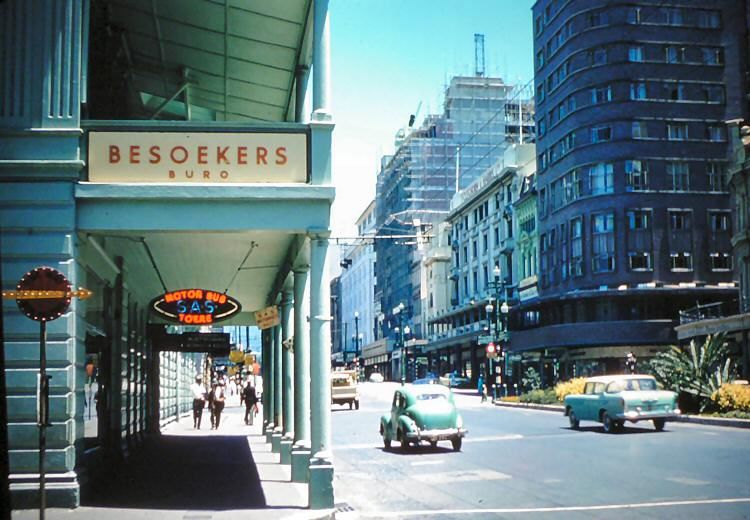
Rhodesia: Where New Zealand Is Headed

There exists a globalist plan to destroy New Zealand, and that plan is being executed on multiple fronts as this piece is being written. The plan is not unique to New Zealand (although some details are), and New Zealand is far from the first target. The globalist plan is to do to New Zealand what they once did to Rhodesia.

Had Marxists not destroyed Rhodesia, it would in all likelihood have become the first First World African country. In the mid 1970s, whites were some 8% of the population and as wealthy as Americans. The campaign to destroy it, led by Judeo-Communists like Joe Slovo, was launched for real in the 1960s, but was in fact a continuation of Communist efforts, best understood in the context of the Cold War.

As elsewhere, this campaign of destruction was externally financed by globalist interests, and its propaganda component involved the relentless demonisation of white settlers as colonial invaders, thieves and butchers. By stirring up anger and resentment among the black population, these globalist interests succeeded in first paralysing the country’s economy and then ethnically cleansing the whites.

In the mid 1970s, there were over 300,000 white Rhodesians; by today, there are fewer than 30,000. The white Rhodesian population has effectively been wiped out. The GDP per capita of Zimbabwe is now lower than in hellholes like Congo, Sudan and Syria. The globalist Eye of Sauron has then turned to South Africa, with similar results that are still ongoing.

Now that Rhodesia is gone and South Africa all but destroyed, the attention of the Marxists will turn to New Zealand. There’s only one thing Communists hate more than wealth: wealth produced by white colonials. New Zealand, like Rhodesia and South Africa, was desperately poor before white people settled it, and soon became wealthy. Its very existence is therefore regarded by Communists as a testament to white supremacy.

As far as those Communists are concerned, New Zealand delenda est.

The plot to destroy Rhodesia centred around Robert Mugabe. The plot to destroy New Zealand has no Mugabe as yet, but it has a likely candidate in Rawiri Waititi. Like Mugabe, Waititi gets his support chiefly from Brown Communists. Also like Mugabe, his modus operandi is to incite this racial proletariat into a frothing rage seeking revenge, and then to graciously accept some kind of donation from the Establishment in exchange for calling the dogs off.

Debbie Ngahere-Packer, Willie Jackson and Marama Davidson are all further examples of this established pattern of well-funded anti-white race grifters being pushed to the exclusion of more reasonable people. The globalist Marxist interests that want to destroy New Zealand plan to empower these grifters, primarily through platforming them in the mainstream media (which is owned by international banking and finance interests).

These race-baiters will then use their access to this audience to spew hate, weakening the chances of national co-operation.

The plan is to set the white and Maori populations against each other, like the white and black populations were set against each other in Africa. To this end, globalist interests are funding (and will continue to fund) a propaganda campaign designed to stir up resentment between the two populations. This propaganda campaign will have two prongs.

The first is stirring up Maori resentment. This is primarily achieved through blasting them with an ‘us and them’ narrative that claims all land in New Zealand is stolen, and that Maoris never benefitted in any way from white settlement. This narrative also suggests that ‘revenge oppression’ is entirely justified – that it’s fair to discriminate against white people for any arbitrary reason, because doing so rebalances the scales of historical oppression.

As in Rhodesia, popularising such narratives will mostly be achieved by external funding of malcontents like Waititi, Jackson et al., who will then incite hate among their followers. The globalists will prominently feature these malcontents and their slimy rhetoric in the mainstream media, leading other Maoris to adopt race consciousness and to abandon class consciousness.

The second is stirring up white resentment by relentlessly screaming ‘Racist!’ at them. If white people ever complain about Government largesse going to middle-class Maoris instead of to working-class white people, the mainstream media will howl them down with cries of racism. The narrative is that working-class whites have to suffer for the historical crimes of their ruling classes. If they don’t accept this, they’re racist.

This will split the white population down the centre, between a working-class half that struggles without any help, and a middle-class half that doesn’t give a shit. So, rather than focussing on the bigger picture, the working-class whites give into despair while the middle-class ones drift off into a haze of mindless consumerism akin to an opium session.

The net result of these two prongs is that Maoris and whites, instead of seeing each other as the yin and the yang of a healthy nation (as per Esoteric Aotearoanism), see each other as the enemy. This makes supraracial organisation impossible. Maoris may organise as the Maori Party, and whites may not organise at all. The country is left crippled.

With resistance neutralised, the globalists can then swoop in and sweep the whites out. This was the plan used to destroy Rhodesia, it is the plan being used to destroy South Africa, and it will be the plan used to destroy New Zealand.

*

If you enjoyed reading this essay/article, you can get a compilation of the Best VJMP Essays and Articles of 2020 from Amazon for Kindle or Amazon for CreateSpace (for international readers), or TradeMe (for Kiwis). A compilation of the Best VJMP Essays and Articles of 2019, the Best VJMP Essays and Articles of 2018 and the Best VJMP Essays and Articles of 2017 are also available.

*

If you would like to support our work in other ways, please consider subscribing to our SubscribeStar fund. Even better, buy any one of our books!


Generation Ruthanasia

Many Kiwis were shocked by a video circulating this week depicting a mass brawl at Te Aro Park in Wellington. The scene made it appear like public violence is now just part of everyday life in New Zealand. The nihilism reflects the rotten state of our economy – a rot that began with the Fourth Labour Government’s introduction of neoliberalism.

Neoliberalism came to New Zealand under the friendly name ‘Rogernomics‘. The Fourth Labour Government, following the trends established by Ronald Reagan and Margaret Thatcher overseas, adopted a number of neoliberal measures that would supposedly increase New Zealand’s economic performance. To some extent, they did. The real suffering didn’t begin until after Labour’s 1990 election defeat.

The Finance Minister of the Fourth National Government, Ruth Richardson, took the scythe to New Zealand’s poor with the 1991 Budget. The combination of the $14/week cut to the unemployment benefit, the $27/week cut to the sickness benefit, the $25 to $27/week cut to the families benefit and the abolition of universal payments for family benefits was a kick in the guts to those already at the bottom of society.

The act was dubbed ‘Ruthanasia’. In the same way that a useless old person is put to death with euthanasia, the useless lower classes were put to death with Ruthanasia. The narrative from the media was that beneficiaries were lazy, thieving scum anyway, and cutting their benefits should motivate them to get off their arses and into work. If not, they could die, it would be just as good.

The measures were particularly brutal to solo mothers, who found themselves $40/week or more worse off. The idea was that solo mothers were society’s filth, and in breeding outside of a stable marriage they were responsible for all of society’s ills, and needed to be punished for it. Their children were surplus to economic requirements, and therefore should be made to understand that they were not needed or wanted.

To a major extent, this strategy succeeded. Today, New Zealand’s youth suicide rates are the second-highest in the developed world. Every year, 14.9 out of every 100,000 Kiwi adolescents decide permanently that their life isn’t worth living. The vast majority of those are from the poorer classes. This is a direct consequence of the fact that the abuse and neglect of New Zealand’s poor was normalised by Ruthanasia.

However, the children that Ruth Richardson threw to the wolves in 1991 mostly survived.

Some are now the ironhearted gang leaders who hold the loyalties of other violent young men. Winning the favour of such hard men may have been the reason for the fight in the video link in the first paragraph. Such mindless aggression might sound barbaric, but that’s the reality for young men in Clown World.

The children born into beneficiary families between 1980 and 1995 are now Generation Ruthanasia. Many of these children killed themselves as adolescents. Many more turned their hatred outwards and mutilated others. Too many of them are missing some of the part of the mind that allows humans to feel empathy with other living beings.

This absence of empathy is an inevitable consequence of the way they themselves were treated – as before, so after. Yet therein lies a great danger for New Zealand society over the next couple of decades.

Generation Ruthanasia might be outnumbered by people who were raised well, but they are still numerous enough to have a significant influence upon the nature of our society and upon the minds and the values of the following generations. It is their nihilistic cynicism that one sees expressed in the gang brawls at Te Aro Park this week, and in other places.

The now-adult men of Generation Ruthanasia don’t know how to love, neither themselves nor others. The loving parts of the mind and heart have long since been closed off for only bringing sorrow. But these men are already old enough so that the next generation looks up to them. As such, there’s a risk that their absence of empathy becomes normalised.

The natural, logical realisation that went through the minds of Generation Ruthanasia as children is that human life is without value. If children are worth so little that it’s fair to withhold money from their parents so that those children can’t eat, then what does have value? Certainly not this society. This logic is why the savagery of the gang lifestyle is no longer enough to scare everyone away.

This way of thinking is not dissimilar from that of the generations raised in places like inner-city America and Brazil – and that’s what New Zealand is now on track to become like, if the process of social decay is not arrested. But solving the problems posed by this cohort of severely mentally and spiritually damaged people will take decades.

The least part of any effective solution will be a massive financial investment – one large enough to reset the mental health situation. A universal basic income, to give people time to mentally recover, might be necessary here. Any government refusing to consider such measures would do well to bear in mind Machiavelli’s maxim that “If an injury has to be done to a man it should be so severe that his vengeance need not be feared.”

*

If you enjoyed reading this essay/article, you can get a compilation of the Best VJMP Essays and Articles of 2020 from Amazon for Kindle or Amazon for CreateSpace (for international readers), or TradeMe (for Kiwis). A compilation of the Best VJMP Essays and Articles of 2019, the Best VJMP Essays and Articles of 2018 and the Best VJMP Essays and Articles of 2017 are also available.

*

If you would like to support our work in other ways, please consider subscribing to our SubscribeStar fund. Even better, buy any one of our books!

Spiritual Religions And Political Religions

Enormous confusion surrounds the discussion of religion. The term ‘religion’ seems to encompass some extremely different, even contradictory, attitudes and ideas. This essay argues that a major conceptual division needs to be made: between spiritual religions and political religions.

A spiritual religion is a doctrine that, if followed, will alleviate spiritual suffering. The alleviation of suffering is as close as this world gets to a universal moral good. As such, spiritual religions are seen as something holy. So both spiritual religions and political religions claim to be spiritual religions.

But in the same way that visiting a prostitute and having sex is not really making love, even though it appears similar, political religions are not really spiritual.

A genuine spiritual tradition is not concerned with the will for temporal and material power. A doctrine such as Buddhism teaches its adherents that gratifying such desires will not lead to happiness. And it is correct – once a person has met their basic physical needs, further happiness comes not from physical excess but from meeting social, intellectual and spiritual needs.

A political religion is a doctrine that is primarily concerned with temporal and material power. The authorities of a political religion are not concerned with alleviating suffering – they want power, money, fame, prestige. For them, suffering is a good thing, because it gives them a chance to portray their political enemies as the ones responsible, and themselves as the saviours.

The difference between a political religion and a political non-religion (such as Communism) is that the non-religion doesn’t attempt to cloak itself in the shroud of divine morality. Communism was happy enough teaching that consciousness is extinguished upon the death of the physical body. Political religions, by contrast, admit that consciousness survives the death of the physical body – but there’s a catch.

The catch is always this: your consciousness will reincarnate in a place of suffering in the next world unless you obey the political religion in this world. So the political religions demand that you give them money, time, labour and devotion in this world on the threat of suffering in the next.

The foremost examples of political religions are the Abrahamic cults, in particular Christianity, Islam and Judaism. Each of these has aped the spiritual wisdom of their age to create an ideological monster. Each of these teach that only by submitting to the priesthood can one achieve the cessation of suffering. The priesthood speaks for the divine – a power granted only to them. Therefore, obey or suffer.

The characteristic sign of a political religion is that they cause suffering in order to gain power. Relentless, grinding misery causes people to look to higher authorities for solace, which is why Abrahamism is doing so well in Africa and the Middle East. To this end, political religions usually support the persecution of women, homosexuals, prostitutes and drug users.

Also characteristic of political religions is that they drive out other authorities from cultural space, a kind of memetic brood parasitism.

All political religions decree that no other religion may co-exist with them. The Hebrew Bible states that “He that sacrificeth unto any god, save unto Jehovah only, shall be utterly destroyed” (Exodus 22:20), and the Koran commands follows to destroy non-believers at numerous points (2:191-193), (3:56), (4:74), (4:89), (5:33), (8:12), (8:39), (9:5), (9:73), (9:123), (47:3-4), (47:35), (48:29), (66:9).

Following this imperative, political religions do everything they can to destroy spiritual religions in any territory they control. In much the same way that criminal gangs of narcoterrorists don’t allow outsiders to operate on their turf, neither do criminal gangs of spiritual terrorists. True spiritual religions don’t need to aggress against other religions, because they know that the falsehoods of other doctrines will reveal themselves.

All spiritual religions understand that accumulating earthly power and wealth, gratifying as it may be to the ego, doesn’t provide spiritual solace. As such, true spiritual religions never have a “prosperity gospel” in which it is taught that material wealth is granted by God as a reward for righteousness. Neither do they hearken back to past times of military dominance as golden ages.

Buddhism, for example, doesn’t care if people don’t follow it. Anyone is free to reject the Buddha’s doctrine and indulge in sensory pleasures. But when a person tires of such indulgence, and they feel that it’s time to strike a balance between indulgence and abstinence, then the Buddhists are there to explain their methodology.

Islam, by contrast, cares a lot. Thirteen countries impose the death penalty for apostasy, all of them Muslim ones. This means that children are considered to be Muslim when they are born, and if they don’t like it as adults, they are killed. At the time of writing this essay, almost 1,000 people had been killed in the past 30 days in Islamic terror attacks. All of the killers were following the admonition of their religion to expand its political influence.

The irony, of course, is that all this makes spiritual religions look spiritual, and political religions look material, and this pushes all genuinely spiritual people towards the former, and all genuinely base people towards the latter. This explains why hedonistic self-aggrandisers, when they discover religion in adulthood, tend to discover political ones.

The clash between spiritual and political religions has defined much of the world’s history, and may define much of its future. There are many signs that suggest the Abrahamic cults are slowly uniting under one banner, and, when they do, they will inevitably try to conquer the world or be destroyed in the attempt.

As has been pointed out elsewhere, Abraham was probably the world’s first true psychopath. The cult he started developed into the greatest collective evil the world has ever known. This evil reflects Abraham’s sadistic desire for total control and dominance, something shared with all his followers. Indeed, Abraham could be said to be the father of political religion.

On the Mithraic ladder, Abrahamism is equivalent to the lead, the basest possible frequency. The spiritual religions, on the other hand, are equivalent to the gold. They are akin to divine radiance beaming down on us. Thus, although political and spiritual religions may appear very similar on the surface, it’s necessary to draw a sharp distinction between them. Ultimately, they reveal their true interests by their actions.

*

If you enjoyed reading this essay/article, you can get a compilation of the Best VJMP Essays and Articles of 2020 from Amazon for Kindle or Amazon for CreateSpace (for international readers), or TradeMe (for Kiwis). A compilation of the Best VJMP Essays and Articles of 2019, the Best VJMP Essays and Articles of 2018 and the Best VJMP Essays and Articles of 2017 are also available.

*

If you would like to support our work in other ways, please consider subscribing to our SubscribeStar fund. Even better, buy any one of our books!

How A Person From A Gang Family Would Deal With The Gang Problem

I come from a very rough family. At various points in my life, I have been the son of a gang member, the nephew of a gang member, the brother of a gang member and the cousin of a gang member. Both of my brothers have spent time in prison, both of my mother’s brothers have spent time in prison, and I had been struck in the head or face by four different adults by the time I was five years old. Despite all this, I managed to get a research degree in psychology. This is how I would deal with the gang problem.

Any effective program of behavioural modification has to have two elements: reinforcement of desired behaviours and punishment of undesired behaviours. This is popularly known as “the carrot and the stick approach”. Solving our gang problem requires such an approach.

My proposal for the carrot is universal basic income.

People in the upper and middle classes have great difficulty imagining what life is like in the bottom 5%. Only very rarely do they have the life experience to understand how being raised in an environment of abuse and fear causes a person’s brain to develop differently to normal. As such, they have great difficulty understanding why some people can’t hold down a full-time job.

Being raised in an abusive environment causes the brain to develop in a way that is highly optimised for war, and poorly optimised for peace. One consequence is that mild levels of stress can push a person so damaged into homicide mode. If a person’s brain is wired to react with instant and overwhelming aggression to threatening stimuli, they are very unlikely to be able to deal with the daily challenges of the workplace.

The solution to such mental problems isn’t being stuffed full of sedatives and told to get the fuck back to work, as per standard mental healthcare practice in New Zealand. The only effective treatment for the damaged person is to allow them to rest until they grow out of their condition. This requires time, and that’s where a universal basic income can play a role.

A small but guaranteed income would not only help practically by removing an enormous amount of financial stress, it would help morally by removing resentment. Many young people from difficult family environments deeply resent the fact that work is demanded of them before they’ve had a chance to develop a fully functioning brain. A UBI would take away one of the major reasons for people born into disadvantaged families to rage against the system.

My proposal for the stick is crating.

Psychopaths consider all kindness to be weakness. All. As such, lenient sentencing and political engagement merely encourages them to commit more crimes. Not all gang members are psychopaths, but the gang environment provides an excellent environment for them to hide. With the exception of entering Parliament, joining a gang is the optimal path for a psychopath who wants opportunities to abuse people and get away with it.

The key to solving the gang problem lies in accurately being able to distinguish psychopaths from non-psychopaths. The single biggest flaw of the entire “Justice” system is that it makes no effort to distinguish between sadists and psychotics. As such, the former are penalised too lightly and the latter too harshly.

The non-psychopaths should be treated with patience. If someone is from a gang environment and isn’t a psychopath, despite having ample motive to become one, they must possess some measure of spiritual gold. They must possess the capacity to say ‘No’ to evil. People like this need to be cherished. Mental illness is not a reason to punish someone, as it’s often a good thing, because it’s often an alternative to psychopathy.

The psychopaths should be crated. The first step here is to introduce a new category of crime: those committed with malicious indifference to human suffering. A typical example of such crimes are coward punches like the recent ones in Auckland. Most murders and rapes will naturally fall into this category.

The second step is to subject every convicted criminal to a full psychological examination, with the goal of determining whether they have irreparable brain damage making them sadistic.

Modern psychological science can make such a distinction. The amygdalas of such people are less likely to activate in response to observing human suffering, making them callous, and their pre-frontal cortexes contain less grey matter, making them impulsive. Such unusual brain structures reveal that those people are dangerous.

If a person is found to have irreparable brain damage of the kind characteristic of psychopaths, and is later found guilty of a crime committed with malicious indifference to human suffering, then, upon being found guilty, they are immediately nailed into a crate instead of being taken back to the cells. This crate is then loaded into a helicopter, flown 20 kilometers out over the ocean, and jettisoned from a great height.

This carrot-and-stick approach will succeed because of the twofold benefits it offers.

The first benefit is that a more compassionate approach will neutralise resentment. Most young men who join gangs do so because they learn early in life that society hates them, and they reason that they might as well hate society back. A UBI would take away the most of the financial incentive to join a gang (this incentive is much bigger than most people realise). This will mean fewer gang members.

The second benefit is that, on account of the more compassionate approach, it’s justified to be extremely firm against the intractable criminal elements that remain in the population. People would no longer be forced by economic necessity to join gangs, so those who do can be assumed malicious. The widespread crating of known psychopaths will spread fear among the remainder.

The combination of these two effects would be a drastic reduction in both the number of gang members and the amount of suffering caused by gang activity.

*

If you enjoyed reading this essay/article, you can get a compilation of the Best VJMP Essays and Articles of 2020 from Amazon for Kindle or Amazon for CreateSpace (for international readers), or TradeMe (for Kiwis). A compilation of the Best VJMP Essays and Articles of 2019, the Best VJMP Essays and Articles of 2018 and the Best VJMP Essays and Articles of 2017 are also available.

*

If you would like to support our work in other ways, please consider subscribing to our SubscribeStar fund. Even better, buy any one of our books!