1. The feminine elements are waypoints along the Great Feminine Axis.
2. These elements represent different vibrations, all of which inherently have equal value.
3. There are an infinite number of ways of dividing the Great Feminine Axis into elements. Some of these configurations make more sense than others. The most popular are the twofold, threefold, fourfold and eightfold divisions.
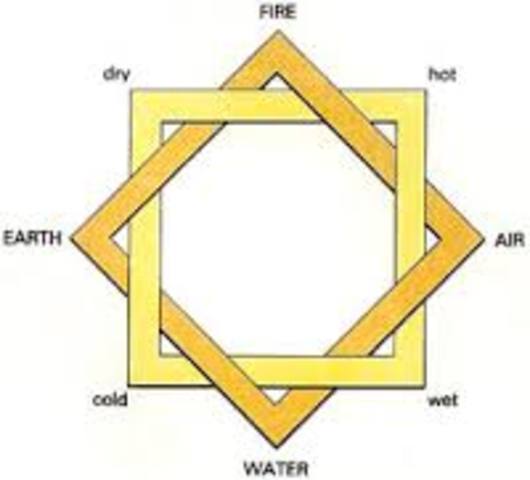
4. The fourfold division of the Great Feminine Axis is represented by the four classical elements of earth, water, air and fire.
5. The first element, nearest the Autumn Pole, is earth, represented by green.
6. Earth is the most feminine of the feminine elements, and is experienced as cold and dry.
7. The vibration of earth is experienced as melancholy, but it also has an aspect of healing.
8. The second element, immediately to the right of earth, is water, represented by blue.
9. Increasing the vibration of earth will cause its hexahedrons to break down into icosahedrons and become water.
10. Water is more energetic than earth, and is experienced as cold and wet.
11. The vibration of water is experienced as phlegmatic, but it also has an aspect of sociability.
12. The third element, immediately to the right of water, is air, represented by yellow.
13. Increasing the vibration of water will cause its icosahedrons to break down into octahedrons and become air.
14. Air is more energetic than water, and is experienced as hot and wet.
15. The vibration of air is experienced as sanguine, but it also has an aspect of sedulousness.
16. The fourth element, immediately to the right of air and nearest the Spring Pole, is fire, represented by red.
17. Increasing the vibration of air will cause its octahedrons to break down into tetrahedrons and become fire.
18. Fire is the most masculine of the feminine elements, and is experienced as hot and dry.
19. The vibration of fire is experienced as choleric, but it also has an aspect of righteousness.
20. All of the feminine elements inherently have equal value, but some will have more value in the immediate environment than others.
21. In an environment of rest, the vibration of earth will have the most value, and will cause consciousness to rise furthest up the Great Masculine Axis. Other vibrations will cause consciousness to rise less far, or to fall.
22. In an environment of love, the vibration of water will have the most value, and will cause consciousness to rise furthest up the Great Masculine Axis. Other vibrations will cause consciousness to rise less far, or to fall.
23. In an environment of sport, the vibration of air will have the most value, and will cause consciousness to rise furthest up the Great Masculine Axis. Other vibrations will cause consciousness to rise less far, or to fall.
24. In an environment of war, the vibration of fire will have the most value, and will cause consciousness to rise furthest up the Great Masculine Axis. Other vibrations will cause consciousness to rise less far, or to fall.
25. Expression of the correct vibration on the Great Feminine Axis will always cause a consciousness to ascend the Great Masculine Axis.
26. Expression of the incorrect vibration on the Great Feminine Axis will always cause a consciousness to descend the Great Feminine Axis.
27. Achieving one’s Aspirations is fundamentally a matter of expressing the right vibration at the right time.
*
This chapter is an excerpt from Elemental Elementalism, the foundational scripture of the new religion of the Age of Aquarius.
The first attempt, using a complicated setup involving a metal crucible, a glass chamber with a seal and a powerful blowtorch, failed in a flash, bang and puff of smoke. There was enough for a second hit, which I tried using the “Terence McKenna Method” of a bong half-filled with cannabis, then a layer of DMT, then some more cannabis. It was hard to light but, thanks to the assistance of a nearby shaman, I managed to blast it back and hold it in.
My first impression was that it felt a lot like salvia, except pleasant. It brought with it a salvia-like experience of the edges of perception vibrating harder and harder until normal perception broke down. As with salvia, I had the sense of seeing entire universes within the smallest fragment of the material world. One such fragment was the ceiling boards above the couch where I lay.
The background music playing, a pleasant downbeat ambient, collapsed into a single tone, a high-pitched frequency that I realised was the same as the Hindu Om, i.e. the frequency of the Universe. I heard this tone in the centre of my head as I felt the particles of my body vibrate and melt into the couch. Also like the salvia, the DMT seemed to enable my soul to look past the restrictions of the body, i.e. vision was no longer restricted to the senses of the eyes.
The only major difference to the salvia was that the DMT felt really good.
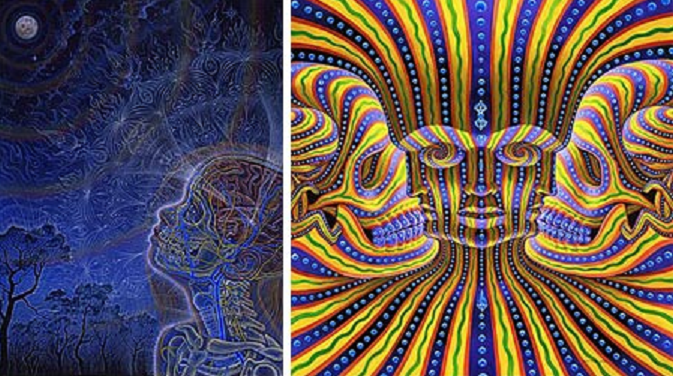
These ceiling boards I stared at seemed to dissipate, as if the particles maintaining the illusion of them had become too high-energy, and they left behind a gloriously multicoloured fractal that vibrated intensely. The longer I looked into this fractal, the more it started to take three-dimensional form, with a number of corridors stretching away from me and away from the immediate surface.
On the walls closest to me, i.e. those not stretching away to form the corridors, faces appeared. At first these were Olmec-style colossal heads. The central one, and the undulations of its colours, transfixed me. Soon it formed into the face of a tuatara, which watched me out of both eyes. I realised that I was being observed by God, who was behind the face of the tuatara, as I was myself God observing the tuatara from behind my own face.
Ensorcelled by these strange hallucinations, the visions before me seemed more true than the material world that I had just come out of. I realised that this was how it felt to die, for one’s consciousness to shed the coat of skin that it’s adorned with in this life – and that to die was the most natural thing in the world.
In the same way that, after you breathe in, the most natural thing is to breathe out, so after you live, the most natural thing is to die. It’s nothing to fear in the slightest.
Life in this space is an experience that our individual fragments of consciousness chose to have. In choosing to do so, they stepped down out of the true reality and into this space, which we call “The World”, but which is more like a single room off a narrow street that itself connects to a larger street which itself connects to a larger street and so on. The great trunk line of reality is somewhere else.
We choose to incarnate into this realm, and after this life we incarnate out of it again. Life is much like a protracted bungee jump: the beginning is terrifying, with a rush of barely comprehensible sensations, then you get used to the fear to some degree, and soon enough you’re back on the platform watching others do it. It’s all very entertaining, and accords with the understanding of Elementalism that the meaning of life is to entertain the gods.
I had a vision of having been buried inside a coffin and reaching out above my head, rising through my own crown chakra and through the ground, into the light above. In that space in the light above was the real world, and there were all the consciousnesses that had ever shared time or space with me here in the material world. They are only ever separated from the rest of us by the flimsiest of veils, one that can be broken through in a moment.
I was not in this space for long – either the dose was not the absolute strongest or some medication prevented the DMT from reaching its full effect. But it was long enough for me to remember the reason why I incarnated into this planet to have this particular life. To do so would afford the opportunity to rebalance the frequency of my consciousness, which had become imbalanced owing to decisions (and patterns of decisions) taken in previous lives.
In this life on Earth, I was born into poverty because I had not sufficiently appreciated wealth in previous lives, and that had left an impact on the frequency of my consciousness. I was born into violence, and was forced to encounter violence, because I had been violent in previous lives, and that had also left an impact on the frequency of my consciousness. I was born into spiritual ignorance for similar reasons.
Incarnating into an environment that is impoverished in these ways trains the frequency of one’s consciousness to appreciate them more. To that end, I said Yes to everything that I would experience during this life, and therefore have no cause for any resentment.
No matter how grim life on Earth may get, the experience serves to rebalance the frequency of one’s consciousness so that one may attain higher dimensions after the death of one’s physical body. As such, there’s no reason to say No to any of it. Even in dying and death, the experience can be embraced. If this is done, one’s consciousness will return to the real world above in a well-balanced state.
These realisations brought with them a powerful sense of the fundamental allrightness of the Universe. I understood that there was a way of perceiving reality so that none of the miseries in this world caused real suffering, and therefore that Plato was correct, when he wrote at the end of Timaeus, that this really is the best of all possible worlds.
There’s no reason to feel any real resentment, not even at the genuine shitness of some of the aspects of life in this world, because enduring them trains the frequency of one’s consciousness to appreciate their absence. The hunger, violence, lies, depression, misery and pain in this world train us to appreciate worlds in which they don’t exist (or are less pressing).
This was a great revelation for me, as I have always struggled with not really wanting to be in this place. These sentiments were especially strong after my grandparents died in 2016. DMT helped me realise that they (like everyone else that has ever incarnated into this world) wait for me in the real world above, and that the best thing is that our inevitable reunion follows a glorious life here, and not an inglorious one. We truly are heroes living under the eyes of the gods.
Muammar Gaddafi’s The Green Book was published in 1975, and was intended to be read by everyone. Gaddafi was murdered in 2011 for opposing the same people that Abraham Lincoln and John F Kennedy opposed, i.e. globohomo. This book is therefore of immediate interest to anyone else who opposes globohomo.
Part I is titled ‘The Solution of the Problem of Democracy: The Authority of the People’. This is divided into ten chapters.
In the first, ‘The Instrument of Government’, Gaddafi points out the inherently tyrannical nature of electoral democracy as practiced in the West today. Up to 49% of the population can have a government that they did not vote for imposed on them. He writes that “dictatorship is established under the cover of false democracy.”
In the second, ‘Parliaments’, Gaddafi decries the parliamentary system as a “misrepresentation” of the people. Democracy must mean the authority of the people, and not an authority that presumes to act on behalf of the people. As soon as the election is over, the representative assumes sovereignty from the people. The people have the right to destroy the parliamentary assemblies that have taken their sovereignty away.
“The most tyrannical dictatorships the world has known have existed under the aegis of parliaments.”
In the third, ‘The Party’, Gaddafi decries the modern political party as “the dictatorship of the modern age”. He states that “A party’s aim is to achieve power under the pretext of carrying out its program.” Any party not in power will seek to harm the nation so as to undermine their opposition. Moreover, a country governed by one party is not meaningfully different to countries governed by one sect or by one tribe.
In the fourth, ‘Class’, Gaddafi argues that leadership based on class suffers the same problems as leadership based on party, tribe or sect: it can only ever represent a minority. Even if the working class replaced the others, differences in material wealth or prestige between working-class factions would soon lead to the old class system reasserting itself. As before, so after.
In the fifth, ‘Plebiscites’, Gaddafi observes that the people’s expression is limited to ‘Yes’ or ‘No’. Referendums are often used to cover up for the failures of democracy. The solution lies, he writes, in finding an instrument of government that is not subject to either internal conflict or underrepresentation of the people it governs. This instrument can only be the authority of the people.
In the sixth, ‘Popular Conferences And People’s Committees’, Gaddafi declares that direct democracy is indisputably the ideal form of government. It’s just impractical. Gaddafi’s Third Universal Theory divides the population into Basic Popular Conferences, each of which chooses a secretariat from among their number. The population then appoints People’s Committees to replace government administration.
In the seventh, ‘The Law of Society’, Gaddafi contends that the natural law of any society must be based in either tradition or religion. Constitutions are artificial, thus invalid. He argues that human beings are essentially the same everywhere, and therefore natural law is applicable to all. Ruling systems must follow natural law, and not the reverse. So all laws must be grounded in tradition or religion.
In the eighth, ‘Who Supervises The Conduct Of Society’, Gaddafi appeals again to his Basic Popular Conference model. No one group can claim the right to police society, therefore society has to police itself. If the people organise themselves into Popular Conferences, however, they can supervise themselves.
In the ninth, ‘How Can Society Redirect Its Course When Deviations From Its Laws Occur’, Gaddafi notes that if a system is dictatorial, resistance to it must take the form of violence. Because the use of Basic Popular Conferences and People’s Committees means that the system is not dictatorial, it can be reformed without violence. Because the system encompasses all, there are no outsiders to direct violence against.
“Violence and revolution are carried out by those who have the capability and courage to take the initiative and proclaim the will of society.”
In the tenth chapter, ‘The Press’, Gaddafi states his belief that the press is primarily a means for society to express itself, and therefore does not belong to individuals or corporate interests. He points out that media sources can only ever speak for their owners and not for society. As such, private publishing or information enterprises must be banned. Only People’s Committees are permitted to act as the media.
Gaddafi finishes this first part of the book by noting that the strongest party in the society is always the one that rules.
The greatest controversy in psychological science today – perhaps in all science – is that regarding the heritability of intelligence. Although the science itself is reasonably clear, the topic is so heavily politicised that certain positions have become entrenched.
The anti-hereditarian side can be dubbed the Jewish Position. This is for two reasons. One – the foremost supporters of the position are all Jews, and two – almost all Jews adhere to this position. Both of these assertions become clear if one examines the history of the debate around the heredity of intelligence.
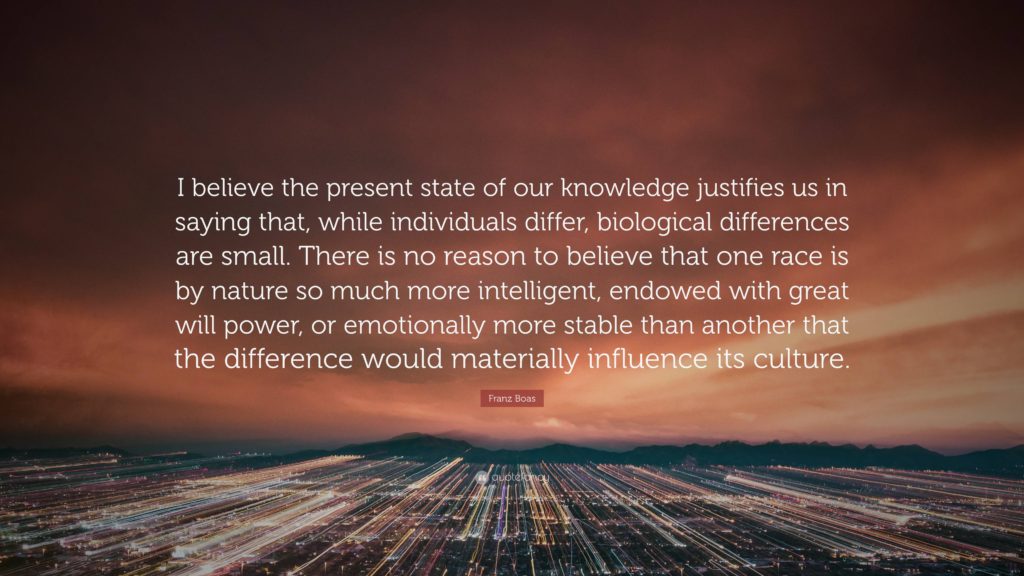
Franz Boas was the earliest major opponent of the hereditarian position. Born in Germany to Jewish parents, Wikipedia says of him that “Boas’s main project was to distinguish between biological and cultural heredity, and to focus on the cultural processes that he believed had the greatest influence over social life”.
This belief – that cultural influences have the greater influence on human behaviour and biological ones the lesser, or none at all – is the Jewish Position in a nutshell.
Boas introduced the concept of cultural relativism to the psychological sciences. Before him, it was assumed that the more civilised a culture was, the superior. After him, it was claimed that no-one could say that any culture was superior to any other. This attitude, which is essentially that of slave morality, is political and not scientific in nature. It’s the attitude of someone who promotes tolerance for the sake of tolerance and not for the sake of alleviating suffering.
When Boas’s supposed finding that American and European whites have significantly different skull sizes was proven to have been made up, Jewish professor Jonathan Marks defended his co-ethnic, claiming that those who had debunked Boas had themselves “been quickly rebutted by more mainstream biological anthropology.”
According to Marks’s Wikipedia page, he is “skeptical of genetic explanations of human behavior” and “of ‘race’ as a biological category.” These two attitudes are core components of the Jewish Position, the intent of which is to encourage out-group favouritism and to discourage in-group favouritism. As such, it strenuously denies any scientific evidence that suggests an out-group might be genetically inclined to behave violently or criminally.
Marks once wrote, citing fellow Jew Richard Lewontin (see below) that “…the point of the theory of race was to discover large clusters of people that are principally homogeneous within and heterogeneous between, contrasting groups. Lewontin’s analysis shows that such groups do not exist in the human species…” The Jewish Position denies that race is an valid concept.
Boas heavily influenced co-ethnic Elliot Aronson, born in 1932. Aronson’s ‘Nobody Left to Hate‘ continued the established Jewish trope that exclusion is to blame for pathological behaviour. The book suggested that the reason for the Columbine High School shooting may have been that Klebold and Harris had been excluded by the other students, and therefore the solution to violence is to reduce out-group antipathy.
Central to the Jewish Position is the idea that all exclusion on the basis of genetic or biological grounds is inherently immoral. Further, any in-group preference exercised on genetic or biological grounds is immoral. Proponents of the Jewish Position draw a connection between border control and concentration camps. For them, all lines between folk groups – whether lines of inclusion or exclusion – are evil.
Also born in the 1930s was Richard Lewontin. Lewontin pushed the Jewish Position so hard, a fallacy was named after him. A stubborn opponent of genetic determinism, Lewontin’s approach was typical of the Marxist that he proudly claimed to be. As is often the case with both Jews and Marxists, he opposed genetic determinism in part because it downplays the value of social activism.
Lewontin was one of the harshest critics of Edward O. Wilson’s landmark work Sociobiology. As is typical of those pushing the Jewish Position, his criticism of the work equated genetic determinism with fascism. He went on to co-write, with two other Jewish authors, a book called ‘Not In Our Genes‘, a groundbreaking work of biology denial.
One of the co-authors, Steven Rose, was from Britain, whereas the other two were from America. This reveals the degree to which the Jewish Position is supranational: Jews everywhere believe it, no matter which country they’re living in. In Australia, South Africa, Brazil, just as in America and Europe – everywhere there are Jews, the Jewish Position is asserted.
Lewontin collaborated closely with Stephen Jay Gould, another co-ethnic who prominently supported the Jewish Position. Gould had no shame about equating genetic determinism with Nazism, going as far as to blame people who believe in IQ science for the Holocaust. Gould took issue with anyone who believed in border control at all, also equating this to Nazism.
Gould was criticised for his 1981 propaganda masterpiece, The Mismeasure of Man, in which he smeared intelligence researchers as racists. It has been observed that “Gould’s Marxist political beliefs made him attack intelligence research because he saw it as a threat to his egalitarian social goals.” Ironically, Gould was aware that a person’s social goals affected what that person considered to be accurate science. He just didn’t apply this criticism to himself.
Robert Wright wrote in a letter to the New York Review of Books that “many evolutionary biologists consider Gould’s writings a serious impediment to popular understanding of Darwinian thought.” This is of true of everyone who takes the Jewish Position, which in its essence prioritises political expedience over truth and knowledge. It is a form of science denial, in particular biology denial.
The most prominent Jewish anti-hereditarian in popular culture today is Jared Diamond. Diamond’s most famous work, Guns, Germs and Steel, sought to show that the European dominace of recent centuries was a geographical fluke and not due to any inherent genetic superiority. According to Diamond, if Africans had had more plants suitable for domestication and a more pronounced East-West axis, they would have dominated the world instead.
In Guns, Germs and Steel, Diamond describes as “loathsome” the use of biological differences to explain economic outcomes. Yet, as a critique of Diamond’s points out, Diamond’s environmental determinism cannot account for why natural resource-poor Japan is wealthy, or why natural resource-wealthy Nigeria is poor. A biological determinist, aware that the most valuable human capital is the IQ of the people, can easily account for both.
The most prominent Jewish anti-hereditarian in academia today is Robert Sternberg. Sternberg is foremost in pushing nonsense like stereotype threat, the laughable idea that the low academic performance of blacks is because they’ve internalised white supremacist ideas about blacks being dumb.
Stereotype threat has been cited by Jewish researchers such as Joshua Aronson (the son of Elliot menioned above) as the reason for black academic underachievement. The reality is that, like all the other excuses made by people holding the Jewish Position, stereotype threat is a political concept and not a scientific one.
The political conclusion that Sternberg is desperately trying to avoid is that schools ought to be resegregated. To that end, he promotes the narrative that white people are to blame for black underachievement. Sternberg and his stereotype threat narrative claim that blacks only underachieve because white people expect them to, and thus black underachievement is due to white moral failure.
In summary, the Jewish Position is biology denial applied to the subject of human behaviour.
It’s fair to call it the Jewish Position because almost all of the people promoting it are Jews (as mentioned above) and because almost all of the people opposing it (Francis Galton, Ronald Fisher, Charles Darwin, Richard Dawkins, James Watson, Hans Eysenck, Arthur Jensen, Phillipe Rushton, Richard Lynn, Charles Murray, Satoshi Kanazawa, Linda Gottfredson et al.) are non-Jews. Jewish hereditarians, like Richard Herrnstein, are rare.
It’s worth noting that cultures without a heavy Jewish academic and media presence, such as China, India, Japan and Korea, near uniformly reject the Jewish Position. It’s only in the West, which does have a heavy Jewish academic and media presence, where the Jewish Position is taken seriously. Everywhere else, the genetic influence on intelligence is treated much the same as the genetic influence on height, i.e. as an obvious truth.
It’s also worth noting that the Jewish Position is never taken with regards to Israel. Where Israel is concerned, not only are borders and exclusion considered perfectly legitimate, but biological science (in the form of DNA analysis) can even be used to tell if someone is Jewish or not. In Israel, people can have a marriage licence denied if they can’t prove Jewish ancestry by DNA test.
Such policies would result in howls of outrage from all of the Jewish intellectuals mentioned above if any Western country introduced them – yet Israel may do so without a peep of protest.
The reasons why Jews almost uniformly hold the Jewish Position are probably best explained by Kevin MacDonald in his Culture of Critique. It’s enough for this essay to establish the trend that Jews who hold academic positions in the life sciences almost always reject hereditarianism, whereas non-Jews in similar positions in the life sciences almost always accept it.
The sum total of all of these facts is that no-one should ever trust a Jew or anyone pro-Jewish (such as a universalist Abrahamist) when it comes to discussions about heredity and the effect of genetics on human behaviour. They cannot be trusted to be honest on such issues any more than Nazis can, because they have a vested political interest in misrepresenting the truth (an example of what this column has previously called the Palestinian Paradox).