
Author: vjmp
Ranks Of The Soldiers Of The Information War

Edward Bernays wrote about the need to manipulate the perceptions of others if we are to shape human behaviour in our favour. But, because different people have different ideas about how society ought to be run, there is conflict over who gets to manipulate perceptions, who gets their perceptions manipulated and to what degree. As such, we live in a state of informational warfare, which could be said to constitute a Third World War.
The ranks of this information war relate to the amount of influence a person has in shaping the perceptions of others. This essay describes a simple base-4 logarithmic scale that ranges from the most passive and receptive consumer of media to the most influential producer of media.
To act as someone’s main source of information means that a media channel sets the agenda for that person, shaping their basic reality. It tells them what to worry about, who to hate, and what to talk about with their peers. If it’s quality media, it will also tell them what will happen in the future or give them hidden insights into the nature of either the physical or metaphysical world.
As a basic rule of thumb, a media will be the main source of information for a number of people equal to the number of subscribers to that media divided by the average total number of media those subscribers are subscribed to. So a FaceBook channel with 1,000 subscribers, and to which the average subscriber is also subscribed to about 50 other media, will control the perceptions of about 20 people.
Another way of looking at it is that the average person consumes media for between 300 and 500 minutes every day. Taking 400 minutes as an average, that means that controlling 400 minutes of eyeball time is the equivalent of controlling the perceptions of one person. Therefore, a content creator whose content is viewed for 8,000 minutes per day will control the perceptions of about 20 people.
Yet another way of looking at it is in terms of votes. How many people’s voting decisions does this media control? After all, the main benefit of controlling a person’s voting choice is that it means you can destroy your enemies with the arms of the State, namely the Police and the other security services. As such, you have a strong incentive to try to climb as high as possible in the hierarchy of information warriors.
0. Cannon fodder/Civilian.
People at this level don’t even know there’s a war on. For them, war is something fought with bombs and machine guns, and those aren’t killing people right now, therefore there’s no war on. Any talk about informational warfare is “conspiracy theory”. People in this category range from the borderline skeptical at one end to those who believe 100% of what the television says at the other.
The cannon fodder in the information wars are those who watch the television news, listen to the radio or mindlessly click through YouTube, FaceBook and Twitter. They are the receptive principle that is battled for by the ranking officers of the information war: the middle-aged soap opera-watching housewives of the digital age.
1. Corporal (control 1-4 viewers)
This level is when a person controls the perceptions of a handful of other people as well as themselves. It corresponds to Aristotle’s idea that the head of a household was the basic unit of political structure. It’s roughly the amount of influence wielded by a part-time op-ed writer for a small town newspaper – just enough to tip the balance for a few people.
Someone at this level will control up to 1,600 minutes of eyeball time every day. This is like having one article of 800 words read 320 times, roughly the rate of a high-quality post on a decent-sized Internet forum. It might be equal to the ability to make a handful of sales per day.
2. Sergeant (control 5-16 viewers)
This level is equivalent to a person who has moderatorship of one medium FaceBook page or Telegram channel, or ownership of one small FaceBook page or Telegram channel. Someone at this level will control up to 6,400 minutes of eyeball time every day. This is like having 1,280 reads on one’s articles.
A person at the sergeant rank of information warrior should be able to influence others to further propaganda from the sergeant on their own initiative. This means that at least some other people will seek out the sergeant for information, and will repeat that information to others.
3. Lieutenant (control 17-64 viewers)
Someone at this level will control up to 25,600 minutes of eyeball time every day. Assuming two minutes of reading time per page, this is like having 12,800 pages of one’s material read in book form per day. If all this reading was done on Amazon under the Kindle program, it would pay some $US80 per day.
It’s a level of influence roughly equivalent to the amount wielded by a clan representative at a council meeting of village leaders, i.e. someone who represented half a dozen or so families. Someone at this rank will be expected to create original content and disseminate it to followers.
4. Captain (control 65-256 viewers)
Someone at this level will control up to 100,000 minutes of eyeball time every day. This is the equivalent of someone’s 800-word article being read by 20,000 people, or someone’s 10-minute-long video being seen by 10,000 people. It’s enough influence to rile several dozen people up into action.
It’s roughly equivalent to having up to 50,000 pages of your material read on the Amazon Kindle program per day, which would easily pay enough money to live on in most parts of the West. This is a significant amount of influence, because it means that someone at this rank can work as a full-time propagandist (or information warrior).
5. Major (control 257-1,000 viewers)
To rank as a major in the information war means to be the main source of information for between 257 and 1,000 people. This is about the amount of influence wielded by one news anchor or chief journalist at a regional (i.e. subnational) television station, or by a YouTuber at the top of a small niche.
The larger bloggers are at this level, those getting at least 100,000 hits a day. They are comparable to majors because they will direct the perceptions of dozens of people who will themselves go on to direct the perceptions of dozens of others each. To fully control the perceptions of around 1,000 people is the equivalent of partially controlling the perceptions of a few tens of thousands.
6. Brigadier (control 1,001-4,000 viewers)
Such a person would be the main source of information for between 1,001 and 4,000 viewers. This equals roughly a million minutes of daily eyeball time, like holding the attention of a small city for long enough to recite a civil defence broadcast.
Being a contributor to the single most-received media in a major city or minor country would qualify a person for this rank. It reflects a significant level of responsibility, as someone at this rank will themselves control the equivalent of half a dozen full-time information warriors. A brigadier ought to be able to summon enough warriors to significantly alter public perception on minor topics.
7. Colonel (control 4,001 to 16,000 viewers)
A colonel in the information war controls several millions of hours of eyeball time per day. This means that their content either has a minor global presence or a major presence in a major country. Such a person will have many tens of thousands of other people discussing them and their propaganda on a daily basis, all around the world.
Information warriors at the rank of colonel will heavily influence those who themselves have significant media influence. Legions of people will come to them directly every day to hear what the agenda is, or what to think about certain major issues.
Examples of colonels in the information war would be Alex Jones or Jordan Peterson.
8. General (control 16,001+ viewers)
A general is the highest rank of the information war. The perceptions of the whole world are effectively under the control of people at this rank. Such a person would either be a global celebrity reknown for their opinions, or in charge of a major global media channel, such as chief editors of the most influential global magazines, or chief directors of major 24/7 television news channels.
Some might argue that controlling the perceptions of 20,000 people isn’t really very many, but most people’s perceptions are already tightly controlled by previous influences over the course of their lives and, as such, can only be influenced to a limited degree. So a person who ultimately controls the decisions made by 20,000 or more people is extremely powerful. It’s the equivalent of partial control over the perceptions of millions.
An example of someone at this level would be Joe Rogan.
The main network television news in New Zealand gets 750,000 viewers a day for a 60-minute program. Assuming that 30 minutes is watched of that program on average, that equals 22,500,ooo eyeball-minutes, or perceptual control over more than 50,000 people. The hundreds of people who work on these broadcasts would reflect the efforts of several colonels working together with their many underlings.
*
If you enjoyed reading this essay/article, you can get a compilation of the Best VJMP Essays and Articles of 2020 from Amazon for Kindle or Amazon for CreateSpace (for international readers), or TradeMe (for Kiwis). A compilation of the Best VJMP Essays and Articles of 2019, the Best VJMP Essays and Articles of 2018 and the Best VJMP Essays and Articles of 2017 are also available.
*
If you would like to support our work in other ways, subscribe to our SubscribeStar fund, or make a donation to our Paypal! Even better, buy any one of our books!
Why Kiwis Hate The Police III
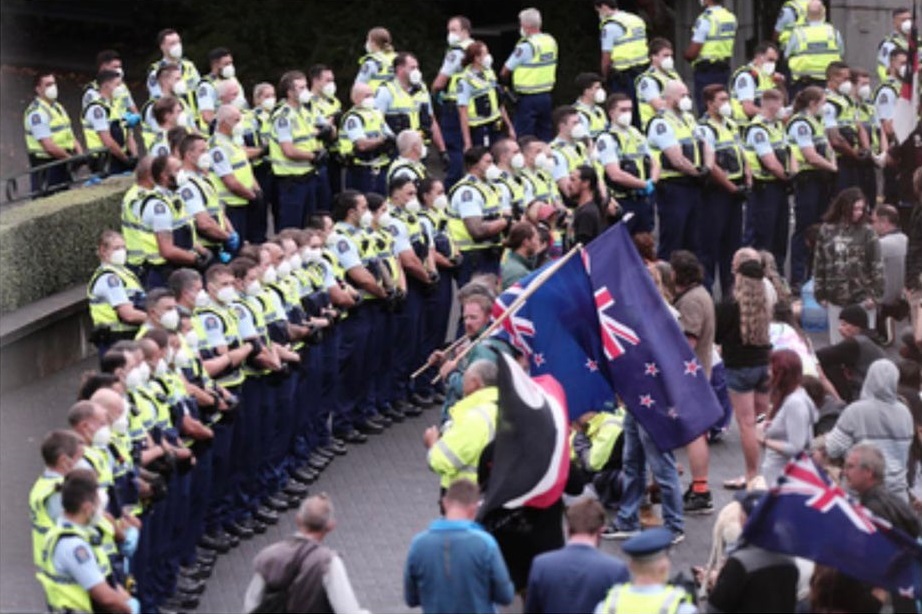
After decades of waging the War on Drugs against us, the reputation of the New Zealand Police in the eyes of the New Zealand people was already low, but this month it took a crash dive into depths never before plumbed. The actions of the New Zealand Police this month showed clearly that they are the enemies of the New Zealand people, willing to follow any order to harm Kiwis in the service of the authorities.
The first disgrace was when the Police flew a helicopter over a property in Coromandel to spray poison on a dying cancer sufferer’s medicinal cannabis plants. The unnamed cancer sufferer had been given pharmaceuticals for their suffering, but found them ineffective in comparison to cannabis, so began growing cannabis to produce a medicine that would help them overcome the cancer pain.
It’s hard to imagine a lower dog act than to destroy a sick person’s medicine. Only the most wretched of authoritarians would think that was justifiable. But the New Zealand Police will happily follow orders to destroy the medicine of other Kiwis. All they require is for an authority figure to say that the medicine is actually a dangerous drug, and they go on the attack.
The second disgrace was their use of violence against peaceful protesters on the Wellington Parliamentary lawn during the ongoing anti-mandate protests. At one point, officers went in and dragged a woman out by her hair. At another point, a Maori youth got his head squeezed by a full weight press from another officer. While not necessarily disgraceful by the standards of Anglo countries, it certainly was by the standards of anyone who expects a K-selected quality of policing.

As this video shows, New Zealand Police officers feel no shame at what they do. This is partly because police officers in all countries deal with the scum of society, and sometimes inadvertently generalise those experiences to the population at large. But it’s also at least partly because some of those officers are malicious and sadistic inside their own hearts, and enjoy the opportunities their job gives them to abuse people and get away with it.

The officer in the above video is representative of the New Zealand Police. Most New Zealand Police officers have similar sentiments towards the New Zealand public, as proven by the fact that no officer is willing to speak out against the abuses they commit. Like the staff of concentration camps, New Zealand Police officers just go along with the crimes committed by their fellows.
The New Zealand Police have demonstrated that they’re willing to cause any amount of suffering to Kiwis if they are given the order to do so. They have no concept of “fellow citizens”. There is no solidarity towards us, the New Zealand people, on behalf of the New Zealand Police. The New Zealand people are, as the officer put it in the clip linked above, The Great Unwashed.
If they were given orders to mow us down like dogs, Tiananmen Square-style, they would obey those orders.
Ultimately, however, it’s not their fault. As the Police say themselves, “the job is fucked.” It need not be, but it is. The Police should be taking orders from wise and benevolent leaders, but such people are not in power. Those in power are globalist authoritarians like World Economic Forum lackeys Jacinda Ardern, Justin Trudeau and Emmanuel Macron. These authoritarians are at war with their people – at war with us – and the Police are just tools at their disposal.
The Police, deep down, know that their actions place them in the same moral category as the criminals they claim to be protecting us from. So we must help them heal. The strategy must be to win in the same way Gandhi defeated the British – through good vibes and good cheer. The Camp Freedom protesters on the Parliament lawn are already showing how this can be achieved – with music, singing and dancing.
Part of reconciling the Police with the people must be ending the obviously failed and sadistic War on Drugs, which has already ended in many American states. It’s insane for Police to be spraying poison on people’s cannabis plants when states such as Washington and Oregon have already advanced beyond medicinal cannabis to medicinal psychedelics. Even Thailand, whose cannabis laws were infamously much harsher than New Zealand’s 20 years ago, has now legalised growing cannabis at home.
Colorado legalised cannabis in 2014, and they now have a $US 2.2 billion annual cannabis market. The anti-mandate protests aren’t about cannabis, even though a lot of it has been smoked in Camp Freedom. But the cannabis issue is one of several contributing to the frustration and rage that have fuelled these protests. That Ardern’s Government hasn’t taken the simple and easy measure of legalising cannabis, when all the evidence supports the idea, has convinced many that our ruling class aren’t interested in our well-being.
Until some kind of reconciliation occurs, the New Zealand Police need to be considered an occupying army, acting to bring the New Zealand people into a state of subjugation on behalf of the international banking and finance interests who own the governments of the world.
*
If you enjoyed reading this essay/article, you can get a compilation of the Best VJMP Essays and Articles of 2020 from Amazon for Kindle or Amazon for CreateSpace (for international readers), or TradeMe (for Kiwis). A compilation of the Best VJMP Essays and Articles of 2019, the Best VJMP Essays and Articles of 2018 and the Best VJMP Essays and Articles of 2017 are also available.
*
If you would like to support our work in other ways, subscribe to our SubscribeStar fund, or make a donation to our Paypal! Even better, buy any one of our books!
Why Don’t Leftists Support The Truckers?
The basics of our political education teach us that the right is in favour of the land-owning class while the left is in favour of the working class. As such, the right is in favour of the status quo and wants to maintain it, whereas the left is in favour of change and wants revolution. Given these basics, it’s hard to understand why the left opposes the ongoing truckers’ protests in Canada and New Zealand. This essay explains.
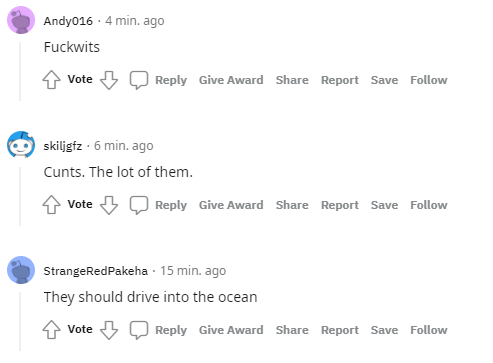
It’s rare that one sees the left united for any reason, but they are currently united against the truckers’ protests. Leftist hangouts like Reddit are full of abuse directed at the truckers (see screenshot at top of page), calling them “fuckwits”, “cunts”, “scum”, “feral lunatics” and any other derogatory epithet they can think up. Leftists are currently cheering on the Police looking to break up the protests in Canada.
On a surface level, it seems strange that a movement claiming to represent the working class would refuse to support that class when it stands up against oppression. The energy behind the truckers’ protests mostly comes from anger at oppressive coronavirus measures, in particular mask and vaccine mandates. The protests are therefore anti-fascist, which is precisely what the left claims to be.
It’s doubly stange if one considers that the left threw themselves behind the Black Lives Matter protests of recent times, even though those protests killed people and burned down cities. Why would the left support something as pointlessly destructive as the BLM protests but then say that the truckers’ protests were “a redneck paradise of delusion and ignorance”, as Martyn Bradbury did?
The reason for the left’s refusal to support the truckers’ protests is that most of the truckers are from the white working class.
The truth is that the left hates the white working class. Utterly despises them. The left believes that the working class should give all their power and support to the leftists and then fuck off back to labouring. The attitude of today’s left towards the working class is less like that of brothers in solidarity and more like that of farmers towards their cattle.
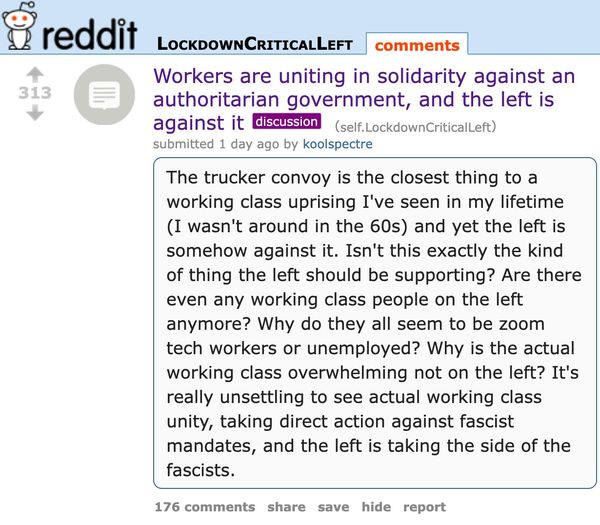
In fact, the working class has been driven out of leftist movements all over the Western World. There are no working-class whites in either the Green or Labour parties of New Zealand. Today’s left is almost entirely comprised of middle-class discontents. These discontents, on account of their great class privilege, have lost touch with reality.
The result of this lost touch with reality has been the inability to see the massive hypocrisy in their current positions.
The left claims to be for the working class, but they hate the white working class most of all. Leftist dogma has it that the reason why the non-white working class is poor is because of racist oppression. The non-white working class hasn’t been given their opportunities to ascend the status ladder yet, but the white working class has already been given these opportunities and has squandered them. As such, the white working class doesn’t deserve help or support.
Today’s left has redefined ‘working-class’ to mean ‘those at the top of the progressive stack‘. This term refers to a hierarchy of victimhood, in which people at the top deserve the most support and people at the bottom the least. The overwhelmingly white and male truckers are at the bottom of this stack. As such, they are enemies and not allies. The truckers, being white and male, ought to know their place, which is to be broken, submissive and penitent.
The end result of the leftists’ rejection of white, working-class men is that those men no longer have a voice in the political system, despite having done more than any other group to build the Western World and to keep the lights on. There are only two places this can lead.
The first, apparently desired by leftists, are that those white working-class men are exterminated, or at least marginalised even further into total irrelevance. The second, already predicted by VJM Publishing, is that those men throw their support in behind an anti-Establishment movement.
When a genuine anti-Establishment movement arises, those supporting these truckers’ protests will support that movement. When they do, they will face opposition from the Establishment’s apparatus of propaganda in the mainstream media. Foreshadowing of this opposition can already be seen in the Establishment’s reaction to the truckers’ protests. Working-class protesters must now understand that the left has abandoned them.
*
If you enjoyed reading this essay/article, you can get a compilation of the Best VJMP Essays and Articles of 2020 from Amazon for Kindle or Amazon for CreateSpace (for international readers), or TradeMe (for Kiwis). A compilation of the Best VJMP Essays and Articles of 2019, the Best VJMP Essays and Articles of 2018 and the Best VJMP Essays and Articles of 2017 are also available.
*
If you would like to support our work in other ways, subscribe to our SubscribeStar fund, or make a donation to our Paypal! Even better, buy any one of our books!