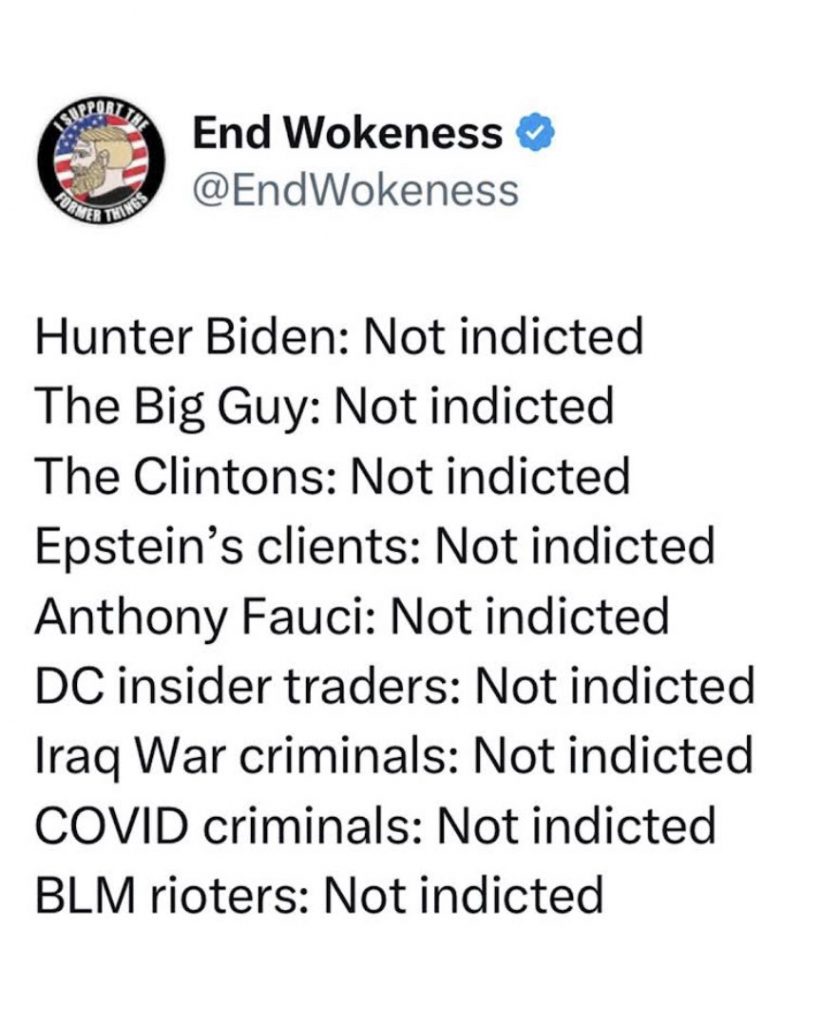
Kiwis were baffled this week by news that podcaster Vinny Eastwood has been sentenced to three months’ prison for the crime of protesting the Government. The excuse given is that Eastwood violated a public health order and thereby jeopardised New Zealand’s Covid response. But the Black Lives Matter protesters who also violated that order were not charged.
Why the discrepancy? Simply put, it’s because Vinny Eastwood challenged The Agenda, while the BLM protesters supported it.
What is The Agenda? In summary, it is the agenda of the world’s ruling classes to maintain their position at the top of the social dominance hierarchy. There are two major prongs to this agenda. The first is to deflect all criticism from the ruling classes. The second is to divide and conquer the masses by setting them against each other.
The Black Lives Matter protesters served to deflect criticism from the ruling classes by blaming everything on racism. The more that white people can be hounded into guilt for supposedly destroying the world with their racism, the less criticism the ruling class has to take for the order of things.
Vinny Eastwood, by contrast, directly criticises the ruling class. He is indifferent to identity politics, never playing the role of victim. And he does all this with humour and good cheer. These are the reasons why he has been sentenced to jail – not because he breached a public safety order. Eastwood previously faced intense Police harassment during Operation Whakahumanu, so the ruling class has long sought to ruin him.
Similar reasons explain why I faced Police harassment during Operation Whakahumanu for selling ‘It’s Okay To Be White’ t-shirts on TradeMe. The Agenda acts as if it isn’t okay to be white, because that way they can lay the biggest guilt trip on the largest number of people. The Agenda seeks to deflect blame by blaming working-class whites, who never had any power, for the crimes of ruling-class ones.
This also explains why Marama Davidson can get away with declaring that all the violence in the world is caused by white men: because blaming white people for everything serves The Agenda. Blaming white men in general distracts from the fact that only ruling-class people have any power. This is why she will face no consequences for her racist outburst last weekend.
If I would make a video blaming Jews for the violence in the world I would be arrested immediately and promptly hauled before a judge for inciting racial animosity. This is because blaming Jews (who make up a massively disproportionate number of ruling-class people) does not serve The Agenda. Only whites may be blamed; all other races are innocent of all charges.
Such moves fit the now-established pattern of deplatforming everyone who goes against The Agenda. VJM Publishing has, apart from the Police harassment, also suffered shadowbans on FaceBook, Google and Reddit, three Establishment-run tech enterprises. This is because we place truth above The Agenda. As such, we are the enemy of the ruling class.
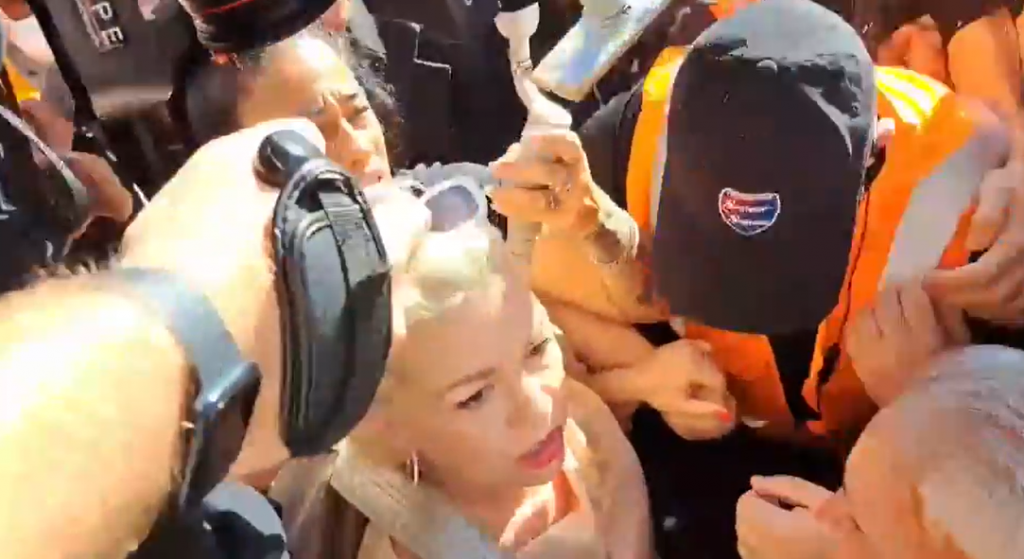
The latest absurdity was when Posie Parker was assaulted by a feral anti-free speech mob when she tried to speak in Auckland last weekend. Speaking out against men in women’s safe spaces does not serve The Agenda, because the ruling class seeks to destroy natural families, knowing that natural families create people who resist their oppressors. Damaged, broken families do not.
Why did the Police not protect Parker? Because Parker speaks against The Agenda. In this instance, it’s the agenda to destroy natural families by tricking confused members of them into becoming trans. Speaking out against that caused the ruling class to label Parker a Nazi, and that made it possible for them to raise a crowd of rabble to shut down her right to speak.
Ignoring the crimes of those who serve The Agenda is nothing new. Going back a few decades, this is why George W Bush and Tony Blair faced no punishment for their war crimes in Iraq. Iraq was apparently a threat to Israel, and serving Israel serves The Agenda, therefore destroying Iraq served The Agenda. As such, Bush and Blair faced no punishment for the million deaths they caused.
It’s also why Donald Trump, the only recent American President to not start a war, has just been indicted for supposed hush money payments. Why do Bush and Blair escape justice while Trump gets hammered? Bush and Blair served The Agenda, and Trump did not. It’s as simple as that – no conspiracy theories necessary.
In summary, furthering control of the ruling class is known as The Agenda, and it’s the explanation for why some people get punished for some actions while other people don’t get punished at all. Any action taken to further the control of the ruling class is permissible, and any action that weakens the control of the ruling class is impermissible. This might sound like the rules of a totalitarian scumhole, but that’s what the West is now.
When Posie Parker tried to speak at Albert Park on Saturday, and was attacked and silenced by a frenzied mob of far-left extremists, a dark and cold wave washed through the nation. Many Kiwis, lost in the blissful ignorance for which our country is reknown, had little idea of how precarious our rights to free speech had become. On Saturday it was driven home to us by a multitude of shrieking, hissing lunatics.
The anti-Parker protesters had been emboldened by a number of wins for the authoritarian side in recent years.
One of the first was shutting down VJM Publishing’s ability to sell ‘It’s Okay To Be White’ t-shirts on TradeMe. This was a double win for the globalist authoritarians, because not only did they silence someone who was satirising them, but they also established that they could silence their enemies at will by telling lies (there is nothing “white supremacist” about saying that it’s okay to be white).
Another big win was silencing Stefan Molyneux and Lauren Southern when they attempted to speak in Auckland in 2018. Molyneux and Southern had some redpills to share about the nature of mass immigration from certain cultures, so the globalists whipped up a crazed mob in order to stoke fears of violence, when they then used as an excuse to shut down the Canadians.
The authoritarians struck again when VJM Publishing’s best-selling book, Clown World Chronicles, was banned from TradeMe on false grounds. It seems that you can be an admitted far-leftist and former terrorist fundraiser, and still TradeMe will delist a book on your word.
These examples set the precedent: the far left decides if you get to have free speech or not.
Emboldened by these victories against free speech, the far left expected that they could shut down Posie Parker in Auckland. And they were correct. On Saturday a mob – incited to hysteria by a week of mainstream media scaremongering – attacked the rotunda on which Parker was to speak, and drove her away under Police escort.
It’s now apparent, if not publicly spoken, that your rights to free speech only exist if you have political power.
Such events underline the genius of Brian Tamaki. He never gets silenced, because he effectively travels in a gang, and this gang provides security for his talks. His entourage consists of dozens of high muscle mass males, most of who also have a past history of violence. They surround him like beta chimpanzees surround their tribal chief. Anyone mocking him for the crudeness of his approach is a fool; he gets to speak where few others do.
New Zealand is now much like an Anglo Somalia where only warlords have any true freedom of speech, and that only on account of their command of a capacity for extreme violence. Thus, anyone expecting to use their supposed right to free speech in the future best start lifting weights, training in martial arts and making friends with violent people.
The contrasting examples of Parker and Tamaki prove that anyone who wants the right to speak freely in New Zealand needs their own gang to protect them. So if there’s anyone out there who dreams of providing a genuine alternative to the political Establishment: don’t start with a manifesto or a million-dollar donation. Start by assembling a fighting community of high muscle mass men who are willing and capable of following orders.
If a fighting community of honourable and loyal men sounds like something out of the 1920s, that’s because it is.
In the same way that German Communists in the 1920s were inspired by the Bolshevik Revolution in Russia and the German Revolution of 1918-19, the far-left extremists of 2023 have been emboldened by the victories of recent years. Just like in Russia, ultimate victory for the far left means physically destroying the people they hate.
Antifa terrorists have been known to stalk freethinkers and attack them with hammers and metal bars, as they did on six separate occasions in Hungary last month. This is the sort of thing that any free-thinking person (right-wing or otherwise) now needs to deal with.
If you want to exercise your free speech in New Zealand today, you need to get fit and strong. Lift weights. Get used to receiving blows to the head. Study the basics of all the major martial arts. Find like-minded men and create bonds of solidarity with them through ritual and spending quality time with each other. When you have a group, learn some basic drills.
Today’s Albert Park protests taught us that anyone who wants to prevent New Zealand from sliding into tyranny needs to study the Laws of Iron.
Many thought that holding a cannabis referendum at the same time as a General Election would lead to a surge in support for the Aotearoa Legalise Cannabis Party. In the end, they only got 13,329 votes, or around 0.5% of the party vote. This chapter explain why a hundred times more people voted for cannabis law reform than for the cannabis party.
It will be surprising for many to hear that there wasn’t much overlap between those who voted ALCP in 2020 and those who cast a special vote for Yes in the cannabis referendum- the correlation between the two groups was 0.23. This was statistically significant, but only barely so, and is much weaker than many other correlations with voting ALCP in 2020.
Variable
Voting ALCP in 2020
No qualifications
0.55
Level 1 certificate
0.55
Level 2 certificate
0.64
Level 3 certificate
0.37
Level 4 certificate
0.53
Level 5 diploma
0.36
Level 6 diploma
-0.56
Bachelor’s degree
-0.56
Honours degree
-0.55
Master’s degree
-0.53
Doctorate
-0.44
The trend here is obvious: the better-educated a person is, the less likely they were to vote ALCP in 2020. This is similar to previous elections. What this trend reveals is that the ALCP is seen as a joke party by the vast majority of the electorate, and people only vote for them if they feel that their vote doesn’t matter.
In this regard, a vote for the ALCP is similar to not voting, in that it follows the General Disenfranchisement Rule. The ALCP is something of a joke party and so, like not voting, it tends to appeal to those who feel that their vote doesn’t matter anyway. We can predict from this that the demographics of ALCP voters are very similar to the demographics of non-voters.
These correlations explain why the correlation between voting ALCP in 2020 and special voting Yes in the cannabis referendum was only 0.23. The more poorly-educated a person is, the more likely they are to vote ALCP, but the better-educated a person was, the more likely they were to special vote Yes in the cannabis referendum.
Variable
Voting ALCP in 2020
European
-0.08
Maori
0.88
Pacific Islander
-0.05
Asian
-0.53
Indeed, we can see an extremely strong correlation of 0.88 between being Maori and voting ALCP in 2020. Kiwis of European descent and Pacific Islanders were generally neutral about voting ALCP, and Asians were strongly against it. These patterns mirror the numbers of poorly-educated and disenfranchised people among those racial groups.
For many Maori people, the Establishment is implacably opposed to them and so it doesn’t matter who they vote for. This is why so many of them either don’t vote or vote for protest parties like the ALCP. Their high levels of support for the ALCP could be considered a consequence of general disenfranchisement.
However, it isn’t just a protest vote. Maori people are much more heavily affected by cannabis prohibition than other races, on account of that they are much more likely to use it as a recreational alternative to alcohol in comparison to all of whites, Pacific Islanders and Asians. Moreover, the relative insecurity of dwelling suffered by Maori people means that they are more likely to use cannabis in public, and thereby more likely to suffer legal consequences.
Variable
Voting ALCP in 2020
Voting Labour in 2020
-0.27
Voting National in 2020
-0.60
Voting Greens in 2020
-0.23
Voting ACT in 2020
-0.48
Voting New Zealand First in 2020
0.38
Voting New Conservative in 2020
-0.31
Voting The Opportunities Party in 2020
-0.34
Voting Maori Party in 2020
0.81
Voting Advance NZ in 2020
0.68
Voting Sustainable NZ in 2020
-0.41
One pattern immediately leaps out when we look at the correlations between voting ALCP in 2020 and voting for other parties: all of the correlations between voting ALCP in 2020 and voting for one of the four major globalist parties is significantly negative.
The most negative of all was the correlation between voting ALCP in 2020 and voting National in 2020: this was -0.60. The ALCP-voting demographics differ from the National-voting demographics in several major ways, as this chapter will discuss.
Some might be surprised to see that the correlation between voting ALCP in 2020 and voting Greens in 2020 was -0.23. The ALCP is considered by many to be a Greens-adjacent party, on account of that the cannabis law reform issue has been pushed by the Greens more than by any other party. But the only major quality shared by both Greens and ALCP voters is that they tend to be young.
Those surprised at that will likely also be surprised by the correlation between voting ALCP in 2020 and voting New Zealand First in 2020, which was 0.38. This reflects a shared tendency for ALCP and New Zealand First voters to be both Maori and poorly educated.
The heavy Maori support for the ALCP also explains why there are strong correlations between voting ALCP in 2020 and voting Maori Party in 2020 (0.81) or voting Advance NZ in 2020 (0.68).
Variable
Voting ALCP in 2020
Median income
-0.28
Mean income
-0.26
Variable
Voting ALCP in 2020
<$5,000
0.01
$5,000-$10,000
0.25
$10,000-$20,000
0.58
$20,000-$30,000
0.33
$30,000-$50,000
0.23
$50,000-$70,000
-0.36
$70,000+
-0.51
Fitting with the general theme of disenfranchisement, ALCP voters are considerably poorer than the average voter. The correlation between voting ALCP in 2020 and median income was -0.28. This is actually wealthier than would be predicted from their education level, but still significantly poorer than the New Zealand average.
The most positive correlation between voting ALCP and belonging to a particular income bracket was the $10,000-$20,000 “beneficiary” bracket, which was 0.58. The most negative correlation between voting ALCP and belonging to a particular income bracket was the $70,000+ bracket, which was -0.51.
Variable
Voting ALCP in 2020
New Zealand-born
0.69
Disenfranchisement is only very rarely imported to New Zealand. The vast majority of people at the bottom of our society are home grown. This may sound strange, especially to those who follow the narrative that being an immigrant automatically makes a person a member of an oppressed group.
The reality is that New Zealand-born people make up the vast bulk of those doing bad, and ALCP voters are often among these.
On the surface, it seems paradoxical to have a situation where highly-educated people voted in favour of cannabis law reform in the referendum, but mostly poorly-educated people voted in favour of the cannabis law reform party at the 2020 General Election.
The explanation is that the ALCP is something of a joke vote for people who aren’t serious. Many people feel that their party vote is worthless anyway, on account of that the Establishment will always win, so they protest by casting a vote for the ALCP. These sentiments did not apply to the cannabis referendum, where many people felt that they had an opportunity to stick it to the Establishment by voting for freedom.
Variable
Voting ALCP in 2020
Living in an urban electorate
-0.39
Living on the North Island
-0.04
ALCP voters are more likely to be rural dwellers than urban ones – the correlation between voting ALCP in 2020 and living in an urban electorate was . There are several possible reasons for this. The most obvious is the large Maori proportion of ALCP voters, because Maori people tend to live rurally. Another likely reason is that, because cannabis is currently illegal, people who grow it prefer to operate away from high concentrations of potential noticers.
The correlation between voting ALCP in 2020 and living on the North Island was not only not significant, it was negative. This will surprise those who thought that most ALCP voters are gang members from Hastings and Napier. The truth is that the ALCP gets a lot of votes from hippies and “Dark Green” environmentalists, as well as doomsday preppers, and many of those live in rural South Island.
Variable
Voting ALCP in 2020
No religion
0.29
Is Buddhist
-0.57
Is Christian
-0.35
Is Hindu
-0.41
Is Jew
-0.39
Is Muslim
-0.41
Is follower of a Maori religion
0.72
Is Spiritualist or New Ager
0.35
We can see even more evidence of heavy Maori support for cannabis law reform when looking at the correlation between voting ALCP in 2020 and being a follower of a Maori religion, which was 0.72. This was much stronger than any other correlation between voting ALCP in 2020 and religious affiliation.
The next most positive correlation was the one between voting ALCP in 2020 and being a Spiritualist or New Ager, which was 0.35. The explanation for this is not as obvious as the one for Maori religions, but comes down to the fact that New Agers in particular consider cannabis to be a spiritual sacrament and its prohibition a moral obscenity.
There was also a significant positive correlation of 0.29 between voting ALCP in 2020 and having no religion. This will surprise those who are aware that people with no religion tend to be better-educated than those with a religion, and that ALCP voters tend to be poorly educated. The explanation is that most of the prejudice against cannabis users comes from religious people, who see cannabis use as a rival spiritual practice.
In the case of Christians, this represents a significant antipathy towards cannabis users (see Chapter 11). In the case of the followers of the religions not yet mentioned (particularly Jews), it reflects the fact that the ALCP is a joke party in the minds of many, and followers of Asian religions tend to take their votes seriously.
Variable
Voting ALCP in 2020
Employed full-time
-0.25
Employed part-time
0.12
Unemployed
0.64
Few will be surprised by the strong positive correlation between voting ALCP in 2020 and being unemployed – this was 0.64. Unemployment is correlated with many other variables that are themselves correlated with voting ALCP in 2020, such as being young, being Maori or being poorly educated.
The correlation between voting ALCP in 2020 and being employed part-time will surprise many, on account of that ALCP voters are stereotyped as non-workers. But, as with other disenfranchised demographics, ALCP voters often find themselves working part-time to make ends meet. Many ALCP voters on the Supported Living Payment or the Sole Parent Payment will fall into this category.
Variable
Voting ALCP in 2020
No source of income
-0.06
Earning a wage or salary
-0.00
Being self-employed or owning one’s own business
-0.35
Receiving interest, dividends, rent or other investment income
-0.58
Receiving ACC or private work insurance
0.70
Receiving NZ Super or Veteran’s pension
-0.19
Receiving JobSeeker Support
0.77
Receiving Sole Parent Support
0.77
Receiving Supported Living Payment
0.55
Receiving Student Allowance
0.03
Some might think that, because many ALCP voters are young and because the ALCP is something of a protest party, that many students would support them. This is not the case. The correlation between voting ALCP in 2020 and receiving a Student Allowance was a mere 0.03. This is probably because cannabis law reform is mostly an issue for those doing it tough, and tertiary students tend to be middle-class.
The two least disenfranchised categories of benefit recipients are pensioners and students. This is because pensioners usually own their own homes, and students are usually middle-class and only temporarily poor while they are young. Following from this, neither of the correlations between being either on a pension or on a student allowance and voting ALCP in 2020 were statistically significant.
The strongest correlations between voting ALCP in 2020 and any income type were with receiving JobSeeker Support and receiving Sole Parent Support. Both were 0.77. This paints a picture of the ALCP as a party for those who feel excluded by society to some extent, the true protest vote in contrast with Greens and ACT.
Supporting this contention are the strong correlations between voting ALCP in 2020 and receiving a Supported Living Payment (0.55) and receiving ACC or private work insurance (0.70). The mentally and physically damaged people in these categories are the ones most likely to have discovered the medicinal properties of cannabis.
Variable
Voting ALCP in 2020
Working as a manager
-0.31
Working as a professional
-0.48
Working as a technician or trades worker
0.21
Working as a community or personal services worker
0.57
Working as a clerical or administrative worker
-0.36
Working as a sales worker
-0.14
Working as a machinery operator or driver
0.37
Working as a labourer
0.59
When examining the occupations of ALCP voters, some patterns are evident that are the reverse of patterns of people who voted Yes in the cannabis referendum. This goes a long way to explain why there was such a weak correlation between voting ALCP in 2020 and voting Yes in the cannabis referendum.
Unlike with voting Yes in the cannabis referendum, the more disenfranchised a demographic is the more likely they were to vote ALCP in 2020. The reasons for this are complex.
Simply put, many disenfranchised General Election voters don’t feel that they have a realistic chance of influencing the election, so they throw their vote to a joke/protest party. On the other hand, voters in the cannabis referendum felt enfranchised, and felt like they did have a realistic chance of influencing the outcome, so they acted more seriously, and voted Yes.
Variable
Voting ALCP in 2020
Working in agriculture, forestry or fishing
0.26
Working in mining
0.20
Working in manufacturing
0.27
Working in electricity, gas, water and wastewater services
0.25
Working in construction
0.36
Working in wholesale trade
-0.34
Working in retail trade
0.02
Working in accommodation or food services
0.02
Working in transport, postal or warehousing
0.35
Working in information media or telecommunications
-0.37
Working in financial or insurance services
-0.45
Working in rental, hiring or real estate services
-0.38
Working in professional, scientific or technical services
-0.49
Working in administrative or support services
0.13
Working in public administration and safety
-0.02
Working in education and training
-0.06
Working in healthcare or social assistance
0.04
Working in arts or recreation services
-0.04
As with occupations, a familiar pattern presents itself with industries. The more enfranchised workers in any given industry tend to be, the less likely they tend to vote ALCP.
The industries peopled by those who usually take their lives seriously don’t vote ALCP often. The correlation between voting ALCP in 2020 and industry was significantly negative in the case of working in professional, scientific or technical services (-0.49), financial or insurance services (-0.45), rental, hiring or real estate services (-0.38), information media or telecommunications (-0.37) or wholesale trade (-0.34).
Industries peopled by those who tend to have less ambition, by contrast, show the opposite pattern. The correlation between voting ALCP in 2020 and industry was significantly positive in the case of working in construction (0.36), transport, postal or warehousing (0.35), manufacturing (0.27), agriculture, forestry or fishing (0.26) or electricity, gas, water and wastewater (0.25).
This lays bare the reality of the Aotearoa Legalise Cannabis Party: it’s not seen as a serious Parliamentary option, and so mostly attracts votes from protest voters. This is the reason why most demographics vote very differently when it comes to General Elections on the one hand, and cannabis law reform referendums on the other.
*
This article is an excerpt from the upcoming 3rd Edition of Understanding New Zealand, by Dan McGlashan and published by VJM Publishing. Understanding New Zealand is the comprehensive guide to the demographics and voting patterns of the New Zealand people.
Many people browsing through the NZ mainstream media recently have thought to themselves: “this is absolute crap!” And it is – but not because the editors of the mainstream media are incompetent or stupid. To the contrary, they know precisely what they’re doing.
Although it’s usually denied, a people’s main concerns and desires are not always organically and naturally generated, but are often implanted in their minds by the controllers of the apparatus of propaganda. These controllers consciously decide which ideas they want implanted in the minds of the masses, and then use the apparatus of propaganda to normalise those ideas through repetition.
There are, therefore, understandable and logical reasons why the mainstream media runs thousands of articles and segments about utterly inconsequential issues.
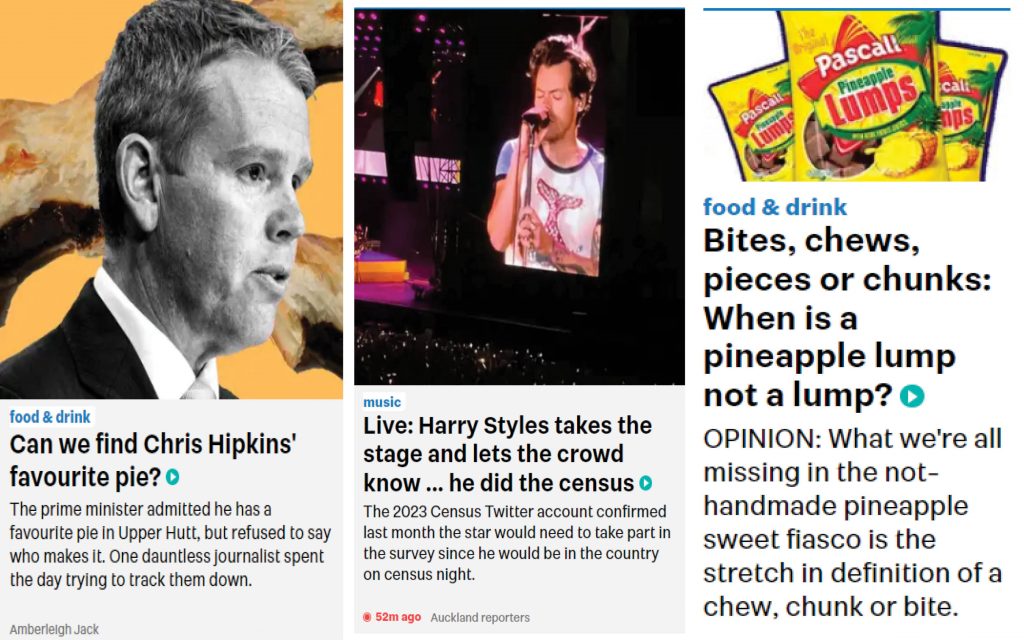
By constantly promoting trivia, the mainstream media normalises the idea that the nation has no pressing concerns; everything is running well, and there’s no cause for any alarm. If journalists can be sent looking for Chris Hipkins’s favourite pie, or tasked to write 2,000 words about the finer points of pineapple lumps, then it’s natural to assume that they have nothing more important to wrote about, and so one shouldn’t complain.
The trivia promoted is usually one of a few common types. Celebrity trivia is the most common of these. Sporting trivia is also very common. Particularly common right now is drama about transgenders and transgender rights, hence the shitstorm over Posie Parker’s planned visit to New Zealand. When transgender rights become boring, the media will move on to some other issue that affects less than 0.5% of the population.
The total effect of pushing all this trivia is the normalisation of the idea that there’s nothing important to complain about, so we should just march happily to work, then back home to watch television and to consume pies and pineapple lumps, before another day of the same, every day for the rest of our lives.
The mainstream media’s normalisation of trivia serves the purposes of the ruling class in two major ways.
The first is by filling the minds of the people with garbage. This is a deliberate strategy to make people unable to come together and build a resistance movement. The more trivia in people’s minds, and the more trivia in their general conversations, the less they can build deep and true bonds of friendship.
To that end, the mainstream media employs the strategy of “flooding the zone”. They produce so much garbage that it floods the social media feeds of people on FaceBook, Twitter, YouTube, TeleGram, Reddit, SnapChat, Discord, InstaGram and anywhere else people gather to discuss current events. Now, no serious person can get talk of revolution started because everyone’s constantly talking about crap.
After a flood of propaganda normalising trivia, anyone who talks about serious political issues now becomes unpopular. Their seriousness makes them abnormal. That abnormality means that people soon get tired of their heavy vibes. When people become normalised to media garbage, they want more and more of it, the same way a daily McDonald’s eater does.
The second is by preventing the discussion of important issues. The ruling class doesn’t want discussion of housing, mental health, wages or child abuse because all of these issues can only realistically be solved by forcing that ruling class to siphon less wealth from the masses. To that end, the more trivia the better.
Any position that suggests that the ruling class might have to change anything about their own actions is forbidden. The only people obliged to change their ways are the plebs, hence all the talk about how individuals (and not corporations) need to cut consumption. Promotion of triviality pulls things down to the most trivial level, that of the individual.
Anyone talking about anything serious is ostracised as a bore or a fanatic. Who cares about mental health? I want to know what Ed Sheeran thinks of New Zealand! Who cares about the labour share of production? I want to hear from the sexual deviant of the week about how everyone is a Nazi! And so it becomes even more difficult to arrange any true resistance to the ruling class.
Job done.
There’s no easy way around this. Apart from becoming the Government ourselves and redirecting Public Interest Journalism Fund money, the easiest way is to become the media ourselves: writing and talking about issues of actual importance to everyday people, and laying out a clear plan by which change can be effected.