
Orderworkers And Chaosworkers

There are many different ways of making an elementary magical division among the people of the world. Some say that there are black magicians and white magicians, others say there are lightworkers and shadow-workers. This essay divides the world’s magicians into two basic types on their relation to order: orderworkers and chaosworkers.

The essential distinction is that orderworkers cause change to the world by applying order to chaos, whereas chaosworkers cause change to the world by applying chaos to order. In theory, an orderworker will impose order upon a harmful chaos, whereas a chaosworker will impose chaos upon a harmful order, although this need not always be the case.

An example of an orderworker would be a doctor who prescribes a medicine that gets rid of a disease. Such a person would recognise that the physical body before them is in a state of disorder, and their diagnosis and prescription is an attempt to apply order to reduce the suffering that the disorder was causing the patient.

A cleaner is another example of an orderworker. They take something that has become disorderly on account of use, and apply order to to it to make reusable for other people. They apply order with mops and vacuums in much the same way that a surgeon does with a scalpel – perhaps with less precision, but the action is the same on a metaphysical level.

Another example would be a Police officer or security guard. Their remit is to keep the peace or to prevent things from being stolen, which means that they have to impose order upon the various criminal elements out there. They apply order in the form of preventing outside elements from disrupting the status quo.

It can be seen from this that being an orderworker does not imply any moral superiority to a chaosworker or even any higher social rank, as order and chaos are on an entirely separate axis to good and evil. It’s simply a descriptor of someone who applies order to achieving their goals.

Chaosworkers introduce chaos into order. This requires some elaboration because many people automatically assume that order is a good thing and that chaos is a bad thing, and that anyone fitting the label “chaosworker” must be a destructive and malevolent force. This is true to an extent, but there are major ways in which it is not true at all.

An excess of order can be suffocating. It’s easy to imagine order as a straight line – in this sense, an excess of order could be like a prison cell that confined a person to a limited space.

An excess of order can also be sterile. A fertile ground for growth requires a variety of components that can interact with each other as necessary. An excess of order will produce a desert; such an environment requires the addition of chaos in the form of water before it can become fertile.

A chaosworker, then, is someone who releases someone else from bonds that imprison them, or who provides a form of novelty that serves to fertilise the mind of those who encounter it.

The most common examples of chaosworkers are the bartenders and musicians that one would encounter in a city’s entertainment area. After a hard day of work, most people have built up an excess of order in their minds. They have become excessively conditioned, and as such risk becoming entrapped by their thoughts. These people have a need to unwind.

Such an excessively conditioned person is at risk of becoming aggressive if they cannot get a chaosworker to help them relax. Bartenders and musicians are here in the same category as cannabis dealers, sportsmen and comedians. In applying chaos to people’s minds, these people break down harmful order and help them find joy and contentment.

Prostitutes are also chaosworkers, because they take a powerful instinct and work to dissipate it into something harmless. This chaos work serves to prevent rapes, suicides and other expressions of sexual frustration. Soldiers are another kind of chaosworker, in that they work to blow things up and to kill people. They break down the harmful order that is the enemy command and control structure.

The orderworker/chaosworker distinction explains why there is a distinction between jobs such as Police (whose warrant is to keep the peace) and the Army (whose remit is to fuck things up). It’s a similar distinction to how non fiction exists to to inform, while fiction exists to remove ignorance.

Note that neither implies moral superiority. Although it’s certainly true that an orderworker will feel a kind of disgust at an excess of chaos, so too will a chaosworker feel disgust at an excess of order. As far as everyone else is concerned, the best of the two is whoever can best help with the current problem. A man with a broken arm needs an orderworker; a man with a neurotic obsession needs a chaosworker.

Orderworkers and chaosworkers are just as valuable as each other, because the transitory nature of all Earthly phenomena mean that sometimes it’s the yin that is ascendant, and sometimes the yang. This means that sometimes it’s chaos that is the greater problem (which requires an orderworker) and sometimes it’s order (which requires a chaosworker). The same person might even have to do both.

*

If you enjoyed reading this essay, you can get a compilation of the Best VJMP Essays and Articles of 2018 from Amazon for Kindle or Amazon for CreateSpace (for international readers), or TradeMe (for Kiwis). A compilation of the Best VJMP Essays and Articles of 2017 is also available.

If you would like to support our work in other ways, please consider subscribing to our SubscribeStar fund.

Clown World Chronicles: Who is Wojak?

A simply-drawn MS Paint image of an expressionless man is one of the commonest memes seen today. Some know him as Feels Guy, but to most Internet denizens he is called Wojak. As this essay will show, Wojak and his many incarnations are a core part of the Clown World pantheon.

To many who see him for the first time, there is nothing special at all about Wojak. He is simply a generic-looking white face with a blank expression. Neither is he drawn with any great finesse – he is merely an MS Paint depection of a young adult male. This, however, is his great power. Wojak represents the common human spirit that is shared by all of us.

Wojak bears the brunt of the cruelties of Clown World. This is shown in his manifestation as Feels Man. As Feels Man, Wojak is the face that expresses the disappointment and crushing sadness that follows coming to terms with the reality of living in a Clown World. He is the expression of all kinds of sadness, disappointment and despair.

A common portrayal of Wojak is from behind as he stares out across an ocean towards a setting Sun. This meme speaks to the sense that one’s naivety has come to an end. As the Sun sets and leaves Wojak on the beach, so too do our conceptions of an ideal world disappear, leaving us in Clown World with all its insanity.

Another common portrayal of Wojak is as the Doomer (this concept is elaborated upon in another chapter). The Doomer is a man who has been worn down to near breaking point by the insanity of Clown World. He cannot see anything getting better – doom lurks just beyond every horizon. He is strung out, with bags under his eyes, stubble under his chin and a cigarette butt in his mouth.

Yet another is the Coomer (also elaborated upon elsewhere). The Coomer is a man who has become hopelessly addicted to pornography, to the point where he lives for nothing else. This incarnation of Wojak represents the potential sex addict inside each of us, and serves as a warning.

So Wojak, much like Pepe, represents another kind of everyman. Perhaps the essential difference is that Pepe is the masculine form, whereas Wojak is the feminine form. Whereas Pepe feels disgruntlement leading to rage, Wojak feels sorrow leading to despair.

Fundamentally, though, Wojak’s place in the Clown World pantheon is as a representative of the youthful idealism that is lost when a person realises that they live in Clown World. It’s natural to grow up thinking that one lives in a world of reason, where science and evidence weigh heavily. The realisation that only power matters and that logic is meaningless comes as a spiritual shock to many.

For those who have been through it, however (and most have), this spiritual shock is highly relatable. This relatability is the reason for the success of the Wojak meme and its descendants – the ubiquitous nature of Wojak means that he can serve as a kind of template upon which other memes are based.

NPC Wojak is a variant of the original that satirises the unthinking nature of the average pleb. NPC Wojak is similar to the original, only with a grey face and simplified features. The commonest meme to feature the NPC Wojak is a multipanel comic where he is presented with some inane political fact and becomes enraged – a satirisation of how the average NPC out there has no consciousness and simply responds to stimuli like any invertebrate would.

Brainlet Wojak is another common variant. This one involves the regular Wojak but with a variety of cranial deformities so that his brain is clearly much smaller than that of a normal person. The implication, of course, being that the idea associated with the Brainlet Wojak image is a stupid one.

There is also a female version of Wojak, identical to the male original but with long, coppery hair. This version is most commonly seen incarnated as Tradfem Wojak, wearing a flowery blue dress. In this incarnation she also represents a lost promise, in this case the promise of a loyal wife who was interested in raising a family – something that Clown World has made impossible.

Wojak and the various forms that he appears in could be described as an ur-meme and its memetic offspring. Wojak represents the grim, inescapable awareness that the world is really much, much worse that what it promised to be. His feels are our feels; his loss of innocence is ours too. Wojak represents the everyday citizen of Clown World: lost, confused, dismayed.

*

This article is an excerpt from Clown World Chronicles, a book being compiled by Vince McLeod for an expected release in the middle of 2020.

If you would like to support our work in other ways, please consider subscribing to our SubscribeStar fund.
If The Nazis Had Won World War II

Trade is a human universal and, as such, is more fundamental than trivialities like who exterminated who

The common perception of World War II is that, had the Nazis won it, the world would now be a wasteland of rubble and burning wreckage. It’s true that the world would certainly be different in some major ways to the timeline we currently live in, but there are many things that would be recognisable. This essay asks the question: what would our societies look like today if the Nazis had won World War II?

If the Nazis had won World War II, and united all of Europe under one Reich, our political leaders would have found an accommodation with it. If the Nazis had knocked out the Soviet Union and made peace with Britain, our political leaders would have shrugged, said “fair enough” and started to do business with the new bosses.

Some might doubt this, but an examination of history and human nature make it very clear. If the Nazis had won World War II, our political class would be lining up to whore themselves out to them.

If the Nazis had won World War II, and established a Lebensborn project to populate Poland with German settlers, and if this had led to an excess population such that many of these Germans sought to emigrate to other countries, our political system would tell us that this was a good thing. We would be told that we had to accept it otherwise we were evil.

Politicians all around the world would be clamouring to curry favour with the Nazi Empire by forming trade and diplomatic links with Nazi territories, or by agitating in favour of further immigration from Nazi territories or by attacking those who criticise Nazi actions. These politicians would dismiss anyone who accused them of siding with evil as conspiracy theorists, bigots and haters.

Politicians of German ancestry would be climbing onto social media saying that it’s hate speech to mention the Hungerplan, or that the Hungerplan didn’t really happen, or that the Poles deserved it because of genocidal attacks on Germans in Polish territory in the lead up to World War II. As with the Armenian genocide, a sufficiently strenuous denial would cause people to either doubt or to not care.

Many outside Europe would have ended up marrying Germans once the war tensions cooled off (as they have done in this timeline). They would say “Yes, the Nazis are evil, but Ulrike/Heike/Beate is against all that stuff.” Some of the fathers of these brides and grooms would be Nazi Party functionaries, and would have done some horrific things, but their sons and daughters-in-law would operate on a “Don’t ask, don’t tell” basis.

If the Nazis had won World War II, it would be an accepted fact that the Nazi Empire was too big to not trade with. People would say “Yeah I know that they starved a hundred million people to death but you can’t just not trade with an entity that comprises X% of the world’s GDP.” Even if they still had millions in concentration camps this would not matter.

No doubt the Nazi Empire would have established a competitive advantage in some economic manner, such as vehicle manufacture. It might be possible that the whole world would be driving German-made cars, or flying in German-made aircraft. In such a case, most people wouldn’t think anything of using such goods. Some might make jokes about the tens of millions who were exterminated to make it possible, but this wouldn’t prevent trade any more than the North American genocides prevent trade.

Had the Nazis won World War II, there would be politicians and pundits trying to curry favour with them by talking about Naziphobia. An excessive dislike of Nazis would be likened to a mental illness by politicians and by media enterprises chasing the Nazi advertising dollar. There would be mutterings that hate speech legislation ought to be introduced to prevent people from being too open about their dislike of Nazism.

If the Nazis still had people in camps, their plight would be ignored, save for the propagandising of a small number of social justice activists. These activists would widely be seen as obsessed or unhinged. In much the same way that the imprisonment of many Uighur people is dismissed as an outcome of the Uighurs’ religious fanaticism, so too would the imprisonment of the Jews be dismissed as an outcome of their predations.

If the Nazis had won World War II, our entire education system would be different. Naturally, we wouldn’t be taught that Germany started World War II by invading Poland. We would instead be taught about the German Revolution of 1918-19, and who was behind that revolution. We would be taught about the Holodomor, and how the Holodomor influenced anti-Communist attitudes in central Europe in the 1920s.

Nazism more general would be seen as an anti-Communist movement that arose in response to the horrors of Soviet rule. The role of the British and the French in forcing the Versailles Treaty on the Germans after World War I would be emphasised. The psychological effect of hyperinflation would be explained at length to all schoolchildren.

Perhaps it may even have been necessary, had the Nazis won World War II, to accept that many of the actions of the British and French Empires in colonising the world were effectively criminal. Perhaps conquering 40 million square kilometres of territory and then declaring war on Germany was a bit hypocritical. Winning the war meant we never had to face up to this charge, but losing it would have meant that we were forced to.

None of this is to say that the world would have been any better if the Nazis had won World War II. The fact is, however, that a Nazi victory in Europe would not have changed human nature in any way. Humans would still be opportunistic, acquisitive and dishonest. The winners would still write the history books, and they would still do so in a way that absolved them of all guilt.

*

If you enjoyed reading this essay, you can get a compilation of the Best VJMP Essays and Articles of 2018 from Amazon for Kindle or Amazon for CreateSpace (for international readers), or TradeMe (for Kiwis). A compilation of the Best VJMP Essays and Articles of 2017 is also available.

If you would like to support our work in other ways, please consider subscribing to our SubscribeStar fund.

Who Are Virgin And Chad?

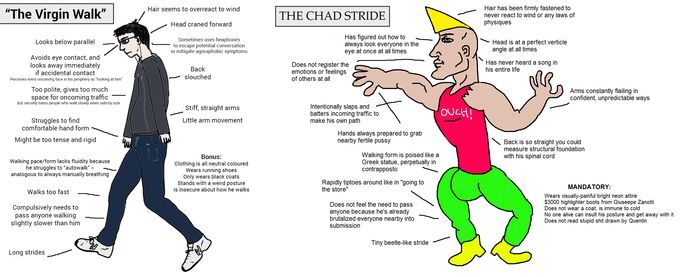
A common meme contrasts two opposing figures: the Virgin and the Chad. These two figures represent a diametrically opposed pairing in the Clown World pantheon. Like Apollo and Dionysus, who represent human reason and human nature, the Virgin and the Chad represent manifestations of the divine in human form. This essay explains.

At the most basic, Virgin and Chad represent opposite ends of the spectrum of sexual success with women.

Virgin, as suggested by his name, has had no sexual success with women. He is deeply neurotic, the sort of person that women feel uneasy around or even find creepy. He shuffles along, staring at the ground, downcast. His mind is plagued with thoughts of rejection and worry. Dressed in pallid greys and wearing cheap sneakers, his very appearance suggests rejection and despair.

There is nothing Virgin desires more than female attention, but there is also nothing that his nature is less likely to attract. This enraging paradox means that the Virgin is a deeply pitied figure. All of the memes that include the Virgin use him as a figure of fun – the example of what not to do or be like.

Chad strides along, his bearing perfectly upright at all times. His mind is clear, untrammelled by self-doubt. The appearance of Chad is the opposite to that of the Virgin: where the Virgin blends in with his grotty surroundings, Chad extrudes light and colour. His clothing is bright, with a cheery, glib slogan emblazoned without shame on the front. A genital bulge protrudes suggestively from his pants.

It’s wrong to think of Chad as a mere peacock, something that attracts females only through a visual display. Chad is also a genuine athlete, probably a wrestler or rugby player. His musculature and height are such that women notice him from a great distance just from his silhouette. He is the stuff of female fantasy.

The Virgin-Chad dichotomy represents the contrast between good and bad in a judgmental sense. In other words, the Virgin is something execrable, to be avoided. The Chad, by contrast, is a kind of ideal man similar to Hercules. Every Earthly man is morally obliged to make himself as chadly as possible – indeed, transcending the state of the Virgin could be said to be the act that makes a man a man.

This dichotomy is not merely a physical distinction. Implicit to all the Virgin-Chad jokes is that the Virgin always makes the wrong decisions, or fails to make the right decisions, because he doubts himself too much and lacks courage. The Virgin might be able to make himself physically attractive, under the right circumstances, but his mind will always preclude him from being a Chad. He is mentally weak, unable to control his baser impulses.

Chad, on the other hand, has no concept of fear. He doesn’t need fear, as he is naturally so in touch with his inner being that he can act on higher instinct. If Chad wants to do something, it is always the right thing to do. Therefore, he can act with perfect self-confidence.

Ultimately, the real advantage of the Chad is spiritual, and this is why the Virgin-Chad pairing has a spiritual dimension in the Clown World pantheon.

The Chad is in tune with the Tao, and this is why he always makes the right move. He does not desire anything other than a world precisely like the one that he moves in. Having no desire to change the world, the world has no desire to change him. Consequently, the Chad can operate without resistance. Women don’t resist him because they understand his advances to be the Will of God.

The Virgin, by contrast, is a creature of ego. This ego clouds his vision, which means that he cannot see reality accurately, and this is why he makes so many mistakes. He is desperate for recognition, for attention and for adulation, and this thirst frightens and repels people (especially women). The Virgin is entirely trapped in the illusion of materialism, in the commercial and advertising matrix.

There is a sense in which the Virgin represents the everyday man, and Chad represents, by way of contrast, a Zeus-like figure, something larger than life. According to this manner of thinking, Chad is envied by the Virgin, but is not resented. The Virgin sees Chad not so much as a competitor, but as a force of Nature that has its way with mortals, something to be emulated if possible and appreciated if not.

In magical terms, the Virgin can be thought of as an energy to be rejected and Chad as an energy to be summoned. A man going to a bar in the hope of getting laid wants to summon his inner Chad. The Virgin is, therefore, elementary masculine sexual energy that is rejected by the natural feminine, whereas the Chad represents elementary masculine sexual energy that is accepted by the natural feminine.

*

If you enjoyed reading this essay, you can get a compilation of the Best VJMP Essays and Articles of 2018 from Amazon for Kindle or Amazon for CreateSpace (for international readers), or TradeMe (for Kiwis). A compilation of the Best VJMP Essays and Articles of 2017 is also available.

If you would like to support our work in other ways, please consider subscribing to our SubscribeStar fund.