

VJMP Reads: Edward Bernays’s Propaganda XI

This reading continues from here.

Chapter Eleven in Edward Bernays’s Propaganda is called ‘The Mechanics of Propaganda.’ Here Bernays talks about how propaganda gets transmitted to the public.

Bernays defined propaganda here as “the establishing of reciprocal understanding between a person and a group.” Therefore, there is no practical limit to the number and type of media that may be employed to transmit propaganda (one wonders what Bernays would have made of the Internet).

He writes about how the public meeting was the best means of propaganda 50 years ago (i.e. in the 1870s), but people have become “sick of the ballyhoo of the rally,” and prefer to get information from the radio and newspapers. The propagandist must keep up with the shifting patterns of the popularity of various media, as well as anticipate future changes.

Bernays notes here that there is almost no item of news that, if published, would not benefit the interests of some people and harm the interests of others. He notes also that the newspaper does not care about the propaganda value of a piece of information, but only about its news value. Thus, propaganda that is also news is more likely to get propagated.

It’s important to tailor the message to the audience. The propagandist must create propaganda items with specific audiences in mind. To this end, magazines are different to newspapers because they’re not obliged to print news. This also means that magazines are kind of naturally like propaganda organs.

The propagandist might like to consider supplying a propaganda organ with a series of articles that puts the case to a particular audience. This is especially likely to succeed if that organ feels like they can derive prestige from the association with the company the propagandist works for.

Hilariously (with hindsight), Bernays is able to speak about the radio when it was a new invention and its development uncertain. He notes that many newspaper enterprises have moved into radio, correctly in his estimation. Anticipating the Internet, he predicts that various groups will have an ev ever-increasing interest in buying media space for the sake of propagandising.

Incredibly, Bernays was able to write 90 years ago that Hollywood films were major propaganda devices. He also predicts the rise of the cult of personality by noting that “the public instinctively demands a personality to typify a conspicuous corporation or enterprise.” This is acutely true in New Zealand, where our Prime Ministers have little to go on apart from the personality cults.

Bernays notes that the public has already become cynical to attempts at manipulating them through the media, but some interests are universal. People will always have a need for food, for amusement, for beauty and for leadership. For this reason, they will always seek out sources of propaganda.

He leaves us with the statement: “Intelligent men must realise that propaganda is the modern instrument by which they can fight for productive ends and help bring order out of chaos.” This statement must be read in the light of World War I, which was itself the result of the old methods of fighting. In this sense, Bernays and this book herald a shift from an Age of Iron to an Age of Silver.

*

If you enjoyed reading this essay, you can get a compilation of the Best VJMP Essays and Articles of 2018 from Amazon for Kindle or Amazon for CreateSpace (for international readers), or TradeMe (for Kiwis). A compilation of the Best VJMP Essays and Articles of 2017 is also available.

*

If you would like to support our work in other ways, please consider subscribing to our SubscribeStar fund.
The Cannabis Legalisation And Control Bill: A Weak But Realistic Compromise

The Government released news this week about the exact form of the cannabis referendum question at next year’s General Election. The Cannabis Legalisation and Control Bill, currently in draft form, will serve as the basis for next year’s referendum question. Long-time cannabis law reform campaigner Vince McLeod, author of The Case For Cannabis Law Reform, gives his thoughts on the proposal.

The proposed law is weak, but it’s a realistic compromise with the forces of evil.

Most importantly, it makes the possession of up to 14 grams of cannabis, a small homegrow and licensed retail cannabis sales all legal. As far as the cannabis-using community is concerned, this achieves most of the long-stated goals of cannabis legalisation. It’s broadly in line with what other states and territories in North America have introduced.

Section 18 of the Cannabis Control Bill will allow up to 14 grams of cannabis to be possessed in a public place, and for cannabis to be smoked at home. People are allowed to possess more than this if they are transporting it from one person’s home to another. There appears to be no limit on how much cannabis one is allowed to possess at home.

This will mean that it will no longer matter if a Police officer smells cannabis on you in public or while during a visit to your house. Evidence of cannabis will no longer, by itself, be a sufficient cause for the Police to attack you. Even if the case of smoking cannabis in public, which will still be illegal, the punishment is only a $200 infringement fee.

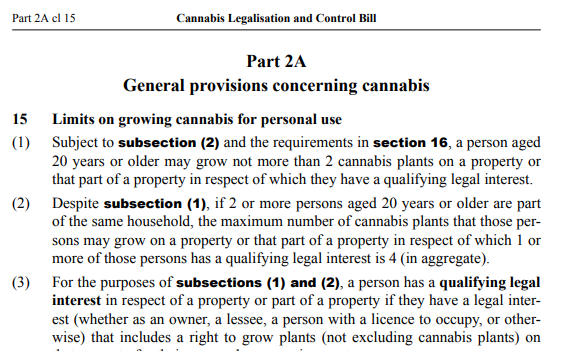
Section 15 of the Bill will allow for two plants to be grown at home per person, and up to four plants to be grown per household.

Two plants is not a lot. However, if you grew four plants in a small grow tent under a 600W light you could get ten or twelve ounces per grow. Assuming that you’re able to get hold of clones, this would mean ten or twelve ounces every eight to ten weeks. In other words, a household could meet its demands for recreational cannabis easily enough by growing it themselves.

Moreover, there is no proposed restriction on the size of the two plants, as has been the case in some North American jurisdictions. This suggests that people will be allowed to put down a couple of honking sativas in an outdoors greenhouse and get them both up to ten feet tall. Such an arrangement would make it legal to grow a year’s worth of cannabis in one season, sparing the need for the environmentally-unfriendly grow tents.

Section 19 of the Bill allows for recreational cannabis sales. Purchases will be limited to 14 grams per day, but this is at least two weeks’ worth by any reasonable measure. Aside from this, it appears the proposed model will be fairly similar to the cannabis cafe model that has existed in the Netherlands since the 1970s.

In other words, it appears that the proposed model is intended to allow for recreational cannabis sales in cafes in a similar fashion to how alcohol is already sold in pubs. Section 49 of the Bill makes reference to “consumption licences” which will allow certain premises to allow people to consume cannabis in public. Such premises will not be allowed to also sell alcohol, and will therefore follow closely to the Daktory model that Dakta Green has already established in New Zealand.

Despite these major wins, the Bill has a number of flaws from the perspective of the average member of the cannabis-using community.

Nowhere in the Bill has provision been made for running a mother plant that clones can be taken from. If one household can only have four plants, it makes having a mother plant that one can take clones off difficult. Against this criticism, however, is that it appears the Bill will allow for retail sale of feminised seeds.

It’s also a mistake to set the legal limit at 20. For one thing, it implies that cannabis is more dangerous than alcohol, which is entirely false. For another, it means two years where young Kiwis will be legally allowed to drink booze but not smoke weed, which will mean two years of exposure to the more destructive of the two drugs. Legal cannabis has been shown to lower rates of alcohol use overseas, and the sooner an alternative to alcohol was available the better.

Perhaps unsurprisingly, the Bill doesn’t address our right to use cannabis for spiritual purposes. Absolutely zero acknowledgement is made of the fact that cannabis is a spiritual sacrament, but this is not unexpected if one considers that New Zealand has been ruled by completely godless people since the turn of the century, and that for their sort spirituality is mental illness.

Also predictably, there is no provision for an official Government apology for conducting a war against them without their consent. The War on Drugs has been the worst human rights violation to occur in the West since World War II. The Government’s role in this war has involved decades of lying to the public about the effects of cannabis and putting people who defy them in cages. Their conduct has been obscene, and an apology should be part of legalisation – but it won’t be.

Perhaps worst of all, the Government is still committed to minimising cannabis use from the standpoint of cannabis use being inherently harmful. It’s possible that they have calculated that legalising cannabis would make it possible to strangle cannabis culture through ever-increasing taxes and red tape, as they have almost successfully done for tobacco. More likely, however, is that they have shifted thinking so that cannabis is now (rightly) grouped with alcohol and tobacco and not heroin and methamphetamine.

There are many possible criticisms of the Bill, but ultimately it is definitely worth supporting. All of the legitimate criticisms relate to aspects of cannabis law that could best be fine-tuned after the referendum has been passed.

Realistically, what the proposed Cannabis Leglisation And Control Bill means is an end to the fear. It would be taking away that dark, nauseating feeling that comes with being marked as a criminal. People smoking or growing cannabis at home will no longer have to fear saying the wrong thing or inviting the wrong person to their house, and the net result will be a reduction in the suffering of the New Zealand people.

*

If you enjoyed reading this essay, you can get a compilation of the Best VJMP Essays and Articles of 2018 from Amazon for Kindle or Amazon for CreateSpace (for international readers), or TradeMe (for Kiwis). A compilation of the Best VJMP Essays and Articles of 2017 is also available.

*

If you would like to support our work in other ways, please consider subscribing to our SubscribeStar fund.

History Is The Patterns Of Conflict Between Master And Slave Moralities

Many historical theories view the world as an eternal struggle between two forces. The Christians call it good and evil, the Communists call it the proletariat and the bourgeoisie, and the Nazis call it the Aryan and the Jew. A previous essay here suggested it was between the K and r-selected. This essay takes a new approach: that Friedrich Nietzsche was more accurate than anyone else, and the true eternal struggle is between those with a master mentality and those with a slave mentality.

In The Genealogy of Morals, Nietzsche described two basic forms of morality.

Master morality judges actions on the basis of good or bad. Nietzsche defines master morality as the morality of the strong-willed: it is championed by the noble and the powerful. This doesn’t mean that master morality is mere domination – it also prizes honesty and an accurate appraisal of one’s own weaknesses. People with this mentality are not concerned with what the herd thinks. They prefer to pursue their own self-defined form of excellence.

Slave morality, by contrast, judges actions on the basis of good or evil. In slave morality, strong people are equated with evil. In slave morality, goodness is equated with passivity, timidity, agreeableness and an insipid kindness. Slave moralists aren’t concerned with accurate viewpoints – they simply believe whatever makes them feel good. Questioning the herd is a great sin, because it requires strength and therefore only someone evil would do it.

The masters are always fewer in number, and the slaves more numerous. In this regard, master and slave morality maps fairly closely to the mentality of the K-selected vs. the mentality of the r-selected. The major differences are that K-selected people are liable to suffer from pathological altruism, whereas the master morality (not feeling pity) does not, and that r-selected people do not lack vitality and are not prudish, whereas the slave morality is neurotic.

The true course of history has been the ebb and flow of these two different forms of morality.

Nietzsche himself wrote that the ancient Greco-Roman culture encapsulated master morality, but was subverted from the inside by Christianity, one of the original forms of slave morality. When Christianity became the official religion of the Roman Empire in 323 A.D., Westerners became slaves, our natural spiritual traditions having been thoroughly destroyed and replaced with superstition.

This victory of slave morality endured until the Renaissance (an event which a previous essay here called the Minor Renaissance). At this time, some of the old master morality returned in the form of the quest for scientific knowledge, previously hidden or taboo philosophy and exploring the world. Unfortunately, this didn’t last.

The 19th Century was a relative high point for master morality (of course, Nietzsche didn’t know this). During this decade, the European Empires reached their greatest extent. The British Empire had achieved such a state of dominance that it was able to settle Australia and New Zealand – lands on the other side of the planet – at the same time as providing most of the settlers to North America, and all this while keep the world’s shipping lanes open.

Unfortunately, there was no Major Renaissance, as the wider Western consciousness kept falling at the first three hurdles of dumb Abrahamism, blind Materialism or deaf Satanism. The West never managed to revive the master spirituality it had before being poisoned by Christianity some 1,700 years ago.

It has long been observed that empires tend to fall from the inside, rather than get smashed by any outside force. The reason for this is the internal rise of slave morality. The reason why the West has fallen into the decrepitude that it has is because slave morality has risen to the point where it is normal. Accordingly, we are weak.

It has also long been observed that good times lead to weak men, who then create hard times, which leads to strong men, who then create good times. This has been discussed here as the Red Pill-White Pill-Blue Pill-Black Pill sequence. New Zealand philosopher Rick Giles describes it as the Dignity Culture-Honour Culture-Victimhood Culture-Slave Culture quadrichotomy.

Hard times lead to strong men by process of selection. When times are hard, there’s not enough surplus to waste any of it. Therefore, the people in charge of resources have to be discriminating. Even more pressing is the fact that, when times are hard, people will fight over what little resources exist. This fighting, being in the realm of iron, rewards the hard and those who can do without.

This Spartan sense of miserliness leads to efficiency and a masterly mindset. When things operate efficiently, life is good. Everyone has their needs met and, as is usually the case when people’s needs are met, they become wealthy. When everyone is wealthy, everyone tends to be happy, and it is as if a Golden Age had descended upon the land.

When everyone has their needs met, they stop being hard. No-one with a full belly wants to fight – better to just wait until the problem goes away. If there’s no food in the cupboards, that’s when it’s time to worry. People in the “fat and happy” mindset tend to ignore challenges rather than respond to them.

This doesn’t only lead to physical softness but, more crucially, it leads to mental softness. This mental softness prevents people from being able to make sharp and accurate distinctions between the phenomena they encounter. Consequently, they become apathetic and indifferent, a malaise that they mistake for the virtue of tolerance.

This apathy and indifference leads to a failure to adequately deal with corruption. Either corruption is ignored, or the corrupt are not punished – a slave’s mindset. Because no-one is strong enough to challenge the corrupt, they come to positions of dominance. When corrupt people are in power, hard times are just around the corner. And so, the cycle repeats.

In today’s Clown World, slave morality has the total ascendancy. We are so apathetic that our politicians can kick us in the guts on a daily basis and we just roll over and take it. The total victory of slave morality is, perhaps, the fundamental explanation as to why Clown World is the way it is. This is a world without masters. The slaves have completely inverted natural morality.

What’s needed is the Major Renaissance. This would constitute a spiritual renaissance that would reconnect the people of the Western World to God. Being reconnected to God, we would then possess the necessary illumination to see the path forward in the darkness. We need a new set of masters for a new age.

*

If you enjoyed reading this essay, you can get a compilation of the Best VJMP Essays and Articles of 2018 from Amazon for Kindle or Amazon for CreateSpace (for international readers), or TradeMe (for Kiwis). A compilation of the Best VJMP Essays and Articles of 2017 is also available.

*

If you would like to support our work in other ways, please consider subscribing to our SubscribeStar fund.

Clown World Chronicles: What Is A ‘Behavioural Sink’?

The story of Clown World is a story of collapse. Therefore, it’s unsurprising that all of the signs and symptoms of social collapse in other mammalian species can also be observed in our societies today. The concept of the ‘behavioural sink‘ is an ethological observation that applies just as well to human society.

In the 1950s and 1960s, ethologist John Calhoun ran a series of experiments with Norwegian rats. This involved creating a controlled environment where the rats could thrive – food and quality shelter were limitless. These are sometimes called the Mouse Utopia Experiments on account of that the environment was so conducive to life.

In one of these experiments, known as “Universe 25”, the easy nature of life led to a population explosion, as the natural birth rates of the r-selected rodents (mice in this instance) were not kept in check by the natural death rate that would have existed had they lived in the wild. The overpopulation eventually reached such an extreme degree that the inhabitants of Universe 25 began to exhibit some strange behaviours.

Beyond a certain degree of overpopulation, asocial and then antisocial behaviour became much more common.

First the rodents would start to become asocial. The typical expression of this was a passive form of withdrawal. Some rodents would avoid the others during the daytime, only becoming active at night when the others had settled down. Other rodents, dubbed the “beautiful ones”, came to devote all of their time to grooming, withdrawing from social interaction completely.

If overcrowding became worse than this, the rodents would become aggressive. They would start to randomly attack each other, sometimes fatally. The slightest irritation could trigger a murderous assault. At its worst, infant mortality came close to 100%, as the rodents came to completely neglect their parental duties. Eventually the population would collapse on account of all this homicidal and suicidal behaviour.

Calhoun coined the term ‘behavioural sink’ to describe this societal collapse. He described it as a kind of “spiritual death” that preceded physical death. Observing the disintegration of rodent society on account of this overpopulation gives us great insight into the nature of Clown World. The terrifying truth is that the human animal in Clown World is not so different from the rat and the mouse in the Mouse Utopia Experiments.

The human animal did not evolve in a state of overcrowding. For the vast majority of the 100,000 or so years that humans have existed on this planet, we did so in small bands like the other primates. These bands rarely exceeded 150 or so – if the population of one band would swell beyond this, part of it would split off and form a colony elsewhere.

Because living conditions were so harsh during this time, there was never a time when the birth rate was significantly higher than the death rate. Hunger, disease, natural disaster, tribal warfare and predation from larger animals all worked to keep the human population in check.

This all changed when sanitation and then modern medicine were invented. These two advances meant that the death rate dropped sharply. Because the birth rate initially stayed the same, the human population ballooned. The human population has quintupled since 1900, and most of that growth has been concentrated in urban areas close to the major international trading hubs.

By 2019, the human animal is presented with a set of living conditions very similar to the rats in Calhoun’s study. Perhaps inevitably, we have responded in a similar fashion. The essence of Clown World is the collapse in social behaviour that has come about from the massive overpopulation on our planet. We are exhibiting the same behaviours as the rodents of Universe 25.

In Clown World, many people have withdrawn from social contact completely. This phenomenon is one that we share with the Mouse Utopia. The overpopulation of Clown World has led to a sense that all possible social niches are filled, therefore striving for social success is futile. Many of these people have turned to cyberspace, which offers social contact without being forced into close physical proximity with extremely unpleasant people.

The phenomenon of the beautiful ones is replicated with the rise of the hipster. The 21st century hipster, with his grooming obsession, is simply the result of heavy overcrowding. This is why he is only seen in urban areas. As with the rodents, the modern hipster does not pursue females for reproduction and he does not fight for dominance with the alpha males. He simply withdraws.

Parental incompetence is another feature of overpopulation that the Mouse Utopia shares with Clown World. In the Calhoun experiments, rats in heavily overcrowded pens failed to look after their offspring properly. It was as if the rats became even more r-selected, and adopted attitudes to their offspring normally held by reptiles and amphibians.

This shift towards r-selected patterns of child rearing is also replicated in humans. There have never been a higher proportion of deadbeat dads than there is today. Never before have there been so many single mothers on welfare. Despite the protestations of many conservatives, this isn’t because the welfare system is too generous. It’s because people no longer give a shit.

Consequently, a number of children are growing up feral in Clown World. Their parents have all but given up on life, and so the children wander the streets of their neighbourhoods looking for entertainment. Many of these children end up joining the recluses on the Internet. Others, as in A Clockwork Orange, turn to mindless crime. This breakdown of social order is at the core of Clown World.

A third feature that the Mouse Utopias share with Clown World is this mindlessly random violence. Just this week there was a diversity incident in London where two passers-by were killed by a knife-wielding Muslim. These incidents are becoming so common that they are hardly news anymore. It’s just taken for granted that people are under so much stress nowadays that some will randomly flip out and start killing others.

It’s impossible to understand Clown World without understanding the concept of the behavioural sink. Calhoun’s Mouse Utopia Experiments gave us the chance to observe the behaviour of social mammals in a state of extreme overcrowding. Now, with 8,000,000,000 people on the planet, we can see those same behaviour patterns arising in humans.

We’re going down the plughole of the behavioural sink.

*

This article is an excerpt from Clown World Chronicles, a book about the insanity of life in the post-Industrial West. This is being compiled by Vince McLeod for an expected release in the middle of 2020.

*

If you would like to support our work in other ways, please consider subscribing to our SubscribeStar fund.