
A Tribute To J R Mooneyham

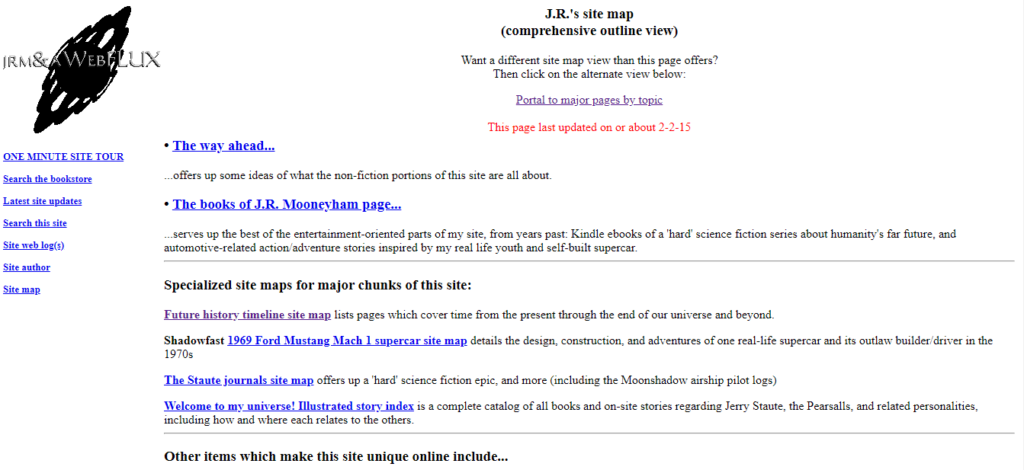
This is a tribute to American science fiction author J R Mooneyham, creator of one of the most excellent websites on the early Internet. The eponymous jrmooneyham.com was (and is) a treasure trove of hyperlinks to all kind of futuristic and scientific advances, as well as the superb Future History Timeline, which showcased Mooneyham’s predictions for the future.

I discovered this website around 1996. At that time, only people with a special interest in technology had a personal computer with Internet access. If you were friends with such a person, it was possible to access a world of information many times larger than your local town library. For any true nerd such as myself, this was a thousand birthdays all happening at once.

Because the early Internet was populated only by people who could get their heads around the new technology, it was full of the kind of niche interests held by those people. Serial killers and Satanism were favourite topics, one of the highlights being a Richard Ramirez tribute page that said “Hail Satan” through the speakers once per minute – a terrifying experience to anyone discovering the site at night!

Another favourite topic was science fiction. The sort of person who was an early adopter of the Internet was often a science fiction fan. After all, the Internet was clearly the technology of the future, and science fiction deals with the future. Many early Internet users were either science fiction fans or even writers. One of them was J R Mooneyham, who created the website that bears his name.

Mooneyham’s webpage was the first one to really instill in me a sense of awe at what the Internet was capable of. Not only did the page consist of a number of pages all hyperlinked together, but many paragraphs were backed up with hyperlinks to other parts of the Internet. For a young person who had only previously been exposed to books, both of these things were incredible, an entirely new dimension of information arrangement.

On the Signposts of the Future pages, Mooneyham made a number of predictions, some of which I agreed with, and some of which I thought ridiculous but which ended up coming true. Apart from the usual cyberpunk-style predictions about ever-increasing surveillance technology and an ever more precarious geopolitical situation, there were more specific predictions

I scoffed at his prediction that technology would lead to child millionaires, reasoning that the new technologies would be so complicated that it would take many years to study them long enough to have mastered them. Mooneyham had the last laugh, however, as shown by the 8-year old YouTube star Ryan Kaji, who made $26,000,000 this year.

Mooneyham predicted that a major terrorist event would strike New York City near the beginning of the 21st Century. This may have not been too hard to predict, given that there had already been a Muslim attempt to destroy the World Trade Centre in 1993. In any case, Mooneyham was proven correct in spectacular fashion by the events of 9/11.

He also predicted that America would, at some point in the 2010s, start using their military and economic advantage to spark a trade war. This came true with the ascension to power of Donald Trump and the start of the trade war against China. This was part of a wider trend, foreseen by Mooneyham and discussed at length, of hard power giving way to soft power.

My favourite Mooneyham prediction, though, was the “Bounty Economy“. Today we call this the gig economy, but Mooneyham predicted in the 1990s that we would end up with an economy characterised by precarious working conditions, suppressed wages, the mass importation of cheap labour – and tremendous profits for those best positioned to take advantage.

All of this was found in a website that was nothing more than HTML. For a young scholar in the 1990s, the simple genius of this was astonishing. Here was a glimpse of the future of life on Planet Earth, in more than one sense. Although websites such as Mooneyham’s are out of fashion today, thanks to fat data pipes shifting the focus from text to images and then to video, the elegance of the site appeals to the same sort of person that it appealed to in the 1990s.

There will always be a niche, in informational space, for someone targeting the high-IQ sort of forward thinker that actively seeks out information (and who reads, as opposed to passive information seekers who watch YouTube videos). VJM Publishing has targeted this niche, and to that end we have modelled the organisation of our site on jrmooneyham.com.

Some people have criticised the VJM Publishing company page on the grounds that it looks like a Geocities page from the early 2000s. It is our contention, however, that this is what a website ought to look like. It is the excellence of J R Mooneyham’s page, discovered over two decades ago, that inspired the clean, text-heavy and massively hyperlinked look of our own company page.

J R Mooneyham is a pioneering figure in Internet culture, especially in the high Internet culture that has avoided the televisionisation process that has occurred since the coming of FaceBook and YouTube. He ought to be more widely known. Thus, this article is in tribute to him, and to the minds he expanded thanks to reaching people with his excellent website.

*

If you enjoyed reading this essay, you can get a compilation of the Best VJMP Essays and Articles of 2018 from Amazon for Kindle or Amazon for CreateSpace (for international readers), or TradeMe (for Kiwis). A compilation of the Best VJMP Essays and Articles of 2017 is also available.

*

If you would like to support our work in other ways, please consider subscribing to our SubscribeStar fund.

The Law of Assortative Reincarnation

Some people, upon being told that consciousness survives the death of the physical body, say: so what? The really interesting question is what the order of reality looks like on the far side of death. This essay discusses an ancient concept – the Law of Associative Reincarnation.

A person’s frequency of consciousness determines the sort of reality they manifest. This is true in life, and it’s true in death.

In life, this rule is known as the Law of Attraction. This holds that (among other things) a person’s frequency of consciousness repels both higher and lower frequencies, so that people tend to attract other people like themselves. Angry people attract angry people, humble people attract humble people and curious people attract curious people.

This law holds that the energy you put out into the world will be the same as the energy that comes back to you from the world. Reality will come to manifest itself according to your thoughts, because thoughts lead to actions. If you dwell on bad things, they will come. If you dwell on good things, they will come.

In death, we might call this rule the Law of Assortative Reincarnation. This is a very similar concept to the biological concept of assortative mating. This refers to the observation that, in sexually reproducing species, mating tends to occur between individuals that have important things in common. Tall people tend to mate with other tall people, pretty people with other pretty people, smart people with other smart people etc.

In order words: we attract, on the other side of death, the same sort of beings that we attract on this side of death. This we do by means of the frequency that we project into the world.

When a person’s body dies, their ego dies with it, and so the person no longer has the part of the mind that lies and makes unjustified excuses for itself. After death, consciousness returns to God – and to God’s judgment. Being without ego, people don’t question God’s judgment on the other side of death. Consequently, they accept their fate.

Although God is without malice, the fact is that every person, when stripped of ego, will agree that they ought to get what they deserve. The fairest thing for every sentient being is to live in a reality filled with beings on the same frequency of consciousness as themselves. God facilitates this. Some call this the Law of Karma, and this law underpins both the Law of Attraction and the Law of Associative Reincarnation.

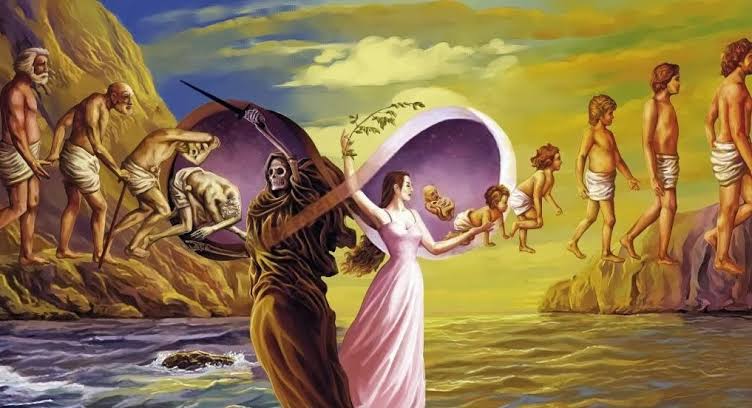
The frequency of consciousness that a person is at when the death of the physical body occurs is the same frequency of the part of the Great Fractal that that person will reincarnate into. All the beings that populate the next world that a person reincarnates in are fractal expressions of that person’s own frequency of consciousness – and that person is a fractal expression of all those other beings.

The Law of Assortative Reincarnation holds that people reincarnate into worlds with the same frequency as themselves. This means that people reincarnate into worlds populated by beings at a similar frequency. Some will be lower, and some will be higher, but the average will be similar to one’s own. Thus, each being is assigned to the part of the Great Fractal that is appropriate for their frequency of consciousness.

Shocking at it may sound to some, the Universe is perfectly just – but only at high levels of resolution, such as when one observes chunks of multiple lifetimes. At low levels of resolution, such as a mere decade, it can appear extremely unjust. This is why short-sighted and materialistic people are often preoccupied with some grievance or other.

This means that people really do get what they deserve. People who are cruel will adopt a frequency that reflects cruelty. Consequently, they will attract cruel people into their lives and will repel kind ones. People who are kind will adopt a frequency that reflects kindness. Consequently, they will attract kind people into their lives and repel cruel ones. This is true on both sides of death.

A person may or may not get punished legally for acts of cruelty, but they always get punished spiritually. This is because acts of cruelty transmute a person’s consciousness into a cruel frequency, and that attracts similar beings, who then inevitably treat the cruel person the way they treated others. It’s impossible to transmute one’s consciousness into a cruel frequency and attract kind people. It might be possible to temporarily do it by tricking them, but they will never intuitively trust a cruel person.

If a person wants to go to heaven after they die, or at least wants to reincarnate in a world with less egregious suffering than here on Earth, they need to perform enough works of alchemy to transmute their consciousness into a level where it would be heavenly to be around that person. Are you the sort of person whose frequency would create a heaven? If not, you don’t deserve to live in one.

Understanding the Law of Assortative Reincarnation means that one would never complain about the nature of life on this Earth. This Earth may be cruel, and it may be brutal, but the reason why everyone incarnated here is because of the frequency of consciousness that we cultivated in our past lives.

If a person thinks that the world is too cruel (and who doesn’t?), it’s impossible to change things by suicide. Committing suicide simply means that one will incarnate in a world where other beings are inclined to commit suicide. Because suicide is a cruel thing to do, one will therefore incarnate around other cruel beings and will not have escaped the cruelty of Earth.

The correct thing to do is to transmute one’s frequency of consciousness from the basest, most egotistical level to the highest and most noble one. This will ensure that one attracts other beings on that level, whether on this side of death or the other. The easiest way to do this is to focus on alleviating the suffering of one’s fellow sentient beings.

*

If you enjoyed reading this essay, you can get a compilation of the Best VJMP Essays and Articles of 2018 from Amazon for Kindle or Amazon for CreateSpace (for international readers), or TradeMe (for Kiwis). A compilation of the Best VJMP Essays and Articles of 2017 is also available.

*

If you would like to support our work in other ways, please consider subscribing to our SubscribeStar fund.
Has Firearms Confiscation Failed Like Cannabis Prohibition?

The amnesty period for the recent firearms confiscation in New Zealand has just ended. Early estimates suggest that fewer than half of the recently-banned firearms have been handed in, which means that some 100,000 Kiwis are now criminals. This essay asks: if the New Zealand people aren’t going to obey the new firearms law because they don’t consider it legitimate, is enforcing it even feasible?

No people are obliged to obey immoral laws.

Intuitive recognition of this natural law of morality is why cannabis prohibition has failed in New Zealand. The people of New Zealand feel that they have the inherent right to use cannabis, and therefore they don’t care about the manmade laws prohibiting it. The people who follow and enforce these laws, not the ones that break them, are the ones who shall incur the karmic debt.

This widespread refusal to submit to cannabis prohibition has made the law unenforceable. Not only do Kiwis continue to use cannabis, but they regularly collaborate to help each other evade law enforcement. Although people getting ratted out for cannabis offences is still very common, it’s not routine like it is for offences that actually harm people. So for every cannabis user arrested, a hundred more people become cannabis users.

In a system such as ours, our politicians are supposed to be representatives of the public will. Therefore, the New Zealand people feel that politicians who do not follow the public will are acting in bad faith, and that these politicians do not need to be respected. Overseas, such sentiments regularly lead to violence and civil unrest. Consequently, our politicians try to make sure that they’re seen respecting the public will.

This is part of the unwritten contract that prevents we, the people, from killing them. We have the right to kill anyone trying to enslave us, as per the Iron Tenet of anarcho-homicidalism, and anyone refusing to accept our legitimate will is trying to enslave us. The ruling class understand this, which is why they are now giving way on the question of cannabis prohibition.

The problem is that it’s starting to look as if the public will is against the new firearms prohibitions. The New Zealand Council of Licenced Firearms Owners estimates that, although some 56,000 weapons have been surrendered, there are still 100,000 that have not been. There are also suggestions that, of the 56,000 rifles surrendered, many were effectively useless anyway.

The question raised by the refusal to hand in the now-prohibited firearms is this: if the New Zealand people refuse to submit to the new firearms prohibitions, are these laws any more enforceable than the cannabis laws? In other words, is it possible that widespread defiance of the new firearms prohibitions could lead to their withdrawal in the future?

There are already counter-movements to the firearms crackdowns.

The New Conservatives have promised to repeal the recent changes to the firearms laws. VJM Publishing has declared the ownership of weapons to be an inherent human right granted by God, as part of the Sevenfold Conception of Human Rights. Predictably, a large proportion of rural dwellers are against tightening firearms prohibition, with many having stashed weapons away.

There is one major difference between the cannabis laws and the firearms laws. It’s much harder to prohibit something that grows in the ground from a seed than it is to prohibit precision instruments that have to be manufactured overseas in a dedicated factory and then imported.

The New Zealand Police might calculate, therefore, that if they smash a few Kiwis in high-profile firearms raids, and co-ordinate this with a mainstream media propaganda campaign calling the targets “white supremacists,” the remainder will submit.

After all, it took ninety years of utter futility, wasting billions of dollars and many millions of manhours, before it was admitted that cannabis prohibition was a failure. So there’s no reason to think that the New Zealand ruling class will lightly give up their ambitions to render the population harmless through firearms prohibition. Even if it has failed, they will not readily admit it.

Ultimately, it doesn’t matter what laws are forced on us by our ruling classes. The Police will attack any Kiwi that the ruling class tells them to attack, but if repeated attacks don’t change the people’s behaviour, then there’s good reason to think that it won’t ever change. This has already been proven true with the failed attempts to prohibit homosexuality, prostitution and cannabis use.

The next few years will see a battle between the will of the ruling class, expressed through the actions of the New Zealand Police, and the will of the Kiwi nation who will be targeted by those actions. If the New Zealand people utterly refuse to co-operate with the new firearms prohibitions, then the ruling class might be forced to concede that those prohibitions are unenforceable.

*

If you enjoyed reading this essay, you can get a compilation of the Best VJMP Essays and Articles of 2018 from Amazon for Kindle or Amazon for CreateSpace (for international readers), or TradeMe (for Kiwis). A compilation of the Best VJMP Essays and Articles of 2017 is also available.

*

If you would like to support our work in other ways, please consider subscribing to our SubscribeStar fund.

Clown World Chronicles: What Is ‘The Muttening’?

The eschatology of Clown World encompasses a number of endgame scenarios. One is “The Great Awakening,” where the entire world rises into a higher spiritual dimension. Another is “The Boogaloo,” an orgy of violence that redefines the world order. Another, as this chapter will examine, is called “The Muttening.”

Everyone is aware that ethnic diversity is increasing in all Western nations. This is primarily because our ruling classes, beholden to international banking and finance interests, keep the immigration taps open to pump up house prices and to press down wages. They do this with the full support of those they have brainwashed into thinking that opposing immigration is racism.

But this diversity has both benefits and drawbacks.

Among the benefits are an increased richness of life, primarily manifested in an increased variety of food, music and other cultural expressions. It has become possible to meet people from a large variety of different cultures and to hear about their different perspectives on life, politics, religion and philosophy. It’s also been possible to shag some of them.

The drawbacks are harder to talk about. This is partly because they are less obvious, but also because they are taboo. As mentioned above, the population at large has been conditioned to believe that opposing the mass immigration of cheap labour is racism. Many have even come to believe that pointing out any difference at all between two human groups is racism.

This has led to a number of probably unforeseen outcomes.

The reason why this rapid increase in ethnic diversity is called “The Muttening” and not something positive is for the same reason that a mongrel dog is called a mutt and not something positive. The depressing reality is that diversity destroys nations, a consequence of the fact that it makes it harder for the average citizen to relate to others. This is proven by science.

Scientific research shows a negative relationship between ethnic diversity and social trust. The greater the ethnic diversity of an area, the less people trust their neighbours. This has serious consequences for the viability of a country, because the less trust in a society the harder it is to govern. Less trusting people are less accepting of things that go against them and tend to fight and argue more.

This is why there is an association between increased diversity and lowered economic performance. Commerce is dependent on trust – for a modern economy to function, customers have to be confident that they’re buying quality goods and services, and not rubbish designed to rip them off. When trust dries up, the wheels of commerce have trouble turning.

Ultimately, as was argued in this paper, “…when diversity is low in a society and people feel close to their fellow citizens, they can identify with one another and are hence more likely to trust one another.” In other words, diversity makes every society shittier and generally less pleasant to live in. Diversity brings poverty and rage in its wake.

Another consequence of this sudden increase in diversity has been challenges of personal identity. As mentioned above, one of the results of diversity has been an increase in interracial marriage. Naturally, this leads to an increase in the number of mixed-race people.

Many of these mixed-race people find it difficult to assume a coherent identity. Often they are accepted by neither of their parent’s groups. Men like Barack Obama are simultaneously too white to be accepted by other blacks and too black to be accepted by other whites. Obama managed to find a place in the world as an American, but many others live as ghosts, between two worlds.

Some earnest do-gooders have concluded that, if all of the different races in the world would mix together, there would no longer be any ethnic conflict. These people have never seen the state of Brazil. Consequently, these people agitate on the side of the international bankers and finance interests to destroy borders, ostensibly in the belief that to do so would help the “global working class”.

This process of extreme race-mixing at both the individual and group level is known as The Muttening. The reduction of all the vibrant cultures of the world into one homogenised mass of consumer whores. A Starbucks, a McDonalds and an Apple store on every corner, and their patrons interchangeable with the patrons of any other large city. No-one knowing their neighbours, but everyone knowing the latest consumer fashion.

It’s not clear how far The Muttening will go. The entire Western World may end up like Brazil and South Africa, or we may end up with a pan-Western Hitler figure who puts a stop to it all. It may trigger the Boogaloo, or it may trigger the aliens coming to Earth and accepting us into the Galactic Confederation. In any case – the longer it continues, the more fragile Clown World becomes.

*

This article is an excerpt from Clown World Chronicles, a book about the insanity of life in the post-Industrial West. This is being compiled by Vince McLeod for an expected release in the middle of 2020.

*

If you would like to support our work in other ways, please consider subscribing to our SubscribeStar fund.