

The Elementalist Understanding Of Free Will

The question of free will is one of the classic philosophical dilemmas. Do we have any choice over over our own behaviour? Or are we fated to perform certain actions because of our genes and conditioning? Traditional philosophy has explored a variety of approaches to this question, but Elementalism provides a new one.

The questions above are the basis of what is known as the free will vs. determinism debate.

The free will argument contends that people can do whatever they want to. People have a choice between good and evil, between selfless acts and selfish ones, and if a person’s true will is good they will do good. As such, people who do good can be treated as if their will is good, and vice-versa.

The determinist argument contends that a person’s future actions are restricted to a range determined by, among other things, a person’s genes and their conditioning. People don’t really have a choice about what they do, because they can only motivate themselves to act if the wiring of their brain creates an impulse to action.

This is an important philosophical question because, as alluded to above, the resolution of it determines how certain miscreants are to be treated. If free will exists, then criminals can be punished harshly. If not, then they have to be guided into making the right decisions by behaviour modification.

The Elementalist perspective, as is often the case, is that mainstream philosophy has missed the point entirely.

Elementalists believe that all of us are, fundamentally, individuated consciousness, and that these individual consciousnesses traverse the Great Fractal by way of matching frequencies. To the Elementalist, there is no material world – every individuated consciousness is aware of a set of perceptions, and each set of perceptions exists somewhere in the Great Fractal.

These sets of perceptions change as the frequency of one’s individual consciousness changes. Therefore, to change the world to that which one desires, it’s only necessary to change the frequency of one’s consciousness. This can be done through repeated exertions of pure will.

Because there is no hard material world, there is nothing forcing a human being to behave in any pre-determined manner. There aren’t really any neurotransmitters, or any limbic system, or any instinctual response brain circuitry or anything else involved in decision-making. There is just consciousness and the contents of consciousness. Life is but a dream, through which consciousness passes, forever.

Elementalists believe that anyone can get anything they wish for, whether in this life or in one to come, by matching the frequency of one’s consciousness with the frequency of the part of the Great Fractal in which that thing exists or is happening. In fact, Elementalists go as far as to believe that one inevitably lives a life that matches the frequency of one’s consciousness, whether this is wanted or not.

Accordingly, a person has to be careful about what their true will is – because they will get it.

If a person’s true will is to assert themselves violently over others, they will gravitate to a part of the Great Fractal where the order of reality is the violent assertion of power over others. Sometimes they will benefit from that, and sometimes they won’t – that’s how it goes when you wish for such things.

If a person’s true will is order, then they will get order. They will end up in a part of the Great Fractal where chaos is minimised. A person who ends up in such a place might not like it on account of that they find the order suffocating. In such a case, this will be reflected by their true will, leading to a change in the frequency of that person’s consciousness, in turn leading them to another part of the Great Fractal.

If a person’s true will is peace, their frequency will come to reflect this as it comes to reflect the sum total of that person’s actions in their life. This will cause them to gravitate to a part of the Great Fractal populated by peaceful beings. An individuated consciousness might experience this as bliss – or hellishly boring.

In summary, Elementalists believe implicitly in free will, so implicitly that they strive to perfect their mastery over it. Mastery over one’s true will is mastery over how one navigates the Great Fractal – either one drifts ignorantly through existence or one dances skillfully through.

The Elementalist conception of reality teaches that we are individual fragments of consciousness experiencing the Great Fractal, which we are free to explore in perpetuity. As such, there is no reason to assume any kind of determinism beyond the Seventh Hermetic Principle, or the Law of Cause and Effect.

What that means, in practice, is that one can only move through the Great Fractal at a pace and manner determined by one’s previous actions. The more heavily one’s karma weighs, the more restricted one will be to certain pathways, and the less nimbly one will be able to change direction. One’s karma is, of course, a reflection of one’s previously expressed true will.

Such arguments were no doubt understood by the monk in the image at the top of this page. Although he was a Buddhist, and not an Elementalist, he would have been aware that the material world is illusory and therefore that all sensations are transitory. As such, he would have possessed a great deal of the wisdom that Elementalists aspire to.

*

If you enjoyed reading this essay, you can get a compilation of the Best VJMP Essays and Articles of 2019 from Amazon for Kindle or Amazon for CreateSpace (for international readers), or TradeMe (for Kiwis). A compilation of the Best VJMP Essays and Articles of 2018 and the Best VJMP Essays and Articles of 2017 are also available.

*

If you would like to support our work in other ways, please consider subscribing to our SubscribeStar fund. Even better, buy any one of our books!
Paula Bennett’s Cannabis Stance Emblematic Of National’s Failure

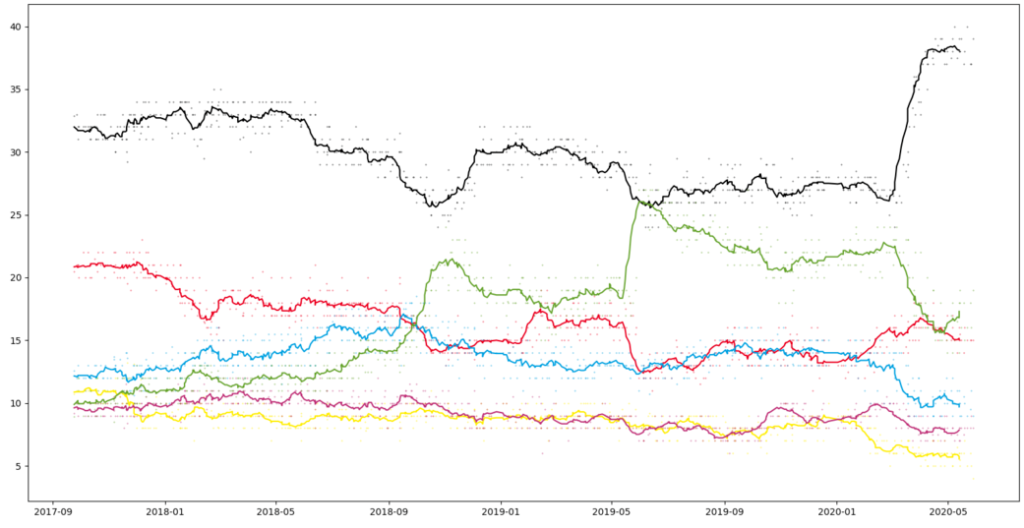
Yesterday’s Reid Research poll suggested complete and utter failure for the National Party in this September’s election. Most media commentators rushed to congratulate Jacinda Ardern’s Labour Party, and suggested that their steady hand during the ongoing coronavirus pandemic was the reason for the good polling. The alternative explanation, as this essay will explore, is that National are shit.

The poll suggested that Labour is currently favoured to win 56% of the vote at the next general election. This would only be a fraction lower than what the African National Congress won in last year’s general election in South Africa, a country often criticised for being a one-party state. It’s a triumphant poll for Labour supporters; their opposition lies scattered and disorganised.

Predictably, most National supporters reacted by bleating about how Reid Research was in Ardern’s back pocket and how everything will be different once the economic effects of the lockdowns are more widely understood. But it won’t be. The fact is that the country has fundamentally lost confidence in the current National leadership.

This magazine reminded everyone last year, in response to increased complaining about the human rights abuses committed by the Sixth Labour Government, that Labour were only in power because National were shit. The Fifth National Government had unmistakably demonstrated its indifference to the suffering of New Zealand’s working class and younger generations, and, subsequently, Winston Peters went with Labour after the 2017 General Election.

Nothing has changed on National’s part.

Deputy Leader Paula Bennett has announced that she’ll be voting to keep putting cannabis users in cages this September. She isn’t bothered that cannabis prohibition costs the taxpayer $400,000,000 a year to enforce, or that it causes great suffering to many of her fellow citizens for no justifiable reason. She wants to charge on with cannabis prohibition as if we’ve learned nothing at all from the past 45 years of failure.

This position is a microcosm of National’s failings.

We tried the politics of cruelty for nine years – the term of the Fifth National Government. We saw John Key and then Bill English sit on their arses as medicinal cannabis was legalised across the world, leaving desperate Kiwis to suffer needlessly. They wasted some $3,600,000,000 on enforcing cannabis prohibition during their term, with nothing to show for it at the end.

During those nine years, we saw the suicide rate climb as the mental health system was pared down to the bare bones. Banking and finance interests grew fat and wealthy, while working New Zealanders were driven first into debt and then to the wall. The National Party rejected all pleas for relief with the same contemptuous indifference that the previous National Government had shown.

By 2017, New Zealanders decided that they’d had enough cruelty. National lost so much support that they lost their grip on power, and Winston Peters dealt the killing blow. It seems that National didn’t learn much from this, however. They have continued to campaign for a kick in the guts to all the usual victims.

Bennett’s position on cannabis shows that National still don’t give a fuck at all. They don’t give a fuck about science, or evidence, or what’s happening with cannabis law reform overseas. They’re just drifting along, in their own little bubble, as if it were still the 1990s.

Things were different in the 1990s. The Fourth National Government passed a Budget in 1991 that left the children of poor families to go hungry, and were rewarded. Kiwis didn’t care about hungry kids then, so we voted National back into power – twice. In the 1990s, we didn’t give a fuck either. But we do now (at least generally speaking).

New Zealand, and the world, have moved on from beggar thy neighbour politics, but the current National leadership has been slow to see it.

Today’s National Party are so out of touch with the average New Zealander that they might as well have a Deputy Leader who wants to put homosexuals in cages. Bennett’s position on cannabis is ludicrous in the light of existing evidence. The electorate inevitably punishes someone holding antiquated positions, and cannabis prohibition is an antiquated method of dealing with cannabis misuse.

To be in favour of cannabis prohibition today is to deny reality. A person is insane if they think that, by using the criminal justice system to put cannabis users in cages, the Government decreases the sum total of human suffering. Kiwi voters can sense this, and so they have overwhelmingly chosen to support the opposition.

The National Party needs to move away from the politics of hate that have characterised it in recent decades, and accept that policies like cannabis prohibition belong in history’s garbage can. This might necessitate a clearout of their current leadership. Nikki Kaye has previously demonstrated a 21st Century approach to cannabis law reform, and the electorate might reward this good sense over what Bridges and Bennett are offering.

*

Vince McLeod is the author of The Case For Cannabis Law Reform, the comprehensive collection of arguments for ending cannabis prohibition.

*

If you enjoyed reading this essay, you can get a compilation of the Best VJMP Essays and Articles of 2019 from Amazon for Kindle or Amazon for CreateSpace (for international readers), or TradeMe (for Kiwis). A compilation of the Best VJMP Essays and Articles of 2018 and the Best VJMP Essays and Articles of 2017 are also available.

*

If you would like to support our work in other ways, please consider subscribing to our SubscribeStar fund. Even better, buy any one of our books!

Why Stuff Is Worth Less Than VJM Publishing

Many New Zealanders were surprised last week by reports that the Stuff news portal at www.stuff.co.nz was worth less than one dollar. How could it be possible that our foremost media portal, which employs hundreds of people, has a lower net value than a ramshackle outfit like VJM Publishing? This essay explains.

Stuff has a world Alexa rank in the top 4,000, and was ranked 7th in New Zealand at time of writing. They get hundreds of times more traffic than VJM Publishing does. They have been legitimised in most people’s minds as the “mainstream media” and, despite being shit, are considered to be “proper” journalism.

So how can they make less money? The simple answer comes down to who owns Stuff and what they have bought ownership for.

The VJM Publishing strategy is not to churn out vast numbers of shitty articles, with clickbait headlines, about vapid celebrities, in the hope of tricking some pleb into clicking on some more clickbait in the form of an advertisement.

No wonder advertising revenue is plummeting, if that is the business model.

VJM Publishing doesn’t make money from spamming Google ads through every page or by having banks of them at the bottom of every article like Stuff does. In fact, we don’t make any money from advertising revenue – we make it from selling books. Every page on this website has a set of links to our book sale pages on Amazon and TradeMe.

Making a living selling books is tough, but it’s possible. The trick is to produce material of a high enough quality that it promotes and advertises itself. This is the secret to ranking well in the Google algorithm, because that algorithm can estimate a page’s quality by measuring the responses of its readers. If the readers tend to click away quickly, it’s probably a low-quality page, and vice-versa.

This is a different business plan to that of Stuff, but we are in fact a publishing company, not an advertising seller (or reseller). As such, we compete on quality and not on volume.

This company operates under the logic that if we can provide quality articles about esoteric subjects and alternative psychology, as well as intelligent political commentary from an alt-centrist perspective, that this will give us an edge. As long as this edge leads people to become aware of our books, some people will buy them, and we make profits.

All of this sounds so obvious, that the question has to be asked: why doesn’t Stuff do similar?

The first thing is to look at who owns the New Zealand media: essentially it’s owned by international banking and finance interests. This was demonstrated by us here at VJM Publishing, in an example of the kind of journalism that the mainstream media will never give you.

These international banking and finance interests don’t care if they lose money from Stuff. They gain something of far, far greater value: control of the narrative. Thanks to having control of the narrative, they can normalise all kinds of things that are in their benefit. In principle, every article on Stuff has been calculated to suit the agenda of its owners.

By directing Stuff to constantly cry and scream about racism, those owners achieve several objectives.

The international banking and finance interests make enormous profits from mass immigration. Not only does every new immigrant push the price of housing up and generate one new mortgage account, but their cheaper labour also pushes the cost of running a business down. On top of all that, their presence destroys the solidarity of the host nation, making it easier to rule over. Win-win-win.

The major opponents to the mass importation of cheap labour are the native working class. They lose the most heavily as they don’t tend to own houses, and they tend to sell rather than hire labour. As such, the mainstream media makes a great effort to paint these people as ignorant bigots who oppose mass immigration out of nothing but pure hatred.

It has to be understood that the mainstream media stokes up hysteria about racism for money. Not only does it generate clicks and traffic, but it also normalises the idea that mass immigration is normal and that anyone objecting to it is evil. Multiculturalism destroys the ability of the host nation to resist the predations of the international banking and finance classes – and the latter know this intuitively.

By directing Stuff to fill space with crap about Meghan Markle, they also achieve several objectives.

Foremost of these are wasting people’s time and conscious awareness on shit. If the mainstream media informed people about issues that directly impacted their well-being, it would agitate them. This might lead to chaos, which is bad for business. Much better to have a passive population who can be milked for profits without protest.

The best thing for business is for the populace to be induced into maximum docility. Perfection would be a herd of consumers that only get excited when the next product is released. So the mainstream media is directed to fill their pages with fluff pieces about irrelevant people. Meghan Markle, who has no connection to New Zealand at all, is the ideal subject.

All of these objectives serve one greater meta-objective: to gain control over our minds. Whoever controls the mainstream media – otherwise known as the apparatus of propaganda – controls the minds of the people. They control what the people hear, what the people think, what the people consider normal. Effectively they control how the people react to every stimulus that is put before them.

It’s an enormous power, perhaps the archetypal modern expression of what Elementalists call silver magic.

In summary: the international banking and finance interests who own the mainstream media are happy to lose money from it as long as they gain control of the narrative, because this confers a great deal of power. The elites run Stuff as a loss-leader to capture the attention of the masses in the same way that supermarkets run chocolate specials as loss-leaders. The losses from it are written off against greater profits elsewhere.

VJM Publishing, by contrast, is run as an actual business, whose mission is to provide quality information, forecasting and analysis in exchange for money. As such, we have to maintain a net worth above zero.

*

If you enjoyed reading this essay, you can get a compilation of the Best VJMP Essays and Articles of 2019 from Amazon for Kindle or Amazon for CreateSpace (for international readers), or TradeMe (for Kiwis). A compilation of the Best VJMP Essays and Articles of 2018 and the Best VJMP Essays and Articles of 2017 are also available.

*

If you would like to support our work in other ways, please consider subscribing to our SubscribeStar fund. Even better, buy any one of our books!

Writing Characters of Tin

Once a character has a small amount of spiritual energy in them, they become a character of tin. This represents the next stage up the spiritual ladder from lead. As tin is brighter than lead, characters of tin are brighter than characters of lead. However, tin is still near the bottom of the vertical spectrum.

Tin is represented by the planet Jupiter. As such, it is typified by largeness. The typical character of tin is one that other people would describe as “larger than life”. In much the same way that characters of lead can be marked by being small, characters of tin can be marked by being large.

This largeness does not imply any of the other qualities typical of the higher elements. Characters of tin may be large, but they are seldom physically disciplined like the characters of iron. Rather, men of tin have big beer bellies and women of tin have gigantic breasts. The stereotypical jolly fat man is a man of tin.

Jupiter gives us the word jovial, which is the characteristic adjective of characters of tin. This joviality expresses itself as an uncomplicated sociability. Characters of tin, having advanced past the level of lead, understand that life must be enjoyed rather than merely survived. As such, they are all about the next party.

The archetypal emotion of a character of tin is joy. Whereas the character of lead is fearful and suspicious, the character of tin overflows with warmth – perhaps too much. They can be the sort of person whose good-natured naivety leads to them getting their pocket picked. They can also be the sort of person who gets a little bit too flirtatious with the waitress and so upsets their wife.

The flipside of this is guilt. Characters of tin frequently find themselves feeling guilty on account of overindulging in some passion or failing to resist some temptation. Although they’re not petty criminals like characters of lead can be, and they’re not sadistic brutes like characters of iron can be, their impulsive and passionate nature can induce them to commit practically any crime that characters of lead and iron are capable of.

The archetypal occupation for a character of tin is a publican or bartender. When surrounded by other people who are drinking booze and cutting loose, the character of tin is in their element. One can reckon their whereabouts by their booming laughter. Dancing and gambling are other favourite pastimes.

Where you won’t find them is in any occupation requiring long-term physical or intellectual discipline. The character of tin doesn’t consider themself ill-disciplined, however – they are likely to make the argument that their passions are too powerful to be readily controlled. For this reason they don’t necessarily look up to the characters of higher elements.

Characters of tin often have some rudimentary musical skills. Although they don’t have the refinement of characters of copper or the brilliance of characters of mercury, they have no shortage of passion. Sometimes they make more noise than music. A charcter of tin, then, feels right at home behind a set of drums or fronting a punk rock band.

Perhaps the greatest motivation of the character of tin is the prospect of a good hard shag. Being slightly illuminated, they are full of both passion and the lust for pleasure. As such, characters of tin fill the bordellos of the world, both as customer and vendor. Their idea of heaven is a pub full of drunk, loose, big-titted women or horse-cocked men. Concerns about class don’t really come up – characters of tin are in it for a good time, not a long time. They like to say “any hole’s a goal”.

Characters of tin tend to be more forgiving and less petty than characters of lead, but they do have a pronounced dark side. Not being illuminated to the level of iron, they don’t have any true sense of honour. As such, they are still prone to petty hatreds, only they are more likely to backstab someone socially through gossip or rumourmongering than by doing it literally.

Being emotional, characters of tin are also prone to sullenness. If there is nothing interesting happening, or if they don’t get their way for some reason, characters of tin tend to sulk. They also yield easily, although they aren’t as flighty as the characters of lead.

Most usefully from a story-telling point of view, characters of tin are vulnerable to letting their passions get on top of them. This relates not so much to violence (this is more the problem of characters of iron) but to gluttony and licentiousness. Characters of tin are often drug addicts. Much like the characters of lead, they are not particularly good at long-term thinking. So there are many of them who are alcoholics or junkies.

Characters of tin are great fun to be around when times are good, but when times get tough they tend to disappear. A character of tin, then, is the archetypal “fairweather friend”. Lacking the displine of the higher elements, the character of tin tends to cut and run. They also like to bludge.

The character of tin tends to look down on the characters of lead on account of that the latter aren’t much fun. Characters of tin might not be particularly illuminated, but they are smart enough to know that people with no moral refinement tend to cause bad times to those around them. This prejudice towards the less enlightened is a feature of all of the levels between lead and gold.

Characters of tin don’t make sophisticated distinctions between the characters of the higher elements. Although they may have a wary respect for the characters of iron on account of their fighting ability, the characters of copper, silver, mercury and gold all tend to blend together as “rich people”.

Other characters tend to look down on the character of tin for being degenerate. Because the character of tin cares about little beyond the next good time, they’re usually the sort of person who can neither impose order upon the environment around them nor upon themselves. As such, they are often physically out of shape and poorly educated, and so are not afforded great respect.

An underappreciated ability of tin is its capacity for balance. Because tin is the centrepoint between lead and iron on the spectrum of base elements, it can serve as a mediator between the base feminine and the base masculine. As such, characters of tin can be skilled at sorting out petty disagreements, usually with an appeal to have a drink and forget about it all.

Characters of tin can also be lucky. The expression ‘tinny’, to denote someone lucky, has an alchemical origin. It’s related to the idea that a gusto for life attracts Fortune to one’s side. This sentiment is the basis for the amor fati that is the essential attitude of the characters of iron.

*

This article is from Viktor Hellman’s The Alchemy of Character Development, the sixth book in VJM Publishing’s Writing With Psychology series. This book will show you how to use alchemy to create deep, realistic and engaging characters for your creative fiction.

*

If you enjoyed reading this essay, you can get a compilation of the Best VJMP Essays and Articles of 2019 from Amazon for Kindle or Amazon for CreateSpace (for international readers), or TradeMe (for Kiwis). A compilation of the Best VJMP Essays and Articles of 2018 and the Best VJMP Essays and Articles of 2017 are also available.

*

If you would like to support our work in other ways, please consider subscribing to our SubscribeStar fund. Even better, buy any one of our books!