
Is The Fiat Currency System Collapsing?

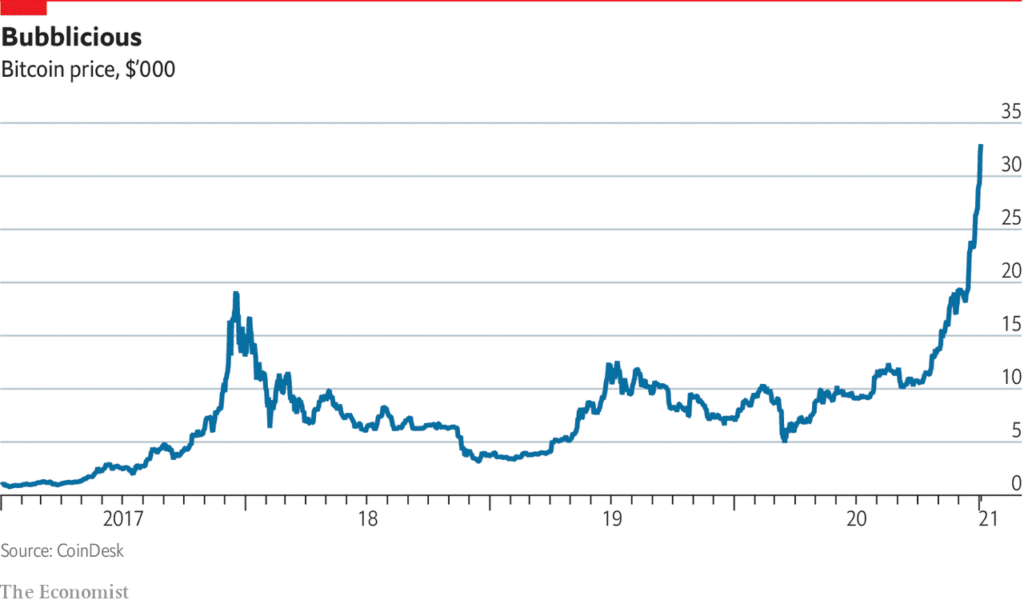
BitCoin enthusiasts have been overjoyed in recent months to observe the rise of their favourite cryptocurrency against the US Dollar. The price of BitCoin recently touched USD40,000 earlier today, making predictions of an eventual six-figure value seem believable. But the good news for BitCoin holders might herald bad news for everyone else. This could be the collapse of the fiat currency system.

The rise in the price of BitCoin has to be understood in the wider economic context.

Ever since the Global Financial Crisis of 2007, Western governments have taken to what is known as quantitative easing. This involves the widespread printing of fiat currency, a practice that has seen the price of everything go up. New Zealand recently increased the Quantitative Easing limits to $100 billion, up from $60 billion, meaning that the Reserve Bank of New Zealand will help to fund the Government through buying bonds.

Almost 24% of all US Dollars in existence have been created over the past 12 months. This money printing has led to a much greater supply of money in circulation, which means one thing: inflation. The fiat currencies of the world are rapidly becoming worthless. This is evident when comparing their value to housing, bullion and BitCoin.

In New Zealand, the average house price has doubled since 2009, but wages have only gone up 40% since then. The average house cost ($330,000/$25) 13,200 hours of labour at the average wage in 2009. By 2020, it cost ($700,000/$34) 20,600 hours. So measured in house-buying terms, the average wage has lost 50% of its power since the Global Financial Crisis.

This is despite that fact that the value of housing stock has served as a kind of heat sink that has taken the steam out of the economy. That sink has now absorbed all the energy that it can. The extra is manifesting as inflation.

The rise in the price of silver bullion is even more striking. Silver bullion has doubled in value since April 2020. The reason for this is mostly uncertainty around fiat currency (the last time silver bullion spiked was in the immediate aftermath of the Global Financial Crisis). Silver has traditionally been seen as an alternative to fiat currency owing to its millennia of trade use.

It’s a similar story with gold bullion, the price of which has tripled since the Global Financial Crisis.

Most striking of all is the price of BitCoin. At the time of writing this article, the price of BitCoin had gone up 30% over the previous week. It had gone up 500% over the previous nine months. BitCoin has gained fame as a digital alternative to fiat currency, owing to the fact that it is not under centralised control.

Many people have predicted that BitCoin will take over once the fiat currency system collapses completely. It will be evident when this is happening, apparently, from a sustained spike in the BitCoin price. Well, there’s a spike in the BitCoin price right now, as well as a spike in the silver price, the gold price and the house price.

All of these trends point unmistakably to one conclusion: the fiat currency system is collapsing. This isn’t surprising to those who were already aware of the life cycle of fiat currencies. Soon, fiat currencies might be worth so little that some people refuse to take them in trade. Then the shit will hit the fan.

*

If you enjoyed reading this essay, you can get a compilation of the Best VJMP Essays and Articles of 2019 from Amazon for Kindle or Amazon for CreateSpace (for international readers), or TradeMe (for Kiwis). A compilation of the Best VJMP Essays and Articles of 2018 and the Best VJMP Essays and Articles of 2017 are also available.

*

If you would like to support our work in other ways, please consider subscribing to our SubscribeStar fund. Even better, buy any one of our books!


Neil Wagner And The Coming Golden Age Of New Zealand Cricket

Black Caps fans were disappointed to hear, last Sunday evening, that Neil Wagner had broken two toes batting in the first innings in the ongoing Test against Pakistan. The natural assumption was that the damage would prevent Wagner from bowling, and so the Black Caps were much less likely to win the match than they otherwise would have been. As it turned out, Wagner bowled 49 overs anyway, and the Black Caps won by 101 runs.

The win against Pakistan was important for a number of reasons. For one thing, it propelled the Black Caps to the No. 1 Test ranking for the first time in their history. For another, it meant that they still had a chance to make the World Test Championship final. But the main reason was spiritual.

There are many reasons why the All Blacks are infamously hard to beat. Their extremely high level of skill is one. The main reason, though, is will. The All Blacks go harder than any other team barring the Springboks. They and the Boks seem ready and willing to die to defend their line, a quality shared by no other teams. The All Blacks are even willing to play on with broken bones.

On the 1970 All Blacks tour of South Africa, Colin Meads played most of a match against East Transvaal with a broken arm. The near-demonic will necessary to do this has since become part of the All Blacks mythology. In the half-century since that tour, the All Blacks have built a winning record against every other side in the world, even the 3-time World Cup winning Springboks.

Part of the reason why the All Blacks are so good is their “aura”. This is the name given to the All Blacks egregore, which is powerful enough to influence games in its own right. This egregore has gained so much power because of feats like that of Colin Meads. Other teams don’t have players willing to play on with broken bones, which is why they keep losing to the All Blacks, who do.

When most Black Caps fans heard that Neil Wagner had two broken toes, they would have resigned themselves to a draw. Tim Southee, Trent Boult, Kyle Jamieson and Mitchell Santner are fine bowlers, but it seems unlikely that they could take 20 wickets by themselves on a placid New Zealand pitch that would continue to flatten out.

That Wagner not only continued to bowl, but took 4-105, is a feat equal to that of Colin Meads half a century ago. Wagner has rightly been lauded for his influence on the outcome of the match, but the larger effect might be Wagner’s influence on the Black Caps’ egregore. The Black Caps are, now, also a team that fields players willing to play on with broken bones.

Wagner’s feat, and the subsequent Black Caps victory, may have created an egregore that is strong enough to win matches on its own. Every team that faces the Black Caps now knows that, as Wagner put it, their opponents would rather be carried off on a stretcher than lose. That is intimidation. That is an aura. That fact will create doubt in the minds of every team that gets ahead of the Black Caps in a match.

It’s also impossible to overstate the psychological effect that the Black Caps win will have on world cricket. The bar has now been set higher than ever before. Every cricketer in the world knows that, if they aren’t willing to bowl 49 overs on a broken foot, they don’t want it as much as the Black Caps do. Net bowlers the world over will tire and, thinking of Wagner, bowl for another hour anyway.

Thanks to the efforts of Wagner and others, the Black Caps are now the world’s leading cricket team.

What seems clear is that the Black Caps are about to enter the true Golden Age of New Zealand Cricket. From now until at least the retirement of Kane Williamson, the Black Caps will either be ranked No.1 or will be threatening it. They have a cadre of both batsmen and bowlers who will be able to perform at world-class level, and there won’t be mass retirements for at least one more World Cup cycle.

Over the next four to six years, the Black Caps will challenge in all conditions against all opponents. That they themselves believe they can do this has been ensured by Neil Wagner’s efforts this week. Both the Black Caps and their opponents know that not even broken bones are enough to stop the Kiwi pace battery. It will provide an invincible confidence.

This Black Caps side is already the No. 1 Test team in the world and easily the best squad that New Zealand has ever produced. The big question is whether they have what it takes to challenge Ponting’s Australia as the most complete side in living memory. The next four to six years should tell us.

*

If you enjoyed reading this essay, you can get a compilation of the Best VJMP Essays and Articles of 2019 from Amazon for Kindle or Amazon for CreateSpace (for international readers), or TradeMe (for Kiwis). A compilation of the Best VJMP Essays and Articles of 2018 and the Best VJMP Essays and Articles of 2017 are also available.

*

If you would like to support our work in other ways, please consider subscribing to our SubscribeStar fund. Even better, buy any one of our books!

Clown World Chronicles: Elections In Clown World

That Clown World is at the point where democracy tips over into tyranny is evident from the state of elections today. If there’s anything in today’s world that could be compared to a grotesque circus, it’s our general elections. The political world has always been like a circus, but in Clown World the circus is 24/7.

Problems with starting a democracy in places like Africa, it is said, don’t generally arise during the first election. It’s in one of the subsequent elections, when the winner of the initial election loses, that the problems start happening. It’s all well and good for one party to assume control after winning the first democratic election. What matters more, though, is what happens when they lose control and are asked to hand over power.

Characteristic of democratic elections in African scumholes is that they are contested. Almost inevitably, the loser accuses the winner of cheating, either by stuffing ballot boxes or by intimidating opposition voters into staying home. This is especially likely to be true if the loser won the previous election. It’s common for these disputes to end up in massacres or even civil wars.

Characteristic of democratic elections in the West is that the loser accepts the result. This is why it was so shocking for the 2000 American Presidential Election to drag on for as long as it did. But in Clown World, elections in the West have started to go down the African route.

The first real sign of it was the Russian interference conspiracy theory that was pushed by Democrat Party operatives in the wake of Hillary Clinton’s 2016 loss. This conspiracy theory suggested that the election result might not have been legitimate because it was influenced by the actions of the Russian Government, who supposedly purchased enough FaceBook ads to switch the result from Clinton to Donald Trump.

At time of writing this chapter, the result of the 2020 American Presidential Election still isn’t clear. Seven weeks after the election, neither Joe Biden nor Donald Trump has conceded (although the mainstream media has anointed Biden the winner). Trump has mounted a number of legal challenges relating to the vote, and rumours persist that he might try to enlist the military in a coup.

The tendency of Clown World politicians to dispute election results is made worse by the fact that the elections themselves have become detached from reality. The election process presents an image of a politician that 99.9% of voters will never meet. So it’s almost impossible to know if the results of a general election reflect the will of the country. This makes disputes much more plausible.

In Clown World, elections come down to a battle between competing narratives. Whichever narrative can assert itself the strongest wins, regardless of what any vote tally might say. Elections aren’t so much won as consent for one side’s victory is manufactured. This has made elections into permanent public relations exercises more than temporary leadership contests.

Buying media space is how positive public relations are maintained, and thereby how most elections are won. 90% of the time, the better-resourced candidate wins. This is because most voters in a democracy simply vote for the candidate with the most name recognition. If they saw Candidate A on the television and not Candidate B, that must mean that Candidate A is superior.

It’s even possible to calculate how much money you need to buy enough positive attention to win. A seat in the United States House of Representatives, for example, will cost around $1.6 million. However, it’s not always as simple as money – Michael Bloomberg spent $500 million to win the Democratic nomination for the 2020 Presidential election, and failed. Generally speaking, the lower the office the easier it can be bought.

No matter how hard it is to buy an office, though, people will always try. Because of all the mainstream media propaganda and disinformation this leads to, we still don’t know who has won the 2020 Presidential election. Faith in institutions is so low that there’s no-one we trust to tell us the definitive truth about who the President will be. FaceBook will censor anyone questioning Biden’s supposed victory, but as of right now it’s not clear that Trump intends to concede.

The great risk when elections become disputed is that it can lead to tyranny. The logic is that if the other side isn’t going to play fair, then why should we? Mistrust can escalate to the point where both sides reason that they had better get their retaliation in first. At that point, the country is essentially in a state of civil war.

Unfortunately, if the last two decades of American presidential elections are anything to go by, civil war is almost inevitable. It seems like the election results are becoming more and more heavily disputed by the loser. Trump is digging in his heels right now, and ill will is so widespread that if he called for a million Republican supporters to hit the streets with firearms he might get it.

For democratic elections to work, there has to be widespread confidence that the electoral process is legitimate. This means widespread confidence that there is no voter suppression, no foreign interference, no collusion with outside third parties and no influential disinformation campaigns. If one or more of these factors are present, the results are liable to get disputed.

It might well be that democratic elections themselves are inherently signs of Clown World. But the decay doesn’t stop at democratic elections. The predictable future is increased Weimarisation, up to the point where the system collapses or is overthrown. One possible pre-emptive solution is withdrawing the franchise from certain anti-social groups.

*

This article is an excerpt from Clown World Chronicles, a book about the insanity of life in the post-Industrial West. This is being compiled by Vince McLeod for an expected release in January 2021.

*

If you enjoyed reading this essay, you can get a compilation of the Best VJMP Essays and Articles of 2019 from Amazon for Kindle or Amazon for CreateSpace (for international readers), or TradeMe (for Kiwis). A compilation of the Best VJMP Essays and Articles of 2018 and the Best VJMP Essays and Articles of 2017 are also available.

*

If you would like to support our work in other ways, please consider subscribing to our SubscribeStar fund. Even better, buy any one of our books!

Clown World Chronicles: Class Relations In Clown World

The West is proud of its egalitarian heritage. We derive a sense of moral superiority from being a culture in which even the lowest classes can, through hard work, determination and applied will, reach the highest positions. The example of Abraham Lincoln, born into poverty in a frontier log cabin, is archetypal. But class relations in Clown World are very different to those in the 19th century.

In Clown World, we’ve effectively gone back to feudal times.

It’s so hard to buy a house today that, if you aren’t born into money, you will need to be in the top segment of income earners to do it. In both America and Britain, the house price to income ratio is at highs not seen since the aftermath of World War II. In the case of Britain, things are so extreme that you’d have to go back to the Victorian Era to find a time when it was harder for the average person to own their home.

This has led to large proportions of entire generations becoming resigned to paying rent in perpetuity. Some have even labelled the lower classes Generation Rent. Class relations in Clown World are marked by the great distance between the landowning class and the renting class. Many landowners in Clown World make more profit from capital gains on property than they could working for a wage.

This state of class separation is maintained by a concerted effort on the part of the Establishment to destroy class consciousness, the only thing that could really threaten it. The mainstream media pushes any and all alternatives to class consciousness: race consciousness, gender consciousness, age cohort consciousness, any possible corporate brand consciousness. Anything but class consciousness.

These efforts keep class relations much less antagonistic than would otherwise be the case. There are no workers’ marches in Clown World, because the working class is divided along multiple lines of fracture. These lines of fracture prevent the solidarity that would be necessary for collective action.

These divisions are maintained by the control that the ruling class has over the apparatus of propaganda. This control allows them to set the agenda in every Western country, and this agenda is inevitably fighting racism, fighting sexism, fighting ageism – and never fighting classism.

Class relations in Clown World, then, are characterised by the relentless efforts of the ruling class to keep the lower classes divided and conquered. The masses are bedazzled by the 24/7 circus of flickering images coming through the television. They are demoralised by the relentless bombardment of bigotry accusations. They are disorientated by the contradictions coming from the government.

The net result of these efforts to keep poor people down is greater inequality, and less social mobility, than ever.

Inequality is now at historic levels. The American Gini Index sits at 41.4, meaning that America is even less equal than kleptocracies like Haiti, Iran and Turkmenistan. Even China and Russia – bywords in some circles for autocratic shitholes – have lower Gini Indexes than America.

It’s similar with homeownership. The homeownership rates in supposed poverty-stricken dumps like India and Mexico is higher than in supposed lands of opportunity like America, Britain, Canada, Australia and New Zealand. Yet the Western mainstream media bleats incessantly about how wonderful everything is and how we’ve never had it so good.

In Clown World, wealth equals the ability to suck productivity out of other people by controlling their labour. The commodification of some people means fat profits for others. The poorer a population is, the more readily they can be extorted out of rents. The class system in Clown World, then, is much like a food chain: energy is passed upwards.

Inequality has reached such levels that a person can be significantly wealthier than average and still be a long way from the upper economic strata. The result of this is a widespread absence of sympathy for those in the lower strata. They are so far below that they might as well be animals. In Clown World, your opinion only matters if you’re wealthy enough to buy media time.

The 2020 American Presidential Election was fought between the billionaire Donald Trump and Joe Biden, a man who had already spent 47 years in the upper levels of American governance. The previous election was fought between Trump and Hillary Clinton, who had also spent decades in the upper levels of American governance. The one before that involved Mitt Romney, whose net worth was $250 million, and Barack Obama, the descendant of slave owners.

An Abraham Lincoln is unthinkable today. Someone born into poverty in today’s America is born so far behind that even becoming a homeowner would be a herculean effort. That they might become President is just laughable. Today, the ownership class has a complete lock on positions of power.

Naturally, a situation like this is ripe for revolution.

Democracy is about the easy satisfaction of desires. When those desires can no longer easily be satisfied, dissatisfaction quickly turns into a will to cause chaos. The widespread rioting of 2020 is a foretaste of the inevitable suffering of the next decade. As it becomes harder and harder to meet desires for decent housing and decent pay, people’s willingness to riot will increase.

The real risk of Clown World is that class relations become so bad that a majority of people want to overthrow the system. That could lead to them putting all their energies in behind a tyrannical demagogue. A leader who promised to get revenge on those hoarding property could summon a hurricane of rage behind them.

For class relations to improve, the masses have to have hope again. This doesn’t mean hope of becoming multibillionaires, just hope of meaningfully improving the station into which they were born. It means that they suffer less drudgery and poverty as they get older, and not more. If economic forces or policies push the masses away from hope, they push them into the clutches of fear and hate.

*

This article is an excerpt from Clown World Chronicles, a book about the insanity of life in the post-Industrial West. This is being compiled by Vince McLeod for an expected release in January 2021.

*

If you enjoyed reading this essay, you can get a compilation of the Best VJMP Essays and Articles of 2019 from Amazon for Kindle or Amazon for CreateSpace (for international readers), or TradeMe (for Kiwis). A compilation of the Best VJMP Essays and Articles of 2018 and the Best VJMP Essays and Articles of 2017 are also available.

*

If you would like to support our work in other ways, please consider subscribing to our SubscribeStar fund. Even better, buy any one of our books!