
Is New Zealand Now A Tyranny?

In the Greco-Roman world, tyranny was defined as a form of government in which the rulers were unrestrained by laws. If the rulers are unrestrained by laws, then they are capable of inflicting any amount of cruelty upon the people, without there being any obvious way to stop them. This is widely agreed to be a terrible and evil form of government. This essay asks: is New Zealand now a tyranny?

One of the clearest examples of a tyranny is the presence of arbitrary and seemingly random punishments. New Zealand man Philip Arps is facing 14 years imprisonment for sharing a video of the Christchurch mosque shootings last month, on the grounds that the video was “objectionable content”. This is an incredible potential punishment if one consider the seven years imprisonment that Myron Robert Alf Felise got earlier this year for punching teenager Eli Holtz to death.

If New Zealand would bring in a 14-year maximum sentence for common assault or petty theft, it would be an obvious case of tyrannical overreach. So how can it be possible for them to introduce equally as severe a punishment for an action that did not harm anyone? It seems especially bizarre if one considers that New Zealanders are sharing and viewing videos of murderous terror attacks every day, but none of these are likewise criminalised.

A second example of tyrannical behaviour is the numerous laws and actions carried out by the New Zealand Government without the consent of the people, or even in cases when the people had explicitly withdrawn their consent. A current and ongoing example of these is the campaign of harassment currently being conducted by the New Zealand Police against anyone thought to be right-wing.

There are several anecdotal reports on social media about people having Police officers come to their house, often without warrants, in order to intimidate them and to gather intelligence (and one hilarious recording of such by New Zealand alt-media legend Vinny Eastwood). According to these reports, Police officers are demanding information about other right-wing people, and demanding to know if people are racists or if they supported Branton Tarrant.

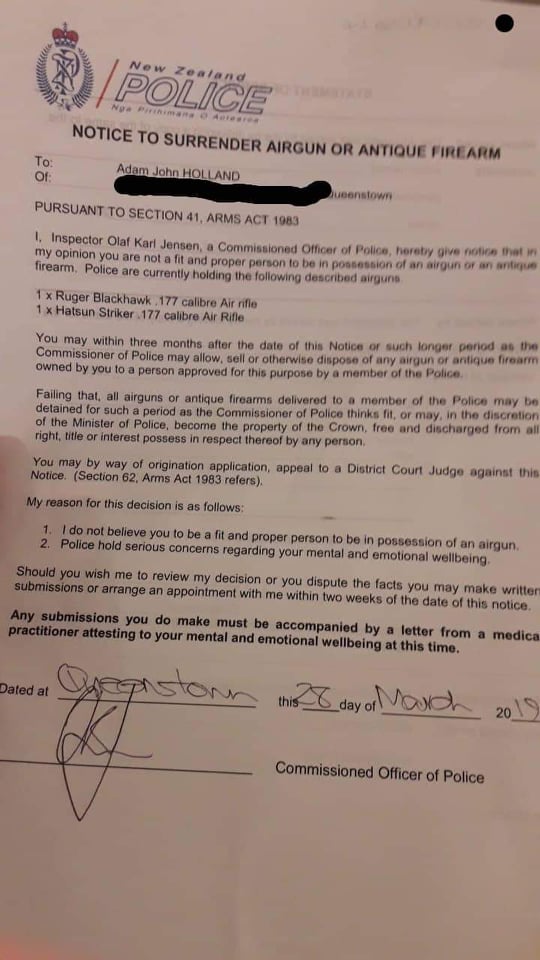
One of the worst examples was what happened to Adam Holland in Queenstown (see image at top of article). Holland had two airguns and a crossbow removed from his possession on the grounds that Inspector Olaf Jensen had personally decreed Holland was “not a fit and proper person to be in possession” of such, and that “Police hold serious concerns regarding [Holland’s] mental and emotional wellbeing”.

Police officers have zero psychological education to justify any serious concern about anyone else’s wellbeing, and their whimsy is nowhere near a sufficient basis to remove possessions from a private citizen who has not used them in commission of a crime. What sort of country strips citizens of possessions on the basis of one Police officer’s judgment? How long until they take machetes and kitchen knives away?

Holland’s experience is just a further example of a process that started before the Sixth Labour Government. The Fifth National Government was happy to sell national assets, despite a referendum that explicitly declared the public unwillingness to do so, and all recent Governments have refused to acknowledge the clear public desire for cannabis law reform.

If a clear and direct expression of the public does not constrain our rulers, then what does?

A third example is the ongoing free speech violations. Justice Minister Andrew Little currently has a giant warboner over the possibility of introducing so-called “hate speech” laws, in which criticism of certain power structures becomes a criminal offence. As has been seen in Austria, where a woman was given a criminal conviction for saying that Muhammad was a pedophile, hate speech laws soon lead to the criminalisation of dissent.

The Government hasn’t started stripping our rights to speak away quite yet, because they are currently in the process of sounding out how much they think they can get away with, but the process of using propaganda to soften public resistance to such tyrannical laws is in full swing. The mainstream media is busy acclimatising the public to no longer being allowed to speak freely.

The really frightening thing is that such laws directly violate Section 14 of the New Zealand Bill of Rights Act, which guarantee New Zealanders the right to impart opinions of any kind in any form. If the Government is not bound by the New Zealand Bill of Rights Act when taking our rights to speak away, what are they bound by? And if they are bound by nothing, as appears to be the case, then how are they any different to the literal definition of tyranny?
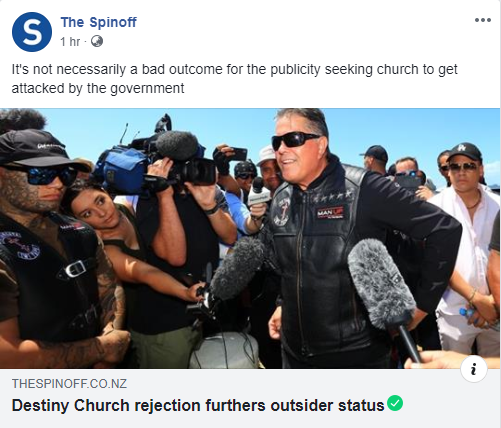
A fourth example is given in the image above. The Spinoff regularly runs articles attacking the enemies of the Government and making apologies for unpopular Government actions (although rarely are they so blatant as in the example above). The worrying thing is, as they admit on their company page, The Spinoff “works with NZ on Air and Creative New Zealand to fund our work” – in other words, they take Government cash to produce propaganda.

When the Government works hand-in-hand with the free press to create propaganda pieces, you don’t have a free press. In fact, the need for an authoritarian government to totally control the narrative was even mentioned by Josef Goebbels in his Principles of Propaganda. So the Government funding a media enterprise that pretends to be independent, but which in reality attacks enemies of the Government and propagandises for Government policies, is something fully in line with tyrannical Nazi principles.

The only way New Zealand can get out of this is to come together as individuals, ignoring the government, and to decide on a set of our rights that are inviolable and which must be respected by anyone who wishes to rule us. A starting point could be the essay published here expounding a seven-fold conception of inherent human rights. If all Kiwis agreed that every other Kiwi possessed such rights, we would be free of tyrannical measures.

If this doesn’t work then we’re left with anarcho-homicidalism.

*

If you enjoyed reading this essay, you can get a compilation of the Best VJMP Essays and Articles of 2018 from Amazon for Kindle or Amazon for CreateSpace (for international readers), or TradeMe (for Kiwis). A compilation of the Best VJMP Essays and Articles of 2017 is also available.
How Mass Immigration Causes Us To Lose Freedoms, And Why It’s Being Pushed

The cultural tensions brought about by mass immigration have claimed several casualties over the past six weeks. From the 50 deaths in the Christchurch mosque shootings to the numerous losses of civil liberty at the hands of the Sixth Labour Government, much has been destroyed. This article explains how the people who advocated for mass immigration of incompatible cultures have provoked this, and by design.

There is now ample scientific research that increasing ethnic diversity has a negative effect on the society. Increased ethnic diversity reduces trust. Social trust is negatively effected by ethnic diversity. Increased diversity causes people to disengage from public life. Ethnic diversity causes people to trust their neighbours less. Even among children, ethnic diversity erodes trust.

The science is reasonably straightforward. Human beings naturally have in-group favouritism and out-group prejudice, and naturally see in-group members as more trustworthy than out-group members. The greater the number of encounters with out-group members, the greater the sense of distrust and suspicion. Increasing diversity then, leads directly to decreasing trust.

The big problem, though, is that decreasing trust leads to a measurably worse society. It leads to people disengaging from the political system, leading to a lower grade of politician, and to politicians with less oversight. It also leads to them disengaging from public life, and from the voluntary associations that society depends upon. These withdrawals mean that society becomes a much lonelier and more depressing and stressful place.

In other words, increasing diversity causes more suffering. However, just because increasing diversity causes suffering among the populations that are forced to become more diverse, doesn’t mean those those populations can avoid it. The diversity is usually forced on them by factors outside their control, such as people who benefit from exploiting those populations.

There are two major forces that benefit from the tensions caused by mass immigration. One is the Government, and the other is religion.

The Government knows that jamming incompatible cultures together will cause conflict. Any idiot knows this, because it’s a simple matter of looking around the world, either physically or through a history book, and one will see that wherever you have different cultures meeting you have violence. Unfortunately, the members of our current Government are autocrats.

Being autocrats, and being control freaks, they want to take as much freedom away from the population as possible. The more freedom we have, the less power they have. So events like the Christchurch mosque shootings are like lottery wins for the people in the Government. They make it possible for the Government to strip away any freedom they want, and anyone who disagrees is made to feel moral culpability for the 50 deaths.

The blueprint for this can be seen with the introduction of the Patriot Act in America after 9/11, which was widely criticised for its multiple civil liberty violations. No intelligent person can doubt that the Sixth Labour Government will use the excuse of white nationalist terrorism and possible Muslim reprisal terrorism to further chip away at our rights to privacy and freedom of association.

Theocrats are the other major group who benefit from “hate speech” laws. Muslims, for their part, know that hate speech legislation is an open door through which they can bring blasphemy charges on infidels. This they have already successfully done in Austria, where a woman was convicted and fined in a criminal court for saying that Muhammad was a pedophile.

Muslims in New Zealand are among the strongest supporters of destroying our tradition of free speech. Federation of Islamic Associations of New Zealand President Hazim Arafeh was instrumental in having Lauren Southern and Stefan Molyneux banned from speaking in New Zealand, and Manawatu Muslim Association President Riyaz Rahman is on record as saying “I think the freedom of expression that we have does not allow for hate to be curbed”.

Muslims would love nothing more than for criticism of their hate ideology to become illegal, and the possibility of sneaking in anti-blasphemy laws under the guise of anti-hate speech laws is also why Christians are broadly supportive of such laws. Every religious fundamentalist will be rubbing his hands at the thought of hate speech laws, because this would give them all a weapon to strike down any criticism.

A conviction for saying that Muhammad was a pedophile is only a tiny step away from a conviction for saying that the Pope protects pedophiles.

This means that New Zealand risks slipping into a double dark age. We have both theocratic authoritarians and secular authoritarians joining forces to destroy liberty among our people. Any real Kiwi ought to be extremely concerned by this alliance, because both parts are possessed of self-righteousness enough to justify any amount of cruelty.

The reality is that “hate speech” laws and blasphemy laws are essentially the same thing. The ruling classes get offended by anyone disrespecting their sacred cows, and so they make such disrespect illegal – it doesn’t matter if those ruling classes are theocratic, secular, or an alliance of both. The plebs shall not be allowed to criticise their betters.

As was the case in Austria, further mass immigration will provide excuses to strip more freedoms away. Even if there are no more mass killings in New Zealand, the control freaks will go after free speech, and greater ethnic diversity creates the distrust that makes it possible for them to do so. “Preserving the religious peace” will be one of the excuses used to crack down on criticism of religions and religious groups.

Fundamentally, it’s important to never forget that these freedoms were only lost because of mass immigration. Had we never opened the borders to cultures that did not respect our values of free speech, we would never have lost our right to practice it. There would never have been the tension that created opportunities for free speech crackdowns. We would never have lost the basic trust on which our society is built.

The worst part is that we were warned about this by intelligent people, and did not listen.

The only way to prevent further loss of freedom is to close the borders to incompatible cultures until such a time as all the people currently in New Zealand have learned to accept and appreciate freedom and liberty. This will mean a complete and total stop to the further immigration to New Zealand of men like Riyaz Rahman and those who share values with him. We’ve already lost too much.

*

If you enjoyed reading this essay, you can get a compilation of the Best VJMP Essays and Articles of 2018 from Amazon for Kindle or Amazon for CreateSpace (for international readers), or TradeMe (for Kiwis). A compilation of the Best VJMP Essays and Articles of 2017 is also available.

An ANZAC Lesson: The Real Enemy Is Always Behind You

My grandfather Fred was born in West Auckland, on the land that is now McLeod Park, named after his father Harry. Fred saw action in North Africa and Italy with the 2nd New Zealand Division and the British Eighth Army. He survived the war, returned to New Zealand, and raised a family. This essay is about one of the lessons he taught me.

He had, like tens of thousands of other Kiwi men, volunteered to fight in World War Two. Having volunteered, and then having experienced war and decided that it was a complete waste of time and something best avoided, he wanted to teach his offspring some lessons to help them avoid ending up fighting overseas.

He only ever spoke of combat, or of the general deprivations of war, to his wife, but he did tell us grandchildren a lot of stories about the lessons he had learned from his war experience. These generally involved insights about psychology, whether general or specific to the various nationalities he had encountered, or relating to military life and the nature of organisations.

One of his favourite stories related an experience that occurred shortly after the German surrender in May 1945. He was on the back of a troop transport truck with the other members of his company, when they encountered a column of German prisoners of war being marched along the road in the other direction. Upon seeing this, the officer in command of the New Zealand troops ordered the company to not acknowledge the presence of the German troops – after all, the war was not technically over yet.

But when the two forces met, the Kiwi troops spontaneously broke into a cheer, and waved to the Germans, who waved back with similar sentiments. It didn’t matter that they had been ordered not to do this, for the war was over, and that meant that the inhumanities of war no longer needed to be inflicted upon each other. Open fraternisation was, of course, not possible, but it was clear that no genuine illwill existed at the level of the average soldier.

It took a while to fully appreciate the import of this story. The first lesson was the magnitude of the relief that the soldiers must have felt upon understanding that the war was over. The realisation that all the killing and dying had ended would have been a joy that is barely comprehensible to someone who has never experienced combat. This joy would have been powerful enough to override any remaining sense of obligation to follow orders.

I spoke with him about this story once, after it had occurred to me that this feeling of goodwill towards the German soldiers was stronger than any goodwill he felt towards his own leaders, who were, after all, on his side. At this point he gave me a lesson, with an admonition to never forget: the real enemy is always behind you.

The apparent truth is that your enemy is the guy on the other side of the battlefield shooting at you. The real truth is that your enemy is the guy behind you, the one who coerced you into fighting in the first place. Never mind the fact that the guy behind you speaks your language – you still have more in common with the working-class man on the other side of the battlefield than you do with your own commanders.

This truth was illustrated by another, darker story, that took place in Italy. Fred’s company had taken a number of German soldiers prisoner during the battle of Monte Cassino. In the heat of the moment, one of the younger German soldiers broke down in tears, apparently under the conviction that he was about to be shot dead.

Fred offered the young German a cigarette, and instead spoke to him. Why would we shoot you in cold blood? he asked. Do you think we are monsters? The German replied that he had been told that the British were, indeed, monsters, whose insatiable greed had led them to try and take over the entire world and to subjugate it and all its peoples. It was in trying to stop this greed that the Germans had been drawn into the war.

Fred realised, of course, that he had been told exactly the same stories about the Germans. Moreover, the men who had been the ones to tell those stories had not themselves been subjected to the horrors of combat. The New Zealand politicians who had organised the war effort were safely back at home, fat and happy, as were the newspaper men. The sense of betrayal he felt upon realising this inspired the lessons he had to teach me.

Never, ever trust the politician or the newspaper who tells you how evil and terrible some men overseas are. It’s all but guaranteed that the politician and the newspaper are lying to trick you into sacrificing yourself for the commercial interests of their sponsors. World War Two was a banker’s war, Fred taught me, and the soldiers who fought in it were coerced into doing other men’s dirty work for them. There was nothing glorious or honourable about it anywhere.

There are two ways to get a man to do your dirty work for you. The first is to force him, the second is to trick him.

New Zealand’s involvement in World War One had at first been a voluntary affair, but it became a matter of force on the 1st of August 1916 with the passing of the Military Service Act. In total, almost 20,000 Kiwi men were conscripted for military service, roughly 20% of the total who served. Some 3-4,000 of these men were killed in battle.

By the time World War Two rolled around, the propaganda of the Establishment had become a lot more sophisticated. This was thanks, in large part, to men such as Edward Bernays, who had studied the use of propaganda and how to make it more effective, and who had written about it in books such as Propaganda. So they knew how to use the apparatus of mass media to convince men to join the Army.

This meant that the Establishment media could simply pump out enough stories about how the Germans bayonetted babies, and how they were trying to take over the world, and how Hitler was a unique evil that demanded a unique response, and enough people would believe it so that they didn’t need to conscript anyone any more. Men would simply volunteer to fight.

Fred raised me so as to never fall for the propaganda. Never to believe the politician, never to believe the media. Because, at the end of the day, the real enemy is always behind you. Your real enemy is not the opposition soldier but the one who raised the company, battalion or Army that you are now a member of. He’s the real enemy because the opposition soldier is, in the final analysis, only protecting himself from you.

Once, after I had been studying some military history, I remarked to him about conscription. Sure, I knew that the reasons behind the Vietnam War and the Gulf War were equally as false as for all the other wars. I could be smart enough to know that the television was lying to me about the need for me to participate in the next war, but if enough people my age were also aware of this, what would stop them going back to conscription?

What would I do if a conscription officer came to my house?

His reply was simple, and borne of the bravery that comes from having to face combat: “Shoot the bastard.”

*

If you enjoyed reading this essay, you can get a compilation of the Best VJMP Essays and Articles of 2018 from Amazon for Kindle or Amazon for CreateSpace (for international readers), or TradeMe (for Kiwis). A compilation of the Best VJMP Essays and Articles of 2017 is also available.

20 Years Since Columbine: Are We Still Nihilists?

This week saw the 20th anniversary of the Columbine High School massacre. The massacre shocked a Western World used to adult serial killers, because we didn’t believe that high schoolers could also be capable of such evil. In the aftermath of the massacre, the consensus was that the motivation for the deed came from nihilism. This essay asks: are we still nihilists?

History can be thought of as a series of attempts to solve the basic existential question of what we’re supposed to be doing here on this planet.

For many centuries, we had religion, and the struggle between good and evil, chaos and order. But then we killed God, and (as Nietzsche predicted) this threw us back into Nature, and the world of eternal struggle. This played itself out in the titanic clash of empires that was World War One, and the following clash of nations that was World War Two. After three decades of trauma, we decided that we’d had enough bloodshed, and so we tried a new narrative.

The postwar consensus was based around pure hedonism. After three decades of deprivation, something as simple as being able to buy a milkshake or a cheeseburger on demand was seen as a great pleasure that demanded appreciation. Later, the number of television channels to which one was subscribed was the sign of material fortune. The problem was, of course, that hedonism is not an answer to spiritual problems.

The Columbine High School massacre was perhaps the first major sign that the postwar consensus had failed. The prosperity the Boomers enjoyed was based on the idea that material consumption was the reason for human existence. This was great fun, but it was only ever a distraction. It never solved the basic existential dilemma.

Klebold and Harris’s actions were an example of something that this column has previously called anarcho-nihilism. This is where one proposes to destroy the pre-existing system without offering any alternative system that might replace it. One simply destroys for the sake of destroying.

Anders Breivik and Brenton Tarrant were later examples of this phenomenon. Both men wrote entire manifestos that detailed at length their grievances with the world and the way it was being run. Enemy crimes were listed exhaustively, but neither man suggested much in the way of an alternative. Both will go down in history, but neither as a builder of nations.

Anarcho-nihilism could be said to be the challenge of our time. This isn’t the same as simple nihilism, which was the problem of previous times, because nihilism didn’t always lead to a violent assault on the old order. It usually led to simple suicide, which meant that the ruling class were not particularly bothered by it. Since March 14th this year, there have been more deaths to suicide in New Zealand than to terrorism, but the latter has taken up a hundred thousand times more emotional energy.

If we are to avoid going down the path of Breiviks and Tarrants destroying the whole world in a hail of bullets, we need to assert some kind of anti-nihilism that meets the emotional needs of the masses, while not repeating the mistakes of previous attempts at this.

An idea of what form this anti-nihilism might take can be seen in the various corners of cyberspace. In 1999, The Shroomery was only just getting started. Now it is one of the most popular counter-culture websites in the world, with an Alexa ranking in the top 30,000. Here it’s possible to find all kinds of discussions about aspects of spirituality that ordinary people would have trouble being able to comprehend – at least for now.

Any anti-nihilistic movement powerful enough to truly appeal to a great number of people will have to achieve a number of things. At a minimum, it must convince people that their actions in this world, and specifically whether or not those actions increase or decrease the suffering of their fellow sentient beings, are meaningful.

Achieving this may require the promulgation of the kind of sentiment that arises as a result of the psychedelic experience, the kind that is often derided as “hippie” or “new age” but which, if examined closely, answers with awesome clarity the questions of how we got here and what we’re supposed to be doing. This might require the reinstatement of something like the Eleusinian Mysteries, so that we can collectively revel in something beyond the material.

At time of writing, in 2019, it seems like not only are we nihilists, but we are destructive ones, and not only that, but the destructive and nihilistic sentiments are getting worse. That is certainly cause for alarm, but it’s also cause to take action, and to help promote an alternative. With enthusiastic promotion of psychedelic medicines for curing spiritual illness, it may be possible for us to finally overcome the threat of nihilism, and to allow a new spirituality to rise.

*

If you enjoyed reading this essay, you can get a compilation of the Best VJMP Essays and Articles of 2018 from Amazon for Kindle or Amazon for CreateSpace (for international readers), or TradeMe (for Kiwis). A compilation of the Best VJMP Essays and Articles of 2017 is also available.