Mummy Politics and Daddy Politics

If religion is for those who have outgrown their parents, as Freud had it, then politics could be said to be for those who haven’t outgrown their parents. The only reason why any person would want to vote for a ruler is because of an emotional juvenility that caused them to seek after a surrogate parent. As this essay will describe, there are essentially two reasons to vote for a politician: you either want a Mummy, or a Daddy.

When you’re a kid, it seems like adults have got a pretty good handle on what’s going on. In the majority of cases, your parents manage to keep you from starvation or death. Seldom does it occur to you that they’re doing this, at best, by their seat of their pants, and at worst, influenced by a pile of unresolved mental traumas that you’re about to inherit.

To the contrary: adults initially appear as gods, and then as either angels or demons depending on how fortunate you are. In any case, they know how things are. They understand the world, life and reality and can provide invaluable guidance. Their knowledge and wisdom seem limitless, as if they can genuinely see into the future.

The realisation that adults don’t know what the fuck they’re doing, no more than any monkey climbing a banana tree knows what it’s doing, comes as immense shock to many people in their teenage years. Most teenagers sublimate their dissipating adoration for their parents onto sports stars, movie stars, writers or musicians, and then use this to springboard themselves into an independent adult career.

A great number, however, don’t ever fully recover from it.

The shattering realisation that one’s parents don’t know what the fuck they’re doing leaves a gaping hole in the lives of many people. They need an authority in order to feel secure, otherwise they get panicky. This is probably an old instinct relating to herd behaviour. If this gaping hole is too deep, those people will try to fill it with a great power – either a religion or a government.

If a person decides that they need more government in their lives, it’s inevitably for one of two reasons. Either they need a Mummy, or they need a Daddy.

Mummy is kindness. Daddy is safety. These are the two fundamental motivations that lead a person to vote for a leader in a democratic system. These motivations have led to the formation of the left and the right wings, which closely correspond to Mummy and Daddy politics. After all, the right wing originally existed to keep the French king safe and the left wing originally existed to seek a kinder, more compromising position.

If a person is poor, they want Mummy. This is because poverty means hunger, which means one is slowly dying. Mummy’s breast brings absolution from hunger, therefore Mummy’s breast brings absolution from poverty. Mummy gets resources from elsewhere (we don’t care where) and gives them to us. Therefore, Mummy protects us from neglect.

Mummy rocks us to sleep with enchanting lullabies, and tells us bedtime stories about how the good guys win in the end. Mummy tells us how our side is morally superior to those filthy others, and how she knows that we’re going to get the bastards in the end. Mummy makes us feel warm inside.

If a person is wealthy, they want Daddy. Daddy keeps the thieves away by punishing them. If someone threatens me, then Daddy gets angry at that person to ward them off. If someone wants to take one of my ten houses away, Daddy smashes their skulls in.

Daddy keeps us safe from threats by laying down the law. He brooks no challenges the his authority. Daddy is Jupiter, laying down rule and order by application of might. Daddy causes our enemies to go weak at the knees. Daddy organises things, and gives orders that get followed.

Mummy politics secures resources for the needy, and it secures the home. This it achieves through soft words and smiles. Daddy politics keeps thieves away, whether those thieves come from inside or outside of society. This is achieved by hard words and threats.

Generally speaking, the older someone gets the more they prefer Daddy politics to Mummy politics. This is especially true once they secure their own income, because then they’re not dependent on Mummy anymore. Anyone who has not achieved independence will tend towards Mummy politics. Anyone who has accumulated enough resources to attract thieves will tend towards Daddy politics.

The Western democratic system has evolved, as per Duverger’s Law, into a plurality of different parties as it moves further towards proportional representation. This has meant that the duopoly that characterised the first-past-the-post system has developed into a multiplicity of parties representing different interests.

Nevertheless, the basic division between Mummy politics and Daddy politics still exists. The Greens might constitute an alternative to the old left, but it’s really just a better educated Mummy – a scientist instead of a kindergarten teacher. Likewise, the ACT Party is just a yuppier version of the old plutocrat Daddy who runs the National Party.

Those who don’t need a parent tend to not be interested in politics, unless they are trying to play the parent to someone else. If they are, they may be running a political party of their own.

*

If you enjoyed reading this essay, you can get a compilation of the Best VJMP Essays and Articles of 2018 from Amazon for Kindle or Amazon for CreateSpace (for international readers), or TradeMe (for Kiwis). A compilation of the Best VJMP Essays and Articles of 2017 is also available.
Lessons For New Zealand From the German Electoral System

When New Zealand adopted a MMP electoral system in 1996, we based that system on the German model. Germany had already had decades of experience with MMP, and it was thought that we could learn from their lessons. As demographer Dan McGlashan will show in this essay, there are further lessons to be learned from the German system – including lessons about what the future might bring for New Zealand.

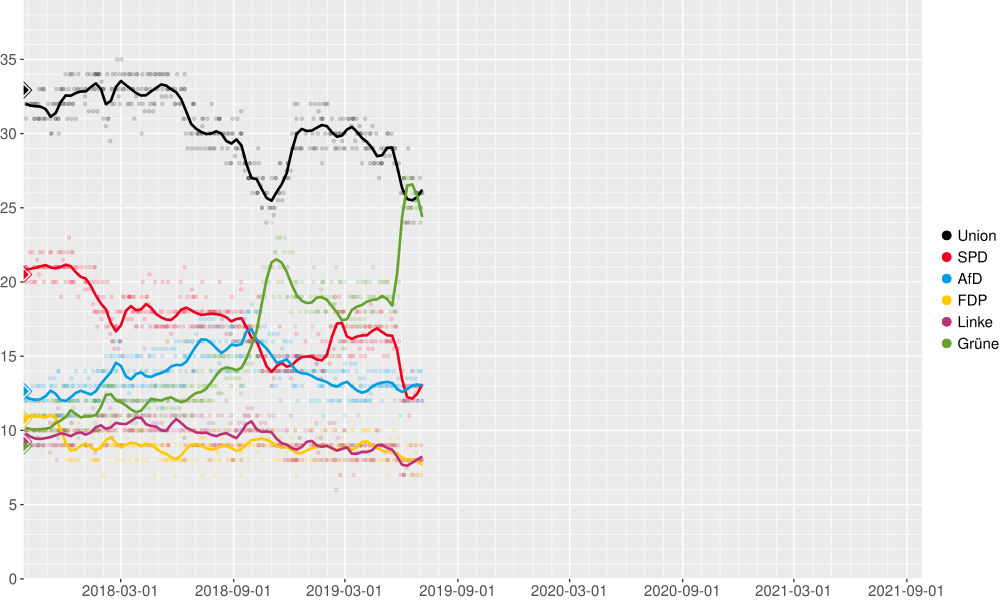
As can be seen from the image at the top of this page, recent opinion polling in Germany shows that the Establishment parties are bleeding support, while the alternative parties gain. Because the German system is more advanced and sophisticated than the New Zealand one, we can predict that phenomena that occur over there will soon be replicated over here. This is not so much true because of MMP as because of the fact that Germany and New Zealand are both part of a wider Western system.

Of concern to the Labour Party would be the fact that their German equivalent is currently polling at about 14%. The reason why the German SPD (Social Democratic Party) is doing so poorly is that they have abandoned the German working class in favour of identity politics – but the New Zealand Labour Party is in the process of making the same mistake.

Of hope to the Green Party would be the fact that their German equivalent is currently polling at about 23%. In fact, the German Green Party was the single highest-polling party in July, a fact that speaks of revolution. The main reason for their rise is the fact that the Greens never even pretended to represent the working class, which means that the large numbers of young people with university degrees have been able to find a home in them.

The major German conservative party, the CDU (Christian Democrat Union), has also seen a fall in fortune, although nowhere near as grievous as that of the social democrats. They are hovering around 27%, which probably reflects the relatively greater unwillingness of conservatives to abandon their party (Understanding New Zealand showed that the National Party had the strongest voting retention rate from one election to the next in New Zealand). It is still a marked decline from previous years.

The decline of the CDU is mirrored by the rise of the alt-right Alternative for Germany (AfD) Party, who are now polling at 13%. This party is frequently derided as being neo-Nazis on account of their strongly anti-Muslim sentiment. Some expect them to supplant the CDU on account of that the globalist parties are not conservative when it comes to cheap labour.

If we look at the German model and how it has turned out, we are able to make several predictions about how the New Zealand model will turn out. Two of these predictions stand out as particularly salient.

One is that the Establishment parties will do poorly – the New Zealand Labour Party will get sliced to pieces in coming years, and National will weaken heavily. The German SPD is already polling in the single figures in some states, and it’s clear that their message is resonating ever less with the electorate. The New Zealand Labour Party are steadfast globalists, despite that globalism destroys working-class wages, and rising nationalist sentiment among the working class will see Labour support decay.

If this happens, it will probably be put down to the incompetence of the Sixth Labour Government, but the truth will be that wider strategic and demographic changes make this all but inevitable. The Labour Party was founded by and for the white working class; having decided to no longer represent the white working class, they are in their death spiral.

This process is likely to heavily benefit the Greens, who will gladly take the now-middle-class young people who don’t identify with National, Labour or ACT. The Greens will also be the beneficiaries of that group of young people who, on account of class interests, would have voted National in previous generations, but who now are more concerned with virtue signalling over class.

In short, what’s happening is that the Establishment parties are losing support as those voters who have been propagandised to have faith in the Establishment die off, and who are then replaced by more cynical young voters who prefer the alternative parties. The Greens and the AfD already get 36% of the vote between them, which is almost as much as what the SPD and the CDU get between them.

The collapse of Labour will likely see its white voters turn to the Green Party on account of that they don’t identify with being working-class any more, its Pacific Islander voters turn to National as their religious sentiments clash with Labour’s globohomo agenda and its Maori voters turn to New Zealand First on account of that they feel abandoned by a Labour that panders ever more to refugees and urbanites.

A second prediction is that an alt-right movement will come to stake a meaningfully large presence.

In New Zealand, the lazy stereotype is that the strongest anti-immigrant sentiments are held by old white people who don’t have much experience in interacting with foreigners. This is mostly true when the anti-immigrant sentiments are held towards Asians and Islanders, which is to say that it was mostly true in the 1990s. By today, things are different.

In Europe, the new generation of anti-immigrant sentiments are held by young people who do have experience in interacting with foreigners. The fact is – although this will be strenuously denied by Marxists, slave moralists and equalitarians – interacting with another group will only improve sentiments towards them if those interactions are pleasant. If the interactions are unpleasant, sentiments towards that group will worsen.

The nature of the interactions between native Westerners and Muslim and African immigrants is radically different to the nature of interactions between native Westerners and immigrants from Asia and the Pacific Islands. Therefore, it can be predicted that, now that New Zealand is opening its borders to Muslim and African immigrants, sentiments towards immigrants in general will sour.

If this does happen, it will create an electoral opportunity for an anti-immigrant party along the lines of the German AfD. The AfD just took 27% of the vote in the regional elections in Brandenburg, and 23% in Saxony. These parts of Germany have fewer immigrants that other parts that have less AfD support, which suggests that at least some of the increasing support for the AfD comes from economic sentiments. But the economic outlook is grim.

Support for this idea comes from Sweden, which opened its borders to mass Muslim and African immigration 20 years ago. Today, the alt-right Sweden Democrats is the party with the best opinion polls. Should a decent alt-right party stand up in New Zealand, they could reasonably expect to get over 5% of the vote straight away.

In Understanding New Zealand, I showed that young conservative people are often more inclined to vote ACT than to vote National. The correlation between median age and voting ACT in 2017 was a mere 0.26, compared to 0.78 between median age and voting National in 2017. This suggests that the ACT Party could potentially surf the crest of this alt-right wave.

This newspaper has previously asked whether ACT would win from refocusing as the alt-right party, but the courage of the current ACT crew cannot be relied upon. One political trend that can be relied on absolutely for certain is that people will age, and for this reason we can predict that the right will eventually evolve into some form of the new right, despite their inherent disinclination to change.

There’s no guarantee that New Zealand will follow the German experience, but the same geopolitical and demographic factors that pushed them in that direction are also at play on us. That will probably mean that, over the coming decade, Labour weakens heavily, National weakens moderately, the Greens surge, and someone fills the demand for an alternative right-wing movement.

*

Understanding New Zealand, by Dan McGlashan and published by VJM Publishing, is the comprehensive guide to the demographics and voting patterns of the New Zealand people. It is available on TradeMe (for Kiwis) and on Amazon (for international readers).

Te Reo With Mnemonics: Spirituality Words

God – Atua

At a beach bar somewhere in Greece, two gods are chatting (imagine Achilles and Apollo). One of them says “Yeah, I’m really into art.” The other god says “Oh I’m into art, too.”

Supreme God – Io-matua-kore

The Supreme God shows off an invention. It is a clockwork android named Corey (if you know someone named Corey, like the cricketer Corey Anderson, imagine that the android looks like them). The Supreme God says “This is Automatic Corey.”

Spirit/Soul – Wairua

A man dies, and it’s possible to see his soul leaving the body as a bright golden wire.

sacred – tapu

A tarpaulin is staked to the centre of a large lawn. People approach it with reverence and bow down to it. It is the sacred tarpaulin.

Life force/Vital essence – Mauri

Late at night, a lawnmower sits on a grassy verge. Suddenly, it is struck by a lightningbolt. The lightningbolt seems to impart some kind of life force or essence into the mower, and it starts up and starts mowing.

Prayer – Karakia

A family sitting at a kitchen table give a lengthy prayer before starting on a meal of a single cracker.

Curse – Kanga

A priest is just about to get into his car when a kangaroo jumps on the bonnet, damaging it. The priest shakes his fist at the kangaroo and yells “Curse you!”.

to bless – whakamānawa

After a battle, a man-of-war enters a temple and is greeted by some temple whores. The temple whores bless him for his service, and then take him into the back room. Their post-blessing intention is to fuck a man of war.

to sanctify/consecrate – whakatapu

A man and his son are both dressed in holy garb. The man is teaching his son how to consecrate a new temple with a holy water sprinkler. “Righto son, let’s get consecrating,” he says. “Don’t fuck it up.”

Wise man/Sage – ruānuku

A wizened old man with a beard and a staff calls into a ruined temple and an echo comes back. The sage caused the ruin echo.

Material/Physical world, Earth – ao mārama

From a spaceship, some aliens look out at Earth. They zoom in on a small part of it, and see and old man hammering plates for a suit of armour. On Earth is an old armourer.

Priest – tohunga ahurewa

Three men stand in line at a McDonalds. One is dressed as a Maori priest, the other two are elderly and dressed in neon clothing like ravers. The priest is in line with two hungry old ravers.

*

This wordlist is an except from Learn Te Reo With Mnemonics, a book being compiled by Jeff Ngatai for an expected release at the beginning of 2020.

The Young Perish, and the Old Linger

In the Lord of the Rings trilogy, King Theoden uses the phrase “The young perish, and the old linger,” to describe the accursed state of his kingdom of Rohan. The phrase strikes a chord, because most people can intuitively understand that society ought to exist to further the young, and that the old ought to gracefully let go of power when their time is up. As this essay will examine, New Zealand has become a place every bit as rotten as Tolkien’s fictional kingdom.

Provisional suicide statistics released this week by the New Zealand Chief Coroner are frightening in many ways. Not only do they reveal the highest suicide numbers on record (685 deaths in one year), but they also reveal a number of patterns once you drill down a level or two. The data is broken down by demographic factors, and these can be compared to previous years’ statistics.

Perhaps the most disturbing of these patterns is that the young are committing suicide at greater rates, while the old are committing it less.

The suicide rate for Kiwis aged between 20-24 was 26.87 deaths per 100,000 people last year. By way of comparison, the murder rate in Mexico was 24.80 deaths per 100,000 people in 2017. Some might be shocked to hear that, even with all the cartel violence and gang warfare in Mexico, our young adults are killing themselves at an even greater rate than Mexicans.

The suicide rate for Kiwis aged between 65-69 was 8.72 per 100,000 people – less than a third of the rate for people aged between 20-24. Old people in New Zealand don’t start to kill themselves in significantly higher numbers than this until they get to 90. The quarter century between the ages of 65 and 90 is now the prime of life for a New Zealander.

Compared to 2010, young people are killing themselves more often – the suicide rate among 20-24 year olds in 2010 was only 21.23 per 100,000. For all Kiwis aged between 15 and 29, the suicide rate was 18.88 in 2010 and 23.62 in 2018. All this means that young people are now killing themselves about 25% more often than they were in 2010.

However, old people are killing themselves less often. The suicide rate in 2010 for people in their golden years (between 65 and 84) was 9.20 per 100,000. By 2018, this had fallen to 8.36 per 100,000 – a decline of some 10%. The young perish, while the old linger.

These suicide statistics reveal a fact about our society that is rarely spoken of: New Zealand is an awesome place to be old, and is increasingly getting more awesome for old people as the economic balance tilts ever-further in their favour. However, it is a truly shit place to be young, and is increasingly getting more shit for young people.

New Zealand is an awesome place to be over 65 because there is a universal basic income for such people, of $370 a week. As Dan McGlashan showed in Understanding New Zealand, there is a correlation of 0.82 between being on the pension and living in a freehold house in New Zealand. This means that the vast majority of pensioners don’t have to worry about paying rent out of that $370 – most of it is disposable income.

If you already own a house, getting paid $370 a week just to hang out in it for a quarter century when you are aged between 65 and 90 is a sweet deal. Anyone owning their own house also has a permanent community, and therefore gets a strong sense of social inclusion. To get $370 a week, no questions asked, to enjoy that lifestyle is an incredible privilege.

There’s little wonder that the suicide rate is so low among people who have got it so good.

New Zealand is a shit place to be young, on the other hand, because they are the ones who have to work and pay for the luxurious retirements of the old. In order for our elderly to get $370 a week of free money for a quarter century, the young have to be taxed brutally. This makes it much harder for them to pay back their student loans, to own their own house or to raise a family.

Most pensioners in New Zealand are homeowners because it used to be possible to buy a house on the average wage in this country. Analysis shows, however, that the average wage would now have to be almost $80 an hour for young people to have the same chance of owning a house that their parents’ generation had. Young people nowadays face a level of financial desperation that their parents never came close to experiencing.

Studies have shown that financial pressures are the second most common contributing reason to suicide attempts, behind only depression. Stressful life events are powerful predictors of future suicide attempts. These stressful life events are much more common for the young, who face unprecedented levels of uncertainty over housing and employment. Unfortunately for them, high stress is all but inevitable as the Boomers demand to be catered for to the level at which they are accustomed.

In a normal, properly-functioning nation, the elderly will happily sacrifice themselves so that the younger generations can prosper. Knowing that the young are the next generation of themselves, the elderly are happy to lay the foundations for the prosperity of the young, even at their own discomfort. This has always been the case in healthy nations.

In New Zealand, the elderly throw the young to the wolves so that they can have more for themselves. Many of the suicides of young people could be prevented if we had a properly-funded mental health system. The old people who control the national purse strings, however, have directed almost every penny towards ensuring their own comfort, and have left the young to go without.

New Zealand spends $15,000,000,000 a year on pensions, much of that going out to people who don’t need it. Many people in their sixties and seventies run a business and get $370 of pension money a week on top of that. This colossal expenditure is evidence that our society is run to the benefit of the old, at the expense of the others.

Precise figures for mental health funding are impossible to find for New Zealand because of our district health board system. In Australia, though, some 5% of total health spending goes on mental health care specifically. We can assume a similar figure for New Zealand. Because we spend about $17,000,000,000 a year on healthcare, 5% of our total health budget works out to be about $850,000,000.

It’s not clear exactly what percentage of funding goes to those aged between 15 and 29, but assuming a figure roughly equal to that age bracket’s proportion of the population, we arrive at roughly $200,000,000 per year. Considering that New Zealand spends $400,000,000 per year on enforcing cannabis prohibition, $200,000,000 for the mental health care needs of an entire generation seems absurdly little.

And it is – it’s an absolute disgrace.

The solution to this state of injustice, and a partial solution to our increasing suicide rates among young people, is to lower the age of universal basic income from 65 to 18. This would allow relief from the insane financial stresses that are now levied on those young people.

Lowering the universal basic income age from 65 to 18 necessitates that today’s wealthy Boomers will have to share their pie with others, so we can expect that they will fight this suggestion tooth-and-nail to the bitter end. The overall outcome, however, would be a reduction in suffering, as the Boomers’ loss of luxury would be compensated for by the younger generations’ emancipation from poverty.

*

If you enjoyed reading this essay, you can get a compilation of the Best VJMP Essays and Articles of 2018 from Amazon for Kindle or Amazon for CreateSpace (for international readers), or TradeMe (for Kiwis). A compilation of the Best VJMP Essays and Articles of 2017 is also available.